
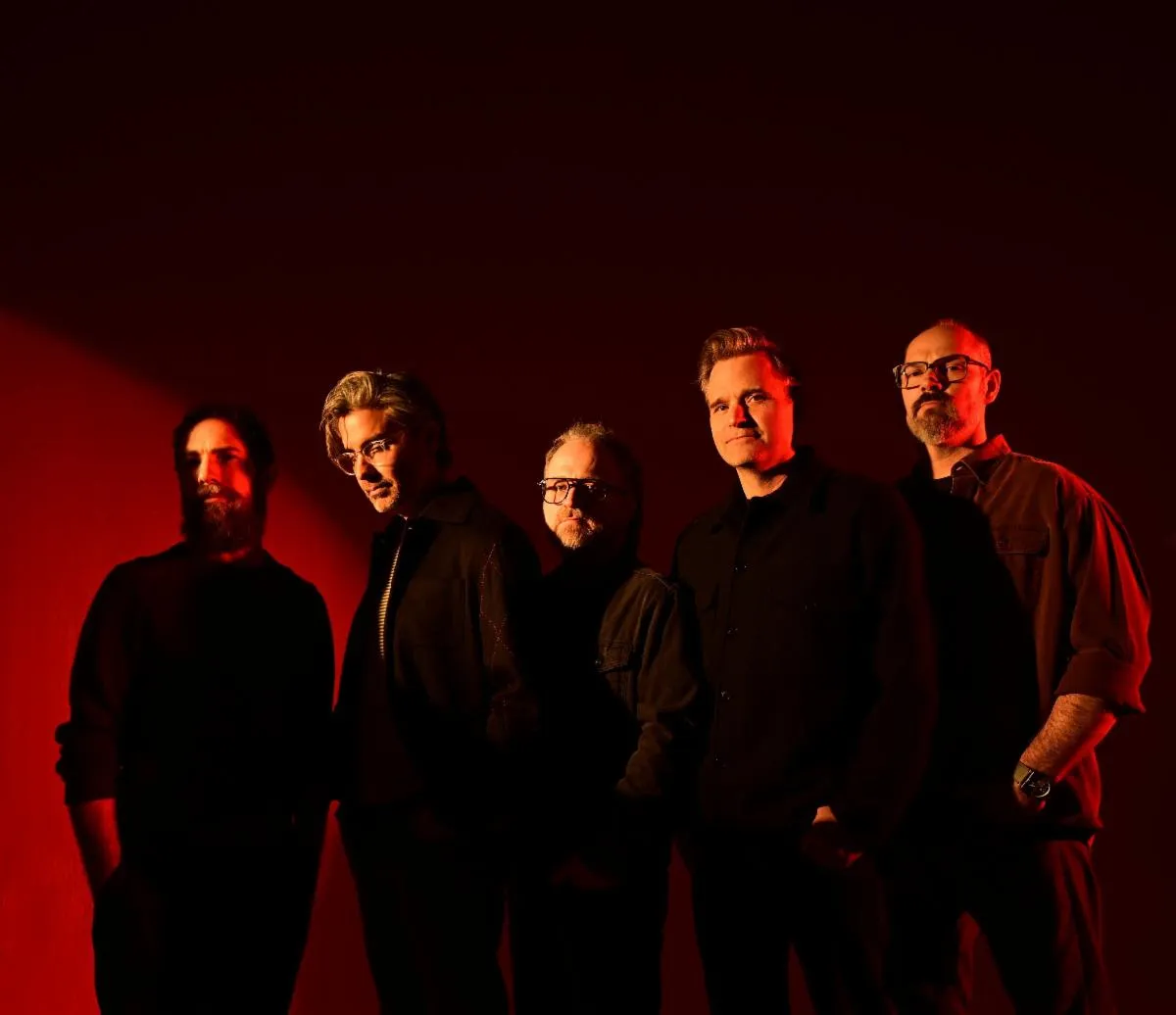
The previous occasion on which Death Cab For Cutie released an album outside Atlantic Records coincided with The O.C. becoming television’s latest phenomenon, and a segment of their fans hadn’t even come into existence yet. That record was Transatlanticism, an indie staple that propelled the group into bona fide rock superstardom. Today, the band is re-emerging into the scene that spawned them. On Friday, for the first time in 23 years, Death Cab will issue a new LP via an indie label.
Slated to land on the esteemed Epitaph imprint ANTI- Records, I Built You A Tower signals a fresh chapter for a group that helped shape a generation of indie rock, and they kick off this new era with a resounding statement. Serving as the successor to 2022’s Asphalt Meadows, the album pairs some of Benjamin Gibbard’s most forceful writing with the familiar hands of producer John Congleton, a disciple of Steve Albini who knows how to heighten the room’s intensity. Yet beside fierce eruptions like “Punching The Flowers” and “How Heavenly A State” there are passages that drift away from aggression—like the intimate opener “Full Of Stars” and the synthesizer-led “Trap Door.” This remains another strong installment in what has been a mid-career revival for the band.
The album’s jagged yet fragile duality mirrors the events that shaped it. In the wake of Asphalt Meadows, Death Cab and Gibbard’s other project, the Postal Service, embarked on an arena trek commemorating the 20th anniversary of Transatlanticism and Give Up. The performances tested Gibbard, who leads both acts, not only in stamina but emotionally. During the tour he was enduring a deeply painful divorce. I Built You A Tower derives its title from his attempts to box off his sorrow amid the peak moments of that tour.
Months later, I sat down on a video call with Death Cab For Cutie’s three longest-serving members—Gibbard, bassist Nick Harmer, and drummer Jason McGerr—to explore how working with an indie label versus a major label changes the process, what went into crafting the new record, steering their career as if they were devoted fans of the band, the experience of aging at festivals, and why they have no interest in hosting their own cruise. Our discussion follows.
You’ve aligned with a new label. What is it like returning to an independent label and initiating a fresh phase at this stage of your career?
BENJAMIN GIBBARD: Honestly, we’re thrilled. ANTI- and, before the talks even began, admired the roster they’d assembled—from legends like Tom Waits to newer outfits such as Slow Pulp and the Beths, many of whom we’ve toured with or count as friends. We’re also close with Fleet Foxes, another Seattle act we know well. Being on a label with such a diverse and cross-generational lineup feels like the natural place for us to land.
JASON MCGERR: I’d add that it’s like finishing a long hike and stepping into a town where everyone’s already part of the same journey. It’s a shared, equitable vibe with the labels’ people. Atlantic treated us well, but this moment feels perfectly aligned—timing and circumstances feel right.
GIBBARD: In our first chat with ANTI-, I was almost star-struck meeting Brett Gurewitz, a Bad Religion icon that I (like many) admired growing up. It was surreal to think I was in a room with him discussing our band. Atlantic gave us two decades of success and enduring relationships, but there’s a notable difference between a label run by industry veterans and one run by fellow musicians. The atmosphere feels distinctly different.
There was a shopping period, I assume. Were there specific criteria you were seeking? It seems like a label run by musicians could be a key factor.
NICK HARMER: It wasn’t a long, searching process. It was an intriguing period where we asked, “What comes next for us?” with broad openness, yet we hoped a partner genuinely excited to collaborate with us would discover us rather than us having to hunt them down. Fortunately, ANTI- stepped forward early on.
There was somewhat more dithering as we weighed what we desired or rejected during the Barsuk-to-major-label shift. After two decades with Atlantic, we had a clear sense of our priorities, and it quickly became obvious who our preferred partner would be. So the process wasn’t drawn-out; it felt immediate and positive. Our initial conversations with ANTI- convinced us that our philosophies aligned, which mattered greatly to us.
GIBBARD: Exactly. We weren’t keen on exploring other major labels; I’m not just glossing over the past—our experience on Atlantic was, in many respects, the opposite of the common major-label narrative. We joined Atlantic in 2004 and were free to craft records as we always had. The label shared the outcomes of our fortunes, but the creative results—whether hits or misses—rested squarely with us.
There wasn’t any pressure from executives to alter our sound or pursue ill-advised features. We simply created our albums, and the label did a solid job promoting them. Signing with Atlantic achieved our goal of expanding our audience in a way that remained true to our identity, and we did it. The notion of signing with another major label—especially in 2025—felt impossible, because no other experience would resemble the authentic partnership we had with Atlantic.
HARMER: The industry has evolved dramatically. Trusting your instincts about what to pursue is essential nowadays. The longevity of our band helps: many choices—whether recording, setlists, touring, selecting venues, selecting collaborators, working with publicists, and even choosing labels—become clearer with time. So the move felt straightforward and unanimously supported within the group. No objections, no what-ifs. It just seemed right.
It seems many peers are at a comparable juncture—Modest Mouse recently wrapped with Epic, for instance. While you described being in a different phase two decades ago, has the terrain changed as well? Is there less incentive to align with a major label now than there was in 2004?
HARMER: I believe so. The way music is promoted and, crucially, how new music breaks has transformed significantly. Major labels today tend to chase immediate breakthroughs rather than cultivate enduring long-term acts. They aim to push new talent to global prominence quickly, then move on after the initial hit. This pace is partly driven by the internet and rapid pop-culture turnover. The churn is relentless. That said, if you’re a band like Modest Mouse or Death Cab—committed to a lifelong career and discography—the model for support and development shifts. The industry landscape has changed, without doubt.
GIBBARD: Building on Nick’s point, back in 2004 the main promotional engines were radio, and to a lesser extent MTV. One reason we pursued a major label deal was to secure radio exposure for our music, which had been largely absent from mainstream airwaves, existing mainly on college radio. In those days, major labels carried in-house radio teams that could push acts like ours in formats such as alternative, AAA, etc.—a significant edge over indie outfits.
Today, alternative radio is still around—I’m not pretending it doesn’t exist, because we’d love to hear our tracks there. Yet it no longer drives culture the way it did in the past. As Nick noted, TikTok has become a primary discovery channel for many, with far fewer people learning about music via terrestrial radio as they did more than two decades ago.
It seems your prior deal afforded ample creative freedom, but did venturing into this new frontier influence your approach to the new record in any way?
GIBBARD: Not exactly. If I’m honest, during the Atlantic era I didn’t try to craft a radio-ready hit per se. The goal of writing wasn’t to chase a single. Yet as we neared completing a record, the talk—internally and with management—often revolved around which track could be considered a radio song or single. While I didn’t feel overt pressure, there was a lingering, subconscious sense that we should have one or two tracks with broad radio appeal. Admitting it now, I can see a trace of that in my process as a songwriter.
And with ANTI-, while radio-ready tracks would be nice, I sensed a release from that particular pressure. They’re more focused on the integrity of the album as a whole than on spoon-feeding potential singles. They never stated this outright, but from early conversations with Andy Kaulkin, Brett, and Alison Crutchfield, it was clear they value albums as a complete statement—and we are, at heart, an album-centric band. That release from the single-centric weight was a relief, even if modest.
HARMER: I think you’re onto something. I definitely also felt like this sense of release when we were done with Atlantic. There was less talk about what was going to happen after the record was done in this hopes and dreams and plans kind of way. For us, whether it was conscious or not like Ben was saying, there was suddenly a lot more conversation and a lot more reflection of us just saying we can turn internal again, and in some ways, we can stop thinking about what’s gonna happen with the record, how it’s going to be received, and really just concentrate on playing music with each other and enjoying the process of making a record with with John Congleton. I don’t want to say a return to form because I don’t ever really feel like we got out of step with that. We’ve always been able to do that. But I felt a lot less outside ears and opinions suddenly, and there was some relief in that, for sure. It felt very small again, in a good way. I liked that.
MCGERR: For me, this is the first time since Transatlanticism that we’ve crafted a record without external input shaping the project; no outside label voice, no outside interference. It was the band and Congleton in the room, and that was the intention and the reality. You saw us, you spoke with us daily. We didn’t route songs through management early on; perhaps late in the process, but we began this venture near the end of our Atlantic tenure and found ourselves back in a wide-open space, simply looking at one another and making music.
MCGERR: The current lineup has been together for twelve years. I happened to tally the gigs the other day to get a sense of our endurance: how long we’ve been at this, how much work and experience we’ve accumulated. The years show we know each other well, and there’s trust. We’d played roughly 1,800 shows—a number that makes many legacy acts look modest. By that measure, we’re in a solid position to approach a record with confidence.
What we approached the studio with—shared respect, mutual trust, and a commitment to doing what each of us excels at while respecting our roles—defines my sense of this record’s creation. It wasn’t driven by a label, nor by chasing a single. It wasn’t a factor at all. I could sense it in Ben, Nick, and everyone else: no one was preoccupied with commercial concerns; the aim was simply to craft the best possible record.
HARMER: We didn’t entertain many other options. Our work with him on Asphalt Meadows was excellent, and from the early demos Ben brought in, we felt Congleton would suit this material well. In the interim, he opened his own LA studio, which excited us about collaborating in his own controlled space and vision. We anticipated this would give the project an extra lift.
During Asphalt Meadows there was a process of mutual familiarity and cautious trust-building, not exactly formal, but there was a sense of establishing a rapport. With this record, we already understood John’s strengths and our own contributions, allowing for greater trust in his approach and, going in, we intended to give him more freedom to steer the overall production and vision.
He contributed to the previous album, but I hear his mark more pronounced on this one. Undoubtedly he has produced a wide range of records, and perhaps I’m projecting what he does in his own projects; still, I envision him sharpening the edge here, giving the material more bite, and it seems audible in tracks where Nick and Jason push the arrangements. Was that assertive feel something you aimed for deliberately?
HARMER: From the drum-and-bass perspective, the material carried a tougher bite from the outset, and we trusted John to push it to its limit. That instinct made him a natural match for the project. Ben, perhaps you can expand on how intentional this was from the start. I could hear a rougher edge in the first demos, and we discussed preserving that roughness throughout the process.
GIBBARD: If you compare the demos to the finished songs, I’m not saying this as a dig at John, but the demos already had a strong backbone. John contributed his own flair and several production moves that boosted their energy and sharpened them, rather than forcing us to push harder. He arrived with the attitude of, “These demos kick; let’s polish them.”
In practice, stripping down to essentials sped things up considerably. If a take nails the drums on the first or second try, we move on; if the bass line is tasteful, or Zac Rae adds a killer keyboard figure, that’s enough. There’s no need to overanalyze or overdub endlessly when the core parts click.
HARMER: John’s production approach meshed perfectly with our workflow. He doesn’t pressure you to rush; instead, he provides reassurance—“We’ve got this; it sounds great. No need to overthink, let’s press on.” Having that calm, confident guide in the studio helps prevent second-guessing and self-doubt from taking hold.
GIBBARD: A familiar refrain from John was, “You can redo it if you want, but I’ve got this.” That is, “You don’t need another take.” It’s a nod to the Albini lineage he’s learned from and applies in practice to the sessions.
Well, I was going to touch on that—the Albini influence feels like a Death Cab interpretation of that approach.
GIBBARD: It wasn’t exactly an Albini clone; there’s a touch more compression than on his records. John studied Steve’s methods, but he brings his own flavor. After two lengthy, complicated sessions on prior records—due to both material and production demands—it was refreshing to wrap this one in roughly three to three and a half weeks. We’d sometimes wonder if another week was needed, but the consensus was that what we had was right, and I was satisfied with the result, as were the others.
Ben, the press materials point to your personal grief and collapse fueling the songs. What was the story there?
GIBBARD: I went through a divorce, and I’ll leave it at that. If you’ve experienced divorce or separation, you know how excruciating it can be. For me, the focus became telling the story from my vantage—expressing my own feelings, the quiet nights and mornings, rather than producing a record that feeds a tabloid narrative. I don’t view this as a breakup album; it’s about finding oneself in the aftermath of a breakup, a distinction from the typical spiteful, one-sided vent of many breakup records. Those classics often dwell on how you wronged me, but I’m too old for that approach.
The lyrics carry an introspective vibe, and the tower imagery reinforces that inner dialogue. It feels intimate, almost monologue-like, as if the singer is speaking to his own inner self rather than to another person.
GIBBARD: I’ve always enjoyed pairing buoyant music with somber lyrics, or the reverse. I’ve often joked that many of these songs seem to push back against fading light. We’re an older band now; by year’s end, more than half of us will be over 50. And I know we all feel, in our own ways, that we don’t want a quiet, sedate exit. I wanted this to be a rock record from the start—songs that feel good live and that people won’t be scrolling through their phones during. I refuse to make music that’s merely reflective and quiet. Not me. Not us.
HARMER: It’s also an extension of our identity: there’s a long-running dialogue about how our live shows compare to the recorded material. Fans often remark that our live energy feels more intense than what the albums suggest, and I’ve always appreciated that duality. You can witness a genuinely sweaty, high-energy performance, which isn’t always reflected in the studio versions, and I love that about our act.
But the studio approach—keeping a tight lane and pursuing that raw vitality—has a connective thread through the record. It’s a principle Ben championed: to capture the energy of our live performances. We aim to preserve that vigor in the studio, regardless of aging. The plan is to produce a record that defies any notion of fading energy, instead serving as a living extension of who we are as players and how we create music together.
MCGERR: It’s a throughline throughout our catalog—maintaining energy while also delivering honesty in the songs. If our debut had a more mellow mode like James Taylor, this record wouldn’t be the same. I’ll admit I worried a bit at the outset, given John’s penchant for heightened grit, that fans might balk at a more assertive sound. Yet once you witness us in a live setting, the essence of Death Cab—the dynamic energy and stage-heat—becomes clear. We’re eager to perform this material live; the vitality will be unmistakable, just as it was in the studio.
In the press materials you note that the anniversary tour drained all nostalgia and left you primed to advance. Are you ever tempted to linger in nostalgia, or does the idea terrify you?
GIBBARD: It doesn’t scare me. We’re music fans first, and we often imagine what we’d want to experience if we were fans of Death Cab. What would excite us to see?
We’re all huge fans of the Cure. If we could get inside Robert Smith’s head and make him do stuff, what would we make him do? Well, we’d probably have him make a record like he just made because that record is fucking amazing, right? We’d probably be like, do what he’s done before, which is like, “Oh, you’re playing the first three albums at Royal Albert Hall, and all the B-sides? That’s awesome. I’m a huge fan. I wanna see that.” Or, “Oh, you’re gonna go do Disintegration in its entirety? Yes, I’m a huge fan. I wanna see that.”
So first and foremost, it’s not so much that we want to exist solely in the band’s nostalgia or lean into that. But it really is a reflection of how I make the setlists, how we go about our business, that we try to always keep it in front of mind: What do fans of this band want? And try to serve that as much as we can while still trying to make music that sounds like the music that is made by people who have our lived experience.
But I do think that by the time we got through — we toured Asphalt Meadows starting in 2022. We had a month off. We started immediately preparing for Death Cab/Postal Service. We did that off and on for a year. We had some time away. We came back, we did a handful of shows to celebrate the Plans 20th anniversary. And by the time we were finishing up those shows, it might have been Zac or you, Nick. I mean, we all said it to each other in varying kind of combinations — like, “Man, I just really wanna play some new songs.”
I can’t imagine any of us, given who we are as people and as musicians, ever deciding that we wanted to just continue on as a catalog band — “Oh, we go on tour during the summer and we play state fairs and play the hits.” That’s just not something that any of us are gonna be interested in. At a certain point, it becomes not about why you started doing this in the first place. And right now, I think we’re all really excited about having new songs to play for the first time in almost four years.
In the press materials you note that the anniversary tour drained all nostalgia and left you primed to advance. Are you ever tempted to linger in nostalgia, or does the idea terrify you?
GIBBARD: I wouldn’t say it horrifies me. For me, and I think for all of us, we’re music fans first and foremost, right? And oftentimes, we ask ourselves, if we were fans of this band, what would we be psyched about? Like, what would you wanna see?
We’re all huge fans of the Cure. If we could get inside Robert Smith’s head and make him do stuff, what would we make him do? Well, we’d probably have him make a record like he just made because that record is fucking amazing, right? We’d probably be like, do what he’s done before, which is like, “Oh, you’re playing the first three albums at Royal Albert Hall, and all the B-sides? That’s awesome. I’m a huge fan. I wanna see that.” Or, “Oh, you’re gonna go do Disintegration in its entirety? Yes, I’m a huge fan. I wanna see that.”
So first and foremost, it’s not so much that we want to exist solely in the band’s nostalgia or lean into that. But it really is a reflection of how I make the setlists, how we go about our business, that we try to always keep it in front of mind: What do fans of this band want? And try to serve that as much as we can while still trying to make music that sounds like the music that is made by people who have our lived experience.
But I do think that by the time we got through — we toured Asphalt Meadows starting in 2022. We had a month off. We started immediately preparing for Death Cab/Postal Service. We did that off and on for a year. We had some time away. We came back, we did a handful of shows to celebrate the Plans 20th anniversary. And by the time we were finishing up those shows, it might have been Zac or you, Nick. I mean, we all said it to each other in varying kind of combinations — like, “Man, I just really wanna play some new songs.”
I can’t imagine any of us, given who we are as people and as musicians, ever deciding that we wanted to just continue on as a catalog band — “Oh, we go on tour during the summer and we play state fairs and play the hits.” That’s just not something that any of us are gonna be interested in. At a certain point, it becomes not about why you started doing this in the first place. And right now, I think we’re all really excited about having new songs to play for the first time in almost four years.