
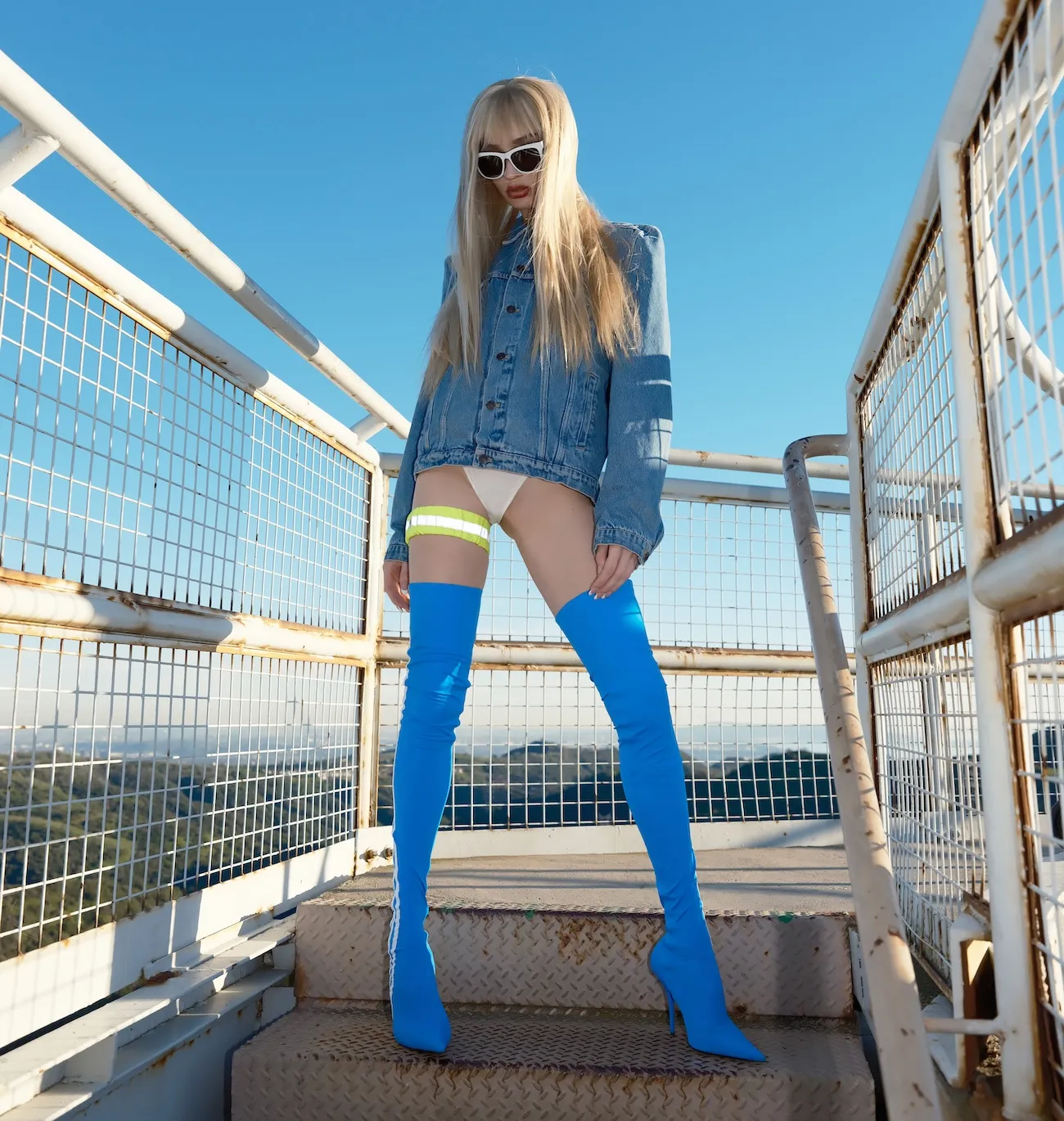
Kim Petras opens with the finale of her newest project. Earlier in the year, the German-born, Los Angeles–based pop artist parted ways with her major label, Republic Records. With Detour, released on her own today, Petras steps into a fresh chapter of independent pop reinvention marked by audacity, upheaval, and creative detours.
She has already built a substantial career as a pioneering trans pop vocalist, launching with early cuts like 2017’s “I Don’t Want It All” and 2018’s “Heart To Break,” before partnering with the late producer SOPHIE and Charli XCX, shaping eras such as Slut Pop and her Halloween cult favorite mixtape TURN OFF THE LIGHT, and later delivering a global hit with Sam Smith on “Unholy.” Now, at her request, she has stepped away from the conventional major-label pop highway. Straying from the well-trodden path, she returns today with the riotously playful Detour, her strongest album to date, crafted with underground pop collaborators Margo XS, Frost Children, and Porches.
Over the last few months, Petras has been dropping a sequence of chaotic, high-octane singles. Detour fully embraces a vision of pop reinvention through disorder, where personal history and industry mythology blur into a single storyline. The album traces a restless journey through Los Angeles — hedonism, late-night appearances in statement outfits, and secret romances stitched together like scenes from Fear And Loathing In Las Vegas meeting Thelma & Louise meeting Spring Breakers.
“This is the beginning of the end/ Everything before is just pretend,” she proclaims on the album’s self-titled opening track. It’s glamorous yet foreboding, capturing a sense of collapse as an inevitability: If everything is going to fall apart anyway, why not seek clarity within the wreckage? Petras leans into that collapse as both spectacle and metamorphosis, layering 2000s production nostalgia with nods to Gwen Stefani’s solo era and Timbaland’s peak maximalist sound.
She directly addresses the industry on “Need For Speed,” taunting: “My label is yelling in my ear/ ’Cause they love the money and they want it now/ And they love it when I got no boyfriend in my life.” Throughout, she remains acutely aware of how visibility and exploitation intertwine. “You don’t really know me/ No one really knows me,” she sings later.
But Detour also expands her persona by introducing new angles on her artistry. On “Brutalist,” she deepens vulnerability and experimentation, singing about her father taking her to hormone therapy and the gentrification of historic architecture. She mulls over decay, structure, and emotional inheritance. Across the record, she reframes self-destruction not merely as collapse, but as clarity, release, and rebirth.
Where renovation implies refinement, Detour embodies demolition: breaking things down as a creative instrument, reconstructing narratives from shards, and embracing storytelling with sharpened purpose. It’s music born from movement rather than arrival, the sound of perpetual driving, fragmentary memory, and the sensation of outrunning oneself long enough to become someone new.
Read our conversation below.
Each album across your career has cast a different persona or caricature, and Detour feels more intimate, touching on meta aspects of being a pop artist. What is the most absurd or inaccurate thing someone has inferred about you personally from the music you’ve released?
KIM PETRAS: Probably that I’m a nepo baby [laughs], because my early music painted me as “that hot girl in L.A. who gets anything she wants.” That was the character I created. I truly moved to L.A. on my own and spent years writing songs before anything started happening, and I hustled hard for this. People can take my music too literally, especially with Slut Pop. I wrote that project because it was so enjoyable to explore that topic and those words, and the taboo surrounding it. Yet I’m a fairly shy person, and that music lets me live out parts of myself I’m perhaps too afraid to pursue in real life.
I think that’s why I’m continually reinventing myself. I love reinvention and the use of persona, and that’s what fascinates me about pop stars — that facet is incredible because it proves you can continually transform your life and your point of view, and it’s never too late or too early to do so. You’re allowed to change your mind and be a fluid person who goes in all kinds of directions and confronts both the ugliest and most beautiful parts of themselves — which, to me, is a crucial element. I’m also weary of the stereotype of the spoiled rich kid, which is just one thing that irritates me.
That’s an interesting angle on reinvention, because I sense Detour teeters between reinvention and self-destruction, and how those trajectories can intertwine. How has your understanding of reinvention evolved within the music business?
PETRAS: There are things I tried doing to gain freedom to explore other facets of myself, and that often spiraled. With this project, I’m fully present—really feeling my body, surrounded by friends, and living each moment of the album. The downfall of a pop star became a compelling theme here. I tend to be more drawn to the downfall than the ascent. The rise of the hometown hero, while touching and inspiring, is a familiar path; what fascinates me is cracking under pressure, feeling as if you’ve built a self-imposed prison you want to escape. Not shying away from that seemed essential. I believe artists grow more compelling with time, and I don’t feel I’ve hit my peak yet; there are richer things I want to say.
Is this perhaps a human nature thing, or a personal fascination with that narrative? It also feels like a broader media pattern—an opportunity to use music to dissect a topic that resonates with many of us.
PETRAS: Usually when you decide to trust your instincts and bet on your music, you’ll face questions about your sanity: why aren’t you hiring known hit-makers, why work with these rising talents, why celebrate underground culture? People around me often interpreted it as signs of going crazy instead of a sign that I’m finally becoming an artist. Using independence as a critique of the industry, some interpret it as a downfall, or as if I’m driving off a cliff, undermining my pristine pop image and vocals—a perception I’ve faced before, given my penchant for precise, stacked pop harmonies in the 2010s. I wanted to honor the messy, imperfect, off-kilter vibe as a deliberate tool to emphasize a note of “this is my downfall,” that sense of being unstructured and on the edge. I hope that made sense—
Yeah, absolutely. When you brought in Frost Children, Margo XS, and Porches, did they help you lean into imperfection? What was the process of retraining your mind away from perfectionist pop singing?
PETRAS: We engaged in a lot of music philosophy during the making of this record. Margo, the Frost Children, and Porches each bring their own ecosystems, yet we shared a belief in prioritizing the most emotional takes over the most flawless ones. We all agreed that the emotion and storytelling matter most, and that perfection can impede genuine feeling and the candid peek into the psyche I want to share on this album.
We also drew from shared life experiences and common opinions about music, which was invaluable—having people who “get you” and who appreciate a vocal crack or a deliberately off-timed moment lets me breathe as a performer and prevents me from sounding robotic. Looking back, I realize that the pursuit of perfection had sometimes made my earlier work feel heavier.
There’s a myth that chasing flawlessness elevates you, yet it can actually block growth to a deeper level.
PETRAS: Absolutely. Being widely seen can incline you to disappear. A key lesson recently is that I want to be known by people. I don’t want to hide behind perfection or a mask, and I think the personas you create—like Slut Pop or Turn Off The Light—are as real as the person you are. I believe the things you imagine about yourself are as authentic as your tangible self.
Yeah —
PETRAS: Some heavy stuff. [laughs]
No, totally. [laughs] I find it fascinating how pop remains joyful and crunchy, yet can lead you down existential pathways even as you’re having a blast.
PETRAS: That’s what happens when I party—either I spiral into a mental breakdown, dwelling on what’s wrong, or I crash into sadness and start crying, and a song flips the mood and suddenly I’m buoyant. Dance music will always be my solace; I adore warehouse raves and the act of dancing more than socializing. This record captures that on-edge feeling of a night out, with a million thoughts racing through my head.
I love that, and Detour is a joy to hear. I’m curious about a track I notably want to hear your take on—“101.” It’s one of my go-to favorites and feels like it can branch into several different directions or detours of its own.
PETRAS: Absolutely, I’m glad you noticed. The songs tend to drift into detours—one mood hits, then suddenly I’m in an entirely different mental space, and everything sounds distinct. “101” was conceived as a map of L.A. in many respects, with the 101 freeway acting as the thread that ties moments together. Driving at high speed on the 101 makes me feel like a cocky, amplified version of myself. I’d just earned my driver’s license around that time, and cruising became influential for this record. The braggadocio in that song—“you bitches are all stealing from me, and I’m getting no recognition, but I’m in my fast car, and I’m going to own the road”—is the energy that propelled the track. It originated on the 101 and came back into the chorus, almost as a vocal stim. My friends and I still do that kind of thing for fun.
There are so many nostalgic references, which feels intentional, yet there’s a moment in that song that evokes Gwen Stefani’s “Wind It Up”—a hint of that early-2000s melody.
PETRAS: I adore “Wind It Up” by Gwen Stefani—an absolute jam, thank you.
Did you meet all of your collaborators for this project while you were in Los Angeles?
PETRAS: I connected with Margo at a party a few years back, and we stayed in touch. I reached out to Frost Children after hearing a remix they did of a song I kept replaying, and they were up for it, which led to a strong friendship. Porches is part of my circle as well, someone I’d cross paths with at events and who has consistently released incredible music for years. So the lineup is a mix of friends from parties, friends of friends, and artists I’ve admired and wanted to work with for a long time.
It’s interesting because I feel Porches and Frost Children bring a New York energy to me, while this album is so rooted in Los Angeles. How do you all connect across those bi-coastal lines?
PETRAS: I have a deep bond with New York. My career began there—clubs first started spinning my music, and that city still feels like a wellspring of inspiration. It’s exciting to bring New York friends to Los Angeles and experience that culture clash. The record ends up feeling bi-coastal in spirit, with LA at its core but with New York’s influence quietly threaded through. New York remains essential to this project, even as it lives in an LA frame.
Another track I’m eager to hear more about is “Basketball.” Given SOPHIE’s involvement on that song, is it the oldest cut on the album? How did it fit into this era or why was it included?
PETRAS: Yes, it is the oldest track here, dating back to 2019. It’s floated around as something I always wanted to release, but it didn’t quite fit narratively until now. I’m just sipping soda and observing how fans respond online as we talk.
You’re good.
PETRAS: There’s a narrative in this album around sports, seen in “Bitch Ball Out,” “Basketball,” and the idea of dating athletes—an intriguing character study of locker rooms, the closeted ambiance sports sometimes harbor, and the tension within that world. The connection with Darby Park and meeting someone there felt very aligned with how I approached “101,” where lines like “Your boyfriend buss a lot/ When I walk in in my outfit in the parking lot” hint at a private dating life that isn’t openly acknowledged. In my own dating history, I’ve rarely met men who openly wanted to date me; it often felt clandestine, and I wanted to address that truth. I appreciate that the song handles it with tenderness, nodding to an older version and a newer version of myself.
It fit thematically as well because it’s about dating different people and becoming different versions of myself as I date them—so the idea of dating an athlete while things remain discreet and under wraps was a compelling layer. I’m genuinely glad the track made it onto the project. I’ve collaborated with SOPHIE many times, and this is one of the last pieces I’ll release with her, so the bittersweetness is palpable in this song.
Yeah, thank you for opening up—this fits so beautifully on the album. It’s one of the softer yet bittersweet tracks, an intriguing contrast.
PETRAS: Thank you.
I know you’ve been doing a lot of press around this album, and I’m always curious, as journalists project theories and their own ideas onto a record, did you have an interpretation of this album that surprised you or altered how you saw it?
PETRAS: No—the reaction has surprised me more than anything. I’m genuinely impressed by how much people grasp this project. I expected it to feel more outlandish, but much of what I’m reading aligns with the lane I’ve walked and the risks I’ve taken in pursuing a path that feels true to me. I’m thrilled that listeners seem to understand it exactly as I hoped they would. Detour is out now.