In 1989, Tang Dynasty began when Kaiser Kuo, a guitarist born in New York to Chinese American parents, returned to the land of his ancestors. (To note, Tang Dynasty as a historical reference dates back to 618 CE.) Before the internet era, cultural exchange between China and the wider world didn’t flow as freely, so when Kuo shared some of his favorite Western artists with his Beijing friends, the reaction was instant and transformative. They were compelled to form China’s first heavy metal outfit.
“I exposed the other members of the group to much of the music that shaped them (bands like Queensrÿche, for instance), and I did come up with the band’s name,” Kuo told the Death Metal Underground blog in 2008. “But they transformed me as much as I changed them. Playing with Tang Dynasty, I discovered that blending traditional Chinese music with Western metal really works: it wasn’t something I’d tinkered with before starting Tang Dynasty.”
G.H.Z., the vocalist and guitarist for the Atlanta-based metal band Chariots Overdrive, recalls seeing Tang Dynasty perform years later while he was growing up in China. “I was maybe in high school or middle school, something like that,” he remembers. “Back then I didn’t recognize it as metal. I just thought they were a rock band. Then I realized they were already doing heavy metal in the 1980s. That was a fascinating revelation.”
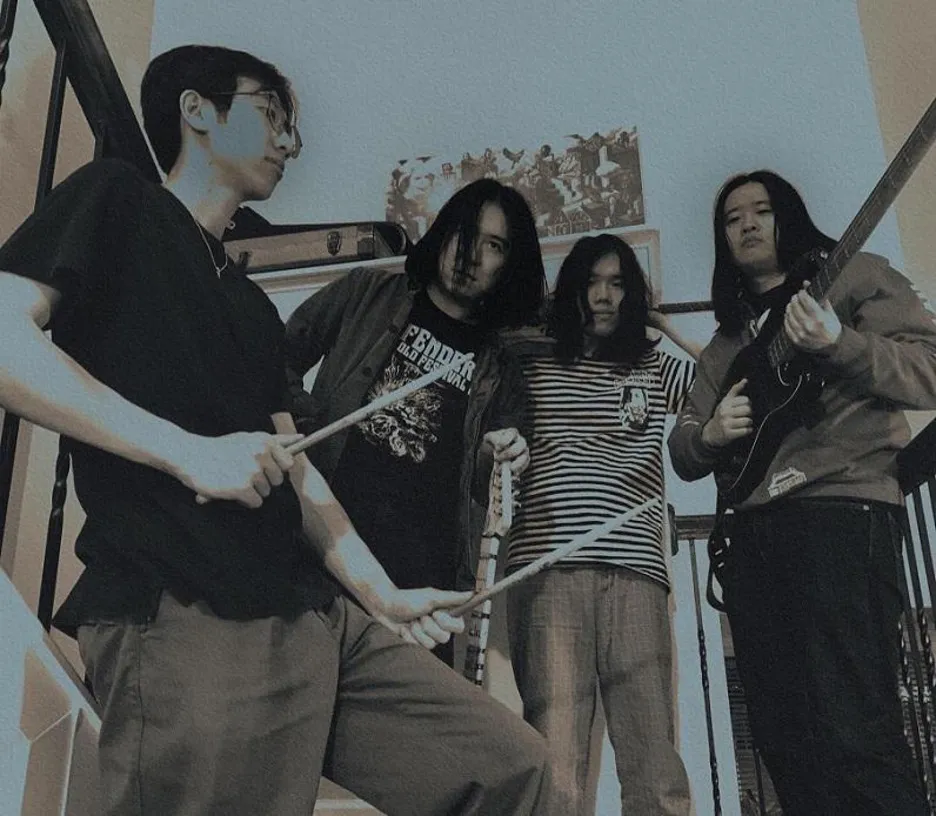
Chariots Overdrive sits on the opposite arc of Tang Dynasty. G.H.Z. founded the band soon after finishing graduate school at Georgia Tech, assembling a lineup of fellow international students. The project has always been anchored in Atlanta, but every member of Chariots Overdrive was born in China. Like Kuo in Beijing in the 1980s, G.H.Z. needed to introduce his bandmates — co-guitarist Y.Z., bassist Z.Z.Y., and drummer W.R.C. — to the cornerstones of the NWOBHM and USPM that would form the bedrock of their debut The End Of Antiquity. The result is strikingly individual and invigorating in its own right. Chariots Overdrive has offered a refreshing breath of air to an American trad metal movement that was beginning to feel stagnant.
All four members of Chariots Overdrive started playing music early in life, but in China that doesn’t automatically guarantee a deeper passion later on. “For Asian kids, you’re always encouraged to learn an instrument when you’re young,” says Z.Z.Y. “My first instrument was the violin, when I was six or seven. Honestly, I don’t think it sparked a lasting interest in music at that time.”
“My experiences are pretty similar to Z.Z.Y.’s,” adds G.H.Z. “I was urged to learn the piano by my parents. I started when I was four. That’s a very standard thing. You see all the Asian kids doing it. I’m one of them, but I’m not, like, exceptionally skilled compared to those you see on YouTube. For classical music, I’m okay.”
“For rock, my entry point was the movie School Of Rock,” he continues. “On Chinese national television, a new American or European film would be shown every weekend—every Saturday—and I watched those with my parents.”
With Jack Black’s voice echoing in his mind, G.H.Z. began digging deeper into music, working his way through classic rock and punk before discovering heavy metal. He fell for the New Wave of British Heavy Metal, not only the giants like Iron Maiden and Angel Witch but also the bands that had just a single release. The more obscure the band, the more they inspired him: “I enjoy spending time with those obscure acts,” he says proudly.
Meanwhile, the players who would eventually join G.H.Z. in Chariots Overdrive were charting their own paths in their respective hometowns. W.R.C., Z.Z.Y., and Y.Z. all played in school ensembles. W.R.C. recalls playing Radiohead and Green Day covers with his group, and Z.Z.Y. introduced original alt‑rock compositions to his cover band’s repertoire. Y.Z. played pop tunes with his undergraduate group, but back at his dorm he was teaching himself fingerstyle guitar, aiming to play the American jazz and blues he adored. None of them had ever played metal in China.
As it turned out, that wasn’t an obstacle. The earliest version of Chariots Overdrive was a loose series of jams focused on G.H.Z., Y.Z., and their former drummer Z.L.H. Y.Z. recalls that he and G.H.Z. became friends through their shared graduate studies, not through music. “He would usually drive me to Chinese restaurants when I didn’t have a car,” Y.Z. says. “He knew I could play guitar, but we hadn’t really started a band yet. I’m not really a metalhead. The first metal show I attended was Manilla Road during school, which G.H.Z. took me to. When I joined the band, I asked him, ‘What should I play?’ He said, ‘Remember Manilla Road? Play like that.'”
“It started with me and our first drummer, and we were like, ‘We need another guitarist who can handle all those crazy solos,'” G.H.Z. says. “We immediately thought of Y.Z., and we invited him in. So there were three of us. Then we needed a bass player.” Z.Z.Y. came into the picture shortly after, when he reached out via the Georgia Tech group chat on the Chinese messaging platform WeChat to see if anyone else was going to Cloak’s show, a local black metal band. G.H.Z. replied, they met at the gig, and Z.Z.Y. joined. By the summer of 2023, Chariots Overdrive was formed.
Initially, the band had no plans to release their own music. The jam sessions were carefree and spontaneous, and the members simply enjoyed each other’s company. Remarkably, original material continued to emerge. “For most of the bands I’ve been in, they don’t write new songs; they’ll cover something,” Z.Z.Y. recalls. “But at the first rehearsal, they weren’t covering anything.”
“It felt natural to me, because every time we rehearsed, something new would appear,” Y.Z. confirms. “It’s not that someone writes a song and we just play it. It’s more that everyone brings ideas to the jam, and we all contribute to the flow, and the chemistry feels great. We rehearsed regularly, more and more. We had songs we thought were good, so we decided to refine them and release them.”
Their first release as Chariots Overdrive was a demo, When The Wheels Start, with Z.L.H. on drums. When Z.L.H. left Atlanta, W.R.C. took his place, and they quickly completed the rest of what would become The End Of Antiquity. (Interestingly, Z.L.H. and W.R.C. are the only members who had met each other back in China, despite never sharing the same lineup at the same time.) They moved to Meadowlark Audioworks in suburban Atlanta to record with Greg Hendler, a former classmate of G.H.Z. and Y.Z. The chemistry clicked immediately.
“Greg is incredibly knowledgeable,” Z.Z.Y. says. “He knows how to coax the tone we want. He’s very professional, and I think he offered a lot of constructive guidance during the sessions—like altering some notes to ensure all the bass lines and guitar parts interlock nicely, or choosing the notes for the vocal harmonies on certain tracks.”
The End Of Antiquity is a genuine knockout for a debut, a raw and offbeat heavy metal odyssey that nods to Paul Di’Anno-era Iron Maiden, Kai Hansen-era Helloween, Manilla Road, Cirith Ungol, Heavy Load, and Metalucifer—yet never quite sounds like any of them, save for fleeting moments that vanish the moment you think you’ve identified the reference point. Fast, punchy anthems like “Parasite” and “Marching Maniacs” land with brutal impact, while stranger, more esoteric tracks like “A Taikonautic Alchemist” and “A Bizarre Pilgrimage To The Cubik Mansion” wander down winding corridors of warped melody. “A Bizarre Pilgrimage,” in particular, is a beast. At 12 minutes, it’s easily the album’s longest track, bringing in ideas well beyond Chariots Overdrive’s usual wellspring of influence.
“Maybe about three years ago, we toyed with something reminiscent of Saint Vitus or Reverend Bizarre, and that’s when Z.Z.Y. came up with some very slow doom riffs,” G.H.Z. says. “We considered weaving them into a section, maybe not a full song.”
“And then we have the structure,” Z.Z.Y. adds. “We decided to start with the first riff of that piece and then craft a connection between sections. So we’d compose the second and third parts to complete the first. We realized the doom motif didn’t work well as a concluding section, so we added the final portion. It’s like building a wall brick by brick.”
The majority of the lyrics on The End Of Antiquity draw from Chinese history and myth. The references aren’t laid out plainly, so someone unfamiliar with Chinese culture may not pinpoint exactly what G.H.Z. is singing about. That’s intentional. “If a Chinese listener reads our lyrics, they can infer the meaning even though names aren’t stated,” G.H.Z. says. “Maybe I should spend more time with Romance Of The Three Kingdoms.”
Even if you don’t identify the stories behind The End Of Antiquity, it’s clear that Chariots Overdrive approaches heavy metal from a distinct, sincere angle. One could call it heavy metal with Chinese characteristics—deeply informed by the raw power of classic metal, yet unmistakably shaped by the personal histories and musical journeys of the four men who created it.
“We feel we don’t have to be 100% metal,” G.H.Z. says. “Y.Z. is a superb jazz player. He can bring some different influences. We’ll make our band a touch different from other metal outfits.”
“But G.H.Z. will ensure we remain true metal,” Z.Z.Y. quickly adds. “We’re not going to become a progressive metal act, or something too New Wave. He steers us back to the old school. We’re simply adding more elements. We don’t want to be a pure cliché. We want to maintain a unique voice.”
TEN NAILS THROUGH THE NECK
10
Father Dionysios Tabakis – “Ἠλεκτρικαὶ Ὑμνωδίαι – Α΄ Ἑωθινὸν μὲ ἠλεκτρικὴν κιθάραν ἄνευ τάστων (perdesiz)”
Location: Nafplio, Greece
Subgenre: drone metal/devotional
There are at most ten minutes of metal on Paradise Metal, the debut record by 53-year-old Greek Orthodox priest Dionysios Tabakis. The majority of the music is performed on the perdesiz, a fretless guitar from Turkey that lends itself to eerie, microtonal textures. When Tabakis plays the perdesiz, he channels Byzantine liturgical music and the devotional spirit of his faith, yet he also evokes Earth and Sunn O))). Grayson Haver Currin wrote a thoughtful review of Paradise Metal for Pitchfork, rightly pondering whether the curiosity surrounding Paradise Metal—already a Bandcamp top seller for a month—reflects fetishization as much as real appreciation. It’s undeniable that the novelty factor helps attract listeners, and the faux‑private press cover art of Tabakis bearing his instrument against a Photoshopped blue sky invites memes. Yet the perdesiz drones here are genuinely affecting, both in their heft and in the sense that they’re offered in service of Tabakis’s deep religious devotion. Beats Hillsong, at least. [From Paradise Metal, out now via Heat Crimes.]
9
Dimhav – “Tides Immemorial”
Location: Stockholm, Sweden
Subgenre: symphonic/progressive power metal
Daniel Heiman has sung on many of power metal’s defining records, from his early work with Lost Horizon to his recent appearance on Sacred Outcry’s Towers Of Gold. Heiman’s range is the stuff of legend—his upper register is the stuff fans debate on metal‑vocalist forums. He’s been quiet since Towers Of Gold, but this month Dimhav enlisted his nearly unlimited range for the lush, orchestral second album Ondine. I personally prefer Heiman’s grittier projects, but there isn’t a better fit for what he can do than Dimhav. Brothers Olle and Staffan Lindroth crave both complex structures and grand orchestration, and they push Heiman to the edge while he rises to the challenge. Ondine is packed with moments that showcase the greatest power metal vocalist of all time at what could be a late‑career peak. [From Ondine, out now via the band.]
8
A Forest Of Stars – “Ascension Of The Clowns”
Location: Leeds, UK
Subgenre: avant-garde/progressive black metal
They’re wonderfully peculiar enough to stay niche, yet A Forest Of Stars deserves discussion among the era’s leading black metal acts. For almost twenty years, vocalist Mister Curse has delivered the thunderous sprechgesang à la Devil Doll’s Mr. Doctor, backed by clattering drums, roaming guitars, and a torrent of violin, flute, and piano. Katie Stone provides the violin and flute that helped shape one of the best My Dying Bride records in the last quarter‑century. The Leeds collective also inspired Ashenspire and helped shape Pensées Nocturnes’ late‑career experiments. Stack Overflow in Corpse Pile Interface stands as another inspired burst of madness from the group, and frankly I’m still parsing its hour‑plus maze of discursive structure and dense wordplay. It’s an album I plan to revisit throughout the year. [From Stack Overflow in Corpse Pile Interface, out now via Prophecy Productions.]
7
Balmora – “Moon Light Hysteria”
Location: New Haven, Connecticut
Subgenre: metalcore
I didn’t know the phrase “angel statue metalcore” until Tom Breihan dropped it in Stereogum’s March post about Balmora’s debut album. And yes, that’s an accurate descriptor. Melodic, dramatic metalcore with a hint of Christian imagery that borrows At The Gates‑style riffs and Acacia Strain‑style breakdowns, with solos that explode as if they’re breaking through the ground at a haunted cemetery. “Moon Light Hysteria” carries a vibe reminiscent of Darkest Hour, though Balmora seem less concerned with Judas Priest and Slayer than with forging their own path. I’m not usually into modern metalcore, but Balmora—pardon the Priest pun—deliver the goods. [From These Graven Halls, out now via Daze.]
6
Panopticon – “Ghost Eyes In The Fire Light”
Location: Ely, Minnesota
Subgenre: atmospheric black metal
Det hjemsøkte hjertet completes a trio of Panopticon releases reflecting mainman Austin Lunn’s life in his adopted northern Minnesota home. The Laurentian Trilogy (which also includes 2021’s …And Again Into The Light and 2023’s The Rime Of Memory) never quite moved me as much as Lunn’s earlier trilogy, which contained three genuine modern classics in Kentucky, Roads To The North, and Autumn Eternal. It’s not that the Laurentian albums ever sucked, but at their best they showcase the mastery of one of American black metal’s premier atmospherists. The standout track of the trilogy is the closing piece of Det hjemsøkte hjertet, “Ghost Eyes In The Fire Light,” a 14‑minute epic with commanding tempo shifts, dense swaths of distorted violin, and guest vocals from alt‑country singer Jordan Day. The suite unfurls like a single, rising crescendo as Lunn climbs toward an emotional boil that peaks in its haunting finale. As the last notes fade, the Laurentian Trilogy recedes, leaving the ledger square. I’m eager to hear where Lunn takes Panopticon next. [From Det hjemsøkte hjertet, out now via Bindrune Recordings.]
5
Nedgravd – “Black Blood Descension”
Location: Oslo, Norway
Subgenre: death metal
I know it’s a cliché to marvel at the youth of musicians in a scene long driven by younger players, but I genuinely wonder how a crew of kids born after the iPhone’s advent managed to conjure something so ancient and sinister. Nedgravd’s members are all between 16 and 19, and their take on death metal channels the great “I” bands—the Infesters, Impetigo, Imprecation, Incantation. Vocals are deep, gurgling growls that barely resemble human speech. Riffs and drum patterns remain spare, while tinny keyboards and horror‑movie samples provide eerie contrast to the raw instrument bashing. Precision isn’t the point; feel is. Would proponents of devil‑worship spend eight hours a day practicing guitar while watching Archspire playthroughs on YouTube? No—they’d be sacrificing. On Ascension, Nedgravd sounds as though they’ve spent all day at the altar. [From Ascension, out now via the band.]
4
Dimmu Borgir – “As Seen In The Unseen”
Location: Oslo, Norway
Subgenre: symphonic black metal
If you’ve checked out Dimmu Borgir’s recent work and thought you heard signs of growth, you were right to expect more on Grand Serpent Rising. This set expands the epic scale to near‑70 minutes and somehow earns every second. The orchestral textures weave through Silenoz’s sharp riffs and Shagrath’s vocal delivery, which is mixed prominently but remains powerful. Dimmu songs have always operated like compact operas, and the meticulous attention to detail on Grand Serpent Rising is on full display here. There’s new detail to discover with each listen, and the album rewards repeated visits. The track “As Seen In The Unseen” serves as a strong proving ground for the album’s maximalist vision, and it passes with flying colors. [From Grand Serpent Rising, out now via Nuclear Blast Records.]
3
Sabotør – “Skyggens Frekvens”
Location: Bergen, Norway
Subgenre: heavy metal/punk
Here’s a satisfying boot to the throat of the forces polluting the metal scene: a resolutely old‑school, punk‑flavored heavy metal band paying homage to the Norwegian Resistance. During the five dark years of Nazi occupation in Norway, the Resistance infiltrated, sabotaged, and resisted at every turn. Bergen’s Sabotør memorialize their countrymen’s heroism on their Norwegian‑language debut, Første aksjon. It’s a fast, dirty slab of NWOBHM that shares the ad‑hoc aggression and righteous defiance of the Resistance. Every track here feels like a battle hymn, but the sharpest writing is on “Skyggens Frekvens,” which sounds like late‑period Darkthrone with a heavier Motörhead pulse. It charges forward with abandon, crushing any Nazi fool who dares stand in its way. [From Første aksjon, out now via Dark Essence Records.]
2
Junon – “Dolorosa”
Location: Germany
Subgenre: avant-garde black metal
I, Voidhanger is running the show here. The Golden Citadel Of The Astral Sphere, Junon’s anonymous German collective debut full‑length, sits squarely as a signature release for I, Voidhanger’s anti‑archetype approach. Junon remains rooted in black metal, yet at their best their music feels almost formless, allowing grand, yawning movements to host reckless experimentation. “Dolorosa” closes The Golden Citadel with 21 riveting minutes that glide between minimalism and maximalism, drone and density, microtonality and shredding metallic passages. Junon’s unnamed, chameleon‑like vocalist has the charisma to thread these disparate strands into a coherent musical narrative. “Dolorosa” unsettles on purpose, and that’s the promise of I, Voidhanger—Junon fulfills it with aplomb. [From The Golden Citadel of the Astral Sphere, out now via I, Voidhanger Records.]
1
Eternal Evil – “Forever Feared”
Location: Stockholm, Sweden
Subgenre: thrash metal
All of the quintessential ’80s thrash bands either ended up filling arenas or wished they could. The revival waves of the genre have largely overlooked that aspect. As metal retreats further underground, bands seldom attempt the big, arena‑sized gestures Metallica and Megadeth once rode to fame. Eternal Evil aren’t likely to headline Wacken, but on Forever Feared they write and perform as if there could be such a moment, and that is a beautiful impulse. The Stockholm trio’s third album is bold, audacious, and packed with melodies so colossal they would sound splendid sung in unison by twenty thousand voices. The hook‑laden title track feels like it could’ve come from Kreator’s 1999 album Endorama, which was disliked at the time but now stands as a prime example of a European thrash band weaving a pop sensibility into their extreme metal core. Eternal Evil have the energy to follow a Kreator‑like arc in the years ahead. Their 22‑year‑old guitarist/vocalist Adrian Tobar carries himself with the blistering confidence of a young Yngwie Malmsteen. He resembles him a bit, too. Metal could use more of his earned swagger. [From Forever Feared, out now via Listenable Records.]