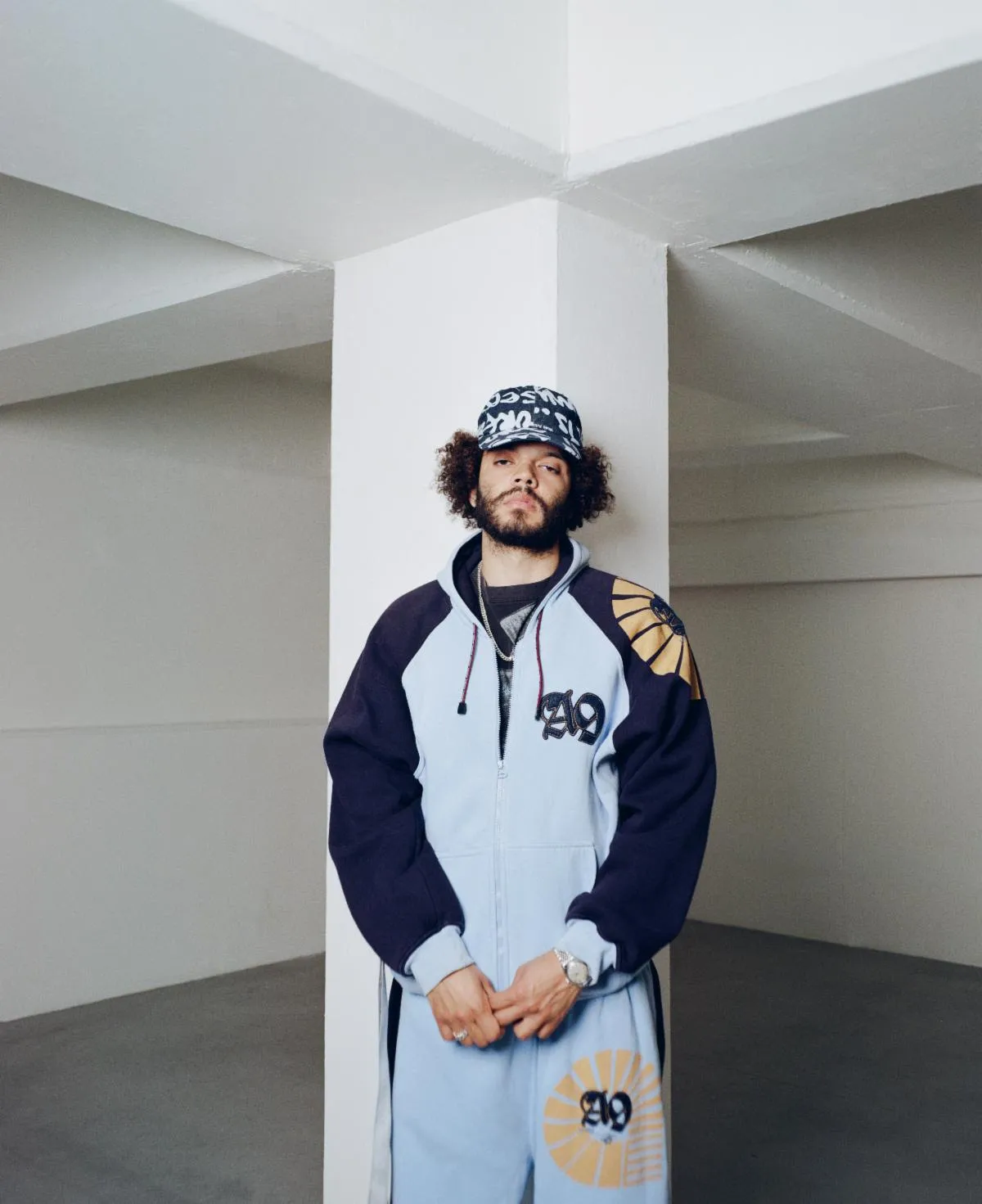
When I quiz Jadasea about his new album title, Holly Grove, it feels like I’m navigating a multi‑choice prompt. One moment it reads as a heartfelt homage to his hometown. The next, it seems he picked it simply because it sounded cool. Sitting back in a friend’s garden on a bright London afternoon, he settles on an answer that blends all of the above, with a tilt toward local inspiration and immediate practicality.
“I wanted to name it after something connected to where I’m from,” he tells me. “But [it’s] not my actual street, so people can’t pin me down.” With his terse cadence and a habit of rapping with ellipses, Jadasea often feels elusive in his music, too. Melding hazy beats, deadpan vocals, and abstract lyricism, the 31-year-old has stood out as one of London’s most singular stylists since breaking out with the Sub Luna City crew alongside King Krule twelve years ago. Through a cross‑continental exchange with MIKE and Earl Sweatshirt, he helped spark the fusion of formless, associative poetry and dreamy soundscapes. It’s a connection that’s rarely looked more legible than on Holly Grove, a project Jadasea says began from hangouts with his frequent producer, Harrison.
At seventeen tracks and roughly thirty-one minutes, Holly Grove unfurls as a haze of fragmentary musings and beats that feel like a morning fog. Jadasea threads it with flows that wander or accelerate in double-time, while his deliberately under‑pronounced lines lend the songs an impressionistic drift. He blends the elements on tracks like “Intrinsick,” where self‑medication, loyalty, and existential themes meet a poet’s gaze at metaphysics and a rapper’s exacting syntax.
While many artists chase newer sonic ground, Jadasea frames this as more of a throwback—specifically a nod to the Blitz era he released about six years ago. He’d evolved his sound by then, yet fans at shows kept asking him to perform Blitz cuts during sets of newer material. His range made revisiting the older sounds his supporters adored feel effortless: “I’m always doing a bit of everything.”
Long before he picked up a microphone, Jadasea was a Peckham kid with a voracious ear. Locally, he gravitated toward SN1 and Giggs, both hailing from the area. Looking across the Atlantic, he absorbed Yasiin Bey (fka Mos Def), Dilated Peoples, and Kanye West. His mother introduced him to Jay‑Z, whom Jadasea praises for combining sharp wordplay with street‑level references. “If you can speak to your own people and reach the masses at once, that’s one of the secret recipes,” he says.
By the time he was sixteen, Jadasea was cooking up his own rap methods. While Giggs’ street‑driven style influenced him, he knew he couldn’t credibly or meaningfully rap about real street life. Drawing inspiration from Earl Sweatshirt and Wiki, he decided to push his approach further into abstraction. “That’s what shaped my style—the abstract,” he explains. And yet, as a high school dropout, there was also a more elemental impulse: “When you’re that age, you’re just trying to vent something.”
Some of those venting sessions surfaced online when Jadasea and King Krule released City Rivims Mk1 as Sub Luna City in 2014. Over decidedly lo‑fi production, the tape felt as disorienting as a midnight mushroom journey through Epping Forest. It also served as a prelude to a Jadasea run that would unfold a few years later.
During the same period, MIKE—a 16 or 17-year-old rapper visiting London to hop into Slums—connected with Jadasea to create music together. Their collaboration flourished across projects like Half-Life (2019), Old Earth (2020), About Time (2020), and Blitz (2020), and a palpable synergy between their styles emerged.
It would be tempting to label Jadasea as merely an admirer’s student of Earl and MIKE, but listening to how their timelines intersect, and how his own releases have tracked since the early 2020s, makes the influence feel mutual and multidirectional. “Earl and Wiki had their impact on me … then MIKE came along about five years later, yet he’d already been tapping into me and everyone else, influencing us backward … and forward as well,” he explains.
In 2020 Jadasea and MIKE tested their chemistry on the road. “I booked that tour off my own email,” he recalls. “I fronted the money, booked the hotels, and my buddy did the driving.” Since then, they’ve added tour managers and booking agents, and the venues are consistently sold out.
To Jadasea, the stacking of coins isn’t the primary measure of success; it’s the people who fill the rooms. “Music to me is like a hobby I’ve ended up doing almost every day while I’m able,” he says.
After twelve years in the game, Jadasea swears off self‑myth and linear trajectories about rap stardom, even as he acknowledges the symbolism of changing circumstances. “Being a part of the ecosystem has been the most rewarding thing for me. You do something at a certain moment, and ten years down the line you can see the impact it had,” he notes. “Now we’re all in flux—no longer elder statesmen, but well on our way, I guess.”
ICE-COLD BEATS
BabyChiefDoIt – “Ghetto Love Story”
The subject of last month’s feature threads a ghettotech beat with a lighthearted chorus that’s sincere, playful, and really a lot of fun. RAMBO still finds a place in my rotation.
Rich The Kid – “Calling My Line”
Sometimes I worry whether Rich The Kid receives proper recognition for his run in the 2010s. More hooks than folks remember, a flow that left a mark more than it’s often credited for. Listening to him glide over the Blondie sample on “Calling My Line” makes me revisit his legacy, looping the track several times before dawn.
Kodak Black – “Lemon Squeeze”
Yak has looked more vibrant in recent performances. That’s good, because he still crafts fun little quirky tracks like this one, and there are some sharp lines too: “Yeah, nick-nack-paddy-wack, bulletproof Cadillac/ Nigga diss, got ’em whacked, move/ I’m in the cut, nigga, alley cat/ Nigga tryna swagger jack, but he ain’t got the bag to match.”
Future – “Radio”
Hendrix says this track isn’t destined for radio, but it feels one of his most accessible radio cuts in a minute. The beat is murky and restrained, and his voice sounds wearied in the best possible way.
Belly Gang Kunshington – “WTF GOIN” (Feat. 21 Savage)
Pure Atlanta energy here as Belly Gang Kushington nods to the Bluff, Magic City, and the daily life of a premier trapper. 21 Savage drops by, and the Latto shout‑out lands nicely: “My girl’s richer than these rappers, but she still spoiled/ Ain’t no pussy in the world that I can’t afford.”
Wiki – “Right Away”
A totally different lane for Wiki than in the past, but Ancient History is tight, with the bubbling groove behind “Right Away” matching Wik’s quick, wandering thoughts.
Maxo Kream – “Time Out”
Maxo links with JPEGMAFIA for a retro‑tinged track that’s heavy with sober reflections on outsiders, a sojourn to Lagos, and the practicalities of having a therapist: “I can’t tell a white boy what my people kill and die for.” Not everyone can cap like Tony Soprano.
Benny The Butcher – “Can’t Be Much”
Benny raps over a Harry Fraud production that feels tailor‑made for a drug‑dealer horror flick. Count me in every time.
Quavo – “Haavin”
I hope Offset and Quavo bring Migos back, but in the meantime, “Haavin” plays like quirky space‑funk great for barbecues and good times. It has a vibe reminiscent of “Stir Fry,” just a touch less corny.
GloRilla & Pooh Shiesty – “Mane”
Epic trolling energy here. Beyond that, Pooh Shiesty again reminded me how frustrating it is that he can’t escape jail, and GloRilla remains one of my favorites of the last few years.