
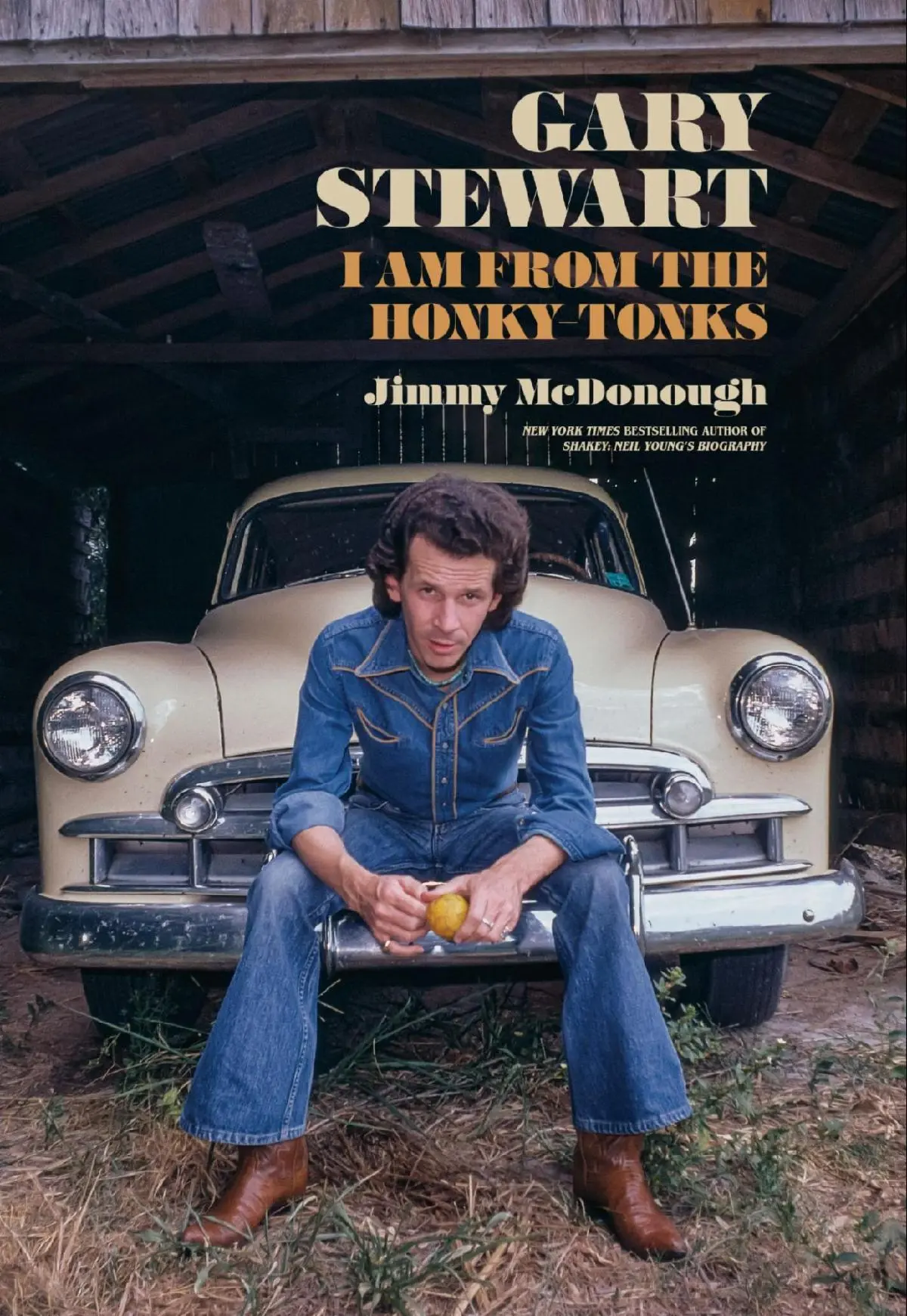
Acclaimed biographer Jimmy McDonough’s new book Gary Stewart: I Am From The Honky-Tonks delves into the rough-and-tumble life of Stewart, one of country music’s unsung giants. My own first brush with Stewart came through a stunning rendition of his track “She’s Actin’ Single (I’m Drinkin’ Doubles)” on Wednesday’s 2022 release Mowing The Leaves Instead Of Piling ‘Em Up. That cover quickly became a personal favorite and sparked my curiosity about the source material. So I’m eager to share this new essay from Wednesday’s Karly Hartzman, who writes about her affection for Stewart’s music and reflects on McDonough’s biography. —Chris DeVille
“I’d like to take country and kick it in the ass.” – Gary Stewart
At 2 a.m. on a Tuesday in 2021, surrounded by emptied bottles of two-dollar wine and crushed beer cans on our porch in Asheville, slouched on a suede sofa we had deemed ill-suited for indoor use, my roommate spun Gary Stewart’s “She’s Actin’ Single (And I’m Drinking Doubles)” from his iPhone. We had been trading tunes, debating what a song could express and what we hoped our own music might convey. We were worshiping the kind of music that made our hearts ache.
Our usual crew kept the records rolling, our songwriting idols: Jason Molina, Will Oldham, John Prine, Neil Young, Lucinda Williams, Richard Buckner, Sparklehorse, Silver Jews, the Truckers… my roommates and I lived inside our own canon, drunk and high each night, sharing the songs we were writing in between.
When “She’s Actin’ Single” began, the ache every music lover recognizes hit me with full force. A pedal steel hook that grabs you instantly. A goatish, gravelly voice that has tasted love, endured battle, and surrendered in both. Lyrics that feel as iconic as they are brutal. “I hide my pain/ I drown my troubles/ My heart is breaking/ Like the tiny bubbles.” It was over—obliteration achieved.
If you could bore a hole through a song by listening to it too many times, you could practically see through “She’s Actin’ Single” from the countless drives to and from work after that first night of hearing it.
In McDonough’s own words: “a three-minute soap opera, that’s what a country song is.” Gary and his band had deciphered the secret to the perfect country tune with this track long before I arrived on the scene.
A few months later, when we were offered a chance to record a handful of covers in a polished studio in Carrboro, NC, I knew one of the songs we’d capture would be “She’s Actin’ Single.” I was proud of the result, though it was daunting to release a cover of a song I had idolized so fervently and to feel I’d done it any justice at all.
Little did I know then that years later our band would sell-out venues, and fans would shout for us to play it from the crowd.
There was so much about Gary Stewart that I didn’t grasp until reading I Am From The Honky-Tonks. And there was plenty I could never have known without speaking to his family, as well as the many musicians, producers, club bookers, and record- label staff who knew him personally.
Fortunately, Southern folks are among history’s most devoted custodians. They stockpile family lore and memories, guarding the signifiers of what matters to them. The catch is that they are fierce guardians of those memories, and entry into their world demands a level of trust rivaling kinship. Jimmy McDonough invested years of care to piece together Gary’s life, and the stories he uncovered—from the floorboards of family homes, on tour buses, and inside honky-tonks—are extraordinarily intimate in their detail. They’re treated with a fidelity to the narrators, often voiced in their own words. They’re unapologetically sensational.
McDonough’s tribute to the life of Gary Stew artfully casts a bright light on the Kentucky and Florida Panhandle communities whose traditions risk fading away as mining towns and rural outposts shrink. In tracing Gary’s world, he becomes a kind of reverent chronicler of the people, their idioms, and their ways of speaking. I find myself itching to drop the phrase “He got more ass than a toilet seat” in conversation the next time I encounter a notorious rake.
Gary’s kin occasionally outshine his eccentricities, which is hardly surprising for families touched by mental illness and addiction. When fame, access, and hard drugs intersect, the stories—infidelities, reckless behavior, suicides, and violence—tend to surge. Gary himself wed at seventeen, while his parents were away, to the woman who remained by his side until his death, Mary Lou. It’s a tale that, in the book, sits among the tamer anecdotes of his youth, including the doctor-approved ruse that declared him to be twenty-one for marriage purposes. McDonough collects these fragments from Gary’s early years and shows how the scrappy honky-tonk attitude many of Nashville’s pretty boys wore was a costume that Gary wore with remarkable honesty. On stage, “he spills his guts out… and walks around in them,” and it isn’t theater—his life compelled these songs to be sung.
McDonough’s reverence for Gary’s music never flinches in the face of his more sorrowful chapters or recordings. Indeed, midway through the book you reach the apex of Gary’s fame and talent, and the remainder chronicles his slide into pill addiction, uneven records, and the sorrow that trenched through his life, culminating in his suicide. Working with his idols in the Allman Brothers and sharing stages with them did not save him; music did not rescue him, nor did his children prevent tragedy. It’s a frustrating tale of a musical genius who becomes disenchanted with life, and it serves as a cautionary note for any aspiring musician. It’s not a glossy portrait.
Reading Honky-Tonks prompted me to revisit tracks from Gary’s mid-career that I’d previously overlooked, perhaps because I clung to his debut. McDonough makes a convincing case that these albums—often undervalued, like Steppin’ Out and Your Place Or Mine—deserve full attention and a place on the shelf that matches his early work.
Through these stories, McDonough argues compellingly that Gary Stewart deserves to stand shoulder to shoulder with Waylon, Willie, and the rest of the mythologized outlaw-country pantheon. It’s almost a crime that he isn’t celebrated with a dedicated wing at the country music hall, a memorial highway, a biopic, a theme park, or even a breakfast cereal.
What McDonough achieves in this biography is precisely what any devoted admirer of a songwriter and performer longs for: a genuine appetite for more of their music. He frankly states that he hopes the book will loosen the lid on more of Stewart’s unreleased recordings.
There are numerous performances discussed in this volume that I am eager to hear, not only because of their context within Gary’s arc of grandeur and torment but also due to McDonough’s vivid descriptions after having had the privilege of hearing them himself (a fortunate stroke of luck for a son of a very lucky man). I yearn to hear the Motown covers that helped Gary secure a deal with RCA, a complete collection of songs he wrote with his friend Bill Eldridge, Roy Dea’s productions penned by Stewart (such as “The Ballad Of Corsia And John,” “4th Of July,” or “Stella Mae”) which time has hidden, the shelved Red Ash label recordings, and the numerous live performances McDonough chronicles across Gary’s tumultuous years on the road.
The appetite for this music will undoubtedly spread once readers dive into Stewart’s life story. It’s the same hunger I hope to ignite in our audiences as they belt along with the chorus of Gary’s song during our performances.