
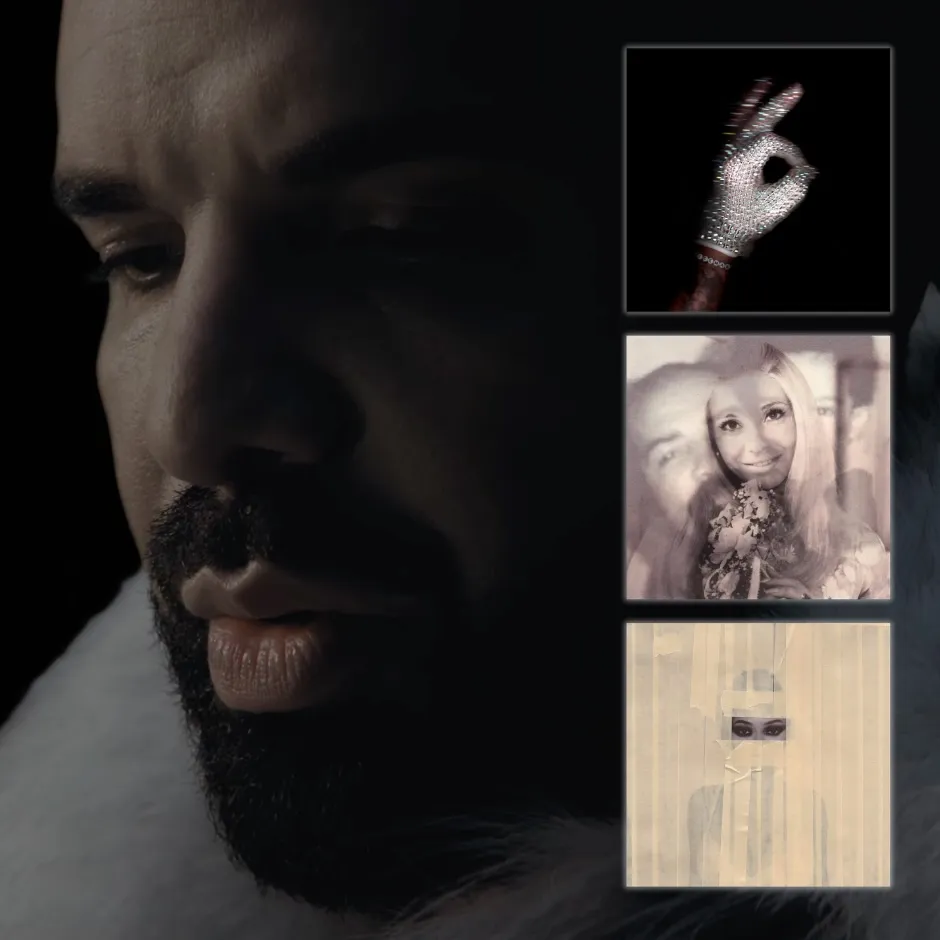
What did you expect from this guy anyway—gracious sportsmanship, a moment of clear-sighted perspective, or that rare kind of brutal self-examination that only arrives after enduring a humiliating defeat on the grandest stage? Not this fellow. It was never going to happen. Any hint of that sort of introspection would have contradicted the entire framework of the Drake persona. It isn’t that Aubrey Graham never speaks about his own fragilities; it’s that he only does so on his own terms. He’ll admit that he adores women a bit too much and that it stings when they hook up with other men in the apartments he rents for them. He will not allow himself to entertain the notion that the whole world has laughed at him and danced on his grave. That isn’t how Drake operates.
To try to pin down the Drake project—its arc, its motives, its drift—is a fool’s errand, but I’ll give it a shot anyway. In essence, this charming, solidly middle-class former child actor pulled off something almost unimaginable. He slid out of the Canadian teen-soap milieu, ingratiated himself with Lil Wayne’s circle, and emerged as a fresh-faced, fully formed post-Kanye superstar. He projected warmth and accessibility, capable of sounding tough when it mattered, but really wanting to talk about his feelings regarding strippers and Hooters waitresses. He arrived at the right moment in the right place, and he ascended to become one of the most formidable commercial forces in hip-hop’s history. His music, once buoyant and fluid and inventive, grew colder, sterner, more paranoid as superstardom tends to do. He became too influential to fail, cruising on autopilot for years. Then he took a beating from someone he hadn’t viewed as a serious rival. Energy tipped into hubris, and Drake didn’t realize how exposed he’d made himself.
At least in artistic terms, Kendrick Lamar did Drake a significant favor. In the years leading up to the Drake–Kendrick feud of 2024, Drake’s music had languished in a purposeless torpor—an endless loop of half-hearted bravado about amorphous situationships and a certain lazy cynicism. It was, frankly, dull. When the tensions between their camps finally spiked and Kendrick turned a long-burning cold war into a short, hot confrontation, Drake seemed to wake up. He appeared engaged, and his response tracks with Kendrick were full of unsubstantiated claims and deliberate misreadings, just as Kendrick’s records about Drake did. Drake sounded like he was enjoying himself again. He felt alive. Yet he hadn’t reckoned with Kendrick’s blistering, almost biblical vitriol or with the swelling backlash that gathered as a catalyst. It took him by surprise. What did he miss?
Over the last few years, Drake’s public persona has been all about sulkiness. He and his longtime collaborator PARTYNEXTDOOR released their long-promised joint project, $OME $EXY $ONGS 4 U, as if everything was perfectly fine, and he even snagged a genuine comeback hit by recapturing some of the sticky, carefree vibe of “Hotline Bling” on “Nokia.” Still, it didn’t give him much relief. He mingled with figures from the manosphere-adjacent online sphere and pushed questionable gambling ventures. He dropped cryptic, emotionally charged signals through his fashion choices on social media, and online sleuths speculated about what he was really saying. He spent an extended stretch in Australia as if living out the idle dream of that kid in Alexander and the Terrible, Horrible, No Good, Very Bad Day. And then he began to plot a return, a grand three-album burst that would seize the internet for days on end.
In terms of spectacle, Drake’s rollout for Iceman has been unusually effective. The colossal melting-ice sculpture in downtown Toronto felt like a pure publicity gambit, but it delivered on its promise. The wave of music videos that followed has been a lot more impressive. Some of those clips are genuinely striking: the prancing cowboys in “Plot Twist,” the ice-rink dancing in “Slap The City,” the austere, often cold close-ups in “Whisper My Name.” It’s pure showmanship. Yet the one that stays with me most is “Burning Bridges,” which unfurls in long, Goodfellas-like tracking shots through kitchens, up staircases, and into an upscale restaurant where Drake and his crew gleefully taunt the camera with their little peekaboo dance. They’re gathered to celebrate… the fact that Rihanna didn’t post A$AP Rocky’s single on Instagram. It’s a tightly choreographed publicity machine, calibrated for maximum effect, with little sense that anyone outside Drake’s immediate circle would actually care about any of it.
That, in a word, is the point of Iceman: it’s raw energy and petty grievance pressed into a weapon. It’s Drake staking out authority through sheer, petty stinginess. And, somewhat to my surprise, it’s sort of working. On Iceman, Drake fires off shots at Kendrick Lamar—“Muggsy Bogues dunked for once, even I’m a bit amazed / Yeah, someone give the kid a raise / What is it, the braids? / Even when I cut ’em, I could never fade”—but let me be clear: this stuff doesn’t advance the case. The Kendrick feud is settled business, and even Drake seems to sense as much. What animates Drake these days is the long list of people—some named, some implied—who joined in the pile-on, or who failed to offer him the backing he imagined, or who revealed themselves as something other than mere supporting players in Drake’s personal saga of eternal glory.
Here’s an incomplete roll call of Drake’s targets on Iceman: A$AP Rocky, J. Cole, Jay-Z, DeMar DeRozan, LeBron James, Pharrell, Dr. Dre. The topic of Israeli genocide briefly surfaces, but it’s merely a pretext for Drake to land a casual strike on DJ Khaled, and I’m not sure where Khaled fits into the grand tapestry. Drake also invokes one current manosphere ally to take a stab at another former rap comrade: “I was aidin’ Ross with streams before Adin Ross had ever streamed.” (I’d rather not hear Adin Ross’s name on a Drake record, but that line is funny.) And that’s only the publicly known cast. Drake allocates a sizable chunk of the opening track “Make Them Cry” to someone who allegedly pawned an OVO chain and then claimed it had been stolen. This really irks Drake: “I could never forgive such a nefarious action.” No slight is too minor to escape Drake’s notice, and the one former friend who’s welcomed back with open arms is Future, who slips through “Ran To Atlanta” with ease—an anthem of spectacular showmanship and genuinely strong music.
The key thing, though, is that Drake is rapping with purpose here. He’s oriented, he’s driving, and you can hear it in the production credits for Iceman and the other two fresh albums—even if the streaming metadata is maddeningly opaque, you can tell he assembled a top-tier team of producers and selected a set of rugged, twisty beats that suit his flow, allowing him to move through a range of rap traditions. He leans on a handful of forced punchlines and goofy lines on Iceman (“I do buy everything like I’m Middle Eastern”), but even those occasionally sit within longer, more inventive stretches that push his rhyme schemes into interesting territory. He also crafts memorable tracks, too. On “Janice STFU,” he even crafts a credible hit by flipping a pitch-shifted sample from a Lykke Li song—the kind of move he pulled off once before on So Far Gone. The craft is there, and I’ll admit I respect it. If any song from Iceman provokes another Kendrick response and rekindles the feud, it could well be that one, particularly for the moment when Drake says, “White kids listen to you ’cause they feel some guilt, and that’s how your soul gets fulfilled.” He could have scored a few points if he’d uttered that line two years earlier.
Like every Drake album, Iceman is too long, too ugly, and too self-regarding. It wears out its welcome and lurches off its rails long before the end. Yet for the first time in a while, Drake has a spark. It’s the ugliest kind of spark—grim, sullen, and unfriendly. The vibe is rotten. Drake appears to be here to vindicate his own missteps and to insist on his historical centrality, even in the face of mountains of evidence to the contrary. He attempts to recast his legal battle with his label as a crusade against “the Man.” He’s a petty rumor-monger, a sore loser, and an oligarch who tries to cast himself as a champion of the people. But for the first time in a long stretch, he brings enough energy to the proceedings that you can understand why this guy once mattered.
Iceman is merely one entry in a trio of new Drake albums, yet it clearly stands as the centerpiece. He clearly had something he needed to unload, and he knew that would grab attention. In the hours before its release, it was announced that two more records would accompany it, prompting some to speculate that this was Drake’s version of a Frank Ocean-esque exit from a big-label arrangement. Perhaps, but there are plenty of other motives to consider. A three-album drop signals dominance—Drake showing facets of himself that his peers cannot or will not present. It also helps him avoid diluting the impact of Iceman with softer tones on the other two entries.
Among the other two records, Maid Of Honour emerges as the more provocative and interesting. It places Drake in a high-energy club-music mode, a sharper, more kinetic reimagining of the pivot he tried a little while back on Honestly, Nevermind. I’m still weighing whether Maid Of Honour is genuinely a great album or simply a collection of sounds I enjoy—glacial electro accents, bassy roller-disco thumps, shimmering new-wave textures, Central Cee claiming he has a chopstick for your wonton. (That line always makes me laugh.) At times, especially during the drag-ball interludes, Maid Of Honour suggests a level of comfort with queerness that Drake has never really shown before. Perhaps that’s just strategic positioning, but it’s genuinely interesting that Drake would attempt his own version of a Renaissance moment.
Maid Of Honour offers something unusual: a sign that part of Drake still remembers how to have fun. He’s flirted with dance music before, with varying degrees of success, and here he sounds like he’s attempting to produce a sound that could have powered the Mad Decent Block Party back in 2013. The dynamics of sex and money remain as fraught as ever, but this is Drake at least hinting that he enjoys sex rather than simply manipulating and resenting it—as sometimes happens when your name is Drake. Some choices on Maid Of Honour, like the odd, ultramodern gothic guitar at the closing track “Princess,” hint that Drake and his collaborators may still have new ideas to offer. I’ll be listening to see whether any of these tracks endure as party fuel after the provocations of Iceman fade.
Then there’s Habibti, the album that plunges Drake into a sensitive, almost whining, patois-scented R&B vein for what feels like an eternity, even if the record clocks in at barely half an hour. Habibti introduces a few fresh moves—an emo-country acoustic mood on the opener “Rusty Intro,” for example—but for the most part this is the lowest-energy version of Drake, the one that refuses to hold attention for more than 45 seconds at a stretch. Nearly every Drake album features long swaths that sound like Habibti, and this one is no exception. I’m grateful that it exists as a standalone entry because it makes it easier to disengage. I can simply ignore the whole thing without trouble. I endured Habibti more than a handful of times while working on this piece, and I doubt I’ll ever voluntarily revisit it after publishing. I am done with it.
Even so, two of the three new Drake records carry real forward motion. That’s more than I expected and, frankly, a small win. Drake is five months away from turning 40. If he hasn’t moved beyond his own era-defining ideas about the world and his place in it by now, it probably isn’t going to happen. Don’t pretend there’s a miraculous turn coming. If nothing else, he has managed to seize the cultural moment and turn his own resentments and insecurities into something that feels like blockbuster energy. Reports of his demise were, it seems, wildly overstated. And if Drake refuses to accept his own humbling, at least he can mine it for fuel for the imperious, stubborn anthems that have always defined him. I wish there were more to hope for from Drake, but that’s not the story right now.
Iceman, Maid Of Honour, and Habibti are out now on OVO/Republic/UMG.