
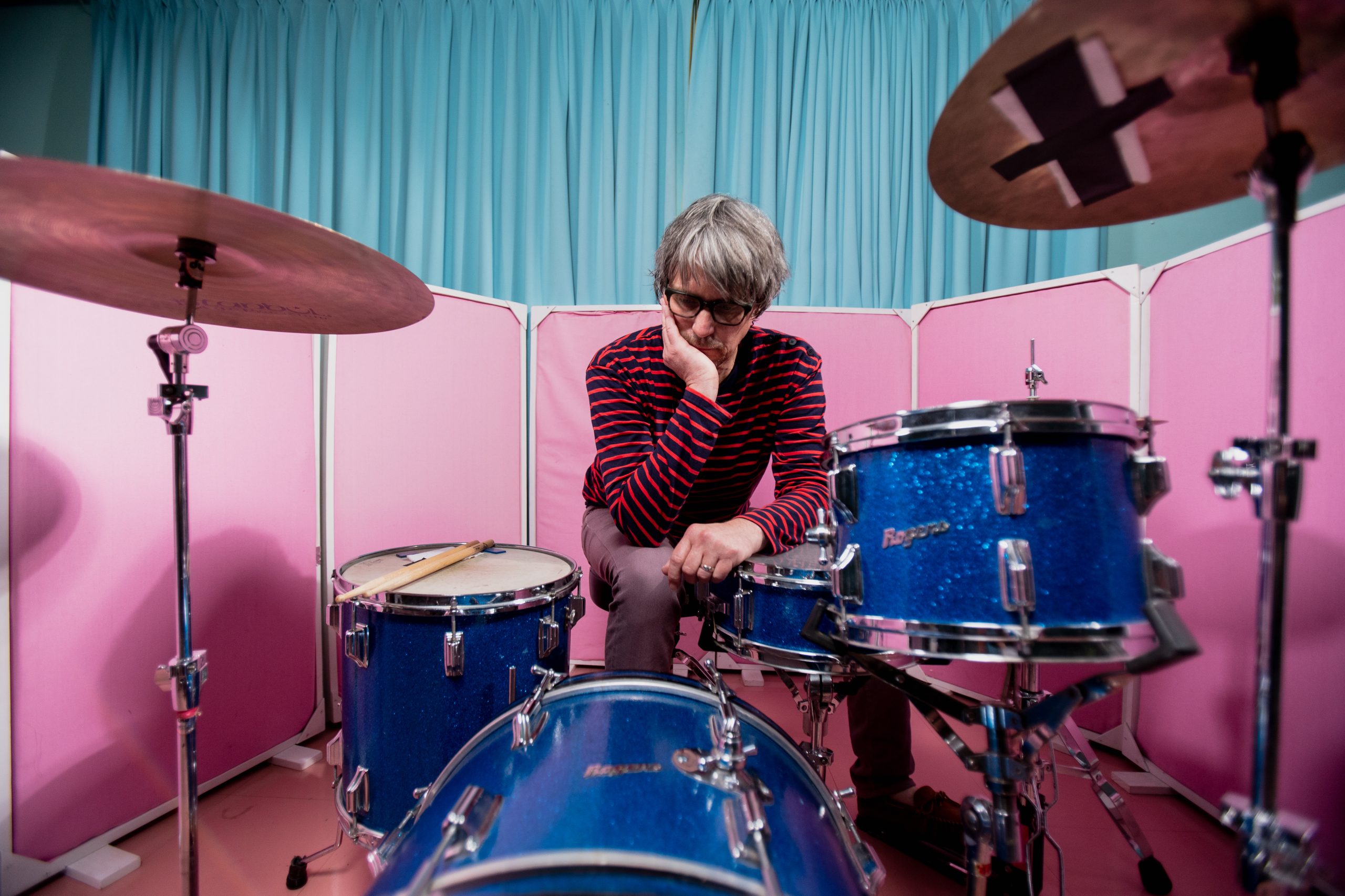
Steven Drozd, the Flaming Lips’ enduring collaborator, reflects on decades with the Lips, his exit during addiction treatment, and the commencement of his solo debut
For more than three decades — as they shifted from underground noise renegades to ’90s alternative darlings to orchestral visionaries to bubble-bubble festival spectacle to elder statesmen of the strange — the Flaming Lips possessed one unwavering asset: Steven Drozd. He initially joined as a drummer, delivering a Bonham-like ferocity on 1993’s Transmissions From The Satellite Heart, but soon broadened his arsenal to other instruments, especially after guitarist Ronald Jones left, and became instrumental in sculpting the bright, cinematic grandeur of landmark records The Soft Bulletin and Yoshimi Battles The Pink Robots.
The multi-instrumentalist’s quirky psych-pop sensibility, melodic instincts, and airy falsetto are woven into the core of the Lips’ discography. No matter how rocky things could get for the group, Coyne could always rely on Drozd to help realize his most outlandish ideas musically.
Then, abruptly, everything shifted. Last year, Drozd was noticeably absent from Lips performances, and in December he confirmed that he had left the band after deciding to step back from touring. What appeared to be a cordial departure soon unraveled when Coyne issued a cryptic message of his own. “The reason he left is sad and infuriating,” the frontman wrote on Instagram before the holidays. “It is HIS responsibility to tell everyone what happened.” (Coyne, through a representative, declined to comment for this piece.)
I reached out to Drozd in February, and a month later he replied and kindly agreed to speak. These days, he’s holed up at home in Oklahoma City, laying the groundwork for his first solo album, which he hopes to release in the fall. He scans Lips tour dates with a sense of relief that he won’t be hopping planes to Greece or Jakarta. The touring life is behind him.
When I spoke with Drozd in mid-April, we talked for an hour, and he seemed to be still sorting through the strangest ending to his Lips tenure. I’ll let him recount that story, along with many others, in his own words. The conversation begins… now-now-now-now-now-now-now-now-now.
It’s been roughly four months since you kind of announced your departure from the Flaming Lips. How’s it going?
STEVEN DROZD: They’re probably touring more now than at any point in recent memory. Which is great for them. But when I see all those dates, all I can think is that I’m glad I’m not touring. I suspect I might have reached the end of the road for me on the road. I’m happy not to be touring. So that part is excellent.
I got the impression that, in recent years, touring wore you down a lot.
DROZD: Definitely. I think for a mix of personal and family reasons, the road became increasingly hard. It all peaked when my daughter went missing in Seattle near the end of that Weezer run in 2024.
I remember reading about that at the time. That must have been a brutal experience.
DROZD: Yeah. It’s hard to re-enter after something like that; it was traumatic. She was missing for three days. We didn’t know what was going on.
That’s an awful situation to endure. Was that the moment you realized you needed to stop touring?
DROZD: Yes. It happened at the tail end of that stretch. I ultimately went into treatment for drinking after it occurred. I came home, entered treatment for a couple of months, got out, and then I relapsed during the holidays. I returned to treatment, and that’s when Wayne stopped communicating with me. So the way it ended is really sad because it didn’t have to unfold like that. I went back to treatment, and he simply stopped talking to me. I haven’t heard from him since January 3, 2025. It’s been strange, you know.
That’s very sad. You and Wayne shared a close musical partnership for 33 years. You’ve been quite open about your past struggles with addiction and drug use…
DROZD: Yeah. I try to be honest, but I also have a family to consider, so I can’t lay everything bare. It wouldn’t be fair to them.
So, 2025 found the Flaming Lips on tour while you were pursuing your own path.
DROZD: Exactly. I returned to treatment, and Wayne didn’t reach out. They decided to go ahead and perform in Australia without me, bringing in someone to cover my parts and to tour with them. It apparently went well enough that they thought I might not come back.
But no one filled me in for ages. I assumed Wayne and I would reconnect after a while, but that never happened. By the late summer into fall of last year, I knew—between you and me—that it was over and I wouldn’t be returning to the Lips. I’ve been focusing on my own material since, trying to accept the new reality. It’s been tough in many ways. It’s strange not to be on the road; I’m glad I’m not there, yet it’s still odd not being out there. I’m so used to it.
I’ve noticed a shift in the Lips over the past five years. It feels like Wayne has steered the group toward nostalgia, with Yoshimi’s 20th‑anniversary shows and a long absence of new material. I think the last new album was American Head in 2020, right?
DROZD: Yes. It was due in June 2020 but actually came out in September.
So we’re looking at more than five years since a new Lips record. It seems more like a touring spectacle than a band pursuing fresh music and evolution. Was that your impression?
DROZD: I know they’reworking on new stuff, though I’m not fully sure of its stage or how far along it is. A friend of mine in Oklahoma City is involved with Wayne in a studio, so I know new material is being worked on. But right now they seem focused on maximizing the tour and keeping audiences engaged with the live show. As for a new album, I can’t say for sure.
Were you fully on board with the Yoshimi 20th anniversary tour?
DROZD: It’s fun at times, but after a while it becomes exhausting, you know. You play the show you know inside out, so you can do it without much thought. Yet it’s not as exhilarating as learning a new set every night, by any means.
When I first fell for the Lips two decades ago, the thrill came from constant novelty. There was always something new—an album on the horizon that would be unlike the last, a continual reinvention that drew me to the band.
DROZD: Sure. Things evolve, and nothing stays the same. Whatever it is now will shift again. It’s odd for me to discuss the Lips in the past tense, but that’s where we are now.
It’s strange for me too. A lot of Lips fans—myself included—saw you as the musical heartbeat of the group for many years, especially after Ronald Jones left and you broadened beyond drums to other instruments. You helped orchestrate much of the magic on The Soft Bulletin and Yoshimi.
DROZD: Yeah…
You were a central figure for so long. It’s big news that you’re not in the band anymore.
DROZD: Indeed. My ego told me it would be a bigger rupture than it turned out to be. But it feels like people are moving forward. I’ve been focused on my own new music and hope to have a record out in the fall. I thought summer, but that now looks unlikely. I’ve got four or five songs in the can and I’m pushing on toward a full record. I hope there are folks who care about what I’m doing.
Fans have been wondering what a Steven Drozd solo album would sound like. This is your first solo album under your own name, right?
DROZD: Yes. I previously did a soundtrack for a documentary—the Heart Is A Drum Machine—years back, but this will be my first official solo album under my own name.
What’s that experience like?
DROZD: I’m excited. Some people will probably say it sounds like the Lips—after all, a lot of what I did within the Lips came from me. I’d describe it as psychedelic pop; it’s Lips-inspired material, but I’m the sole vocalist on it.
And you’re handling production and every instrument yourself?
DROZD: Yes. I’m collaborating with a friend down in Norman, Oklahoma, at Trent Bell Labs. I’ll be playing every instrument, handling all the vocals and writing everything. It’s all on me, though I might invite a couple of guests. I’m talking to Micah Nelson about a Willie Nelson cover he might contribute to. We’ve been trading tracks. I’ve released a few covers in recent months: a Codeine cover around New Year’s, and AC/DC’s “Let There Be Rock.” I’ve shared a few snippets on Instagram—there’s more to come, I promise.
Your Instagram posts always tease intriguing material. It feels like a preview of what’s to come.
DROZD: Yeah, the plan is to generate interest. I’m not great at Instagram, but I’m getting better. In the next week or two, I aim to post more original music rather than mere snippets. I don’t have a label yet, but there are a few interested parties. People ask if I’ll tour; I’m not ready for that yet. It could happen with a band, but I’m not sure I’m ready to re-enter that world.
Do you have songs you wrote during your Lips years that felt more fitting for your solo work and that you’ve kept aside?
DROZD: No. Any material I penned for the Lips was intended for the Lips. Take a track like “Race For The Prize” — it took me several attempts to win Wayne over for that idea. So I don’t have leftover material waiting in the wings…
What was the difference between your fifth attempt and the first four?
DROZD: In the first try, it sounded like Dinosaur Jr.
Really? A particular Dinosaur Jr. track, or their sound in general?
DROZD: Just J Mascis’s signature “wah” noise [mimics high-pitched guitar wail]. I could imagine them doing a cover of it. The second version started to resemble a car commercial, so I kept at it. The demo where a heavy, drum‑and‑distorted-strings section transitions to something more “car ad” felt reached a point where Wayne got involved. As for leftover material, I don’t really have any; everything I’m working on now has been created within the last year.
Is it strange not having to run things by Wayne? You’re now in charge of everything you publish.
DROZD: Yes, I miss lyric writing. It doesn’t come naturally to me, and the harder I push, the more it eludes me. Wayne, by contrast, can walk away for a moment and return with an entire song’s worth of lyrics. He has a true talent for it, and I miss that collaboration. Still, it’s odd doing this solo; I’m used to a two‑person dynamic. We did much of American Head as a band, and I think I played every instrument on every track except two parts. It felt like a Wayne-and-me project with Dave Fridmann in his studio. Now it’s just me, which is strange. The reception to the music I’ve shared so far has been very positive.
I’m eager to hear more. I hope this chat stirs interest in your album later this year.
DROZD: Yeah. Some parts are hard to discuss without speaking ill of the Lips, and the end of that era remains painful.
Yes, I wasn’t aiming for sensationalism; I wanted a candid discussion about what happened and what you’re doing now. When you first announced your departure, it felt like a Threads post that spiraled publicly beyond your intent.
DROZD: That’s true. It really felt like a Gen X slip on Threads. I assumed it was just between me and one person. Threads is a puzzling space! You’re not alone in making a misstep. This situation exploded in ways you didn’t anticipate. I hoped for a longer, more considered talk about your exit.
DROZD: Yeah. No one was saying anything. No one was communicating with me. I still text with Matt and Tommy [the Lips’ drummer and bassist]. Not regularly, but I ran into them and was cordial. Still, I heard nothing about any of this. My Threads blunder did prompt a public reckoning, but that’s not how I wanted things to unfold.
Within Lips fan circles—Reddit and Facebook—people wondered, “Where’s Steven? Why isn’t he on tour?” People picked up on it. It’s notable that Michael Ivins left the band five years ago and Wayne offered little public comment then. To me, that felt a hush-hush moment.
DROZD: Yeah. It was a “we’ll see if anyone notices” moment. Not to slight Michael—I texted him today, and he’s somewhere with a band. He may have been surprised by how little fanfare accompanied his departure. In the early days, you, Michael, and Wayne seemed like the definitive Lips lineup, much like Pink Floyd’s classic 70s trio. So Ronald’s exit was a shock, and the lack of public acknowledgment was a letdown.
DROZD: There wasn’t much acknowledgment of it, yeah. That was a shame.
It feels like the Lips have shifted to a Wayne-centric operation, with him hiring a backing band for live shows.
DROZD: Some members have stuck around—keyboardist/guitarist Derek has been with them since 2009, for example. Still, it feels very much a Wayne show. The stagecraft—lights, videos, the whole spectacle—has its own logic, and people seem fine with that onstage.
I was struck by Wayne’s December Instagram statement when you announced your exit. He wrote, “The reason he left is sad and infuriating, and it’s his responsibility to tell everyone what happened. What he told everyone was a lie.” Do you want to weigh in at all?
DROZD: I’ll reiterate what I told you before: I went back to treatment, and he stopped talking to me. That’s basically how I was dismissed. So, I didn’t leave—I was let go. I suppose you could say I left because I went to treatment and didn’t perform the shows that were planned.
I was surprised that Wayne would post something so petty instead of acknowledging your long service. You were a remarkable part of the Lips for thirty-three years.
DROZD: You’d hope for something more generous. It was upsetting and it affected my family. People in Oklahoma City asked what was going on. I didn’t know what to tell them. It’s a painful ending to a fruitful collaboration, and there’s little I can do to change it. I went into treatment, came home, relapsed around Christmas, and that’s when Wayne stopped talking to me. That’s how it ended.
I sometimes imagine, if we were in a band the size of Oasis—not that I’m comparing us—the show would have been canceled so I could get treatment and return later. But that isn’t how it played out.
It’s undeniably sad that such a fruitful collaboration should dissolve so abruptly and unexpectedly.
DROZD: It was abrupt, with no real finality. It feels like a question mark at the end, even though I’m living it. And I know I’m not coming back.
Let’s go way back to the start, when you joined in the early ’90s at age 21 or 22. How did you first get invited to become part of the Lips?
DROZD: I was 22. A long story: I had moved from Austin to Norman, Oklahoma, in the summer of 1991. I was playing with a band called Janis 18, based in Norman but with roots in Austin. They were fed up with Austin, so I followed them to Norman. I lived in a house that housed an eight-track studio—a hub for cool players in the area for demos and recording. One day Wayne and Michael showed up; they’d done some demos there and asked if I’d like to come jam with us to see if it was a fit. A year earlier I wouldn’t have known much about the Flaming Lips, but by then they were among my favorite acts—the Jesus Lizard, Nirvana, Dinosaur Jr.—and they’d just bought a nice drum kit. We jammed for about an hour, and it felt right—like it would work.
I joined as the drummer, but I was already writing songs. I started writing in 1992 and shared some with Wayne. Some of the material on Transmissions From The Satellite Heart began as Drozd’s ideas that Wayne helped shape.
Your drum sound defined those ’90s records. Especially on Transmissions, the raw, booming percussion had a Bonham-esque presence.
DROZD: I’ll take that as a compliment, sure.
That distorted beat on “Slow Nerve Action”—that was your doing, wasn’t it?
DROZD: That was a deliberate move. I lived in a place with an eight-track setup, but those guys were masters of four-track, too. It was around the same time the four-track techniques were becoming popular in indie circles. We distorted the drums with a four‑track feedback approach, and on “Slow Nerve Action” we pursued that effect so aggressively that we ended up applying distorted drums to nearly every track on the record.
It was a personal budding interest that the band embraced, and that unusual drum texture became a hallmark.
Then a few years later Ronald Jones left. Did you think you’d replace him, or did you sense you’d have to assume more roles yourselves?
DROZD: We knew replacements wouldn’t replicate what he did. We expected to change directions, not replace him. We didn’t know exactly what the new form would take, but we were aligned in desiring a sound not driven by guitars. Wayne and I began sharing four-track demos, and a lot of the songs came together quickly in late 1996 and early 1997. The Soft Bulletin finally arrived in 1999, but some of those tracks—like “Race For The Prize”—were conceived at the end of 1996. When Ronald left, we realized we wouldn’t find someone who could match him, so we chose a different path.
He produced astonishing, peculiar sounds from that guitar. It’s hard to imagine anyone else duplicating it.
DROZD: He was one of a kind. We recognized there was no one on his level, and that acknowledgment pushed us toward change.
Are you still in contact with Ronald at all?
DROZD: Not really. He’s stayed out of the public eye since the late ’90s. I think Wayne may keep in touch with his brother, but I haven’t spoken to Ronald since the ’90s.
That brings us to Zaireeka, perhaps one of the most audacious albums ever made. I recall listening to it on four CD players in college and having my mind blown. Do you look back on that record with pride?
DROZD: Absolutely. When we were making it, it felt special. Initially Wayne had hoped to do something even grander—maybe ten discs? My memory’s hazy. Our manager, Scott Booker, urged Warner Bros. to fund both Zaireeka and The Soft Bulletin on a single budget so they wouldn’t need extra money to support Zaireeka. Some songs we’d considered for Zaireeka ended up on The Soft Bulletin. “Race For The Prize” was a contender for Zaireeka; it didn’t click, so it went onto a separate plan for a future release.
Looking back, I rigged a home system to hear the album: my main stereo, plus three boomboxes, tied together so I could start all four players at once with two fingers, a tongue, and a toe. The boomboxes sat on extension cords across the room.
Any band that convinces Warner Bros. to release such a wild, imaginative project must have a thrilling aura about it.
DROZD: [laughter] After Ronald left, we didn’t tour for a while, which coincided with a downturn in the label’s industry fortunes as the “alternative nation” dream faded away.
It’s remarkable that Lips remain tied to Warner Bros. after all these years.
DROZD: Somehow, miraculously. The right people at Warner Bros. argued to keep us on, and we never pushed for extravagant compensation. They seemed happy to have us around, and we were happy to stay.
Of all the Lips albums, which one are you most proud of?
DROZD: My taste shifts over time. During the Embryonic period I didn’t fully enjoy the process, but now hearing it, I can appreciate it more. The Soft Bulletin stands out as a standout—despite everything around us, we crafted something enduring and special, and I’m very proud of that.
Those songs carry a timeless quality and real emotional depth.
Embryonic, too, marked a drastic shift—returning to a raw, aggressive edge after a period of more polished, accessible sounds. What was exciting about that record?
DROZD: It felt like a potential second coming of At War With The Mystics, starting with heavy, slower, somewhat pop‑leaning tracks. Wayne suddenly suggested a radical pivot: abandon the familiar path and go completely left field. We embraced that wild detour, which took a moment to find its footing, but by the end it felt like a double album that truly worked. Now, when I hear it, I think it holds up as a coherent double set.
Is there a Lips album you wish had turned out better or that you felt you were less connected to?
DROZD: I’d say Oczy Mlody. I wish I’d been more involved in it. It’s not that it’s a bad record, but I felt less connected to it than to others.
Back in the Yoshimi era, the Lips’ live show became highly visual—lots of stage props and the giant bubble. Did that visual emphasis sometimes distract from the music?
DROZD: There were moments when I’d get irritated by new elements. But then I realized the audience comes for that sensory experience. The live show breathes as much through performance as through sound, and it grew naturally rather than as a preplanned blueprint. That organic evolution helped relieve some pressure on the music itself. It wasn’t only about the sonic side; there was a whole world to explore onstage, which allowed me to relax into what was happening.
Before you left the band, were you and Wayne planning new Flaming Lips material?
DROZD: There were a couple of songs Wayne and I were working on that didn’t make it to completion. They’ve fallen by the wayside for now, and I’m not sure what will happen to those tracks in the future.
Did Michael’s departure slow the Lips’ momentum on new music? It seemed to pace down in the early part of this decade.
DROZD: COVID was a big factor. American Head was finished and ready, then the pandemic hit and everything slowed. We did some shows in the middle of the period, but playing in a bubble felt disconnected from the audience. The rhythm of writing and releasing slowed naturally as we aged and as Wayne started a family—his first child arrived in 2019, which also contributed to the deceleration. It wasn’t one single cause, but a mix of aging, life changes, and a more deliberate pace after so much output in a short span.
Do you hope there will be some reconciliation with Wayne someday?
DROZD: I’d welcome it, but I’m not counting on it. I hope it could happen in the future.
Would you be open to it?
DROZD: Yes, I’m open to it.
The Flaming Lips defined a lot of you for years. It must feel surreal to reframe that identity now that you’re pursuing your own path.
DROZD: It’s strange. My identity has been so wrapped up in being a Lips member. Now I’m no longer in that role. I’ve had to confront this shift and navigate what that means for me personally. I’m doing the best I can to adapt to this new reality.
There’s a vast network of former Lips members—yourself, Michael, Kliph, Jonathan Donahue, Ronald. Do you keep in touch with anyone else?
DROZD: I’m loosely in touch with Michael; he even texted me today about a cymbal he’s searching for. Kliph reached out recently as well. After everything, he checked in on me, which I appreciated. When legends like Keith Richards pass someday, I imagine Kliph will text me on that day as well.
You’ve mentioned hoping to release your solo album in the fall. Do you have a working title?
DROZD: At the moment I’m calling it Laugh Out Loud Rest In Peace. Just six words, no punctuation beyond what’s shown. The idea comes from a chat with Eric Slick of Dr. Dog, who’s been a strong supporter and even contributed drums to one track. He and I traded ideas, and the phrase LOL RIP came up in a discussion; I loved how it sounds—this playful phrase about embracing life while acknowledging its end. It has a ring to it that suits the project.