From 2009 through 2014, Uta Plotkin served as the frontwoman for Witch Mountain, a Portland-based outfit that helped sketch a miniature epoch within American doom metal. A half-decade in this scene can feel monumental: the phrase “New Wave of British Heavy Metal” first appeared in 1979 and its momentum had largely faded by 1984. There was also a mere five-year gap between 1986—when thrash metal fully exploded—and 1991, the year Metallica effectively redefined the genre. In the interval from 2009 to 2014, bands such as Pallbearer, Khemmis, Windhand, Dark Castle, Occultation, Usnea, and Un issued their debuts, while SubRosa, Elder, and Yob delivered some of their most acclaimed work to date.
Witch Mountain embarked on a three-album surge—2011’s South Of Salem, 2012’s Cauldron Of The Wild, and 2014’s Mobile Of Angels—that still sits among the defining stones of the New American Doom Revival (trademark pending). Plotkin’s voice was their secret weapon, a grounded, blues-tinged contralto with the versatility to summon biting death growls and tender, melodic highs alike. For a glimpse of her range, listen to “Can’t Settle” from Mobile Of Angels. Even today, no other singer convincingly conjures a Janis Joplin-Gollum hybrid, which helps explain why her absence from a full-length metal album for more than a decade still stings so sharply.
Now, at last, Plotkin is back. Her project Lividus has issued its blistering debut album, Scarabaeus, after a pair of proving EPs released in 2022 and 2023. (Plotkin has also released material with the tongue-in-cheek “satanic pop” group Inverted Crosses.) Scarabaeus isn’t a doom record, and its precise genre alignment isn’t easy to pin down. Lividus traverses death metal, black metal, thrash, and prog, yet Scarabaeus feels gloriously liberated from rules. Part of its force lies in ex-Dark Castle guitarist Rob Shaffer’s jagged, off-kilter riffs and in Plotkin’s most expansive vocal expression to date. She’s growling more than she did with Witch Mountain, but her clean singing remains impressive as ever. The extended hiatus appears to have renewed her focus. Lividus exudes a singular clarity of purpose that seems to shout from the speakers, a vitality she could only recapture by stepping away for a while. She departed Witch Mountain in 2014, citing burnout. She returns to metal like a phoenix enkindled with flame.
“I spent perhaps a year trying to repair my relationship with music after burnout,” Plotkin recalls. “I even attempted a solo album, and it was so dispiriting. The music that came out of me wasn’t something I wanted to share. I recorded some of it and thought, ‘I don’t even want to listen to this.’ I was simply trying to figure out what to do next with my life.”
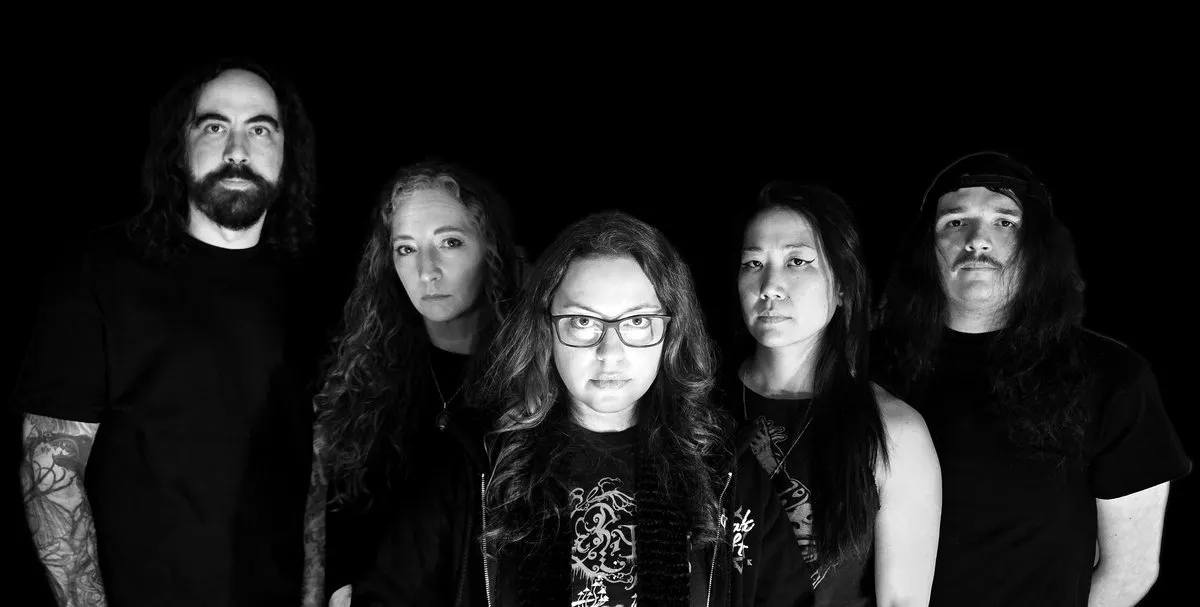
It’s worth noting that Witch Mountain was never Plotkin’s solo project. It began—and continues—as a collaboration between guitarist Rob Wrong and drummer Nathan Carson. Plotkin didn’t initially set out to join a doom outfit until Carson persuaded her to give it a try. “I love the music we ended up making, but I needed something truer to my own sensibilities,” she says today. In Lividus, she’s joined by Shaffer, guitarist Christy Cather (ex-Ludicra), drummer Pierce Williams (ex-Skeletal Remains), and bassist Connie Wang, and it seems she has found that authenticity there.
“This is the music I’ve always wanted to create,” she beams. “It’s been a long journey, and I’m thrilled to have these incredibly kind people in the band, because assembling this lineup was really challenging. Now I’m surrounded by some of the nicest people in metal, and it’s a joy to work with them.”
Below, you can stream Scarabaeus and read our lightly edited dialogue.
Inverted Crosses marked your return to releasing new material publicly in 2017. When you started that project after your hiatus, what sparked the decision to press on again?
PLOTKIN: I didn’t start that band. It was founded by two friends, one of whom was former Witch Mountain bassist Chuck Thomas. I suffered a serious knee injury requiring surgery, and they invited me to join, which I did for a while. We made a couple of short, fun records, and it felt like a release. I needed to rediscover the joy of playing music.
You launched Lividus around the same period, but you initially kept quiet for a while. What were those first years like?
PLOTKIN: I was in the middle of a yoga-teacher training course when I decided I wanted to start an extreme metal project. Inside me there was a torrent of anger that needed a outlet. I reached out to Connie, and she said yes. I returned from training in California, and we began writing riffs, unearthing riffs that had lain dormant for ages. Her then-boyfriend contributed some riffs as well, and we fused everything into a few songs. It was just me and Connie for a while, which made finding players difficult. We relied on friends to record a rough demo and develop the material.
That was before the EPs, right? I don’t suppose you’ve heard the original demo?
PLOTKIN: The demo was rough, recorded at home with Reaper, enough to spark interest. We eventually found a guitarist and a drummer. Ironically, the drummer ended up being the same one we use now, though we’ve cycled through others in between. It’s been a real rollercoaster of lineups.
So you started the band yourself. How important was it creatively that this project was essentially you and Connie’s endeavor?
PLOTKIN: It was crucial. I’ve never felt drawn to join other people’s groups. I wouldn’t have pursued doom if the circumstances hadn’t aligned as they did. I’d previously led Aranya, where I had substantial input into the music. I’ve always needed to create, to make things. Having my own band gave me a level of control over the sound that felt essential.
Let’s discuss the sound’s character. It’s hard to pin down—part death metal, part black metal, part prog, with a dash of thrash. It’s not easily categorized. How did this eclectic mix come to define your direction?
PLOTKIN: The early EPs functioned like riffs collages—contributions from everyone in the band, stitched together until we liked what we heard. It happened naturally; if a riff resonated, it went in. That ad hoc method ended up shaping our approach.
Your range on this project is broad. You’ve done death growls before, but here you’re delivering faster growls alongside clean vocals, sometimes layered. What led you to this broad vocal palette for Lividus?
PLOTKIN: My general method as a vocalist is to ensure the vocals fit the music, and this material invites a lot of growling. I enjoy it because it feels right. But I also love singing, so a roughly equal split (about 50/50) works for me here, and it aligns with the music’s character.
How does performing live compare with such a wide range?
PLOTKIN: It’s not hard for me to switch modes. I also studied with Quinton Gardner, a local death metal vocalist and opera singer, which helped a lot.
And he contributes the spoken-word piece on the album [“They blew the flies from their lips before they spoke”], correct?
PLOTKIN: Yes. I wanted him involved. He taught me techniques that make these vocal approaches feel less taxing. I may not hear a huge difference in the recordings, but I feel it in my throat.
Did you have any classical training before?
PLOTKIN: A handful of lessons in middle school, but little beyond that. This was the first proper vocal training I undertook as an adult, and it helped me address lingering bad habits from years of self-teaching.
What did you have to unlearn?
PLOTKIN: I used to push my voice too hard, assuming volume equates to power. That approach strains and damages the voice; Quinton taught me to rely on resonance and controlled volume rather than brute force. There are now many factors in my mind while I sing, all guided by his technique, though I sometimes need to remind myself to stop overthinking.
The operatic aspect—breath control and the physical instrument of the voice—how did that shape your approach?
PLOTKIN: There are roughly fifteen thoughts running through my head, all guided by Quinton while I sing. Sometimes I must simply stop analyzing and let the music breathe. It’s been incredibly helpful.
Scarabaeus is your first full-length since Witch Mountain. Any nerves about the reception?
PLOTKIN: Some nerves, sure. We’ve performed live a few times and released the EPs; the album has been ready for about a year and a half, and we’ve been shopping it to labels. Nameless Grave was the first to pick it up.
They’re great to work with.
PLOTKIN: Absolutely. It’s exciting to have this full album out with the people involved in the project.
You noted the EPs’ writing process. Was this record’s creation more deliberate or controlled?
PLOTKIN: The major shift was Rob Shaffer joining. We were thrilled when he agreed to play with us. It’s been around four years since he joined. First, he learned the old songs so we could perform them live, then he started writing new material. Two older tracks on the album were from before, but most of the new material came from Rob. He took inspiration from the initial riff-salad approach, and his writing style fits our direction very well. As a result, the album feels more cohesive, since most of the riffs are his.
Still recognizably the same band, though.
PLOTKIN: He truly understood our intent and the eclectic, mixed-up sound we wanted to achieve.
You play viola on the record. Had you used viola in metal before?
PLOTKIN: I played viola in Aranya, an avant-garde act with some metal leanings. It’s a familiar instrument to me, so bringing it into Lividus felt natural. We tuned down to drop C so the viola could anchor the low end in the same register as the guitar and bass. The piece “Sulphur” effectively showcases the viola in dialogue with the guitars; Rob brought that track mostly ready-made, and I added my violin parts where it felt right. I’d like to incorporate more viola on future material as well.
What do you remember about composing “Sulphur”?
PLOTKIN: Rob brought that one in largely formed and it had a big instrumental section where I wasn’t sure what to do vocally. I suggested using the viola there, drawing on my Aranya experience with violin harmonies. I’d like to explore more of that approach on the next record.
Are you writing for the next album yet?
PLOTKIN: We haven’t started formal writing sessions. Rob has some ideas, and I have some thematic directions, but we’re waiting for our drummer Michael Thompson to get up to speed again after rejoining the band recently, so we can dive into the next phase.
Have you continued writing during the downtime between releases?
PLOTKIN: I’m always writing. In fact, I’m currently working on a novel. I keep journals, draft lyrics, and compose short fiction—the writing never stops.
How would you describe Lividus’ lyrical identity? When you step into this project, what occupies your thoughts?
PLOTKIN: My songs often revisit familiar motives: liminal spaces, feeling stuck, uncertain about which path to take, and attempts to understand or interpret the unseen world. This thread continues in Lividus, with this particular album addressing abrupt, life-changing “tower moments” and the process of transformation that follows. How do you cope with such upheavals, and what changes do you undergo as a result?
I’ve noticed frequent second-person address in songs, often to an unnamed you. Is that you, or a broader voice?
PLOTKIN: It’s a bit of both. It can be me talking to myself from outside, or addressing someone else. The ambiguity is deliberate.
You can stay cryptic if you like.
PLOTKIN: Sometimes meanings only reveal themselves after the words are laid down, and then I understand where they come from—often something deeply personal.
Do you typically write lyrics to songs that are already structurally formed, or does the writing itself guide the arrangement?
PLOTKIN: Usually the song takes shape first, and I tailor the lyrics to fit. I also decide how many repeats there are or whether motifs recur later. Ideally, I sculpt the lyrics to align with the music’s architecture.
Is that tricky in this band? The songs feel deliberately intricate.
PLOTKIN: It can be a challenge, but I relish it.
Christy Cather recently joined the band. Ludicra has been a personal favorite for a long time, and I suspect she influenced Lividus in some way.
PLOTKIN: Indeed. Christy relocated from the Bay Area to Portland a few years back, and given the nature of the scene, you cross paths with many talented players. Connie already knew Christy, and we’d been seeking a second guitar for ages. We finally asked Christy, and she agreed—an outcome we’re thrilled with.
How has it been performing with two guitars on stage? Does it broaden the live sound?
PLOTKIN: It doesn’t add space on stage, but it does enrich the texture, as any second guitarist would. It also frees Rob to focus on other aspects of performance. When writing, having two guitars will change the process—it’s a different animal from adding a guitar to songs that already exist. We’ll need to weave in more viola as well, aligning it with the second guitar. We’re confident in the challenge; we love complex music and have spent many years refining our craft, so I’m sure our vision will come to fruition.
TEN NAILS THROUGH THE NECK
10
Jim Ghedi – “The Hungry Child”
Location: Sheffield, UK
Subgenre: doom folk
Is placing this track in a metal round-up stretching the boundaries? Perhaps, but not as much as it might seem. Jim Ghedi’s 2025 album Wasteland demonstrated how English traditional folk can be driven to the brink by pounding drums and gritty guitar distortion, and his latest standalone cut, “The Hungry Child,” pushes the heaviness further. The song opens dark and dissonant, with a scratched violin and foreboding synths underpinning Ghedi’s plaintive vocal. When the full band enters, it becomes a merciless doom-folk ballad on par with the heaviest portions of Wasteland. The main theme carries a carnival-like lilt that clashes with the bleak lyrics drawn from a 19th-century poem about a starving child. The coda finally feeds the child: “When the bread was warm in the oven/ The child lay dead in its coffin.” Ghedi acknowledges that this tale didn’t stay in the past, and his truly pained delivery underscores the point. If this track isn’t heavy, nothing is. [Single out now via Basin Rock.]
9
Memorandum – “Entourée de mes poèmes de douleur, je m’oublie”
Location: Quebec City, Quebec
Subgenre: funeral doom metal
“Surrounded by my poems of pain, I lose myself.” That’s the sentiment behind this piece by the prolific multi-instrumentalist Alice Simard, known as Memorandum. Funeral doom, by its nature, thrives on raw emotion, and Simard leans fully into that tendency here. Thick, molasses-like riffs in minor keys; deep, lamenting vocals; synthesized strings and mournful piano—this track piles on the emotional payoffs that define the genre. If you’re not moved, you’re not trying. [From Enrobée, pour toujours, out now via the artist.]
8
Trace Monument – “Hollow Land”
Location: East Yorkshire, UK
Subgenre: drone metal
I know there’s a fresh Sunn O))) record out this month, and I could name a hundred writers who’d say it’s brilliant—so I’ll skip that. Instead, I’m drawn to this other long-form drone-metal piece from England’s rugged coast. Trace Monument is a collaboration between Daniel Elms, a contributor to Robert Eggers’s circle, and Blind Monarch guitarist Adam Blyth. Both hail from the port city of Hull, and Hollow Land is their 40-minute meditation on their hometown’s post-industrial decay. At times dense with roaring feedback and at others stark in deliberate sparseness, the work could soundtrack an intimate Hull walking tour. In Elms and Blyth’s precisely tuned drones, you hear the hulking derelict mills and the sea that lies beyond. [From Hollow Land, out now via Shadow World.]
7
Immolation – “The Ephemeral Curse”
Location: Yonkers, New York
Subgenre: death metal
Immolation continues to craft fresh anthems of dissonant, sacramental heaviness with astonishing consistency. The duo of guitarist Bob Vigna and bassist/vocalist Ross Dolan—joined over the last decade by drummer Steve Shalaty and guitarist Alex Bouks—remains among death metal’s most dependable partnerships, and Descent bursts with the band’s signature blasphemous grandeur. Every track shines, but “The Ephemeral Curse” features some of the album’s standout guitar work. The squeals, screeches, and sirens Vigna coaxes from his instrument still feel startlingly potent, more than 35 years after Dawn of Possession. [From Descent, out now via Nuclear Blast Records.]
6
Belexum – “Echoes Of The Minds Collapse”
Location: New York, New York
Subgenre: death metal
Belexum blends a touch of Immolation with a broader palette, mixing the rough edges of first-wave black metal and crust punk with classic death-metal brutality. This debut EP surges forward with a rebellious, almost 1987-esque abandon that’s as refreshing as it is fearless. Newer acts often cling to rules; Belexum treats them as suggestions. [From Belexum, out now via Transylvanian Recordings.]
5
Spirit Adrift – “White Death”
Location: Austin, Texas
Subgenre: heavy/doom metal
Infinite Illumination marks the end of an era for Spirit Adrift, the long-running project led for the last decade by Nate Garrett. He closes this chapter with one of his heaviest outings yet under the Spirit Adrift banner. The heaviest track, “White Death,” features Crypt Sermon’s Steve Jansson on lead guitar and a doom riff described as if it were delivered by David Lynch from the Realm of Universal Consciousness (via Hypnagogic Portal). There’s been much talk of Spirit Adrift returning to the roots of doom, and while Infinite Illumination does lean into slower tempos, “White Death” proves Garrett excels when he blends doom’s gravity with the arena-metal swagger he refined on Curse Of Conception and Divided By Darkness. There will never be another Spirit Adrift live show, so the imagined climactic riff would have crowded a sweaty club perfectly. I might have pulled a muscle. (UPDATE: A Spirit Adrift farewell tour has materialized.) [From Infinite Illumination, out now via 20 Buck Spin.]
4
Pure Wrath – “Opaque Mist”
Location: Bekasi, Indonesia
Subgenre: experimentalpost-black metal
Pure Wrath mastermind Januaryo Hardy threads a curious tapestry on Bleak Days Ahead, the fourth album under this banner since 2017. Saxophones, mellotron, and throat-sung textures populate the first four tracks, yet track 5—”Opaque Mist”—drags you through a surprising detour: a proggy trip-hop mood, with Hardy channeling a Steven Wilson-esque vibe over slippery, underwater drums and pulsing piano, an effect that lands surprisingly well. When the piece finally blooms into something resembling atmospheric black metal, the shift works too. The warble of the guitar tones adds a nü/industrial feel that keeps the track from feeling predictable, and its dramatic finale feels like the culmination of an audacious sonic journey. Hardy has stepped far from the ordinary with Pure Wrath and clearly has the chops to sustain it. [From Bleak Days Ahead, out now via Debemur Morti Productions.]
3
At The Gates – “Tomb Of Heaven”
Location: Gothenburg, Sweden
Subgenre: melodic death metal
It’s deeply painful that Tomas Lindberg is no longer with us. It’s been seven months since we lost the At The Gates frontman to a rare oral cancer, and the news still lands hard. The posthumously released The Ghost Of A Future Dead stands as one of the band’s most direct and potent records since at least At War With Reality, perhaps since Slaughter Of The Soul. Lindberg sounds extraordinary on this collection, especially considering the songs were largely demos and he was days away from undergoing surgery that would remove most of the roof of his mouth. I’m still absorbing the record and haven’t chosen a favorite, but “Tomb Of Heaven” feels like a possible live staple that will sadly never be realized. Rest in power, Tompa. [From The Ghost Of A Future Dead, out now via Century Media Records.]
2
Chariots Overdrive – “A Bizarre Pilgrimage To The Cubik Mansion”
Location: Atlanta, Georgia (via China)
Subgenre: epic heavy/power metal
I won’t say too much here, because I recently spoke with Chariots Overdrive for the May edition of Breaking The Oath and I want to hold some details back for that piece. In broad strokes: four Chinese immigrants, who met as international students at Georgia Tech, formed a band drawing from NWOBHM, early USPM, German speed metal, and cult oddities like Heavy Load and Metalucifer. Their debut album, The End Of Antiquity, is my favorite in that classic-metal space in a long time. Give a listen to the truly freaky 12-minute closer “A Bizarre Pilgrimage To The Cubik Mansion,” and check back next month. [From The End Of Antiquity, out now via Gates of Hell Records.]
1
Lividus – “Sulphur”
Location: Portland, Oregon
Subgenre: progressive death/thrash metal
Welcome back, Uta Plotkin! Lividus marks the fresh project from Witch Mountain’s former singer, and it stands as the closest thing I’ve heard to a hybrid of Coroner, Nevermore, Ludicra, Hammers Of Misfortune, late-era Death, and Ihsahn’s early solo work. It doesn’t actually mimic any of those, though; it sounds like Lividus—something I’m thrilled to have in my life. “Sulphur” crystallizes everything they do well into a compact, intricate four-minute powerhouse. Absorb it. [From Scarabaeus, out now via Nameless Grave Records.]
JOURNEY TO THE WORLD BEYOND
Behold, the new standout Instagram account in the metal world, @car_metal_vocal: