
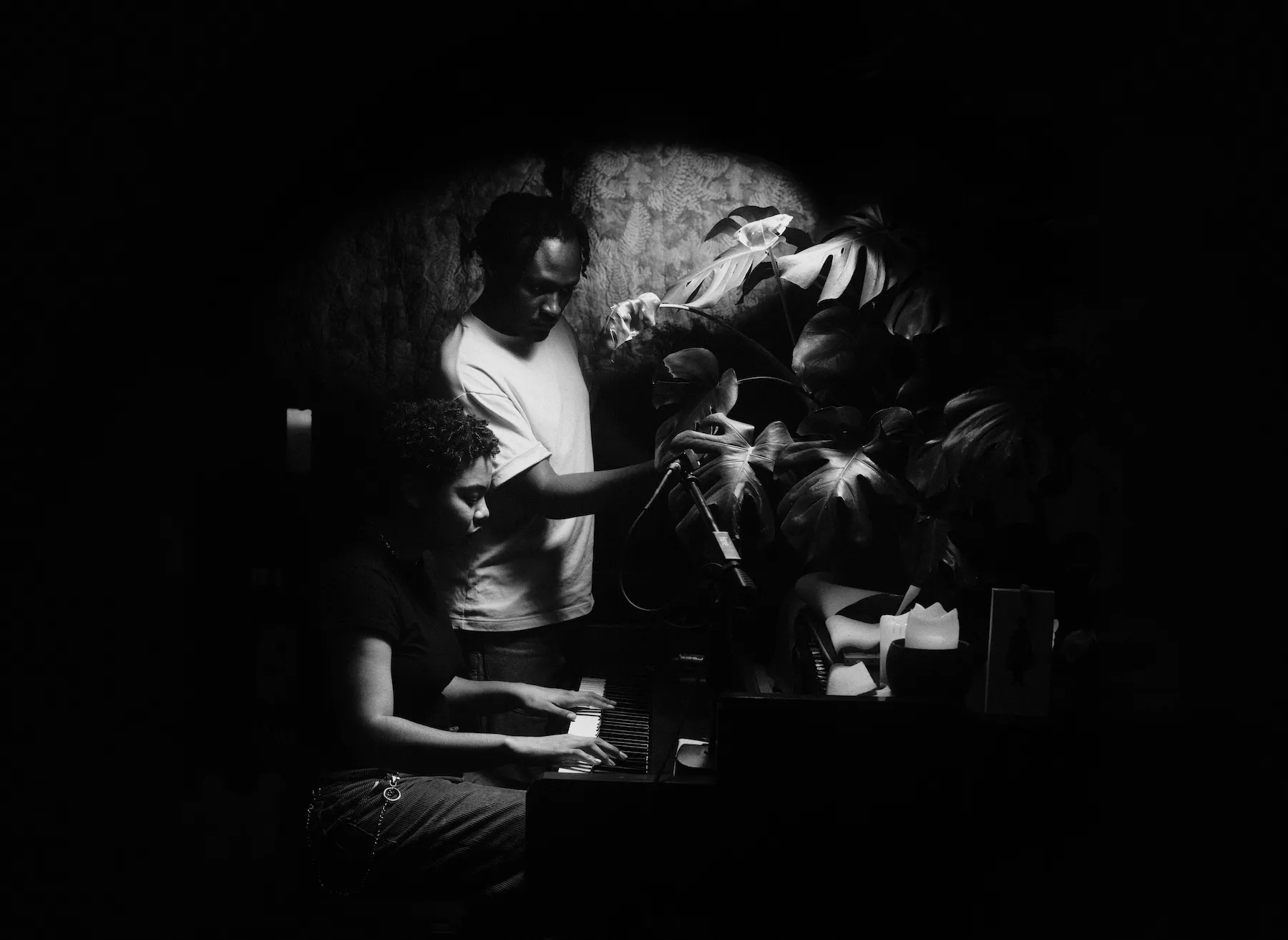
Traditional Noise is destined to be remembered as one of the year’s most breathtakingly beautiful music collections. Dropping today, the album stands as the full‑length debut from April + VISTA. Yet given that the DC duo has been releasing music for nearly ten years, it also serves as a culmination of everything they’ve been building toward. These 11 tracks reward listeners who’ve kept their ears close to the ground, and for newcomers they offer a striking, immersive entrance.
Initially, they toyed with naming it Traditional Noise For Anxious Adults. The idea was for vocalist/composer April George and composer/producer Matthew Thompson (aka VISTA) to seek solace by digging into the sounds of their formative years. But the noise they conjure isn’t strictly traditional, even though there are countless reference points swirling within the album’s blend of orchestral passages, electronic rhythms, and rock textures.
A Moon Shaped Pool-era Radiohead looms large here, alongside Portishead, Broken Bells, alt-J, and other artists from the past whose moody atmospherics meet cinematic strings and thunderous beats. George’s textured phrasing evokes a continuum from Billie Holiday to Adele (imagine her Bond theme having a baby with Radiohead’s rejected Bond theme). In our chat last week, the pair referenced both alt-rock and R&B, calling out European boundary‑husters like Gorillaz and Stereolab, and even the reckless post‑hardcore of At The Drive‑In.
Within this sonic terrain, George’s lyrics touch on archaeology, ancestry, and past selves. In language as vivid as the music, she looks backward to move forward—an odyssey that Traditional Noise realizes in real time. “I ran so fast I left myself behind,” she declares on the late‑album standout “Grotto.” Yet nothing here feels rushed, aside from a possibly brisk runtime that keeps inviting repeat listens. The progressions across the record feel deliberate, earned, and patient.
In our talk, April + VISTA walked track by track through Traditional Noise, detailing the sparks and methods that brought these tracks to life. Below, press play on the album and read the Q&A.
1. Hello — A Soft Opening
The opening piece has its own space. There exists a universe in which this and “Very Bad News” are stitched together. Why split them into separate moments?
MATTHEW THOMPSON: We’ve always liked including interludes on our records. With You Are Here, we began with a quiet interlude that flowed into “Fomo,” so this felt like a natural extension of that idea. These moments aren’t songs per se, but they carry the thread of the narrative and set the mood. “Hello” is one of those storytelling devices.
APRIL GEORGE: It operates like a score. One of our dreams is to compose for a feature film. We’ve done short films here and there, and this is our way of crafting our own mood—letting the listener catch their breath before we crash into “Very Bad News.”
So it’s deliberate: two different dynamics. The intro is hushed and quiet, while the opening blast of “Very Bad News” erupts. We like keeping them separate to heighten the drama.
THOMPSON: We’ve always wanted to make an album that runs longer than ten tracks, so yes—we achieved that goal here. “Hello” began life as a cue for a score I was composing for a short film that ultimately didn’t get made. I’m glad it didn’t, because we found a way to use it ourselves.
How did you frame the sound for this track? Any images or ideas that guided the texture?
GEORGE: We weren’t chasing a single theme, but we did consider how the songs would translate in a live setting. “Hello” grounds the listener and also grounds us. When you hear the word “hello” spoken by multiple voices—the voices of our mothers, sisters, and even my godson when he was little—it evokes people who matter to us. On stage, we use the track as a transition, a way to anchor ourselves and remember the supporters who accompany us. It became a ritual opening and a grounding exercise.
THOMPSON: We like starting with softer, quieter moments before the harder edges hit.
2. Very Bad News — A Blazing Entry
This one really blasts off. There’s a strong bass presence, and the drums hit hard. Where did this song come from?
THOMPSON: It grew out of “Hello.” We began by reworking that opening, and it shifted in a different direction entirely.
GEORGE: We tend to sculpt songs from sonic experiments and unusual ideas. While shaping the elements of “Hello,” I expected it might become a full song, but it instead morphed into something new with “Very Bad News.” I even envisioned a heavier, Sabbath‑like psych edge, and it found that path.
GEORGE: A cool moment in the process was when our studio mate’s old guitar yielded a broken string. Matt suggested recording the string snap, then magnifying it to deliver a monumental “boom.” That tiny event becomes the explosion you hear at the outset of the track. It’s a warped, space‑sliding sound that announces intensity.
The spoken intro—was that a sample or something you created?
THOMPSON: It’s a synthetic voice, like a computer prompt. We sometimes use a little computer voice cue on stage to count our cues; we even type prompts for those moments. For this track, we adopted that device as a sort of infomercial opener for a self‑help book aimed at anxious adults.
GEORGE: It’s our live cue voice, counted in on the fly.
THOMPSON: The central thread of the project was returning to comforting sounds and discovering a sense of security in tradition. We are anxious adults, after all—hence the initial name, Traditional Noise for Anxious Adults, which we shortened simply to Traditional Noise.
In this track you have a memorable lyric. What did you want to evoke as you wrote?
GEORGE: The lyrics reflect a frustration with the rat race and the tension between subsisting in a corporate schedule and chasing a musical dream. My experience working a 9‑to‑5 alongside a lifelong pursuit of music highlighted the disparity and the pressure to conform. I wanted the song to touch on this reality without preaching—an atmospheric commentary that invites listeners to draw their own conclusions.
There’s also a sense of national context—DC’s constant news cycle, personal stories from family and friends about affordability and survival—and a desire to channel these forces into something expansive, not didactic.
3. Do What You Know — Digging Toward the Other Side
The line that really stands out here is “I dug a hole to the other side, had to go lower to reach high.” Can you unpack that?
GEORGE: Absolutely. Do What You Know is among my favorite tracks on the record. It’s a note to my younger self, a reassurance that things improve and that you can chase your dreams. As an adult, you either realize them or come close. It feels like we’re on the brink of something profoundly good.
Growing up, archaeology captured my imagination. The album art—the fossil photograph by Matt—embodies that fixation. I used to collect rocks and insects, and I once dug in myVirginia Beach backyard, below sea level, and found shells and, eventually, an arrowhead that I wore as a necklace. The act of digging—paired with paleontology—tied into the record’s broader themes and helped shape the cover image that sparked the rest of the ideas.
THOMPSON: There’s also a nod to our recent EP Pit Of My Dreams in this track; it’s a twofold reference, with a sense of moving from a hole to a higher place. The beat has a playful, spooky edge, and we kept the drums raw in parts to preserve that vibe. We even kept a few of Foots’s early takes to retain an organic feel.
Anything you want to say about the aesthetics here?
GEORGE: The imagery of digging and discovery runs through the song, plus a visual tie to archaeology—the fossil on the cover—so the track acts as a bridge to those themes. The progression toward the other side also speaks to growth, breaking free from constraints, and leaving behind childhood rituals to embrace a future you control.
THOMPSON: It’s also a wink to our last EP, which helps anchor the record’s trajectory. The beat feels like a return without losing the sense of whimsy that characterizes this project.
Anything more about the mood you aimed for here?
GEORGE: The lyrics evoke a dance between childhood passions and adult ambitions, bounded by a sense of curiosity and resilience. The sonic textures lean toward a dark, whimsical atmosphere that still feels accessible, a balance we chase across the entire album.
4. Two EvergreenS — Quiet Drama, Big Space
I was struck by how dramatic this song feels without a heavy percussion backbone. How did layering and space contribute to its arc?
THOMPSON: One of my favorite starting points is the Moog Subharmonicon. Its bleeps, bloops, and sequences can become a sonic playground. I began with a gentle chord drone for “Two Evergreens” and then stretched it with reverb until a sparse, breathing space emerged. April had preexisting lyrics for an earlier piano version, which felt too good to discard, so I built a new arrangement around that Subharmonicon bed. The goal was to keep the arrangement hushed and spacious, because negative space is as vital to the narrative as any other element.
Yet we still love textures—static and noise find their way in during the middle break to reintroduce tension without being overt. That tension supports the drama without overwhelming the track. We also drew from intimate acoustic traditions—Elis & Tom, bossa nova‑style drama driven by voice and piano or guitar. The dream is to craft something that intimate and quiet could still carry with it a grand emotional weight.
GEORGE: This piece is personal to me. It centers on my grandmother, who passed away as I started college. She’s the reason I pursued music—she bought my first instruments and supported me through it all. The two evergreen trees that stood at her house become a memory anchor: I used to climb them as a child, sticky with sap, and feel safe under her watchful presence. The song honors that guardianship and the sense of safety she represents. It’s also grown with time: my grandfather passed away during this rollout, turning him into another evergreen in my life. So the song became even more meaningful.
THOMPSON: It’s a personal way to articulate memory and loss, and the evergreen imagery keeps evolving with life’s events.
George: That thread of guardianship has become central to how I approach this record—memory, safety, and the people who sustain us.
5. Standing In Place — A Crystalline View
These lyrics conjure a vivid image. When you sing about a “crystalline view,” what exactly are you seeing—water, light, or something else?
GEORGE: The song marks a farewell to a former version of myself. Entering my thirties during the pandemic forced a pause, demanding a transition in life and career. I saw a horizon‑line reflection growing distant as I moved toward who I aspired to become. The sense of fear in that moment is real, but there’s also a comfort in learning to sit with that fear. To grow, I had to leave behind my comfort zone and become someone anew—less shaped by my twenties, more formed by accumulated experience. “Standing In Place” is that pivot—the calmer, braver space on the other side.
THOMPSON: It also nods to ideas explored on our previous work and suggests an ongoing arc of change rather than a fixed state.
Anything you want to share about the music on this track?
GEORGE: The beat leans into a balance of lyric and space, designed to feel like a moment of quiet reflection. It’s about being grounded in the moment while acknowledging the uncertain path ahead.
6. Rot — A Grimy Interlude
We flip to the second side with another interlude. What was the intent here?
THOMPSON: It’s purposeful to begin side B with another interlude. I’m happy the sequence feels symmetrical. “Rot” came from layered sound experiments—often, a lot of the chords originate from an odd loop created with the Subharmonicon, which I then sample and rework. It’s sculpted with pedals, then reinserted into the track to tease out new melodies. We liked its grimy, fuzzy aura and decided to keep it fairly stripped back. I considered adding drums or keys, but the stark, raw vibe won out.
GEORGE: It’s a stripped, pared‑down moment—one that retains the album’s edge without overbuilding it.
THOMPSON: I keep thinking of Pit Of My Dreams when I hear this—Rot feels like a spiritual cousin to that work’s angst and anxiety, a connector piece that sits beside the earlier sample moments we used to open songs like Hello.
GEORGE: The title draws from a graphic novel called Stages Of Rot by Linnea Sterte, which imagines distant futures where a whale‑like alien ecosystem persists after a death that nourishes life around it. I reflected on decay, archaeology, and what we leave behind—this album as a fossil future listeners might discover. Hence the name “Rot.”
7. Bless My Heart — A Riot in a Quiet Frame
We’re amazed by how the track shifts once the beat drops. Was the arrangement built by dropping the groove at a key moment?
THOMPSON: I’ve long wanted to make a track with that riotous, driving kick and snare feel. I found a great drum sound and thought, this could take on a life of its own. Once the four‑to‑the‑floor base is established, adding layers becomes a matter of stacking textures. It’s a fast, almost feral track once that pulse kicks in.
THOMPSON: I also wanted to echo the spirit of Foo Fighters’ “Everlong” in the guitar work toward the end, though I’m no virtuoso, so the result is more of a playful homage than a direct copy. The production nods to classic rock influences while keeping a modern edge.
GEORGE: Tony Kill—our friend and local producer—teams up on the track, bringing a noise‑driven, experimental, rock‑leaning flavor that jostles the mix. Matt believed this should be a Tony Kill record, and once we brought him in, it clicked. Tony’s voice adds a signature layer that elevates the entire piece.
THOMPSON: The finished result feels like a collaboration with a 2018 Tony Kill project; his presence makes the track instantly recognizable as a special piece in the album’s puzzle.
8. Love Unspent — Voices, Choral Depth, and a Little Altered Tone
The vocal texture here is intriguing, with both April and a lowered-pitch timbre. Is that a double pass, or something else?
GEORGE: We use that technique a lot. Matt has a Little AlterBoy plugin—our go‑to for giving a vocal a new dimension, a hint of otherworldly texture. It’s like a dash of hot sauce to sharpen the sound.
THOMPSON: It’s purely a sonic choice; there isn’t a deeper meaning beyond enriching the voice. It helps balance the mix and add depth as April’s voice grows warmer with age. We also invited four friends to join the choir on both “Standing In Place” and “Love Unspent.” Their contributions layered into the vocal fabric here as well.
“Love Unspent” conjures a vivid image—the idea of a dollar bill crumpled in your hand yet never spent. Was that the intention?
GEORGE: Yes, the track carries heavy weight. The pandemic losses of friends inspired a meditation on grief and what that loss means. I’ve come back to a metaphor known as the ball in the box: your body as a container in which grief moves around, initially large and disruptive but gradually more contained as you grow around it. The lyric sits with that image, keeping the weight intact while suggesting that love remains unspent because it’s still alive in memory. The closing line—“I hear your voice rattling inside that box”—cements that idea. Grief stays with you, but so does the love that created it.
THOMPSON: The lyric lands with a final sting that lands in that closing moment.
GEORGE: Thom Yorke is a touchstone here for me—the way he channels grief, anger at systems, and a sense of quiet rage in his writing. His influence helped shape how I approached these lyrics, balancing personal pain with broader concerns. It’s one of my favorite influences and a major driver of the track’s mood.
9. Grotto — Introspection in a Small Room
“Grotto” was the first track we wrote for the project, and it catalyzed the overall sound. We weren’t aiming for solemn perfection, just to see what would happen. Once the foundation clicked, we realized we were crafting the entire album in that mold.
THOMPSON: I got a Christmas gift guitar from April, and this was the first idea I chased on it. It became the seed that grew into the album’s core.
GEORGE: The song is deeply introspective, touching on the same themes as “Standing In Place”—leaving an old self behind as you grow into a new one. It also probes self‑doubt that all creatives wrestle with: the fear that others will limit what you can do. It’s about resisting that pressure and pursuing a broader, believably brave vision for yourself. The line “I ran so fast I left myself behind” remains one of my favorite images from the record.
GEORGE: Thanks. It means a lot to hear that.
10. Modify Your Tradition — Closing the Loop
So we have one last interlude, “Modify Your Tradition.” With the album titled Traditional Noise, this feels like a climactic moment in the arc—am I reading that right?
THOMPSON: It acts as a spiritual echo to another near‑closing instrumental from Pit Of My Dreams. It’s a storytelling device we return to as a way of concluding the journey. The piece originated from another sound experiment we kept returning to because we wanted to develop it, only to realize it spoke more when left in its pure, meditative state. We decided to let it stand as is rather than overproduce it.
GEORGE: The use of the voice here to discuss tradition—these are your own words, a mode of reflection on how tradition shapes us. We’re using this track to explore the tension between comforting, familiar sounds and the impulse to break free from the constraints they can impose. We’re children of MTV and VH1, shaped by the pop and rock staples of the era, but we also recognize tradition as something that can hold us back. Our aim is to honor it while also shaping it into something newer and truer to our identities. The textural palette includes Microsoft Sam’s voice and a quick session with a field recorder—moments of quiet, ordinary life captured to punctuate the mood. It’s not silence, just a different kind of listening.
THOMPSON: It’s a hush, a still pulse, a real‑world counterpoint to the rest of the record.
11. Morning Star — Ending Where We Began
In the closing track, you hear several recurring threads—Rot, burial, and legacy. Is this a summation, or did the sequence demand it?
GEORGE: The place was chosen to feel like a closing arc, even if it wasn’t the final word. Other pieces almost made it onto the record and were trimmed to maintain a cohesive, circular feel that echoes back to the opening number. Some versions of the track include a sharper beat, but we cut it to allow space for breath and memory, creating a clean link back to “Hello.” The song is about ancestry, and in particular the idea of what we leave behind for future generations. As I reflect on Black American history, I think of the suffering endured and the resilience that followed, and I imagine the Morning Star as a symbol of guidance and liberation—both as a weapon and a beacon. The imagery speaks to roots that run deep and a lineage that endures through trauma and triumph alike.
THOMPSON: We chose to keep the production minimal here so the message could carry through. The song’s core is piano and strings, letting the message breathe without distraction.
GEORGE: It felt like a natural close—an ending that circles back to where we began, with a cyclical, reflective vibe. And the winding line about “Roots of the scorned / Oh, they’re buried all the way down” invites deeper listening to a history that’s both ugly and powerful, a history from which we still grow. Morning Star is about heritage, memory, and the lineage that anchors us as we move forward.
THOMPSON: The song’s arc benefits from restraint; too much production would dull the central message. The repetition of themes and the sense of ancestry tie everything together in a neat, cyclical bow.
Traditional Noise is out now via Third & Hayden.