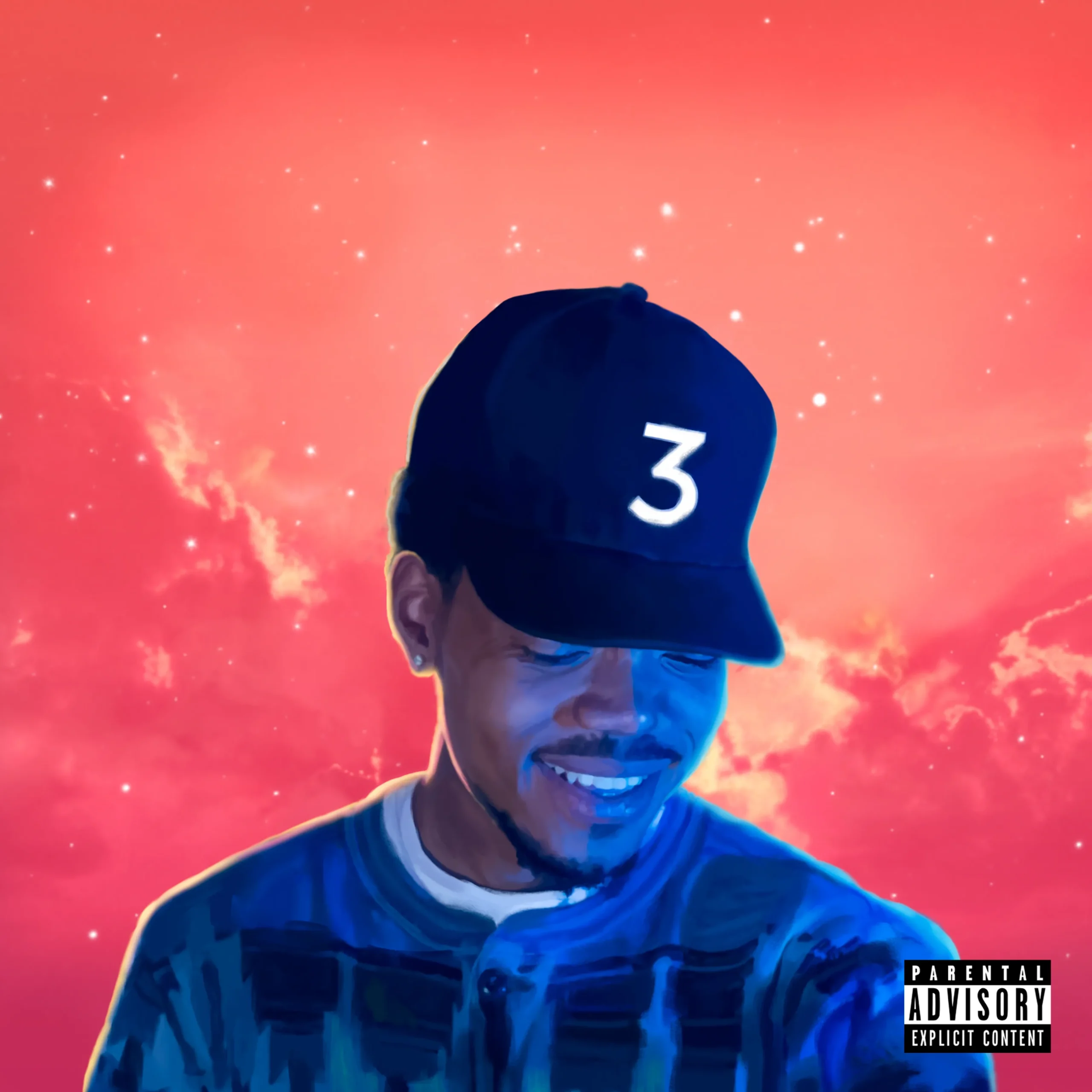
Only a handful of phrases have ever underscored the march of years as clearly as noting that Coloring Book by Chance The Rapper dropped exactly ten years ago today. Indeed, the release happened a decade in the past today. A decade is a substantial span.
Back in 2016, the arrival of the young Chicago hip-hop prodigy’s third mixtape became a cause for collective celebration: the culmination of a long build, a moment of coronation. The world went wild for Chancellor Bennett, and so did I. (He occupied both my #1 and #2 spots for favorite songs of the year.) The praise poured in from critics, but it wasn’t merely music writers celebrating Chance. By the following year, this unsigned rapper had penetrated our most mainstream cultural spaces: sweeping Grammys, a guest appearance on The View, and hosting Saturday Night Live. He seemed to embody a fresh talent with a singular creative vision, a grassroots success story rooted in an authentic community. His joy was contagious, his ascent inspirational. Perhaps he could chart a more hopeful course for the music industry. There was truly no one else like him.
In hindsight, that early enthusiasm now feels a touch misplaced. When his long-awaited, nuptials-themed official debut album The Big Day fizzled in 2019 and his essence became the subject of memes, Chance’s reputation absorbed a blow so loud that I’m not sure he’ll ever fully recover. His decline read like a retroactive stain, so deep that it called into question everything that had come before. Traits that once seemed endearing now felt annoying. The joy that had been infectious turned into something suffocating. The “3” cap, once a symbol of his vibe, now reads awkwardly in retrospect. It took him more than half a decade to bounce back with last year’s Star Line, a sturdy album that reframed him as a durable career artist with a devoted following, far from the superstar glare he once enjoyed.
So what went wrong here? Why were so many of us excited about Chance The Rapper a decade ago, and why do many of those same people now cringe at the memory? Was the hype ever truly deserved? Were we collectively hallucinating, only to be jolted out of it by The Big Day? Or was the backlash an overcorrection? I’d convinced myself that Coloring Book was little more than “No Problem” and a batch of filler, but revisiting the album this week, I found more standout moments than I recalled, from the exuberant, house-inflected “All Night” to the sentimental ballad “Same Drugs.” Chance’s loudest tendencies spawned parodies, yet I’m reminded now of how effective he could be in a restrained, reflective mode, as on “Summer Friends” or “Juke Jam.”
I’m not here today to regale you with tales of Chano’s heyday, but I do think there were legitimate reasons to be excited about him back then. Many of those reasons sit right alongside the flaws on Coloring Book, sometimes interwoven with them. Below, a few thoughts on what drew people to him at the time.
He offered a refreshing surge of air.
As heard on his 2013 breakthrough Acid Rap, Chance emerged as an unusually original talent. Gravitas and a volatile, cartoonish energy seemed to collide within his smoky rasp, fighting for control of his muse like siblings wrestling over a video-game controller, erupting into melodic bursts and rapid-fire onomatopoeia. He used that voice to share harrowing scenes from Chicago’s streets, tender tributes to family love, druggy reveries, and relentless optimism amid life’s unending problems. The backing tracks were largely crafted by his local friends, pulsating with a Chicago-specific energy that fused forward-thinking footwork with bluesy, jazzy, and gospel flavors.
It represented a natural extension of the post-Kanye sound that had been simmering on rap blogs for years, a trajectory that completed the circle by rooting itself in Chicago rather than the internet. In a symbolic moment, Mr. West took Chance under his wing, threading him into the futuristic gospel of his The Life Of Pablo opener “Ultralight Beam” and then popping up on the opening track of Coloring Book, “All We Got,” at a moment when West’s cachet remained high. “Kanye’s best protégé,” Chance rapped near the end of the album. “He ain’t signed me, but he’s proud of me.” That “Ultralight Beam” feature triggered alarms in my brain and sent my endorphins racing. Chance’s momentum was already on the rise. With a show-stealing guest turn on a high-profile project, he had arrived and was teasing a brand-new project that would certainly justify the excitement. You might have found him thrilling, or perhaps he drove you a little crazy, but you could not ignore him. He had the juice.
He signified a final burst of millennial optimism in a period of encroaching darkness.
Many now look back on “Obamacore” with a wary grin—partly because the hopeful visions sagged into broken promises, sour discourse, and the grim realities of our current dystopia, and partly because the era’s unbridled positivity sometimes looked a bit too manufactured. Chance’s stance aligned with that vibe, as a revisited viewing of the ultra-twee “Sunday Candy” video will remind you. But Coloring Book arrived a few years into the Black Lives Matter movement, when the Black joy embodied by Chance and his cohort felt like a necessary antidote to injustice, before the sentiment became a slogan tailored for focus groups among self-important liberals.
The joy on Coloring Book carried a Christian tilt, drawn from long-standing Black church traditions. Whenever music includes religious uplift, some listeners dismiss it as performative pageantry, and a track like “Blessings,” with its theologically charged refrain of “When the praises go up, the blessings come down,” can strike as cheesy if the moment isn’t right. Even at the time, some who had connected with Acid Rap felt misled. (As a Christian myself, though not from within the Black church, I have mixed feelings; lines like “I might give Satan a swirlie” come off as silly, while “Type of worship make Jesus come back a day early” lands as funny in a good way.) Ultimately, how widely that religious euphoria landed depended on the delivery. On a track as dynamic as “Angels,” where those old and new sonic traditions collided in a boisterous fashion, Chance’s approach hit with the force of lightning.
He grew out of a thriving local scene.
When Chance broke through, there was widespread media excitement about his tightly knit, creatively fertile local community. As a teen, he sharpened his craft in an after-school program run by the Chicago Public Library alongside fellow emcees like Vic Mensa, Mick Jenkins, and Saba. Mensa had been part of the teenage band Kids These Days with Nico Segal, who would later lead Chance’s band the Social Experiment under the stage name Donnie Trumpet. Kids These Days also featured future Chicago indie and experimental staples like Macie Stewart and Liam Kazar. Chance, Mensa, and Segal were part of the Savemoney collective, which included rappers like Joey Purp and Towkio. The circle also drew in vibrant talents like Noname and Jamila Woods.
There was an air of potential music emanating from that interconnected scene, with artists appearing on each other’s projects all the time. The features on Coloring Book tell that story well. Chance was on the rise, so the project welcomed superstars like Lil Wayne, Future, Young Thug, and even Justin Bieber. But Chicago-based names were woven in just as frequently: Saba, Jamila Woods, Noname, Towkio. Today, most of those artists have followed their own paths, not unlike how Odd Future members carved out independent trajectories after their blog-era fame. Still, back then it felt like a movement worth chasing, and Chance led the charge, giving these talents their broadest platform yet.
He brought a live band on tour and on disk.
In the 1990s, one surefire way to engage skeptical rock fans with hip-hop was to lean into a live-band setup. I recall a late-’90s CMJ college radio chart where the only hip-hop names among indie rock artists were DJ Shadow and the Roots—hip-hop’s living, breathing alternative to glossy, commercial rap. The ethos that live musicians should take precedence over programmed beats—often called rockism in nerdy music-criticism circles—was echoed by Chance’s backing band, the Social Experiment. Yet by the time they exploded, live-band hip-hop had already fallen out of fashion as tastemakers and hipsters reacted against older notions of authenticity.
For a constellation of reasons discussed in my book—from a digital music revolution that collapsed genre boundaries on iPods and social networks to an explosion of festivals that brought that eclectic blend into physical space, and the rise of poptimism, a belief that all genres deserve a fair shake—many alt-rock listeners who once dismissed mainstream pop and rap began taking those genres far more seriously in the 21st century.
When Chance entered the scene, he arrived amid rap’s blog era, and the indie cultural machinery leaned toward rap and R&B stars like Kanye, Drake, Kendrick, Beyoncé, Solange, Frank Ocean, Future, and Run The Jewels. There was a pipeline for Black-rooted artists to cross into a largely white audience, but that path also created tension. Some listeners wondered whether the crossover helped or harmed the art. If navigated thoughtfully, it could expand a fan base into a broad, diverse coalition.
That’s how Chance functioned for a while. He drew supporters from radically different cultural backgrounds and value systems. Chicago’s rap had already exploded with drill, a stark subgenre tied to the city’s street life. At the same time, Chance’s crew was all about community development and generosity. He consistently resisted portraying the drill world as the sole bad guy—he even shouted out Chief Keef on Acid Rap—but public perception often painted him against the drill scene. For some listeners, drill signified all that was wrong with rap, while Chance’s circle stood for its best potential. In effect, he benefited from poptimism and rockism at once.
He was stubbornly independent.
Another facet of Chance’s ascent that made idealistic music fans’ spidey senses tingle was his unwavering choice not to sign with a major label. “If one more label try to stop me / There’s gon’ be some dread-head n****s in their lobby,” he boasted on the triumphant, menacing “No Problem,” a track that complicated any effort to separate him from Chicago’s rougher corners. Chance rose during a era when many rappers built buzz with a sequence of free-download mixtapes—the kind where artists would rap over other people’s hits, while others gathered original beats—but that same path often collapsed after a label deal.
Chance appeared determined to stay in his mixtape world indefinitely and to sustain a career outside the often predatory label system. “Am I the only one who still care about mixtapes?” he wondered on his collaboration with Young Thug and Lil Yachty, two artists cut from the same DatPiff cloth. This made him an inspirational beacon for those who dreamed of self-directed routes to lasting stardom. Though he wasn’t strictly underground anymore, perhaps he could demonstrate how to scale up without compromising ethos.
Yet the streaming era was dawning, and the business beneath rap was shifting. Drake’s If You’re Reading This It’s Too Late was marketed as a mixtape but released directly to streaming services in 2015, and it felt like a new Drake album to many. The same could be said for Young Thug’s Barter 6, a complete artistic statement in 2010s rap. The line between albums and mixtapes was blurring. While Acid Rap, another auteur-driven gem that played like an album, had appeared on free mixtape sites, Coloring Book functioned as a commercial release released on DSPs as if it were an album, even as Chance maintained it was a mixtape.
This raised questions about industry machinations. Back then, there was a great deal of hand-wringing about which releases could chart and which could be eligible for awards; note Chance’s own lines on Ultralight Beam, “He said, ‘Let’s do a good ass job with Chance 3’/ I hear you gotta sell it to snatch the Grammy/ Let’s make it so free and the bars so hard/ That
Clara Weiss
I write about music as a cultural signal, following the artists, scenes, releases, and movements that shape how people listen today. My work focuses on discovery, context, and the stories behind the sounds that travel beyond borders.