Friday night marked the Club 2 Club Festival’s second straight appearance in New York, continuing its presence for another year. Born in Turin in 2002, the festival expanded into North America with a one-day takeover at Knockdown Center in Queens last spring, and it returned to the same venue this year as C2C gears up for the 25th anniversary of its flagship Italian edition this fall.
C2C presents itself as a platform for both established tastemakers and rising critical darlings within the world of experimental pop and club music. These genre labels are inherently slippery—as many are, in truth—yet the festival’s use of flexible terms like avant-pop prevents the lineup from feeling vague or disjointed. Instead, it gives the event a sense of curated breadth. And while I admit bias, I’ll take a festival that feels a bit like a gathering for music writers’ summer camp over a festival shaped by influencer culture, which seems to be the default mood of many high-budget modern tours.
Titanic—an improvised Guatemala-Guatemala? collaboration between vocalist-cellist Mabe Fratti and guitarist I. La Catolica—has never felt like club music in any traditional sense. Yet when I reached their opening slot of the night, the air was hazy and dusky, the patio’s concrete floor pulsing with a muscular chamber-rock ambience, all under violet lighting that gave the scene a dreamlike glow.
Technically, I wasn’t new to C2C that day. Earlier, I’d wandered into Brooklyn’s Lot Radio, where the festival had taken over the airwaves with DJ sets from several lineup artists. But by the time I arrived, the Lot felt unusually quiet—likely because a nearby pop-up underscore DJ set was about to start a few L train stops away—so I bailed on the Lot and saved the rest for the evening.
By the time I found myself at the barricade of Knockdown’s outdoor “ruins” stage—so named for the partially sheltered concrete slabs encircling it—the sky had grown darker. I was struck by the scale of Titanic’s live sound, how tracks from Hagen—an album that’s dense and stacked—unraveled live, burning harder than their already thrilling studio versions. Fratti’s voice soared, bouncing around the ruins, and her cello’s fingerpicked lines shifted with percussion-like precision. On performances of “Lágrima del sol” and “Gotera,” the blend of Fratti’s strings with I. La Catolica’s guitar found a way to worm into the listener’s chest, leaving a lasting ache.
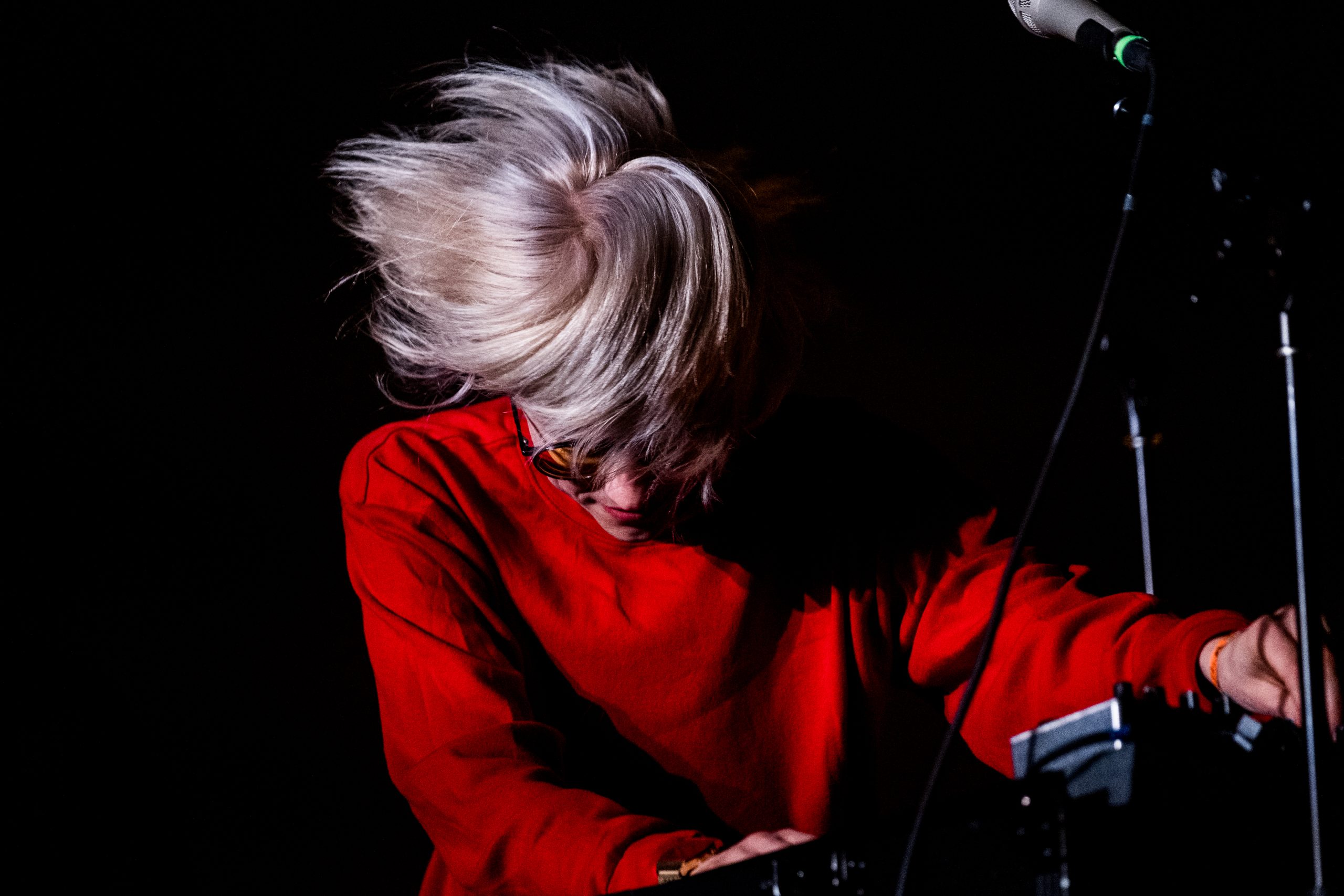
Elias Rønnenfelt’s set followed. I’ve enjoyed the Danish artist’s solo work—especially his 2023 album Speak Daggers and the Dean Blunt–and-Vegyn-produced single “tears on his rings and chains”—but I’ve long preferred his work with Iceage, and assumed a post-Iceage performance might lean toward restraint. I was happily proven wrong. Nearly every track from Rønnenfelt’s discography—more woozy and folksy in studio form than Iceage’s punch—transformed on stage into 1.5x speed delights, delivering wild versions of “USA Baby,” “Mona Lisa,” and “Blunt Force Trauma.” Regardless of collaboration, his stage presence remains manic, tactile, and unpredictable, with a voice and guitar that crackle like sparks from a fire, never taking the same shape twice.
Local noise-punk duo YHWH Nailgun concluded the outdoor stage with an 11-minute set—yes, truly eleven minutes. I’d ducked into Knockdown Center’s “Champagne Room” for a moment to savor a closing drink, recalled a tip about YHWH’s tight micro-set, and rushed back to the ruins to hear nearly a ten-minute blast of entirely new material. The new material felt more punishing and arrhythmic than 2025’s 45 Pounds, a record I hold dear for pushing the boundaries of how danceable a track can be and what constitutes a hook. In performance, YHWH move with an uncanny cohesion, a blend of cacophony and order that only comes from extreme precision. When Zach Borzone and the group wrapped, whispers in the crowd wondered aloud if they’d return for an encore with older material. There was no encore, and when they said 11 minutes, they meant an exact 11 minutes.
Measuring the clock by wandering the inner courtyard and catching up with friends—yet again a reminder of the critics’ summer camp vibe—meant I nearly missed Avalon Emerson’s set, a pity since the New York-based singer-songwriter, producer, and DJ’s latest release Written Into Changes stands as a lovely, earthy dreampop record. Still, I found myself at the barricade for Los Thuthanaka, the sibling duo of Chuquimamani Condori and Joshua Chuquimia-Crampton, who became one of 2025’s most striking outliers and critical breakthroughs with their self-titled, unmastered LP.
I’d caught Los Thuthanaka live at the end of the previous year, which had cemented their mystique for me. There’s something ineffably time-agnostic about their sound: how do you explain what it’s like for an hour, a day, or a month to drift by? Each time I’ve seen them, they seem to loop the same motif—an identical riff—yet in the repetition, everything shifts. It’s music that lulls you into a trance and makes you wonder how you arrived so close to where you started.
Before C2C, Nourished by Time first caught my ear nearly three years ago at Pitchfork’s now-defunct festival, when Marcus Brown released Erotic Probiotic 2 in 2023. Opening a festival set in mid-afternoon, it felt quaint and a touch vintage, yet hinted at the artist’s rising trajectory. I pictured a future where he would close the shows. Fast-forward to the Knockdown Center’s midnight hour, and his retro-futuristic R&B filled the vast space, scattering glitter over the crowd like disco-ball confetti. He kicked off with the explosive one-two of “Automatic Love” and “Idiot In The Park,” two of my favorites from last year’s The Passionate Ones. Yet the defining moment for me was “Shed That Fear,” the track that first drew me to Brown. Its chorus and thunderous bass sounded as if emanating from a speaker buried inside my own head; closing my eyes would turn the room into a giant, brain-shaking silent disco.
Leaving the high of Nourished By Time’s passage felt like the night’s gravity pulling harder. It was well past midnight, and I’d spent the better part of a dozen hours on my feet, fueled by adrenaline, peach-grapefruit tequila-Red Bulls, and a friend’s vape that had cost $20 at the bathroom attendant’s stall and tasted like a watermelon Jolly Rancher disemboweled into your mouth. Dying on my feet but determined, I pushed toward Arca’s headlining set. Her instrumental intro stretched nearly as long as YHWH Nailgun’s entire show—basslines bending and buckling through the room like a brewing thunderstorm. It was a commanding prelude for the Venezuelan pioneer of experimental electronic music, whose stage presence was as captivating as I’d anticipated.
“Good evening, Nueva York!” she exclaimed, perhaps with a sly wink. “I love you guys, have fun!” At that cue, the lights dimmed and purple beacons dotted the space while a gnarly, textured rhythm cut through the crowd. Arca’s set demonstrated the festival’s flexibility, moving from an “abandoned factory rave” mood to a “bat cave fashion week” vibe, and even to a “haunted house at the club” sensation. It served as a microcosm of C2C’s broader aesthetic—proof that pop can be reshaped into virtually any form.