Early in last Saturday’s brief reunion of rap deities, a poised Black woman once again rescued me from my own excess. Or, more precisely, from about nine Espolon shots and a rush of fanboy euphoria. Moments earlier, Eminem had stepped out from the dim recesses of a Yankee Stadium tunnel to join Jay-Z for a rendition of “Renegade” at HOV’s Blueprint 25th anniversary show, and I had my iPhone 15 out, ready to capture the moment. Or so I believed. I rapped along to Slim Shady’s verse for roughly thirteen seconds before she tapped my shoulder with a mission-critical instruction: “Press record.”
I did, and even among the roughly 50,000 fans belting along with me, I could hear my own voice shouting “renegade” in the four-minute clip. It was a peak level of stan energy I wasn’t sure I still possessed. But there I was, watching the man who literally coined “Stan” perform beside the guy who told me to brush my shoulders off. It was their collaboration, yet they were performing my childhood, so for a moment, it seemed inevitable to regress into it.
That sense of time travel washed over the entire stadium; the miniature helicopter HOV had sent skimming across the skyline would have captured entire blocks of navy Yankee caps if it had a camera. When the track came out twenty-five years ago, The Blueprint was music for YNs. Now it’s music for the Uncs—and the Uncs who became grandpas. Maybe, after last weekend, some YNs too. On the second night of three record-breaking Yankee Stadium performances, HOV delivered an album that’s only grown more pertinent, even as the world around it has moved beyond the era that spawned it.
As sentimental as it was precise, HOV’s set transformed fan service into a carefully crafted art form. Some of that magic lay in turning compromises into opportunities. Obviously he can’t go around performing “Takeover” after burying the Nas feud two decades ago—especially after having Mr. Escobar onstage with him the night before, celebrating 30 years of his debut album Reasonable Doubt. But he can stage the “Takeover” instrumental before performing “The Ruler’s Back” and have its namesake, Slick Rick, come out to rap “La Di Da Di” two minutes later. After Kanye’s remarks about his twins, there was no way HOV would allow his “Niggas in Paris” verse to blast through the stadium speakers—so HOV simply spit his “Big Pimpin’” verse instead.
When HOV wasn’t dodging and weaving around broken or rebuilt bridges, he was strengthening and extending the existing ones. Having Em join to perform “Renegade” was already extraordinary, but having him run through “Lose Yourself” moments later felt like watching LeBron James pull off a between-the-legs dunk from the free-throw line. I nearly found myself thinking, “He’s still got it,” even though Slim Shady hasn’t released a strong album in roughly 17 years. That detail didn’t matter in the moment. For an instant, it was 2001 again.
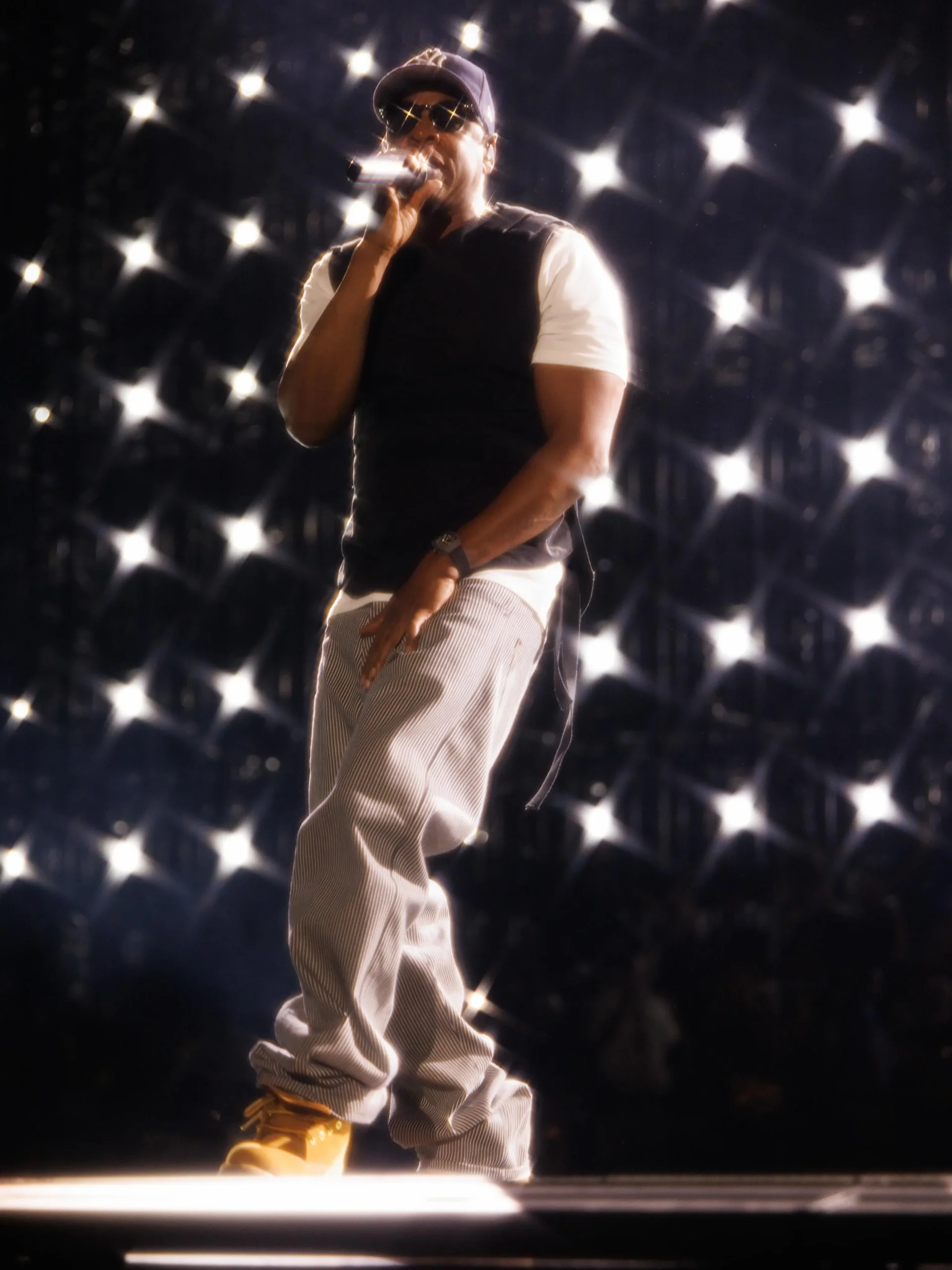
HOV himself seemed like Young Hov, too. At 56, his vocal stamina still largely keeps pace with his rapid-fire delivery; he occasionally skipped the final word of a bar as his cadence settled on the last syllables, but that was a trait I’d noticed when I last saw Kendrick Lamar, a much younger artist, a little over a year prior. Aesthetically, HOV’s bulletproof vest and newly revealed low-cut Caesar cut gave him all the aura of 1988 Michael Jordan. Striding beneath the royal blue stage lights, it appeared as if he were rapping inside a shifting prism framed by his own album cover. In the universe of Jay-Z 25, the era itself shifted—from something generations enjoyed on their own to something communal. In 2026, finding common ground is tough, but by the moment Jay-Z let the crowd finish a bar at the end of “Song Cry,” it was clear one thing everyone could agree on: you never, under any circumstances, get a man back like that.
In most cases, you don’t get live production like that, either. Backed by a ten-piece band and an eighteen-person string ensemble, HOV’s Blueprint carried the refined maximalism of a Super Bowl halftime show staged in a cathedral. With gleaming piano keys shimmering behind his vocals, Jay-Z and his crew truly reproduced a “Song Cry,” and the bursts of tropical percussion on “All I Need” made it sound like a safari performance mid-song. Twenty-five years ago, his show for the album appeared on MTV Unplugged. This time, everything was plugged in.
By the time HOV reached the still-serene “Never Change,” it felt as if some things truly never would change. Cynically and cosmically speaking, that may be true. But literally, they already had. On the day the album dropped, the World Trade Center towers fell. In that moment, HOV took action, reportedly donating $1 from every ticket sold on his Blueprint tour. These days, he might leave it to one of his foundations. He has plenty of them.
On “U Don’t Know,” HOV declares he’s “raping Def Jam” until he becomes the “hundred million man.” By 2026, he’s long since parted ways with the famed label, and Forbes tallies his net worth at $2.8 billion. He stands as the richest musician on the planet, a far cry from the hustler he was three decades ago.
Wherever in Brooklyn he claims to be standing for “Renegade,” it could be a Sweetgreen or a Chipotle. If it’s near the place that became Atlantic Yards, it might be part of the Barclays Center, the arena whose launch HOV helped facilitate by lending his image—an era-defining move that displaced hundreds of longtime residents. Since then, he’s kept riding a seesaw of ambitions and perceptions—sometimes aligned with the lyrics of The Blueprint, sometimes at odds with them.
Fourteen years after vowing to “overcharge niggas for underpaying rap artists,” HOV helped acquire TIDAL, presenting it as a channel to secure fairer profits for artists. After several prominent voices claimed he’d done little to reach that goal, he sold it for $302 million just six years later. Eighteen years after bragging that he represented the seat Rosa Parks occupied, HOV dismissed Kaepernick’s National Anthem protest as outdated and joined forces with the NFL to lead its Super Bowl Halftime Show programming, with the league’s teams effectively blackballing Kaepernick.
Between chasing the goal of Super Saiyan wealth, he’s carved out time for more philanthropic instincts too. Months after helping Meek Mill secure release from prison and an overly punitive probation cycle, he co-founded REFORM Alliance, a group dedicated to criminal-justice reform. In relation to New York, the organization helped pass legislation that limited jail time for technical parole violations. Through his Team ROC initiative, he’s helped expose corruption at a notorious Mississippi prison.
In a tone-deaf yet deliberately provocative early freestyle during the Reasonable Doubt show, Jay was quick to name-drop Kaepernick while nodding to his own long record of charity. The jab responded to criticism over a new Target vinyl deal he signed even as Black activists and customers protested the brand for rolling back DEI initiatives. The fact that he felt compelled to respond is as telling as the actions that started the controversy in the first place. As he rapped on “The Ruler’s Back”: “Plus HOV don’t run, HOV stand and fight/ HOV a soldier, HOV been fighting all his life.” But these battles have evolved since then.
Today, instead of facing assault charges, he’s confronted with accusations of selling out. Instead of being mocked by peers, he finds himself criticized by global leaders. Instead of knives and guns, he wields lawyers and organizations. And his pen remains a constant. That part hasn’t changed.
He’s no longer merely a rags-to-riches narrative; he wields the power to influence the entire nation. As he stumbles and forges ahead, HOV will be judged by a standard that hasn’t even been drafted yet. It hasn’t existed because he’s the one crafting it. The framework revolves around embodying an older era while standing as the most influential force in the new one.
Jay-Z rose to fame during a moment that celebrated Black capitalism. That was a period that seemed to align with him calling himself “the voice of the young people.” Yet to many, he now sounds like the voice of the elders, many of whom were young when The Blueprint dropped. Like the Uncs and former YNs and current grandpas, HOV has evolved. And the world around him—New York in particular—has evolved as much as he has. Listening to “Never Change” for a moment, I remembered that he’s the one who helped sculpt it.
COLD AS ICE
Rick Ross & Jeezy – “Maybach Music VII” (Feat. Don Toliver)
I’ve been tapped out on Ross for a while, but this one’s a worthy sequel in the Maybach Music saga. Props to Don Toliver.
Fat Joe & Stove God & Jadakiss – “The Aroma”
It takes a lot to get me listening to Fat Joe these days, and Jadakiss’ response to 38 Spesh was always part of the draw.
Fergie Baby – “Many Men”
Fergie Baby is basically sprinting through every early- to mid-2000s stereotype in the book, and I’m not mad about it. The Knicks just clinched the chip, we’re riding off HOV weekend at Yankee Stadium, and honestly, he’s just genuinely proud to rep Harlem. Why do I vibe with him? He’s not trying to play any role other than the music he grew up on. No forced experimentation, no fake drill, none of that. Just hard bars over hard-beat energy for rhymers who aren’t ashamed to rep NYC.
Loe Shimmy – “Bag Rite”
Listen, Loe Shimmy isn’t letting up after the Drake co-sign, and I’m here for it. “Bag Rite” sits on a chic beat that could’ve carried Don Toliver himself. But Shimmy’s hushed, staccato murmurs fit perfectly with it.
Future – “One Two”
Yes, the Freddy Krueger motif is a bit goofy. No, that doesn’t stop me from mouthing Future’s version of it while I’m washing a massive pile of dishes.
Juicy J & Project Pat – “Tap” (Feat. Karrahbooo)
If I hadn’t ended up writing about HOV, I’d probably go in-depth on Dem Goats, the Juicy J & Project Pat project that truly lives up to its name. This track with Karrahbooo is one of my favorites, though the list shifts a bit from day to day.
Rome Streetz – “’95 Mega On Shrooms” (Feat. Styles P)
1. The title nails it. 2. The beat sounds like a midnight city-refuse compounder. 3. Styles P goes feral here. 4. Rome Streetz’s entire new project is as sharp, vivid, and witty as he is.
La Reezy – “Gold Chains”
I spoke with La Reezy for 2026 XXL Freshman this year. He’s a genuinely nice guy with some intriguing music, too. It can lean didactic, but he crafts his lines with sharp syntax without getting in the way of the beat, and there’s a natural, New Orleans-influenced melody to his flow that makes each line a touch musical.
Ken Carson – “Shadeson” (Feat. 2Hollis)
Gotta admit, a Ken Carson project entirely produced by 2Hollis might be my favorite, and the track’s beat is menacing, stylish, and somehow muted, creating a cool push-pull with Carson’s sharp bars and metallic tones.
Rylo Rodriguez – “Low Top Vanz”
I’m sorry Gucci Mane, but that line about “Saw a fit in Gucci, and I kidnapped it” is the funniest bar I heard all year, and Rylo is a wild man. Also, S.K.A.T.E.: solid album. Tap in with Rylo if you haven’t. He sounds sleepy, but his bars are brighter than a popsicle box.