If the 2026 summer concert circuit in the United States has a unifying thread, it could be described as blue‑dot fever. Tour schedules are being canceled with alarming frequency, while other performances fail to attract the expected crowds. There are many hypotheses about why this fever is sweeping the scene, but the obvious truth remains: live music is pricey. A Pollstar analysis revealed that the average price for the top 100 global tours climbed by 37.2% from 2019 to 2025.
Beyond the ticket price, the side costs of going to a show accumulate quickly. For instance, a parking pass for a single event at my nearby Blossom Music Center can dwarf the cost of the concert ticket itself. (Indeed, the upcoming Motley Crue show’s reserved VIP parking runs $275 per car, while lawn seating can be had for $24.75 in a “Summer Of Live 4-Pack” offer.) Add potential weather woes, wildfire smoke, scorching heat, high fuel prices, rude attendees, and restrictive bag rules—and it’s easy to see why staying home can feel preferable.
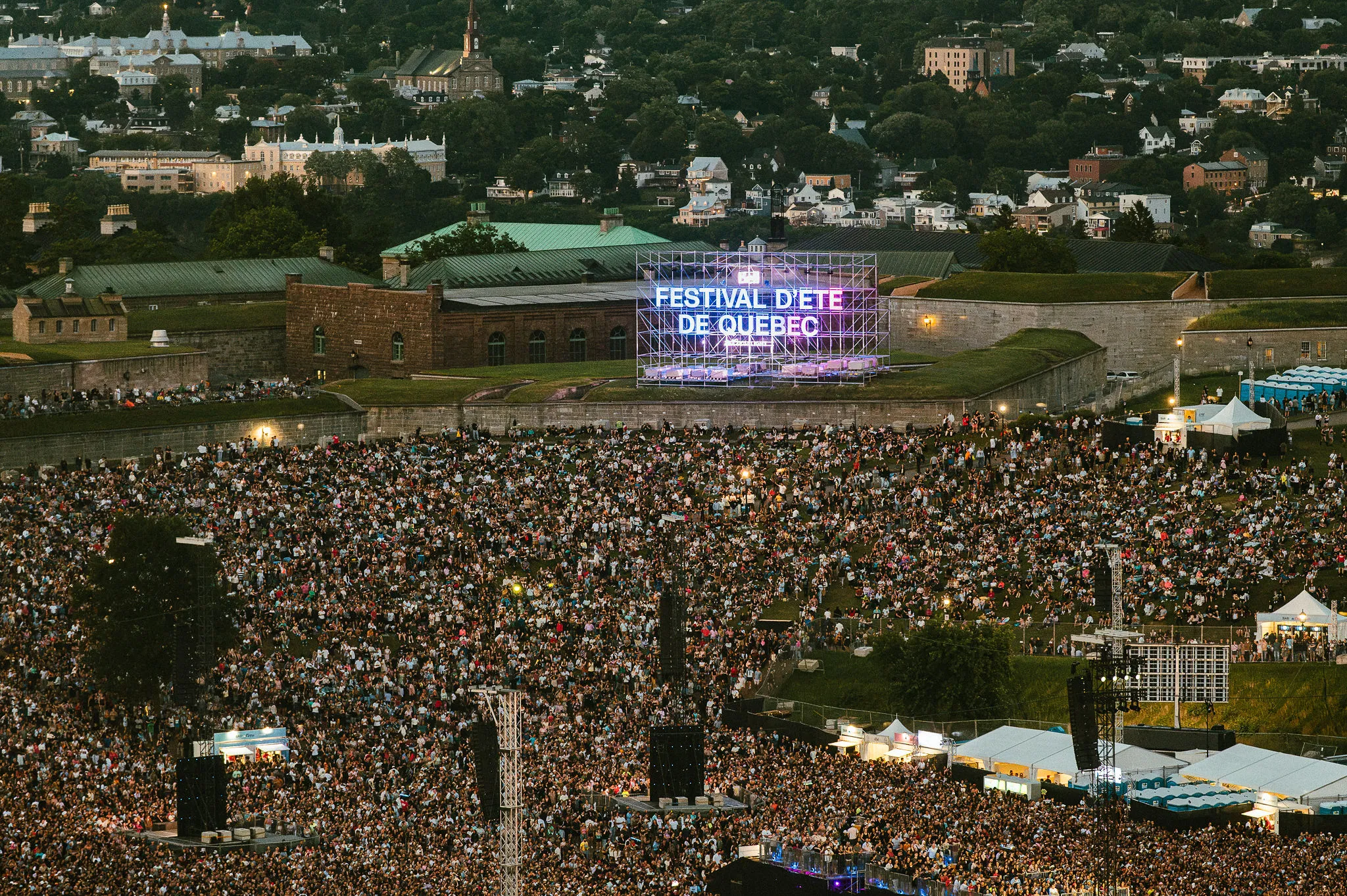
Against this backdrop, spending three days at the Festival d’été de Québec (FEQ) in Quebec City was incredibly rejuvenating: a completely pleasant experience from start to finish—no obnoxiousness, no disappointments, no irritations. Founded in 1968 (older than Glastonbury by a year), FEQ has grown into Canada’s largest outdoor festival, offering more than 150 performances spread across six stages over 11 nights. Its past lineups read like a who’s who of global stars, including the Rolling Stones, Beck, Lorde, Lady Gaga, Lana Del Rey, Rush, and Iron Maiden, all of whom have graced its stages.
Honestly, I’m not built for all-day, multi-day festival marathons anymore. I enjoyed Lollapalooza and the Vans Warped Tour in the 2000s and 2010s, along with other now-defunct regional festivals and one‑offs like Vegoose or Matador at 21. But FEQ makes it simple to switch between areas or take meaningful breaks, since its stages are embedded within Quebec City itself in a compact footprint. Remarkably, the sound from one stage doesn’t bleed into another, and the Bell Stage—an enormous space that usually hosts main‑stage acts—can accommodate around 100,000 people without you realizing it unless you step onto the grounds.
The FEQ program also starts music a bit earlier in the evening, which makes navigating the festival far more manageable—more like attending a single concert than enduring a lengthy festival saga—and the weather during my visit was cool enough to wear jeans and a sweatshirt. Quebec City itself proved to be stunning and laid-back, while the festival’s food offerings were a delight: savoring a warm brie-and-jam sandwich or a plate of poutine between sets felt almost decadent.
FEQ is notably affordable: a general admission pass that grants access to all 11 nights of programming was a mere 180 Canadian dollars (roughly $129 USD).
And FEQ is wonderfully customizable. If you crave the spectacle of a blockbuster show, you can stake out by the Bell Stage. If a quieter, more stationary evening appeals, you can settle near the Sirius XM and Loto-Québec stages, where performances rotate in quick succession. Each other stage has its own mood and character, with nightly lineups often leaning into a specific genre—metal, punk, indie, world music, or hip-hop. The festival’s programming is superbly curated, balancing established acts like Billy Bragg, Testament, and Basia Bulat with rising talents such as the buzzy electro outfit Haute & Freddy.
As expected, FEQ highlights Canadian artists. On the Bell Stage, before Gwen Stefani’s set, Jessie Reyez—who hails from Toronto—delivered a compelling hour-long performance that showcased her range and charisma. She framed her set as a “no shame zone,” encouraging everyone to be themselves and promising to deliver “good vibrations.”
Mission accomplished: backed by a tight live outfit, she delivered tracks spanning hip-hop, R&B, dancehall, and pop. Standouts included honeyed vocal trills reminiscent of Ariana Grande on “Coffin,” a folk-leaning “Forever” delivered from a stool with an acoustic guitar, a rock‑tinged take on “Ridin’” that finished with an intense headbang, and an original rendition of “One Kiss,” a hit she wrote that was later recorded by Dua Lipa and Calvin Harris.
Reyez also connected with the audience as if they were old friends, asking, “Who here made it out of the friend zone?” before singling out a couple in the front row for a dedication. On multiple occasions she stepped off the stage to greet fans in the front rows who were reacting emotionally to the music, making for a touching moment of closeness.
Vancouver’s Mother Mother, who briefly gained U.S. attention with their viral hit “Hayloft,” also impressed as the opening act for Muse on the Bell Stage a few evenings later. The band blends grunge with folk-rock and indie propulsion, with the siblings Ryan and Molly Guldemond and keyboardist Jasmin Parkin providing a three‑part vocal dynamic that lets songs like the tender “Ghosting” and the evocative “Oh Ana” stretch their legs. Their set also included covers of Nirvana’s “In Bloom” and Pixies’ “Where Is My Mind,” which set up the explosive closing “Hayloft II” with booming synths and prog flourishes.
The smaller stages offered a more intimate vibe. On the SiriusXM stage, the Montreal quartet No Joy delivered a remarkable performance to a small crowd, their stage decked with stuffed butterflies and inflatable decorations while they tore through churning shoegaze and grimy dream-pop, anchored by My Bloody Valentine-esque fuzz on “Here Tarot Lies” and the synth‑driven “Four.” Other moments evoked a decaying antique music box or paired quirky keyboard textures with thick, dark grooves.
On another day, a brief early-evening rain did not deter Ontario’s Billianne, a rising folk‑pop singer-songwriter whose 2025 album Modes of Transportation is a quietly luminous coming‑of‑age collection. Her set featured “Save Me” as a highlight of her quiet power. She was followed by Ottawa native Leif Vollebekk, a Juno‑nominated folk‑rock artist whose music hints at smoky soul and blues.
Vollebekk offered a few Bruce Hornsby-esque touches (in a good way) on “Elegy,” buoyed by glassy piano and grooves; “Elijah Rose” showcased expressive guitar work and jazzy drumming; and “False‑Hearted Lover” drifted into a calm, easy vibe. The set concluded with “Hot Tears,” pairing subtle Oasis‑like lyricism with a cathartic finish in which Vollebekk alternated between piano and guitar before laying down a raw, bluesy riffing storm.
Australia’s Dope Lemon took the stage while the sun still hung in the sky, a counterintuitive setting for their dark, hypnotic tone and roguish vibe. Led by Angus Stone and wearing black cowboy hats, the project leaned into gothic-psych rock with a desert‑cowboy edge, thick with ominous harmonica, distorted vocals, and thunderous guitars—though the mood was tempered by playful dancers in oversized lemon costumes who crept around the stage as they played.
Another standout for me was Faux Real, a charmingly deadpan French electro duo consisting of brothers Elliott and Virgile Arndt. In truth, they resembled Sparks with more elaborate choreography: sporting matching all-white outfits with oversized pants beneath ruffled minis and midriff-baring tops, the pair performed exaggerated, synchronized dance moves and even included an occasional flute solo from Elliott. Faux Real’s music was serious and meticulously performed, evoking Hot Chip and Chromeo. Their new single “One & Done” feels like a retro electroclash throwback.
Although the Bell Stage is colossal, the overall atmosphere across the three nights remained unexpectedly relaxed, even with a megastar like Kesha closing the Wednesday lineup on July 15.
The key to enjoying her current tour, The Freedom Tour, is recognizing that she isn’t chasing the hit parade in the same way as before. Having parted ways with Dr. Luke’s Kemosabe Records, she has spent the past few years rebuilding her artistry and reclaiming her catalog, sometimes by reimagining older songs. Her concerts reflect who she is today rather than who she used to be.
While this approach occasionally tempered the momentum, the standout moments were a testament to her maturity as an artist. The country-tinged “Timber” was reworked with glimmering synths and trap-influenced beats, while “Blow” unfolded at a slower, more ominous tempo. The set opened decisively with “TiK ToK,” delivering immediate catharsis. Wearing enormous angel wings, Kesha declared a stance against abusive men and invited thousands of fans to hurl their middle fingers in the air for the song’s new opening line: “Wake up in the morning like fuck P. Diddy.”
In performance terms, the night’s stream of messages resembled Lady Gaga’s Mayhem Ball: highly choreographed, visually stylized, and saturated with deliberate imagery. For Kesha, that included a Ram Dass interlude and theatrical bits; at one point she even pretended to slash her dancers with a prop knife during “Cannibal” and embraced sexual empowerment on “Sleazy.” Beyond the provocative visuals, the evening underscored a bold message: individuality and perseverance in the face of ridicule are worthy and powerful. She joined forces with her dancers for graceful moves signaling solidarity during “Crazy Kids” and radiated joy during the anthems “We R Who We R” and “Warrior.”
Opening for her was Shaggy, the reggae icon who delivered a crowd-pleasing, lighthearted set. He playfully enumerated all the reasons he didn’t come to Quebec—weed, food, weather—and concluded with a cheerful confession: “I came to Quebec for the women!” His hits, including “It Wasn’t Me” and “Angel,” drew hearty responses, while a cover of Bill Withers’ “Ain’t No Sunshine” demonstrated a more serious side.
Gwen Stefani spent the weeks preceding FEQ performing with No Doubt at the Sphere; her solo show on Thursday marked her first full-length solo outing since December. True to form, Stefani appeared as if she had traveled straight from Las Vegas to the Quebec stage, wearing a No Doubt‑esque black-and-yellow plaid ensemble with two-tone hair that recalled Berlin’s Terri Nunn in the “No More Words” clip.
Strategically, her solo set also spotlighted many No Doubt classics and fan favorites, all delivered with the characteristic ska‑pop energy of a first‑rate live band that included a brass section and the contributions of guitarist Liso Lee and bassist Kyla Wright. Highlights included the turbocharged “Sunday Morning,” a passionate take on “It’s My Life” (the Talk Talk cover), and the elastic “Hella Good.” She also stuck to her best-known pop solo hits, led by the glittery “The Sweet Escape,” the unforgettable “Hollaback Girl,” and the sharper “Wind It Up” and “What You Waiting For?” One notable exception was the inclusion of her 2024 single “Somebody Else’s,” which came across surprisingly well in a louder, punchier new wave arrangement.
If there’s a critique, it’s that her stage banter felt a little hollow at times; for instance, a quip about not performing No Doubt’s 2000 track “Ex-Girlfriend” landed awkwardly rather than warmly. And when she brought a wide-eyed, grateful fan onstage for a hug—who wore a Blondie shirt and held a sign that quoted “Hollaback Girl”—the moment of farewell back to the crowd felt a touch rushed.
Ultimately, Muse’s Friday night headlining set left the strongest impression on me. Fans familiar with the U.K. trio know how theatrically ambitious their live performances are, and this night was no exception: a bold rock show that fused prog excess with the pulsating energy of electronic music, all while addressing themes of resistance against dystopian forces and the allure of space-age possibilities.
“Madness” veered Kraftwerk-like, while “Uprising” sounded more intricate—perhaps even more so than in its original iteration. The epic “Knights Of Cydonia” remained staggering: introduced this time by Ennio Morricone’s “Man With a Harmonica,” it built to a fierce, defiant climax. Muse is currently touring behind their new LP, The Wow! Signal. Happily, tracks like “Cryogen” and “Hexagons” slot in seamlessly with their older material; hits such as “Plug In Baby,” “Stockholm Syndrome,” and “Supermassive Black Hole” felt electrified and immediate. Later in the set, Bellamy even donned a jacket and light-up glasses for the electro‑funky new single “Nightshade Superstar”—a modern nod that felt like a wink to Daft Punk.
The encore was brief, consisting of a single song, “Take a Bow,” a fierce critique of corrupt leadership that surged with energy. Pulsing keyboards synchronized with a cascade of multicolored cubes hanging above the stage, while red lighting bathed Bellamy as he raised his arms like a preacher delivering a warning to sinners. He grabbed a guitar for a final wave of scorching riffs as streamers arced through the air, ending the performance with a burst of pyrotechnics. On screen, a fan’s sign—“The Resistance Lives On”—remained visible as Muse bid the crowd goodnight.
Even with a full Belle Stage crowd all weekend, departures were smooth and orderly, with attendees offering to help others find their way back to their hotels. It’s a rare vibe at a festival, but FEQ proved to be that rare creature—a music festival that is both affordable and thoroughly enjoyable.