Midway through my video chat with Cootie Catcher, guitarist/vocalist/beatmaker Nolan Jakupovski unexpectedly brandishes a prop: “This, I think, is what we want to sound like.” He’s holding a copy of the Pastels’ 1998 remix collection Illuminati, where the Glasgow indie icons have their tracks reinterpreted by the likes of My Bloody Valentine, Stereolab, and Jim O’Rourke. “Many of the songs on this record, when I hear them, I think, ‘This is precisely what we want to achieve, but performed live.’”
Having digested Cootie Catcher’s excellent new album Something We All Got, which drops later this week, I’m not shocked that one of the Toronto quartet’s core touchstones sits at the crossroads of jangly, twee guitar-pop and electronic manipulation. Across the album, hazy lo-fi melodies glide over clipped, programmed percussion; the new single “Quarter Note Rock,” by contrast, reads as a seemingly straightforward rock track that slowly dissolves into glitchy distortion.
In terms of contemporaries, Cootie Catcher’s sound resonates with indie-pop behemoths like Box For Buddy, Box For Star from This Is Lorelei — whose Nate Amos, incidentally, mixed Something We All Got — but rather than narrating from a single perspective, the band’s songs probe multiple viewpoints, with Jakupovski sharing vocal duties with bassist Anita Fowl and synth player Sophia Chavez. Thematic and sonic contrast threads through Something We All Got. Read our conversation, lightly edited for clarity, below.
Welcoming the Awkward Phase
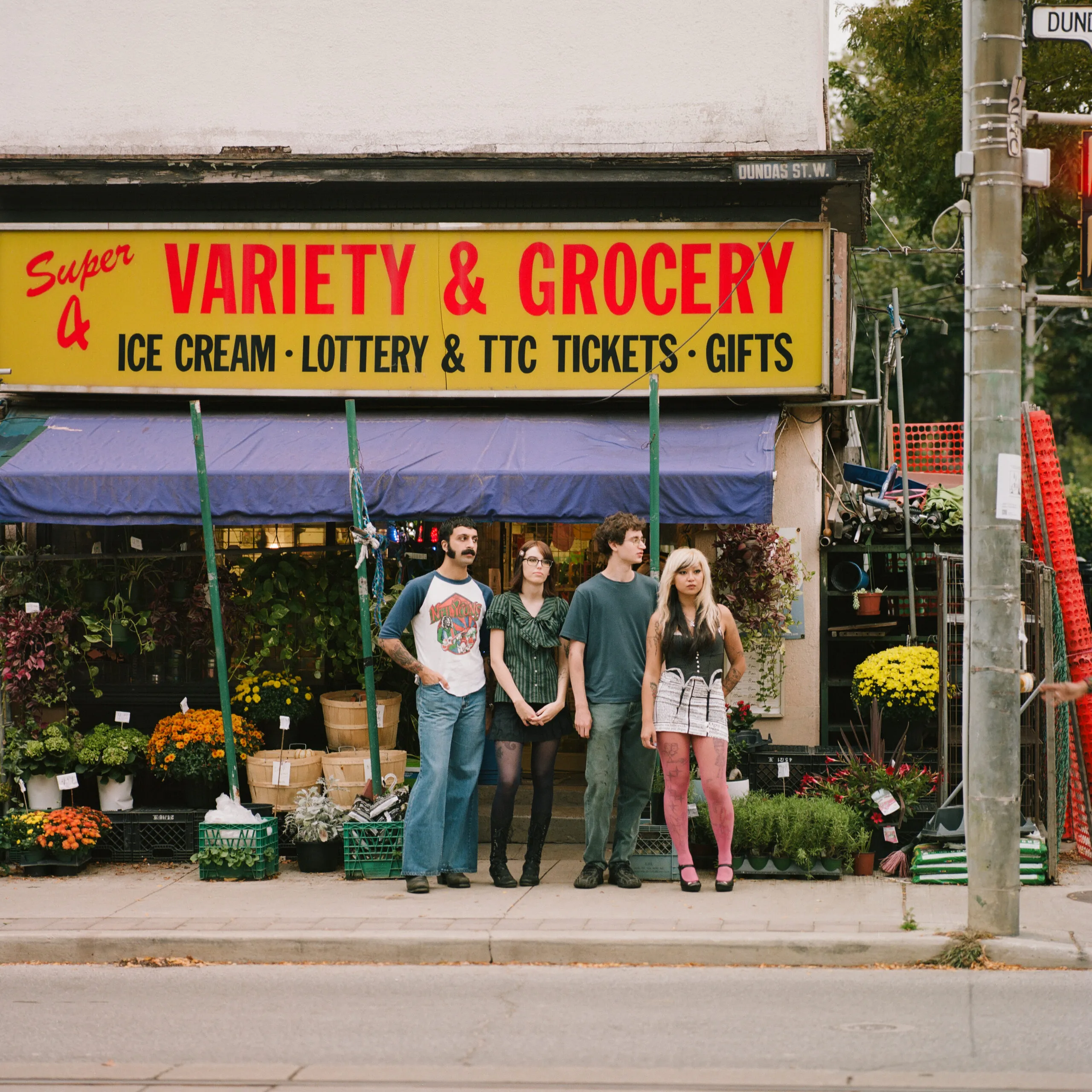
ANITA FOWL: A lot of my writing comes from this sense of distance between what I’m thinking I want to say and what actually comes out. It’s like a wrong place, wrong time thing. That’s very true for songs like “Straight drop.” We’re all roughly in our mid-twenties. When you’re a teen and awkward, that’s just part of growing up and moving through a transition. But once you hit 25 and you’re still awkward, it starts to feel like that’s just who you are. If social situations feel clumsy, you learn to embrace it. I vent a lot of those frustrations through the music, and even the album artwork is awkward—a photo of all four of us crammed into something resembling a school portrait setup. It underscores the idea that even when we’re trying to present our most serious selves—getting ready, posing, recording in a studio—we still come off a bit uncomfortable. And what could be more awkward than promoting an album that features your own face on the cover?
HBO’s Girls
NOLAN JAKUPOVSKI: The social dynamics in Girls are really influential for our lyrics. It covers all kinds of relationships so well, yet it doesn’t take itself too seriously. And it’s genuinely funny. We all think we’re very funny.
FOWL: And with the little music subplots, the characters are pretty spot-on representations of people in the music scene. It’s eerily accurate.
Which of the girls do you feel you identify with most?
JAKUPOVSKI: I think there’s a bit of Hannah in everyone.
FOWL: Toronto is full of Booth Jonathans, for sure.
How would you describe Toronto’s music scene to someone unfamiliar with it?
JAKUPOVSKI: Toronto is home to many small circles and cliques.
SOPHIA CHAVEZ: That’s why our album features several different voices. We’re all close friends, but we each inhabit distinct scenes and do our own thing.
Live Performance and YouTube Set Watching
JAKUPOVSKI: In the early days, I was crafting beats so we could play to them live, but I hadn’t fully realized how challenging they’d be to reproduce onstage. The material can’t swing too slick or too tangled. Now I keep that in mind when I write and structure beats.
FOWL: When we first started out, not every track included a DJ part. There were times we had backup songs ready in case the venue or the sound engineer couldn’t accommodate the DJ setup. That reality helped shape our writing, and I feel like on the new album we finally settled on our formula.
Logistically, do you think watching other bands’ live clips influences how you configure your setup?
JAKUPOVSKI: We aim for a lean setup: a DJ controller, a synth, drums, bass, and a laptop—pretty much all we need. I think this is why we feel like a product of the present rather than a relic from the ’90s.
What are some of your favorite live performances to watch online?
JAKUPOVSKI: There’s a legendary triple-bill of Meat Puppets, Hüsker Dü, and Minutemen that’s beyond magical. I also enjoy watching smaller, local bands in clips.
Disco Inferno
JAKUPOVSKI: There’s a lot of live audio from them, but almost no video, which is a bit sad. They were an early example of a band that performed digital sampling live. I’m not entirely sure how they achieved those sounds—likely with a sample pad or something similar—but they were doing what we’re doing, back in the ‘80s and ‘90s, in a more ethereal way.
We sample from each other quite a bit. Nothing too outlandish on the record, but we’ll often reuse a background vocal or a guitar idea, manipulate it, and drop it somewhere else.
Electrelane
JAKUPOVSKI: There’s a certain rigidity to their approach that I really admire, especially the drummer’s style and the way they use keyboards. I keep thinking of the track where they nearly accelerate…?
FOWL: “To The East?”
JAKUPOVSKI: It could be that one. I adore those drum entrances and I’m drawn to that era of production from the early 2000s. We also really love those kinds of vocals—Nico-style phrasing.
FOWL: There’s a definite performative flair to it.
How do you discover most of your favorite music?
FOWL: I came to Electrelane through Nolan; he told me about them, and then the YouTube algorithm started recommending them to me.
JAKUPOVSKI: Maybe the algorithm itself is a form of influence. [Entire band groans] It’s true, though—Jim O’Rourke used to shun streaming, and I only own that record because I found it on YouTube.
FOWL: I was definitely a YouTube-to-MP3 converter back in the day. A lot of our generation was like that.
I do think the YouTube algorithm tends to feel less ominous. It can feel more personal and niche.
NJ: I’ll take the YouTube algorithm any day. It’s not all harmful; often it serves up an Arthur Russell live clip that hits the spot.
Something We All Got is scheduled for release on February 27 via Carpark.