
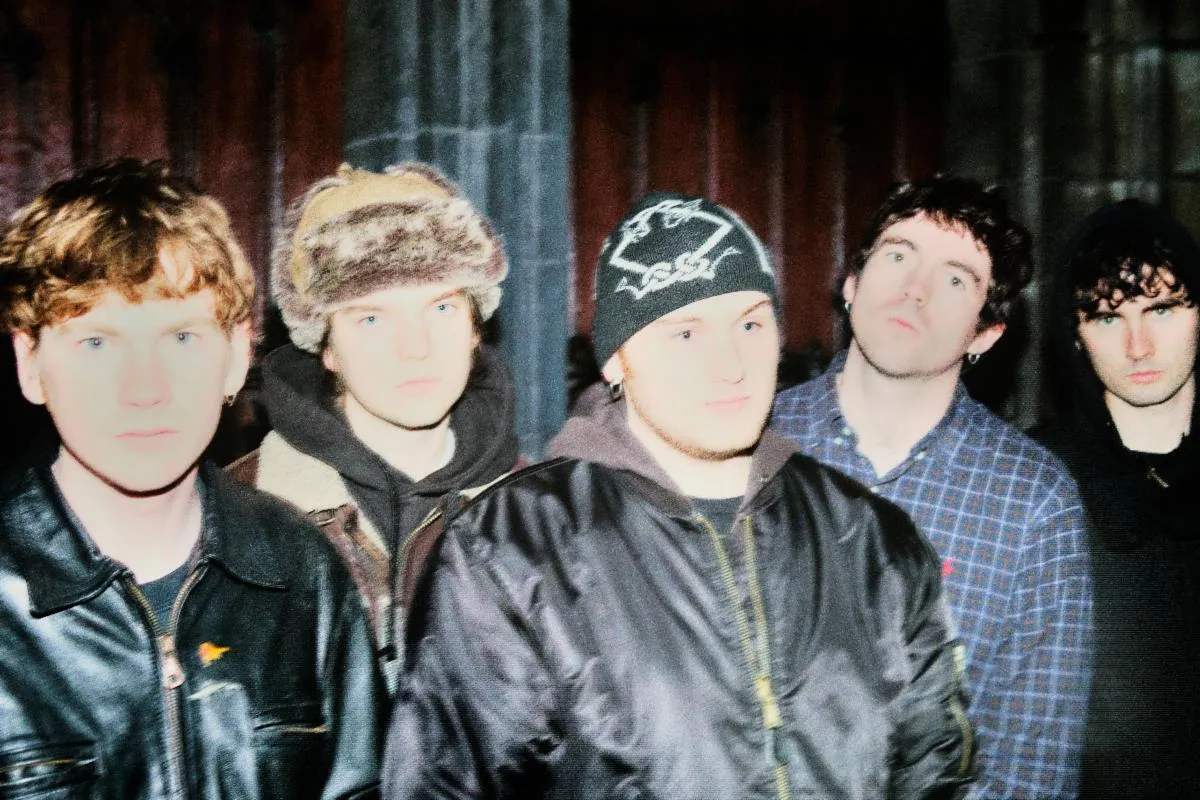
Cardinals regard their songs as if they were animated by a living force. For this group, such an approach—which can come off as evasive—acts as a shield of sorts, offering creative ambiguity that protects both the artist and the listener. Lead vocalist and lyricist Euan Manning describes it this way: “We enjoy the ambiguity. If someone reads into a fixed meaning that—” “You have to interpret it this way,” his brother and the band’s accordionist Finn Manning interjects. Euan continues: “Not necessarily that you must, but that listeners might feel compelled to, if the writer stated that was the song’s intent. I think that would diminish the song. It would sap the listener’s relationship with the tune.” For this Irish quintet, meaning isn’t something to dissect; it’s something to preserve.
We’re gathered around a wooden table in a roomy Islington pub in London to discuss their debut album Masquerade, which is released today by So Young Records. Joining us are all five members: Finn and Euan, drummer Darragh Manning (their cousin), and two longtime school friends, bassist Aaron Hurley and guitarist Oskar Gudinovic. Cardinals take their songs seriously, yet they’re enjoyable to chat with. They rib each other with self-deprecating humor, peppered with nods to films like Good Will Hunting and The Curious Case Of Benjamin Button. There’s even an ongoing bit that Gudinovic bears a resemblance to the lead character from the latter.
The room—black and white with a two-tone palette—drifts with the soft glare of mid-afternoon sun and is lined with relics: concert posters for the Jam, the Ronettes, Buzzcocks, and Morrissey. It’s a nice space, but not exactly their kind of haunt. So what does make a pub feel right to them?
“If someone you know works behind the bar and can swing you a free pint,” Hurley quickly offers. “Trend—tr-end-y?” Euan croons, half-questioning the term but enjoying the sound. “Trendy, yeah,” Gudinovic concurs. “I don’t know, a good atmosphere,” Darragh adds. “A good pub, I’d say, with a maximum of four taps,” Finn argues. “The smallest beer selection. Old walls. No TVs. Minimal music. Music is allowed—depending. And you should be able to have a proper conversation.” That last bit earns a chorus of agreement. They’re partial to classic American dive bars, naming Sophie’s in New York’s East Village and Rocka Rolla in Williamsburg. At the latter, they encountered an unsettling character named Travis O’Shaughnessy, whom they suspected might be a dead man walking.
“I also like a proper English pub,” Finn adds at the last moment. They all groan in disagreement. “I don’t like English pubs,” some of them repeat. Finn presses on, “I want a proper bloody boozer where they pour real ales.” None of them wavers. “Really?” Finn asks the others. “No,” they respond in unison. “Oh man, there are some nice pubs,” his voice trails off, subdued.
For Cardinals, a pub isn’t simply about what’s on tap. It’s about compression: low ceilings, dim lighting, a modest selection. It’s intimacy through limitation. It’s the grit, the wear and tear. The bar becomes its own character, a sanctuary for other memorable figures.
“Look at how vast this room is,” Euan asserts. “The lighting is bright, there are many nooks to explore, and it’s expansive. There’s no coziness to it.”
Although “cozy” might be a strange descriptor for a grubby dive bar (and an odd pairing with the image of a Dead Man Walking O’Shaughnessy), it perfectly illustrates something that can appear rough yet offer a singular comfort. It’s rough, but it feels like shelter: it embodies Cardinals.
To the group, literal interpretation risks flattening the songs on Masquerade. Yet the band esteems vulnerability, honesty, and authenticity as core values. These three ideas recur throughout the hour as central tenets rather than mere topics of discussion. It becomes clear that discussing the process or method feels different—less invasive and more about safeguarding the work. “Vulnerability is crucial,” Euan remarks. “That realization came very early when we started the record. I think it’s a significant reason the record isn’t just straight indie rock, unlike the EP that preceded it. For me, vulnerability is the essential ingredient you must keep in mind when you’re creating something.”
While laying down Masquerade at RAK Studios in London, Cardinals endured some discomfort and shed certain comforts. The sessions spanned a demanding nine days last June, during a brutal heat wave with little sleep. They chose sobriety throughout this stretch. Darragh laughs, “We made up for it in the end. We biked halfway across London to find an off-license that was open.” Finn adds: “Keeping a clear head was important, you know. It might be fun to flip the script for the next album and drink for every second of it and see what that’s like.”
Four of the group’s members grew up in Kinsale, while Darragh was raised on Cork City’s North Side. “It’s like a snow globe. It’s not the real world at all,” Darragh says of his bandmates’ hometown. Laughter fills the room. “That’s good. I like that,” Gudinovic responds. Finn remarks, “It’s a very affluent seaside town. Like sailing—pretty Protestant.”
Although Darragh is the only one born there, Cork is the cradle of the band. After playing music together in their youth, Euan, Hurley, and Gudinovic moved to Cork for college. Finn left for Galway before ending up in Cork as well. They speak of the city with rugged affection. “There’s a rough edge to it,” Finn notes. “Cork is a take-it-or-leave-it place. If you don’t care for it, you can just leave.” He pauses. “There’s a real sense of independence there, and you can hear that in the modest grocers, in the pubs and restaurants, and in the art that’s produced there.”
When I ask what they’re eager to revisit after long tours, Finn points to a Cork City staple named Callanan’s. It also happens to epitomize the city they treasure. “Family-owned for generations, and generations,” Finn explains. “That was the model I pictured when describing our ideal pub.” Euan interrupts: “We know the publican Rob; he’s lovely.” Finn continues: “It’s the cheapest pint and also the best pint. It’s perfect for sitting and catching up with people you haven’t seen in ages. And I think it personifies Cork, really.”
You can hear that rough edge Cardinals treasure in Masquerade—grand in scope, yet a touch feral. The accordion injects dramatic intensity, while the guitars resemble thick shards of glass. The bass tempers the sound, and the drums propel the band forward like a protective guardian. The instruments weave themselves around the vocals, which carry a kaleidoscopic ache. Regarding how to describe their sound through comparisons to other artists, they’re candid: it may not be especially original, but sometimes it’s a necessary evil. So here goes: Cardinals embody a kind of folk hardcore. I sense echoes of Iceage’s tension, the confessional fragility of Bright Eyes, and the intimate oddness of Elliott Smith. Let’s throw in a dash of Nine Inch Nails and Radiohead for good measure.
For these guys, vulnerability isn’t merely a lyrical theme—it shapes how the music itself is formed. “It’s like waking up from a dream,” Hurley poetically describes the creative process. “You wake up and reflect on the dream you just had. Where did it come from? You uncover something about yourself. It’s like letting your subconscious speak to you.”
Those revelations also surface in the words. The loud structures coil around the phrases. A line from the opening track “She Makes Me Real” goes: “Put it in a song/ Cause it hurts beyond belief.” In “I Like You,” Euan opens with: “I won’t write the words past the margin/ When I sit down to write your song.” The act of writing becomes a way of preserving the experience within the music. Whether addressing personal pain, heartbreak, or larger questions of faith or morality, the songs are built around human suffering. Their strongest moments, such as “Over At Last” and “As I Breathe,” become expansive, affecting journeys. It’s a remarkable debut feat.
Listening to Masquerade feels like stepping into one of Cardinals’ beloved dive bars: dimly lit, intimate, a touch rough around the edges, yet alive with character and memory. There’s grit and chaos, but also warmth and shelter. Perhaps it will reveal more with time—or perhaps it will stubbornly stay raw, honest, and true to itself.
Masquerade is out now through So Young Records. Buy it here.