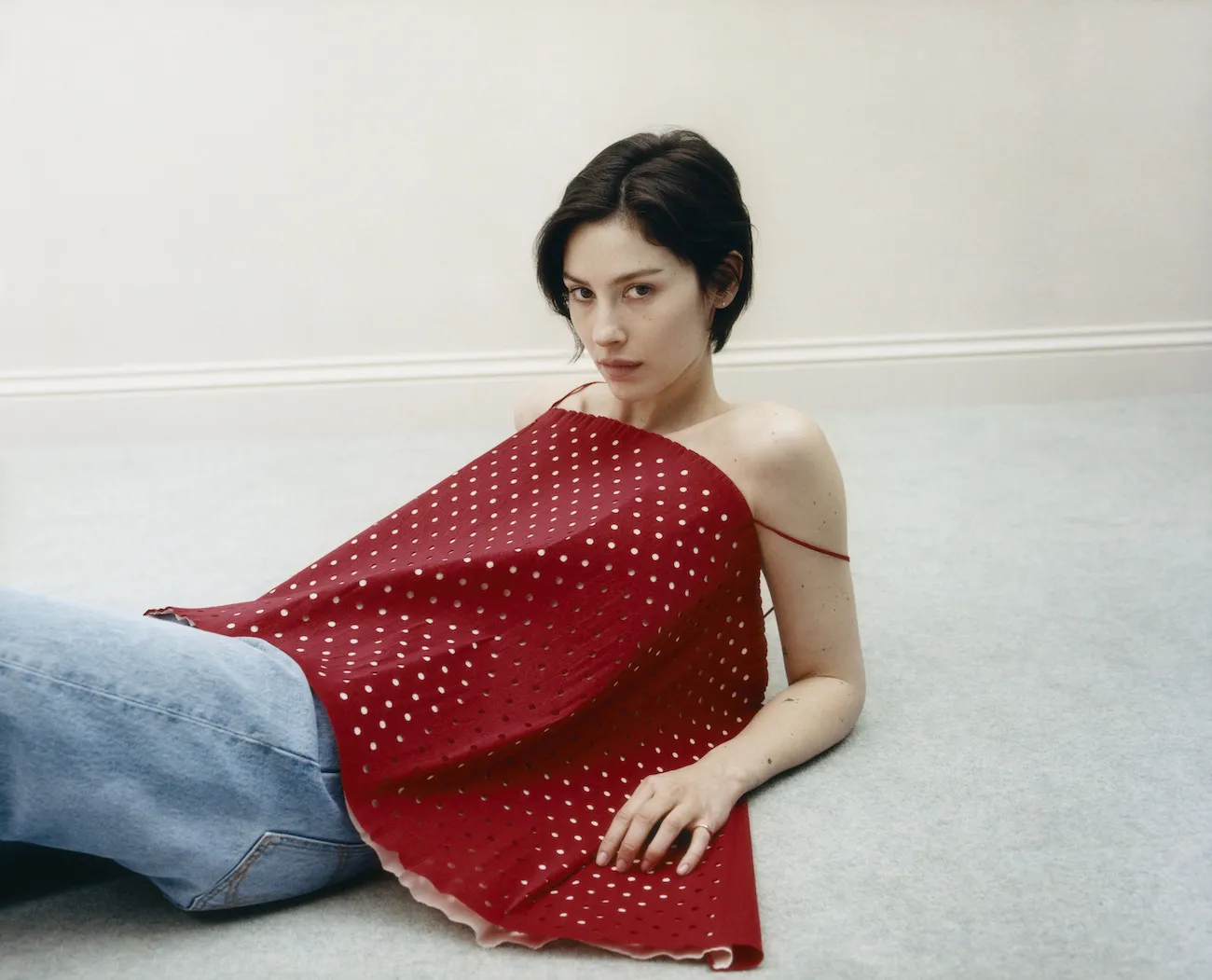
Throughout much of her career, Gracie Abrams has existed within the bounds of expectations and labels. The Los Angeles-based singer-songwriter emerged as a devoted admirer of Taylor Swift before becoming part of Swift’s inner circle as a protegée. Among her fans, she is regarded as a benchmark figure for a generation of “sad girl” pop; a quick search for the phrase yields a remarkably lengthy Spotify playlist titled “gracie abrams but it gets progressively sadder.” And, as commenters often note, she is the daughter of the renowned showrunner J. J. Abrams.
Many of those descriptors have long felt misaligned. The whole Abrams narrative feels overworked. If the Swift connection once felt fresh, it is now largely exhausted; Taylor has wandered so inwardly in her lyric universe that few artists are operating in the same space at present. And the “sad girl” label wasn’t something Abrams embraced or performs—it’s a frame she tends to push back against. She’s more inclined to downplay and deflect, describing, during a lighthearted chat with Olivia Rodrigo, the sensation of missing Audrey Hobert as a “cute loneliness.” (Could you imagine Lana Del Rey uttering “cute loneliness”? Or Gracie Abrams singing the lyric “the blue of my oblivion”?)
That Rodrigo interview is revealing when viewed alongside Abrams’ other album promotions, such as a traditional sit-down on The New York Times Popcast. The two platforms attract very different audiences: one yields surprised appreciation in the comments, the other fosters hopeful parasocial fantasies. Yet Abrams herself remains a notably steady presence. You can often sense her deliberate phrasing, and her replies stay non-controversial and consistent across platforms; you could nearly splice one interview into another. It feels as if she’s acquiescing to the pressure to prove herself, while resisting any label beyond “well-put-together” or “unusually normal.” Media training isn’t novel, and Abrams clearly has access to top-tier guidance. It’s hard to fault her for repeating the same answers when she’s spent most of her career fielding the same questions. Still, the calm is somewhat discordant when the new record is titled Daughter From Hell.
The album, Abrams’ first to reach No. 1 on the Billboard 200, wears the symbols of rebellion on its sleeve; Abrams glares from the cover art as if in defiance of a cornered-filing-card cliché à la Jagged Little Pill, and the lead single “Hit The Wall” contemplates trauma and entrapment. Yet the sound itself remains notably restrained—and that restraint is owed to Aaron Dessner. Daughter From Hell marks the culmination of Dessner’s ongoing mission to reshape pop music into the National’s muted, beige-toned palette; if Folklore and Evermore served as prototypes, this record stands as the final statement.
Folklore brought Justin Vernon of Bon Iver into the mainstream pop sphere after years of guest appearances in hip-hop; he’s again involved here. So too is the seemingly unproblematic Marcus Mumford. Even actor Paul Mescal appears, trading vocals with Abrams (who is his girlfriend, if you didn’t know) on the charmingly supernatural “Imaginary Friend.” Unsurprisingly, they furnish Abrams with a folk-inflected album that often feels refreshingly traditional.
The verses of “Humming” move with the cadence of the centuries-old “May Carol”; the harmonies on “What If It’s Right?” (provided by Mumford) hover near bluegrass. Meanwhile, “Good Reason” and “Daughter From Hell” draw on a more homegrown folk lineage. The former becomes “Fade Into You” with the ethereal mystique replaced by Abrams’ own overanalyzed fretwork, while the latter finds Abrams revering her mother, over a track that’s so briskly propulsive it could easily double as devotional music. The line “I want your sugar” is a curious thing to say to God, but the Bible has stranger lines, right?
What these genres share is a communal impulse. They’re designed to subsume an individual musician into a broader human collective. Their musical ideals emphasize accessibility and timelessness over virtuosity or singularity. The challenge for any artist seeking a distinct singer-songwriter identity is to cultivate both virtuosity and a unique voice. Fans and sympathetic critics occasionally credit Abrams’ idiosyncratic phrasing and off-kilter vocal timing, but I don’t necessarily hear a singular voice. She’s competent, but not uniquely distinctive. Abrams never claimed to be a virtuoso singer, and the album’s low-key, harmony-centered arrangements on Daughter From Hell reflect that. Yet there are moments when more gravitas feels warranted; Abrams can muster a frustrated, non-vibrato loudness on tracks like “Men Like You” and “Hit The Wall,” but a stagey ballad such as “Mews” asks for a weight she hasn’t fully developed. All too often, she seems to fade into the timbres of her collaborators.
This line of thought carries some risk. There remains a tendency to attribute the visions of young female artists to their male collaborators, a susceptibility that bedroom-pop figures like Abrams appear to share. And beyond gender, it isn’t always obvious which artist influences which; influence rarely travels in a single direction. Notably, Abrams’ tendency to disappear from the foreground isn’t limited to male collaborators. She also adopts some of the more playful traits of Hobert, her lifelong friend and co-creator, whose own career is rising on the momentum of last year’s Who’s The Clown? Hobert co-wrote roughly half of Abrams’ previous album, 2024’s The Secret Of Us, including “That’s So True,” Abrams’ only top-10 single so far. On this project, she contributed to just one song.
“Minibar,” the sole Daughter From Hell track co-written with Hobert, stands in stark contrast to the rest of the record. Its hooks are kinetic enough for Radio Disney, the rhythm hops and shimmies, and—if you’ll permit the joke—”Someone perceived me: kinda scarred.” The energy is infectiously awkward, which explains why fans gravitated to it. It’s also unlikely a coincidence that Abrams’ two pop-forward tracks here—this one and the more upbeat, heartbreak-tinged “Look At My Life”—center on the disdain for the kind of parties that major pop anthems often lure you into.
Yet even this moment of vitality carries a telling line: “But I’m always subtle when I’m causing trouble.” Whether Hobert or Abrams penned it, the lyric encapsulates Abrams’ stated musical philosophy. She has said in multiple interviews that having been both the heartbreaker and the brokenhearted, the author and the subject, she has resolved not to write anything that might cross into territory that feels too far. I tend to lean toward Anne Lamott’s stance—”If people wanted you to write warmly about them, they should have behaved better”—but you can make a case for both sides.
British folk singer Laura Marling serves as a compelling foil here: one degree removed from Abrams (dating Mumford) and also a practitioner of confessional but traditional folk. Marling’s 2007 debut single “My Manic And I” is arrestingly harsh, bordering on ableist; it’s hard to imagine someone in Abrams’ position releasing something like it today without facing significant backlash. Still, it’s undeniably striking and showcases a distinct voice. Abrams, by contrast, is so deliberate with her language that she becomes cautious, wary of crossing into the realm of unrelatability. The grief she described causing her parents involved a lot of sneaking out; if that makes her a “daughter from hell,” then hell seems to have many daughters for company.
This presents one approach to songwriting: mine universal experiences likely to resonate broadly. This approach has many sincere adherents. There’s another approach, though: take concrete experiences described precisely and render them universally relatable. Abrams, already well established, stands in an excellent position to bridge these approaches. The fanbase will follow.
POP TEN
Carly Rae Jepsen — “On Wires”
The moment when Jepsen shifts from pure infatuation to a deeper longing, an evolved but no less intense yearning; the kind of make-or-break emotion you hear in muscular 80s power ballads, retooled for confessional declarations of love. (And it’s not hopeless for her.) Pure, elemental pop.
sombr — “My Body Isn’t Ready”
A title that invites memes, yet the track wears its insecurities openly and unabashedly; it clears Tears for Fears on sincerity and lands somewhere near a modern, non-ironic take on “Reflection.” And yes, a lot of teenagers and twenty-somethings probably need this kind of honesty right now.
Riize — “Do Your Dance”
An homage to the groove, with frequent vocal twists and dynamic shifts that keep the energy front and center; the dance moves shown in the video are quickly abandoned in favor of the raw beat, which feels more important than the choreography.
Girlset — “Chat”
Another ode to the beat, this time from K-pop powerhouse label JYP’s answer to their rival’s Katseye. The comparison rings true in almost every way, including the band dynamics. Here, “chat” presumably means a group chat or perhaps, given the video, Twitch chatter—and not some AI chat.
Aitana — “Superestrella”
Spain’s pop princess Aitana delivers 2025’s electropop confection, light and saccharine enough for Radio Disney (in a flattering way); and there’s a cultural tie-in—her World Cup performance with Spain’s win generated positive energy that helped the FIFA anthem’s chart presence.
Victoria Monét — “Reach Out”
More of Monét’s lush, assured ballroom R&B that she can conjure in her sleep. After hearing this track, you could easily imagine her delivering a Mariah-style whistle tone in her dreams. That’s a lot of musical craft to pack into a single eight-track set—get some rest, Victoria!
Henry Morris & Ella Boh — “My Girlfriend”
Morris—still early in his career, enough to be Google-searchable next to the unrelated entry about a Creationist—teams with Boh, a producer-turned-singer with solid taste, to present a surprisingly understated duet on Artemas’ support, trading swagger for restraint.
Tsatsamis — “Angelina”
A wistful, yearning bridge that sounds like what things should be—this bridge comes from a guy whose own case for desirability isn’t airtight, but the arrangement doesn’t quite notice that misstep.
Chad Hugo — “Jumpupw!nya” (Feat. Tierra Whack & Leikeli47)
You have to wonder why Chad Hugo is pursuing a solo path at this moment. The Neptunes aren’t at their peak, and Pharrell’s already carved out a full arc; Hugo is stepping out while keeping a respectful distance and letting two inventive rappers do the heavy lifting. It’s a promising opening chapter.
Paris Paloma — “Pre-Raphaelite”
Perhaps the sharpest nod to Dante Gabriel Rossetti since “Celebrity Skin,” this concept lands well, especially when you sense its most evocative atmosphere echoes Portishead’s “Glory Box.” I’d even wager there’s a William Morris hope chest somewhere in the vibe.