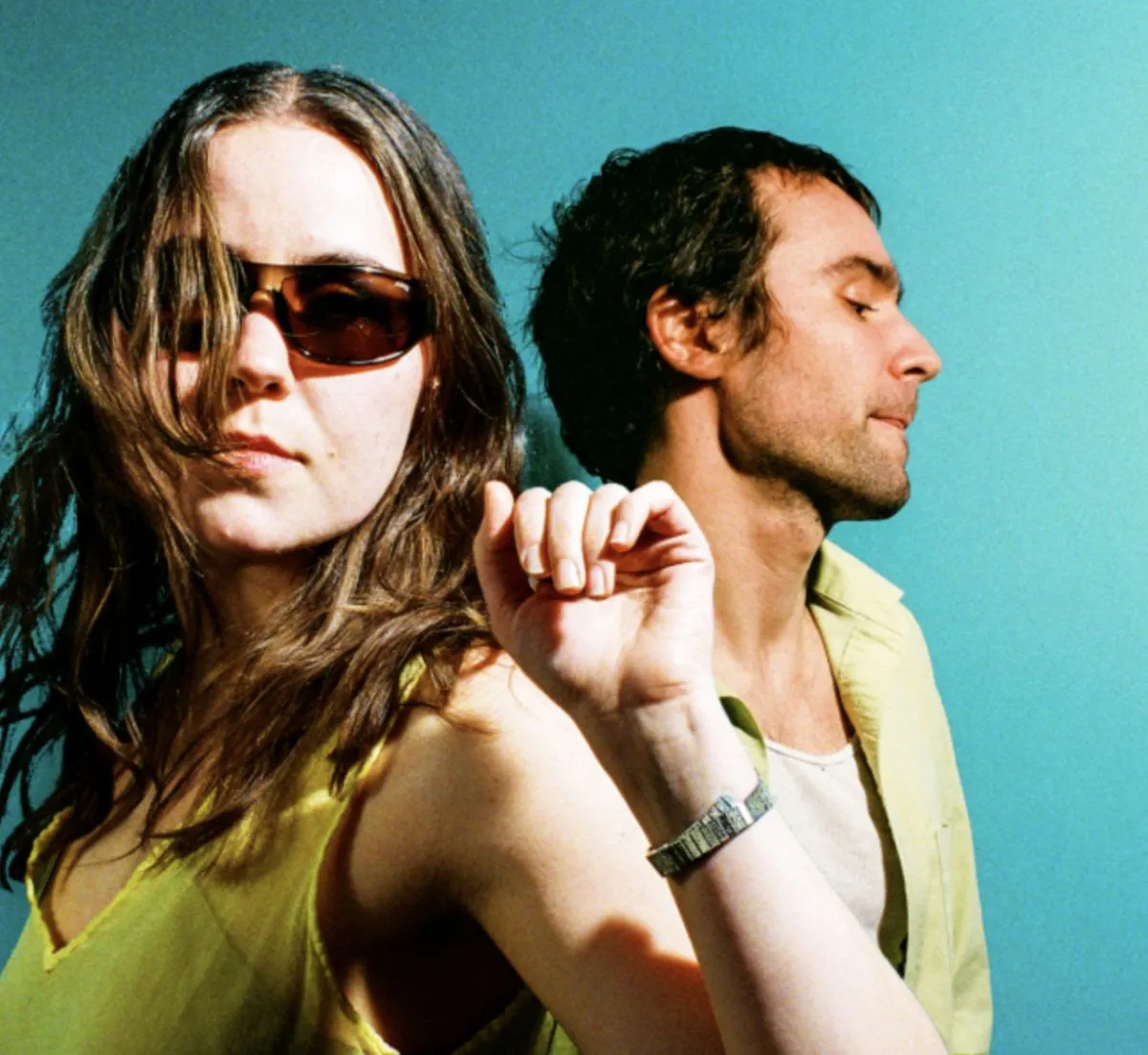
Love & Devotion stands out as one of the standout releases of the year, yet is it really a product of this current era? Philadelphia-based siblings Sam and Louise Sullivan present their third LP as if it were a long-lost gem unearthed after years of dust, now brought back into circulation by Light In The Attic. Infusing a palette that ranges from vintage psych-pop, country, and traditional folk to funk, reggae, and a mosaic of international sounds, the Sullivan duo crafted a batch of tunes that exude charm, immediacy, and a certain “wonkiness” (their own descriptor) that feels both inventive and as if it were recorded half a century ago.
Their project has been a labor of love since the pandemic era—in a sense, a lifelong pursuit—but it’s only recently gaining broader attention. Last year’s Sweet Enough drew the ear of Jeff Tweedy, who invited Sam and Louise to perform repeatedly at Wilco’s Solid Sound festival in June. The rising buzz around Emily Moales (aka Star Moles) and Kevin Basko (aka Rubber Band Gun)—their Philadelphia allies in the Historic New Jersey collective—has also helped to elevate the duo’s profile. All at once, opportunities began stacking up, including the prospect of opening for Australia’s Babe Rainbow on three recent dates, marking a significant upgrade from the basement and dive-bar stages they once called home.
“They reached out to us online and said, ‘Hey, come join us for these shows,’” a bemused Sam recalls, slipping into a jokingly cynical mode. “They were incredibly kind—gloriously cheerful Australians, tall and good-looking to boot, and they’re genuinely nice. I’m not sure what this is, but I like it.”
More such opportunities are on the horizon. The key now is carving out a way for Sam to step away from his day job teaching at a local Quaker school, a position Louise had also held until recently. In the interim, they’re lining up another batch of songs to record in Moales and Basko’s basement studio starting next week. Beyond the expanding career prospects, what excites them most is the chance to push their creative boundaries once again.
I connected with Sam and Louise via a video call a couple of days ago and thoroughly enjoyed meeting the people behind such captivating music. Press play on Love & Devotion and read our conversation below.
On the album, you sing “I’m a little crazy/ I wasn’t even born in the ‘80s.” So when were you both born, and where? Let’s start at the very beginning.
SAM SULLIVAN: I came into the world in 1991 in Morristown, New Jersey, though my folks happened to be living in Brooklyn at the time.
LOUISE SULLIVAN: And I arrived in 1996, in Portland, Oregon. Our mother hails from Portland and our father from New Jersey and Queens. They spent a stretch there with baby Sam, then relocated to Oregon, where we spent some early years. In 2000 we moved to New York, and I grew up in Brooklyn.
SAM: Then we shuffled back to Oregon for a spell, before settling in Hastings-on-Hudson near Yonkers. After another stint in Brooklyn, we remained in the area for eight more years.
LOUISE: We finished high school, Sam went to college, and drifted a bit around the Northeast before landing in Philadelphia. I followed suit in 2018, after finishing college, and I’ve been here ever since.
Do you have any other siblings?
LOUISE: Just the two of us. It would be tough for anyone else to handle the band if there were more.
It’s like the fourth Jonas brother.
LOUISE: Exactly. Our father once played in a band, accordion in hand, and we’d joke, “No more, Dad.”
SAM: He’s basically our fourth Jonas brother. Do you happen to know the name of the fourth Jonas brother with diabetes?
I honestly don’t know. It’s rough to be him.
SAM: Which Jonas brother has diabetes anyway?
LOUISE: I think it’s Nick. Right?
SAM: My wife recently diagnosed with Type 1 diabetes, so I’m very tuned in. If Nick can handle it, so can I.
So Dad used to be in a band? He played with you?
LOUISE: A lot of our childhood music came from him. He adores traditional tunes. We learned Irish music together, especially when we lived in Westchester, taking tin whistle lessons at the White Plains Community Center. He’d organize sing-alongs and other musical gatherings. Music was omnipresent while we were growing up.
SAM: It was steeped in folk and traditional sounds.
That image of a family gathered round singing makes sense from what I read in your bio, and I’m glad that’s how it was in real life.
SAM: It’s true—our childhood was steeped in family music.
LOUISE: And our mother pursues a different kind of making—visual arts, textiles, ceramics. There’s a lot of creative energy in our upbringing.
And you also have a ceramics venture, right? Or you did?
LOUISE: I do. I know I should crank out more ceramics now that it’s getting some press. Sam works as a teacher, and I’ve been teaching for five years but I’m not returning this year. Ceramics is happening, and possibly some music, too. We’re always making things—it’s a blast.
I read that you learned these folk songs at a school on an old farm in Oregon. Is that separate from your family’s influence?
SAM: Yes. I attended a rather free-spirited school in Tualatin, where we’d practice calligraphy and watch goats give birth, among other things. Then I did some time in Hastings’ public schools, and later attended a prep school where my mom taught. Today I teach high school English literature at a Quaker school, which has its own Northeast flavor of hippie culture—similar vibes, but a bit different.
LOUISE: There are still strong songs we can all sing together, and everyone knows the words, so those moments are special.
What prompted the move to Philadelphia?
SAM: I left Providence in search of stability—health insurance, a job, something reliable. I was twenty-something, teaching English and living on a bike, when I decided I needed a calmer environment. Providence’ wintery days and the rough streets pushed me to seek a change.
Did the current batch of songs begin before you actually started playing together in Philly?
SAM: This is new—writing and performing as a duo. The COVID period pushed us to create our own material, and then Philly introduced us to a circle of musician friends who showed us there was a broader canvas to work with. Writing felt more enjoyable than composing poetry, so I kept at it and crafted many tunes.
LOUISE: We began recording Love & Devotion in 2020, trading tracks back and forth between our spaces—me laying things down in my bathroom, Sam doing his thing in Germantown. We crossed paths with Kevin Basko of Rubber Band Gun and Emily Moales of Star Moles, and collaborating with them made the process genuinely exciting. It felt possible to create something substantial while taking the time to shape the record thoughtfully.
SAM: We were a big, easygoing collective—everyone enjoying each other’s company.
LOUISE: And we shared a lot of musical tastes and references, which made collaboration feel natural. The connection started with an Instagram DM, which seems to be how everything happens these days.
SAM: I think we all wanted to craft songs that could stand on their own, not just be vehicles for a vibe. It should work as timeless songs—though vibes are great, the aim was to create something that endures beyond any single mood.
LOUISE: It was thrilling to meet Emily and Kevin because they bring such versatility. We could blend all these influences and still maintain a cohesive sound. The collaboration felt like a natural extension of our shared love for a wide range of music.
Who sent the initial DM?
LOUISE: Kevin reached out to us first.
SAM: I’m still getting up to speed with the indie rock scene; Kevin is a quiet legend with a massive discography. The Star Moles were part of that ecosystem, and meeting them opened up a whole new world of possibilities for us.
LOUISE: We used to listen to whatever cassette or CD happened to be in our car—the soundtracks of our lives.
SAM: We’re in the midst of cultivating our modern sound now. Before working with Kevin and Emily, I mostly listened to Burna Boy, and I still enjoy that kind of music.
What did Kevin and Emily contribute to your music? It sounds like there’s a strong sense of camaraderie.
SAM: We’re all deeply involved in each other’s material. Kevin works on his own record while also joining in on ours—drums, arrangement, and suggesting tiny changes that help the music flow. We’re constantly tweaking parts to improve transitions and dynamics. It’s a collaborative process with everyone chipping in.
LOUISE: It’s the kind of dynamic where you’re all gathered, figuring out how to translate a moment into sound. At Kevin’s place, we’d bring in a first verse and chorus and then expand the arrangement from there.
SAM: Most of the time I’d start with a song with a simple guitar, and then we’d overdub drums. It’s a somewhat chaotic, endearingly messy approach.
LOUISE: We recognize that it’s not about perfection; the charm lies in the imperfect, the human rough edges that keep things interesting.
SAM: Our process is deliberately imperfect. If someone tells you a drum pattern sounds like X, Y, or Z, we shrug and say we intended something else—often that’s what makes the track feel right.
LOUISE: And the sense of collaboration extends to their strengths as well; we contribute to each other’s work, and the result is something lively that breathes in a shared space.
You mentioned the cassette or CD you’d have stuck in your car. Were there particular albums that dominated those drives?
SAM: The Buju Banton record Inna Heights was a staple, as was Chichí Peralta’s Pa’ Otro La’o—indispensable in its own right. Also essential were Africando’s Gombo Salsa, and of course the Roches in their CD form. Maggie and Terre Roche are heroes to us, along with Bruce Molsky and the fiddling tradition he represents. Reggae from Junior Reid, and the classic sound of Bonnie Raitt—those were constant companions, as were the Beatles, whose posters still watch over us in the studio.
LOUISE: The Beatles have a special place for us; we’re big fans of their work.
I’ve heard you’ve carved out your own corner of the Philly scene—a little community. How connected do you feel to the broader Philadelphia music world?
SAM: We certainly feel linked to Babe Rainbow, who are incredibly kind—truly the kind of people you’d do anything for. The Philly scene is rich with talent; we’ve met many folks we admire, and our friendships have grown over time. We’re starting to realize we’re part of a larger network of artists in the area, and that’s very uplifting.
LOUISE: In Philadelphia there’s a flourishing music community, and we’ve built a circle of friends. After a while, you realize you’re all living parallel lives, all pursuing similar aims and sounds. You go to parties, you see your peers, and you discover that this is a credible path for all of you.
SAM: We know a fair number of people who are making waves, and we’ve played at a lot of venues around town as a duo, and more recently with Emily and Kevin in the lineup, along with Jem Seidel on drums, bringing the studio sound to the live stage.
When you compare the first two records from 2025’s Sweet Enough and 2023’s Papier Mâché with this latest release, it feels like a leap forward—strong songs, and a distinctive, funk-inflected vibe. You had a remark about Kool & The Gang played with a hoedown twist. How did you settle on this particular aesthetic for the album?
SAM: I’m flattered you noticed. I’m still chasing a certain ghost—there remains a lot to come. Right now, everything we’ve released is just a taste of what we’re building. Funkiness is not just a word here; it’s a texture—think butter-soft and richly layered. The aim is to craft something that’s both insane in its delivery and surprisingly tight in its arrangement. That means exuberant drums laid on top of one another, creating a groove that breathes like those Dominican records I admire. The third groove—the one that emerges when multiple parts play together—is a key driver for the sound.
LOUISE: We also want the music to feel as if you’ve wandered into a live party, with space and air around the instruments so it sounds real and immediate. Spontaneity is essential; it should feel live rather than overly polished. A complicated drum track needs to sit with a vocal take that isn’t perfectly pristine.
SAM: I’m chasing a sound that blends Irish and old English influences with American styles, and I want it to feel contemporary and danceable without slipping into mere fusion. The larger Atlantic-music conversation is what we’re aiming for.
LOUISE: When we talk about collage, we’re layering pieces rather than seamlessly weaving them together. Sometimes a layer might seem out of place at first, but it ends up fitting in the overall texture.
The rhythmic heart of the album is notable. On a more restrained track like “Ms. Mercedes,” the groove still reveals intricate details. What’s the method behind building these grooves now? Do you begin with a rhythm and then layer chords and melodies on top?
SAM: That particular tune is a tricky beast. We’ve performed it live for years, usually in a simpler rock-jazz form. When we recorded it, we reshaped it—there was a point when we realized some of our approach needed rethinking. The band’s patterns evolved as we reimagined the arrangement.
LOUISE: For “Ms. Mercedes,” we brought in certain folk elements, including fiddle, which adds a quirky edge to the song. My own dexterity on the fiddle still has a few rough edges, so there’s always a touch of wonkiness to the playing.
SAM: We aimed to evoke the vibe of Afrikando’s groove, Ry Cooder’s sensibility, and a distinctly American core—without turning it into a mere world-music label. It’s about marrying these influences into something cohesive and danceable.
So the groove of the album is something you retrofitted into the songs. The first few tracks grip you with their rhythm before you even hear the lyrics. Do you still write chords and lyrics first and then develop the groove, or do you ever start with a jam and let a song emerge from it?
SAM: I don’t jam and let a song happen by accident. Usually I hear a reference and think, “We should write something in that vein.” Then I work with Kevin to map out how to achieve that feel for the whole song. For “Down On Love” and “Love & Devotion,” I knew the exact vibe I wanted, and Kevin and I dedicated months to shaping them until they sounded right.
LOUISE: It’s thrilling to revisit the process once the record is done, recognizing that parts felt painful to get right but ultimately yielded something we’re proud of. We pushed through moments of doubt to arrive at something that’s still enjoyable to listen to.
SAM: I’ll often hand Kevin a rough idea and say, “We’re recording this now. You’ll play the drums and you’ll play them with intention.” The result is a lot of takes, with a bit of self-deprecation about my own guitar skills—yet we end up with the ten tracks that define the album. People want a direction, and I’ll tell them I’m pursuing the ability to keep making music with conviction.
LOUISE: There were moments during the recording when we wondered, “Is this the right thing?”—but we forged ahead because we believed in the songs. The next record promises to be even stronger.
The lyrics are striking throughout. Considering the opening tracks, lines like “Even when you’re wrong, you’re wrong for all the right reasons/ Even the mistakes you make have a certain cohesion” and “I can’t explain why I spent so much mental energy memorizing everything about you” stand out. What’s your approach to lyric writing? Do you collect phrases in a notebook, or do ideas arise spontaneously?
LOUISE: We pay close attention to cadence and vocabulary—three-syllable words ending in -ion matter to us, for instance. The writing process is a collaboration, with Sam often bringing words first and then figuring out how to sing them. It’s a balance between immediate expression and crafted imagery.
SAM: I tend to think of writing as a race against time: you have a brief window to make a listener care about your mood, your day, and your character. A single sticky idea can carry a song, but it has to be intuitive and engaging. I’m drawn to pop music’s efficiency and sincerity, even as I stay true to an inherently quirky sensibility. I like tropes and aesthetics, and I’m not trying to escape them; I want them to feel natural and inviting to the listener.
LOUISE: The word “baby” has a way of sounding wonderful in a song, which is a nice reminder of how melody can carry emotion.
SAM: The process isn’t about pretending to be cool. It’s about serving the song and the character within it, ensuring the vocal and instrumental choices align with the mood and narrative.
LOUISE: We prioritize what serves the song and the character. If a line works, we keep it; if not, we adjust. It’s a practical, instinctive approach rather than an abstract theory.
SAM: I usually begin with words before the music. I jot down ideas and then figure out how to sing them with clarity and honesty.
Are these songs drawn from real experiences, or do you often imagine scenarios that would make compelling stories?
SAM: They rarely reflect my own life directly. I’ll take an idea I’ve heard from friends or observe a situation and riff on it, finding the humor or nuance that makes it relatable and entertaining. It’s about translating everyday life into something a bit more universal.
LOUISE: We borrow from family traits and everyday moments, mixing up references and cinematic moments to craft scenes that feel familiar yet apart from our day-to-day lives. It’s not about a literal recounting of personal heartbreaks; it’s about a crafted, considered narrative with emotional truth.
SAM: If I ever felt a song was truly about a real-life event as it happened, I’d worry about oversharing. We prefer a certain distance that lets the listener bring their own experiences to the music. It’s a deliberate choice, and it aligns with our interest in the broader tradition of storytelling through song.
When you think of sibling duos, Fiery Furnaces sometimes comes to mind, though you’re not aiming for eight-minute epics or grandparent-led records. Do you foresee any radical shifts—like that kind of experimental turn—in your future?
SAM: I don’t know what those bigger leaps might look like. For now, we’re focused on creating strong, catchy songs that still retain a distinctive edge. The next record could be a surge of high-energy, immediate tracks—bombs of creativity back-to-back. That’s the plan, at least. And I’m aware Louise brings a lot of formal training and discipline to our music, which helps keep us anchored.
LOUISE: I feel a bit like I have “stage dementia”—I forget the words sometimes. If I write a song, it’s likely to be pared down, and I’ll cut away anything extraneous. The ten tracks on this album are the ten that we kept; if we need to adjust directions later, we’ll do so for the next project rather than forcing a change here.
Jeff Tweedy has championed your work, and you performed at Wilco’s Solid Sound festival earlier this summer. Any memorable moments or interactions there?
SAM: Absolutely—sharing the stage with Wilco and their crew was unforgettable. Natalie Merchant joined in for Mermaid Avenue, which added to the magic. The atmosphere was warm and welcoming; people were genuinely curious and kind, and we felt incredibly supported. It was a surreal experience, especially after a period of playing mainly for friends and local crowds.
LOUISE: It was inspiring to connect with Chicago musicians and to see Jeff Tweedy’s backstage warmups up close. Chicago’s a city with a deep musical history, and the whole event made us grateful and excited for what’s ahead.
SAM: We also met Living Hour from Canada and were introduced to many other talented artists. It was an energizing, eye-opening experience, and it reminded us how far we’ve come—from playing basement gigs to sharing a festival stage with influential figures in the scene.
LOUISE: The whole event was a joy, and it reaffirmed our commitment to the craft. We’re grateful for the opportunities and the people who’ve welcomed us into this world of music.
SAM: And the chance to hear and learn from others is invaluable. We’re soaking in as much wisdom as we can, every step of the way.
Do you expect to tour this record, given your other commitments?
SAM: We’re currently exploring those possibilities. We’re still new to all of this, and we’re learning as we go. We didn’t expect anyone to listen, and yet here we are, excited and open to whatever the future holds.
LOUISE: We’d be thrilled to tour if it fits with our lives. We’ve just performed with Emily and Kevin in a substantial show, and the idea of taking the band on the road feels exhilarating. I’m confident that people would come out to see us given the right circumstances. I’m thirty-five now, and I’m not worried about whether we’ll make more records—we’ll keep doing this because we love it. It’s all about enjoying the journey.
SAM: If this had happened when I was twenty-three, I would have been a bundle of nerves. Now I’m just grateful for the moment and ready for whatever comes next. It’s been a wild ride—three shows with Babe Rainbow in Australia felt like a dream. We kept it modest, but the experience was unforgettable. We played three gigs, and we savored every single one.
LOUISE: And we’re ready for more, even if it’s a steep climb. The idea of performing longer sets and sharing more of our music excites us. It’s wonderful to have people witness the music we’ve created together as siblings.
SAM: I believe our next release will surpass this one in many ways—the creative energy is there, and we’re eager to chase it down and put it into new songs.
Love & Devotion is out now on Historic New Jersey. Buy it here.