It felt a lot like a family gathering, Ben Swanson observed from the stage at the Buskirk-Chumley Theater on Saturday night—the pleasant kind, not the one where your odd uncle spends hours muttering mildly inappropriate remarks.
He spoke to an audience of roughly six hundred people, comprised of long-time Secretly Group staff, former collaborators, artists, and Bloomington locals. The gathering was for What Comes After The Blues: Secretly 30, a three-day celebration marking three decades of Secretly—the umbrella of Dead Oceans, Jagjaguwar, Secretly Canadian, and a constellation of other independent music institutions. The mood swirled around the idea of a family reunion, a refrain that echoed throughout the weekend despite the jokes about an awkward relative.
Ben and his brother Chris launched Secretly Canadian in 1996 while they were still students at Indiana University in Bloomington. A few years later they teamed up with Darius Van Arman, who had started Jagjaguwar. Then, in 2007, Phil Waldorf joined with Dead Oceans. Today, the four founders/owners shepherd a label group that has grown from scrappy local roots into one of the most acclaimed and influential forces in indie music. To mark 30 years, they organized a Bloomington-based weekend filled with readings, parties, and four distinct performances designed to trace the label’s trajectory—its origins, its current moment, and its future directions.
As expected, the opening night returned to where it all began. The Bluebird, a downtown Bloomington bar/venue, has long been a community touchstone for the local music scene. “This evening feels very much like local vibes,” Van Arman told me as Magnolia & Johnson Electric Co. took the stage, noting it was all Midwestern acts and a bunch of the old guard. June Panic, a singer-songwriter who opened the night, was the first artist to ever sign with Secretly. Next up were Early Day Miners, who released a string of Secretly albums through the 2000s. The night underscored the origin story—a pair of Midwest kids forging their path away from the California and New York hubs, discovering strange, idiosyncratic music at the crossroads of Americana and indie.
That narrative was in large part propelled by Jason Molina, whose late ’90s/early 2000s ascent with Songs: Ohia helped put Secretly on the map (and whose album What Comes After The Blues lent the weekend its title). Magnolia & Johnson Electric Co., formed last year, features Centro-Matic’s Will Johnson performing Molina’s material with the surviving members of Magnolia Electric Co. The group’s blistering two-and-a-half-hour set felt like a heartfelt tribute to Molina’s legacy, who passed away in 2011. Their versions of “Lioness” and “John Henry Split My Heart” carried particular emotional weight, though the climactic “Farewell Transmission” perhaps left the strongest impression—both a farewell to Molina’s era and a ceremonial curtain-raiser for the weekend as a whole.
As the night unfolded, the scope of Secretly—Group’s evolution became evident. By the second half of the organization’s existence, its footprint widened dramatically. People had flown in from Los Angeles, London, and New York City—centers where the label’s operations now cluster, with distribution still anchored in Bloomington. They also maintain footholds across Europe and as far afield as Sydney. The premise of What Comes After The Blues was to bring everyone back to the origin: Bloomington. No matter how far-flung the group’s reach, those roots remained central to its identity and to its success, according to the partners.
On Friday evening, I sat with Chris, Ben, and Van Arman on the sidewalk outside the Buskirk-Chumley. As newly returned IU students spilled between bars, each founder described the label’s core DNA, early triumphs, and where it sits today.
“We were fortunate to land in Bloomington,” Van Arman reflected on Secretly’s somewhat unlikely home. “It gave us room to mess up, and it let us build out our distribution framework. When the industry went through rough patches, we actually emerged in a stronger position than we otherwise would have.” Being more off the beaten path helped keep the early years of Secretly and Jag modest in cost and pressure. It also meant the founders could approach things with a certain independence, a stance that differed from peers and coastal competitors in the before-the-internet era.
“You still want to carve a singular path,” noted Ben, the only founder still living in Bloomington. “We do strong work in our London, New York, and Los Angeles offices, but the work isn’t limited to those markets. We knew early on we wouldn’t be a local—or even regional—label, yet our origins here give us a distinct viewpoint.”
Several inflection points signaled that change was afoot. In those early years, every new Songs: Ohia release amplified Molina’s profile and, by extension, the label’s. Chris pointed to Anohni And The Johnsons’ 2005 release I Am A Bird Now as a decisive moment. Then came 2008 and Bon Iver’s For Emma, Forever Ago—an album that propelled Justin Vernon into an improbable mainstream crossover and, in retrospect, feels less astonishing than it did at the time, given indie-folk’s surge into the pop mainstream (even sharing space on Kanye West’s My Beautiful Dark Twisted Fantasy alongside Jay-Z, Elton John, and Rihanna). The label’s growth then accelerated through the 2010s.
This was the decade I was a young music journalist, and I often think of it as Secretly’s era. Ever devoted to nurturing emerging artists, the combined forces of Secretly Canadian, Jagjaguwar, and Dead Oceans gathered remarkable momentum in the 2010s. They introduced the world to Angel Olsen, Mitski, and Japanese Breakfast. Sharon Van Etten and the War On Drugs released breakthrough records. In short, after 15 years, Secretly Group had transformed from a Midwest oddity into a defining force in indie. As the decade waned, Dead Oceans released the debut of Phoebe Bridgers, a signing that helped push the label into the broader pop sphere and even into competition with major labels.
The road to this point wasn’t without its bumps. Ben recalls a royalties meeting with Molina at his Bloomington apartment, roughly during Songs: Ohia’s 1999 LP Axxess & Ace. At the time, Chris was still tallying the label’s finances by hand. “We came in with a notebook and thought we looked indie,” Ben laughed. “He looked at us and said, ‘Guys, go back and try again.’” The Swansons then upgraded to spreadsheets.
“Our success started to compound,” Chris reflected. “At one point we might have had a big record each year, then two, then three. We began to define our roles as partners and brought in specialists to join the team.” The arc of Secretly, in their view, feels almost unreal when they look back at Secretly 30. Even amid celebration, there are tender moments of wistfulness: given how expansive Secretly is now, the equations have changed. They still aim to discover new artists, but they also pursue projects with a bit more existing exposure.
“After a decade of evolution, we have a clear sense of our place,” Ben concluded. “We still want to be among the champions of the independent ecosystem.”
Where Thursday’s Bluebird performance traced Secretly Canadian’s earliest days, Friday’s Buskirk-Chumley show marked a period of growth and expansion. The night began with a newer signee, Jordan Patterson. Her voice seems to spring from nowhere—between songs she speaks softly with little jokes, then she twists and flings her voice in novel directions during the numbers. It was Patterson solo with her guitar, setting a pace for an intimate, conversational night of singer-songwriter pieces.
After Patterson, Kevin Morby and Sharon Van Etten each performed solo, accompanied by guitars, a drum machine, and a piano. Both acted as de facto ambassadors for the weekend. It was a more subdued, reverent atmosphere than Bluebird, yet still very much a family affair. In fact, Morby was performing his first show as a new father, having only returned to the Secretly circle for this band of kin. “I’ve been in a baby bubble,” he quipped. “Now I’m in a room full of people.” Morby built his set from songs off his Dead Oceans catalog, including highlights from his well-regarded album Little Wide Open released this year, and closed with “Singing Saw,” the title track from his first Dead Oceans release in 2016.
Van Etten followed with a solo set drawn primarily from Jagjaguwar catalog, though selecting material fans may not have heard recently given her Attachment Theory tour focus. There was something especially poignant about her approach, admitting a sense of vulnerability while testing fresh arrangements and revisiting favored moments—piano renditions of “Comeback Kid” and “Malibu,” and a stark “Give Out.” Her set was woven with tributes and recollections from Secretly years, including the origins of her relationship with Van Arman when she worked at Brooklyn’s Ba Da Bing Records and he visited New York. She reflected on collaboratively assembling gatefolds with him, a recurring portrait of the founders as devoted music fans who would roll up their sleeves and handle every job. “Secretly is a wonderful circle of friends who share the same aims, who will grind it out with you,” she remarked onstage. “I’m incredibly fortunate to feel a sense of community wherever I go in the world because of what Secretly has built. I feel like I’ve grown up with them.”
Sunday’s festivities included a daytime block party at the label’s offices, surrounded by oversized reproductions of classic SVE and Bon Iver LP sleeves and the catalog of new-era Secretly artists like Chanel Beads. The mood was ceremonial: the indie quintet Racecourse signed their contract in person, gathered atop crates in a circle around the documents. “We don’t usually do it this way,” Waldorf grinned as the group, some sporting oversized suits, sealed the deal in person. “Usually we just send a Docusign.” This time, the weekend’s history pointed forward, and Ben even popped a champagne cork to mark the moment.
When I asked the founders what they envision for tomorrow, Chris spoke of continuity with throughlines. “Durand Jones exists in a different genre universe,” he explained, “but we met them when they were in Bloomington as students. It’s very Midwest, but a different flavor.” Racecourse likewise slots neatly into Secretly Group’s aesthetic while harking back to a period of helping rising artists learn the ropes. In another chat, Jon Coombs, the group’s VP of A&R, described the signing strategy as a Jenga-like puzzle. From Jordan Patterson to Racecourse and several prospects not yet announced, he envisions assembling a new cohort of breakout artists reminiscent of the wave the label helped nurture in the 2010s.
For much of the weekend, the atmosphere was relaxed and unpretentious—a distinctly Bloomington flavor rather than a mammoth festival in a big city, Waldorf noted. That same sentiment persisted into Saturday’s grand finale at Switchyards Park, which also hosts the local Granfalloon arts-and-music festival—a nod to Kurt Vonnegut’s Indiana heritage. The closing program featured Angela Autumn, Jensen McRae, and Durand Jones & The Indications.
Autumn, a friend of the label, offered a set of Appalachian-tinged folk that has been drawing attention this year ahead of Believer. The lineup then embraced the concept of “the future,” signaling Secretly Group’s ongoing exploration beyond the rock-oriented root sound of the early days. Backstage before the show, Jensen McRae spoke about Phoebe Bridgers’ profound influence on her, naming Stranger In The Alps as the record that taught her how specificity can shape songwriting; that inspiration shows up in McRae’s own blend of pop and singer-songwriter sensibilities. Durand Jones & The Indications, meanwhile, delivered a distinctly soulful vibe that drew the night’s biggest crowd and underscored Secretly’s evolution—pushing into new sonic territory while remaining firmly anchored in Bloomington’s origin story.
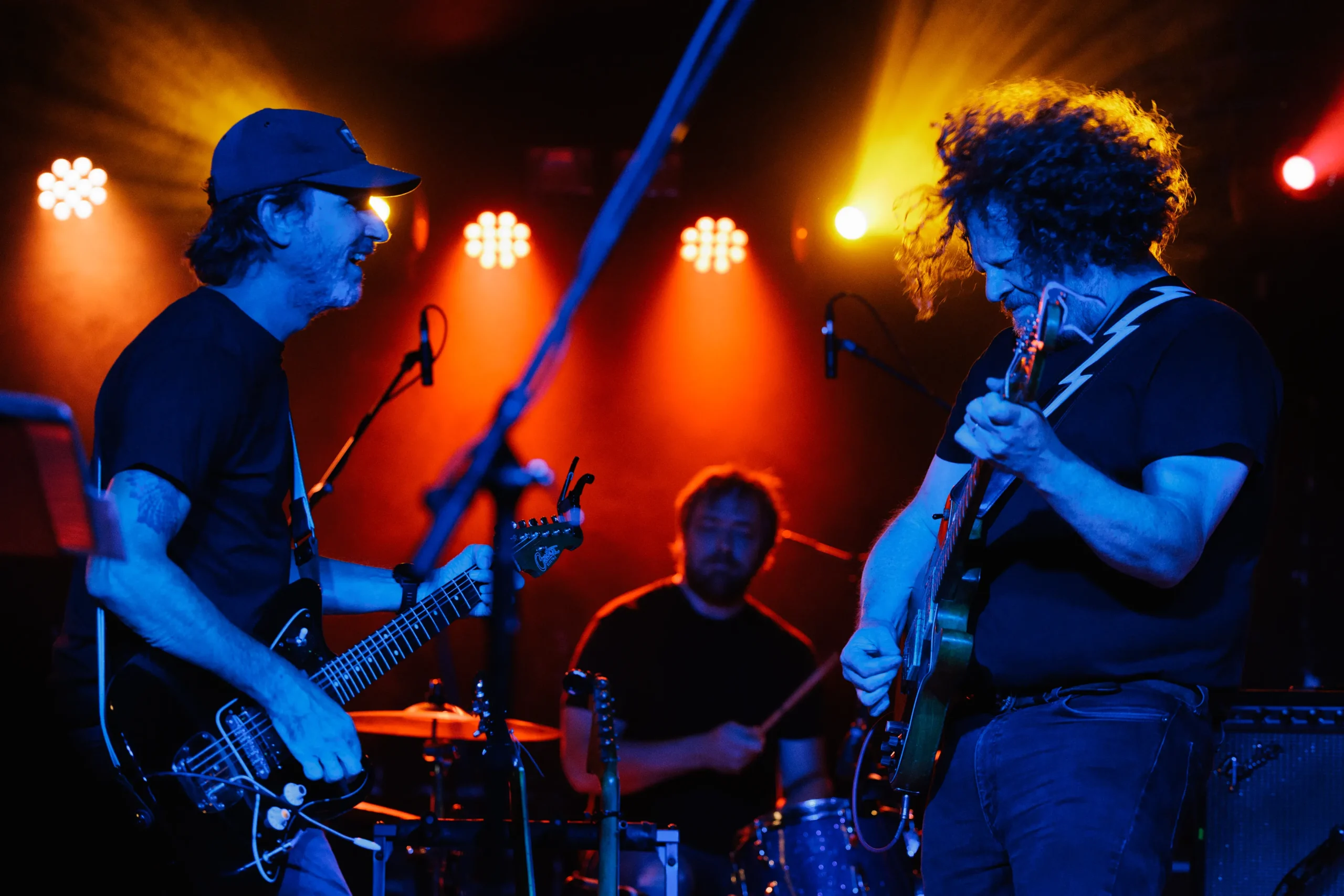
There was, in fact, one more performance after the last proper show—a smaller hang for a tight circle of insiders. Racecourse made their Jagjaguwar debut at Blockhouse, a venue that feels like a VFW basement with wooden walls and a roughly built stage—a perfect setting for a sweaty indie-rock rush. The band’s sound carried hints of classic emo, with glimmers of shoegaze and krautrock, yet everything fused into a distinctly invigorating indie-rock experience. The weekend distilled thirty years into three nights, tracing June Panic’s ’90s aura to Racecourse’s path forward.
And yes, there was, in fact, one more epilogue beyond the epilogue. Late Saturday night, after Racecourse, Blockhouse hosted a rare Tammar reunion. Featuring Ben Swanson, his wife, and a few former Secretly collaborators, it felt more like friends gathering to play for friends, with the room filled by those who’d watched the label evolve from its outset while Tammar’s frenetic psych-rock reverberated through the space.