When they emerged a few years back with a couple of accomplished EPs, Starcleaner Reunion presented an alluring, disorienting proposition. The band name alone sparked questions: Reunion, you say? What exactly is a starcleaner? The surreal cartoons decorating their records gave the group a distinctive visual language. And then there was the music itself, a surprisingly sophisticated post-Stereolab Euro chic that seemed to bloom from suburban New Jersey. It felt like this band had been displaced from time and space, and we were listening in on their hi-fi transmissions from just outside our shared reality.
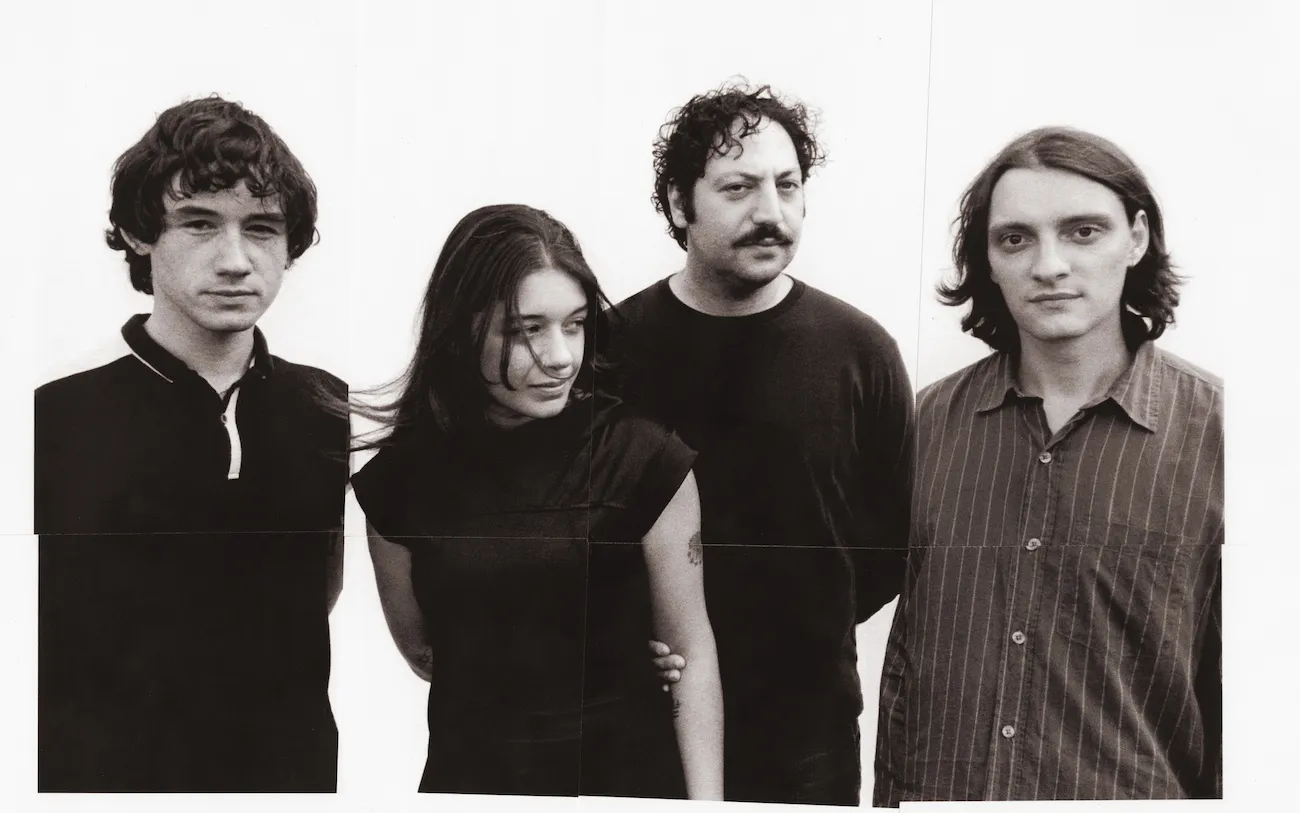
Yet Starcleaner Reunion aren’t aliens or travelers from another era. They’re longtime friends who spent adolescence bonding over music, swapping records, and forming bands in a variety of configurations. In 2022, those years of companionship finally aligned vocalist and tambourine player Jo Roman, bassist Adam Kenter, and guitarists Pat Drummond and Neil Torman, the quartet at the heart of this project. Now based in New York City, the old friends have spent the two years since their breakout Café Life EP crafting a commanding debut album.
Umbrella, released today, is an eclectic joyride through the late twentieth century’s most stylish sounds, revived and reimagined by zillennials who regard the pre‑internet underground as an idealized paradise. Starcleaner Reunion built these tracks without worrying about how to reproduce them live, resulting in lush arrangements full of surprising twists and turns. Guitar and keyboard textures abound, punctuated by banjo, brass, and even the “manta ray,” a friend’s bespoke aluminum cello.
Roman’s dreamy melodies draw listeners into the grooves. Across Umbrella, she paints scenes and feelings onto the music with a rare blend of unguarded intimacy and untouchable charisma. “Can you feel my vibes?” she intones on “Never Odd Or Even,” just as the motorik backbeat shifts into jazzy half-time reverie. The response can only be affirmative.
I found Umbrella captivating from the first listen, and my appreciation deepened after speaking with all four members of Starcleaner Reunion on a recent video call. Below, stream the album and dive into our conversation.
Your band name comes from a children’s book. How did you discover it? Did any of you have it in youth?
NEIL TORMAN: No one in the group had it as a child. I came across it years ago, just before we started the band. I wasn’t familiar with it, and I didn’t even read it fully at first. I simply saw the cover, and something about the imagery and the words clicked in a cool way. It was one of several candidate names, and it ended up being the one we chose.
What else about it clicked or appealed to you?
TORMAN: It sounded right, with a nice ring to it. The name mattered most, but the surrounding artwork carried a vibe that matched what we’re into—soft, hand‑drawn, a sketchy, charming feel. It felt like the whole package resonated with us. We didn’t read the book at first; it wasn’t until we happened upon another copy or someone handed us one that we appreciated it more.
JO ROMAN: Someone gave us a copy of a show we did that was signed by the artist, which was a really sweet gift. It was a lovely moment.
TORMAN: It’s just this one man, and the book is fairly old—likely from the ’70s. He did everything himself, running a tiny publishing operation; he drew it, wrote it, everything.
We know you all met in high school, but can you flesh out the origin story?
TORMAN: Our town was small, so anyone who cared about music tended to know one another. It wasn’t a vast, anonymous high school where you’re just another face; the class size was perhaps around a hundred per grade, so you became familiar with the other musicians. At different points, we bumped into each other musically. Pat, Adam, and I were in a band in high school. Later, Jo, Adam, and I formed another project with various lineups. Then Pat came back from a stint away, and that created a kind of supergroup.
ROMAN: I met Adam in marching band in 2012, and I met Neil in 2015 when we needed a guitarist for Adam and my little group. It started with me, Adam, and two friends, plus another guitarist, so we recruited Neil. I met Pat in physics class—around 2016.
ADAM KENTER: We weren’t all in the same grade, so we only shared high school years once.
TORMAN: Only for one year.
KENTER: I met Neil because I was in a band with him through my brother, who was dating one of Neil’s friends.
That’s Springfield, New Jersey, right? Was there a hangout for kids into cool music?
KENTER: The 7/11 parking lot.
ROMAN: When we went to shows as teens, Meat Locker in Montclair was a frequent stop—where we’d go to see or perform with our different projects.
TORMAN: Yes, but that was after we graduated. We then often headed to New Brunswick for basement shows, which became our stomping ground. The Meat Locker is a funny memory; it used to be a wild, anything-goes venue that was perfect for teenagers, and it’s quite different now.
Your sound has grown lush and sophisticated, yet even on the first EP you had a distinctive palette of influences. How did you envision Starcleaner Reunion’s identity and the kind of music you’d make?
KENTER: When we first connected with Jo in high school, she introduced us to Stereolab. They were a major catalyst for shaping our tastes and have stayed with me as a lifelong influence. In high school I was exploring many bands, but nothing stuck for long—until Stereolab and similar acts.
ROMAN: And to add to that, the four of us have always shared what we’ve discovered—constantly trading recommendations and pushing one another to explore more. That ongoing exchange helped mold our current sound. It was always a conversation, a shared discovery.
TORMAN: Because we’ve known each other since those formative years, there was a constant flow of musical and personal discovery. That created a special bond where everyone influenced the others. The Starcleaner sound, frankly, isn’t a radical departure from what we’ve always done; it’s a maturation of a path we began in high school, evolving but staying true to the core vibe we’ve carried since those early bands. It’s a progression along a shared trajectory—an evolution rather than a detour.
It feels very Gen X.
TORMAN: What makes you say that?
It’s the sense that if you were a cool Gen X kid, you’d be into things like C86 and Stereolab, the kind of music you’d discover in a pre-internet world. I’m the oldest possible millennial in the group, so I’m not speaking from total authority—just guessing.
TORMAN: We’re into that era, for sure.
ROMAN: We love that stuff!
TORMAN: Looking back, well, I can’t fully say this, but it feels like music kind of peaked in that era.
PAT DRUMMOND: That’s exactly what I was about to say. Indie rock as a scene had a moment—the college radio era, the zines, and the mix CDs you’d trade. There was a unique, creative energy in that period.
KENTER: It might be argued that it peaked in the late ’60s, which sparked a raised eyebrow among the group. (Laughter)
TORMAN: There was a remarkable convergence of energy and culture during that time, where experimentation thrived and boundaries were pushed. Since then, it’s felt more diluted, though of course that’s a hindsight view from someone who didn’t live through it. Still, that sense of fusion is how the music resonates with us.
Yeah, a lot of my favorite “indie” bands today draw from pre‑2000 inspiration. It seems people are trying to recapture a purer era, whether real or imagined.
TORMAN: That’s another big piece—the last pre‑internet bastion of culture and music.
How did you translate the sounds in your head for the studio? Did you have mentors in recording or was it something you hacked together yourselves?
TORMAN: It was mostly trial and error. You train your ear—certain tones and textures can’t be learned from a book; you learn by listening and then shaping what you hear through your own brain. It’s years of experimentation that gradually demystify the process and reveal how to achieve what you want.
KENTER: It also helps to dig through old forums and discover what gear other bands used, microphones, or preamps. Sometimes you discover a piece from the ’60s that you’d love to emulate, only to find out the price tag is astronomical. Then you search for more affordable ways to capture that sound. You chase those rabbit holes.
TORMAN: It’s about finding workable routes to a goal without breaking the bank—doing things affordably, which can yield more interesting results.
DRUMMOND: On this record, we didn’t rush the process the way we often do—recording, mixing, and mastering typically took longer than three months. If something didn’t sound right, we didn’t settle; we kept at it until it clicked, which let us tinker with the songs in a meaningful way.
Was gear particularly important for crafting the album’s sound? Any instruments or pieces of equipment you’d highlight, or is that a closely guarded secret?
ROMAN: Whoa.
KENTER: You’d have to pay us to reveal that.
TORMAN: No single gadget defined the record; each track leaned on a different texture or instrument. The banjo was among the more prominent auxiliary elements, not in a country sense but for its textural contribution. I found myself drawn to it and used it on a lot of pieces.
I admit I didn’t expect to hear banjo, but it works—what sparked its use?
KENTER: We borrowed it from our friend Drew, who received it as a gift from someone. It’s a simple story, but the result was that banjo found its place.
TORMAN: We once played a show at a friend’s place in Rhode Island—Betsy’s house with Asher White and others—and there was a banjo in the living room. I started playing it out of curiosity. The Beach Boys and the High Lamas were influences we admired, and their use of texture clicked with me. Banjo offered a percussive, tactile edge that felt fresh when applied to music with a metropolitan vibe, not rustic at all.
ROMAN: We enjoyed experimenting with textures across the songs. For “Docking In Oslo,” the door’s closing sound was kept in, and I mic’d a candle for a portion of the bass to lend an organic feel. It’s about trying unconventional sound sources.
Yeah, searching for unconventional sources.
TORMAN: It’s about keeping things fresh for us. Some tracks dated back longer, and while we weren’t bored with them, reworking them in the studio offered an opportunity to add new layers and textures and to recapture the excitement we felt when first playing them.
ROMAN: Absolutely—time to zhuzh things up. There was also talk about the instrument your friend built—the harp—what was it called?
TORMAN: She refers to it as the aluminum cello, or the manta ray because of its shape. It’s the most singular instrument on the record. A friend, Tallulah Calderwood, built it for her college thesis in composition or something similar. It’s a large sheet of metal with a single cello‑like string bowed across it, mounted with a contact microphone. It’s a wild, almost atonal thing. Meeting Tallulah a couple of years ago through our friend Lena opened our eyes to how it could fit into our music we hadn’t even known we needed.
That’s fantastic. What’s Tallulah’s last name?
ROMAN: Calderwood. Tallulah Calderwood.
On “Theme,” Jo, you sing, “This is my favorite song.” Is it truly your favorite?
ROMAN: When I wrote those lyrics, I pictured the guitar as a jingle—like a radio ad—so I built the vocal around that idea. The song is about hearing your favorite tune on the radio and wanting it to keep playing. It also serves as our own little jingle, a meta‑level thread for Starcleaner Reunion.
So that track functions as the album’s thematic touchstone.
KENTER: We initially toyed with a Sgt. Pepper–style reprise at the end, looping that melody somewhere else on the record, but it didn’t fit.
Yeah, the final sequence has a flow that doesn’t invite that reprise. Perhaps you’ll revisit the idea on the next release.
KENTER: That would be awesome.
ROMAN: I’m fond of bands revisiting a melody across albums. Stereolab did that—reintroducing a fragment from an older song into a newer one. When I hear that, I think, “Recycle that.”
Why the decision to sing “Pasillo Piso” in Spanish?
ROMAN: The melody lent itself naturally to Spanish. I tend to finish lyrics after the melody is set, so when I was drafting a vocal line for that track, Spanish felt like the right fit. We’ve only one other Spanish piece, “Que Dices,” from an earlier EP, but this time the language clicked perfectly.
Are you a native Spanish speaker?
ROMAN: Yes. I enjoy experimenting with another language when it comes to melody, and it tends to come out naturally. Sometimes I’ll start singing in Spanish, and the guys will say, “That actually sounds cool—keep it going.” Then I expand on it.
KENTER: It’s remarkable how it shifts the melody’s character.
ROMAN: It’s a tonal thing. For that track, the Spanish felt like a natural extension of the melody.
KENTER: English can be tricky to bend in that way.
On “Weather Instrument,” you have Gary Olson from the Ladybug Transistor on trumpet. How did that collaboration come about?
KENTER: We met him through Lightheaded, our friends from New Jersey. Jo and I contributed to a couple of Lightheaded tracks from their last album, which was tracked in Gary’s basement studio. That’s how we first connected.
ROMAN: The experience was magical.
KENTER: He kept showing up, so it felt natural to invite him to lay down trumpet on the track. We’re huge fans of the Ladybug Transistor, so having him contribute was thrilling.
ROMAN: We’re big admirers.
On “Eating The Alphabet,” you describe flying to see someone and you include the intimate detail, “I hope the sky’s not gray.” Or on “Tea Drops Park,” you write about watching television and solving crosswords. The music is so dreamy and otherworldly that it’s captivating to see how real life seeps in.
ROMAN: Much of my lyric writing draws from personal experiences and sometimes from dreams. I often write down my dreams, pulling direct details from them. “Eating The Alphabet” is about yearning and the challenge of long‑distance moments—living with the anticipation of reuniting with someone. It’s a made‑up narrative that still matches the mood of the song.
So it wasn’t based on a real romance?
ROMAN: It’s a small story I crafted, though I’m a romantic and a dreamer, so it felt fitting. The sky’s gray question is more open to interpretation.
With the album finished, you released it without worrying about how it would translate live. Now that you’re performing the songs, how are you approaching that?
TORMAN: We invited our friend Drew—who had played with me, Jo, and Adam before Starcleaner—to join for live performances. He’s not a permanent member, but he’s in two or three of our live setups, playing multiple keyboards, a sampler, and other auxiliary pieces.
ROMAN: We’ve included SP‑404, clarinet, falsetto vocals, shaker…
KENTER: And guitar. He’s in a wild, multi‑instrument arrangement that feels like a one‑man band in a spaceship. He won’t be with us every show, but his presence has helped bring the studio sensibility to life on stage, which is exciting.
TORMAN: We’ve talked about incorporating sampling more broadly, but Jo’s tambourine hands mean she’s the only one who can operate certain triggers while playing. If we added more, she’d have to drop the tambourine, which isn’t feasible given how beloved that element is. So it’s a balance—the live setup is evolving, but we’re happy with what we can do with the four of us plus a drummer for now.
ROMAN: Eventually I’d like to integrate sampling more, but it’s tricky—people love the tambourine, and I can’t be juggling too much at once.
KENTER: Jo’s the only one with free hands beyond Drew, so he enables a lot of the production that would be impossible otherwise. Still, we’re keeping the core live lineup intact for the foreseeable future, and the record will always exist in its own form.
Have you started writing more since finishing the album?
ROMAN: We’ve jammed a little and drafted a few new ideas.
KENTER: We’re demoing in my basement, pushing some fresh material forward.
ROMAN: Yes, we’ve generated quite a bit.
DRUMMOND: We did record a separate, special bonus track that won’t be on the album, and it should appear by year’s end.
Can you share more about what makes it special?
KENTER: It was written and tracked in about two weeks, crafted specifically for a compilation we were asked to contribute to, which should be released in October. Think of it as the post‑credit scene for Umbrella, the cliffhanger for a potential sequel.
TOUR DATES:
09/26 – Philadelphia, PA @ Minimart
11/07 – Queens, NY @ TV Eye
Umbrella is out now via Take Care Records.