“It’s essential to keep the sound fresh,” Justin Vernon explained. “For years it was basically just a G chord on a guitar. As I’ve kept at it, I’ve grown fascinated by a wider array of textures, too.”
It was September 2, 2016. Vernon sat at a conference-room table inside the Oxbow Hotel in his hometown of Eau Claire, Wisconsin, addressing reporters about his third Bon Iver record. 22, A Million stood about a month from release, but after four years of self-imposed retreat, Bon Iver’s publicity machine was finally back in gear. In mid-August, the group had revealed the album in full at Vernon’s Eaux Claires festival—a surprise unveiling that felt even more jarring once listeners heard the music.
That sense of wonder reached a global audience ten years ago today when 22, A Million officially entered the world. By then, Bon Iver had become an institution. The band effectively spent the span of Barack Obama’s campaign and first term cultivating its status as one of the most successful indie acts worldwide—an ascent that opened doors in abundance without necessarily turning Vernon’s project into a mainstream fixture.
Vernon’s ascent sprang from a well of failure, summoned during a mythic winter spent at his father’s woodland cabin as he wrestled with the end of a relationship and the collapse of the band he’d placed his hopes in. With 2007’s intimate, bruised For Emma, Forever Ago, Vernon offered a more accessible evolution of the so‑called freak-folk that had thrived in the underground scenes of the 2000s, smoothing its rough edges without betraying its experimental core. It was arresting music—haunting and singular, yet approachable enough to slip beyond niche boundaries.
Praised by both critics and a broad audience, For Emma and its companion EP Blood Bank had ripple effects Vernon never anticipated. The works helped clear space for stomps and handclaps and a cottage industry of gentle indie-folk, propelled Vernon’s falsetto into Kanye West’s sonic orbit, and pushed him to define himself beyond the “Skinny Love” portrait. Side projects proliferated: post-rock with Volcano Choir, soft-rock with Gayngs, and jazz on the live album A Decade With Duke.
For 2011’s Bon Iver, Bon Iver, Vernon reshaped his signature group into “a collaborative venture with Vernon as its central intellect,” as our own James Rettig once described. The music grew broader, trading the stubbly, celestial folk for windswept, emotional epics that defied genre. It amplified Bon Iver’s stature, winning further critical praise and earning the improbable Best New Artist prize at the 2012 Grammys. This triumph brought a dash of public confusion (turns out you can have Pitchfork’s top album of the year and still remain an acquired taste—sorry, Los Thuthanaka!) and even a spoof on SNL in which Justin Timberlake parodied Vernon.
As is common, success bred restlessness and unease for Vernon. “This dazzling upheaval of life after these records sparked an inner storm, a mental struggle of anxiety for Justin,” wrote his friend Trevor Hagen in a later essay accompanying 22, A Million. “Of course it did. The dream had taken on a life of its own.” In response, Vernon publicly stepped away from Bon Iver for a time. In a widely circulated remark from a Minnesota Public Radio interview, he described it like a faucet: he needed to turn it off and walk away, because so much of the music came from the subconscious and discovery. The spotlight on the band could be distracting, so he left with the hope that, if he ever returned—though not necessarily—and only if he truly felt ready, he would approach it with renewed clarity.
He then spent nearly all of Obama’s second term chasing fresh inspiration. There was another Volcano Choir album, more collaborations with Kanye, a revival of his blues‑rock power trio the Shouting Matches, further forays into hip‑hop with the Gayngs crew’s Jason Feathers project. He also traveled solo to the Greek isles, where he faced panic attacks and searched for a path forward. “I was trying to locate myself,” Vernon told the press conference. “I didn’t.” Yet the journey provided the spark that would shape Bon Iver’s next phase.
While in Greece, Vernon experimented with a Teenage Engineering OP-1 sampler and synthesizer. In his hotel room, after days of anxious wandering, he captured a line he couldn’t shake: “It might be over soon.” He chopped the recording with the OP-1 and noticed a recurring syllable in his garbled vocal that sounded like “two, two.” He had always found the number 22 meaningful, suggesting duality and the notion that “it might be over soon” could carry a foreboding or liberating undertone. A seed took root.
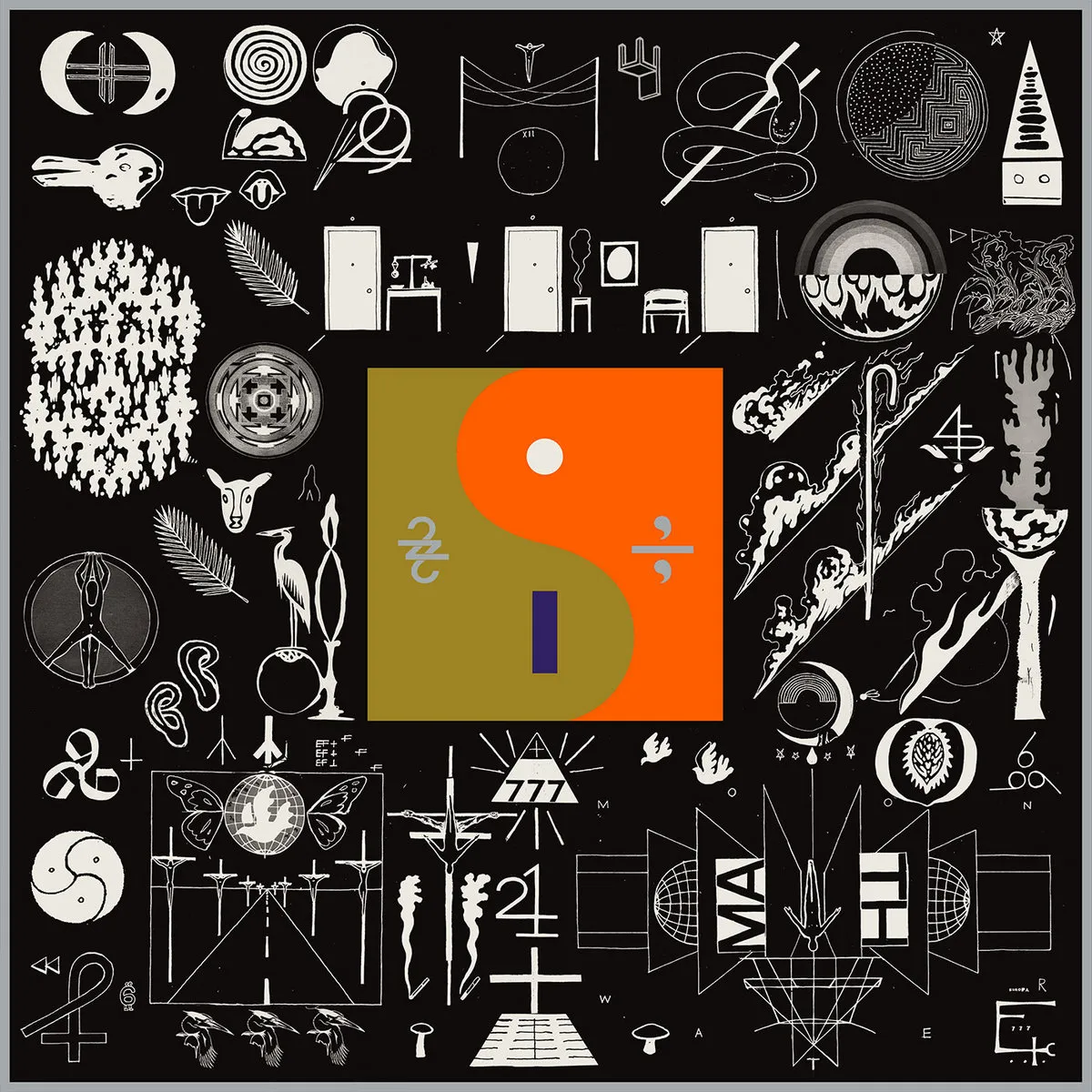
Ultimately, Vernon returned from Greece with a mere 11 seconds of audio. For months, that was all there was. Yet the floodgates eventually opened, and a vision for a new Bon Iver came into view. It would be intimate and spiritual, rooted in numerology and arcane symbols, expressed not only in sound but also in Eric Timothy Carlson’s graphic design and track titles like “21 M◊◊N WATER.” Rather than leaning on his trusty acoustic guitar, the plan was to connect varied tools in the studio, in electronic fashion, and to deliberately disrupt the familiar process. This was a subversion of the old Bon Iver: abundant sampling, manipulated vocals, and a collage of rustic, refined, mechanical, and otherworldly textures. It felt as though they had pried open Bon Iver, Bon Iver and built strange, alien structures from the wreckage.
By the mid‑2010s, the image of an indie band “going electronic” had become as much a cliché as sensitive folk-rock, but this wasn’t about chasing pop. Vernon joined a longer tradition in which a prominent, influential artist recognizes themselves turning into a trope and responds by twisting and obscuring the very elements that inspired so much homage. It’s akin to Picasso moving into cubism. More pointedly, it echoed Kid A, from the existential wobble that followed success to the embrace of avant-garde electronics to the erasure of a peerless, exquisitely resonant voice. (To quote our longtime pal James again: after witnessing Bon Iver premiere the album at Eaux Claires, he drew instant parallels to Oneohtrix Point Never, which felt compatible with Radiohead channeling Aphex Twin around Y2K.)
If this had been a purely reactive project—an artful foil to expectations—22, A Million could have collapsed under the weight of its high concept. Yet the reinvention worked, largely because Vernon shaped the process to serve deeply personal expression. These were songs where the Christianity of Middle America collided with the Taoism that fascinated him in college, where the finite self collided with the infinitude of the unknown. The music includes slices of everyday life, yet time faced eternity at every turn, as in the track that mentions the Ace Hotel while asking Jesus, “Why are you so far from saving me?” Even as Vernon grasps for transcendence, he weighs competing priorities: “A word about Gnosis: it ain’t gonna buy the groceries.”
Creating the album demanded a multidisciplinary approach, and beyond the material’s specific needs, Vernon sought a way to convey his ideas that didn’t feel rote. With input from friends, he crafted a new musical language for Bon Iver that paralleled his attempts to untangle layers of memory, philosophy, and sensation. Alongside co‑producer Chris Messina, the studio boss at April Base, Vernon developed “The Messina,” a hardware/software vocal processor that could bend his voice toward angelic and demonic extremes. BJ Burton, rising as one of the era’s most forward-thinking sonic architects, contributed his signature touch throughout. Dozens of Bon Iver’s orbiting collaborators joined in, enabling a singular blend of harsh electronics, regal orchestration, dreamy soft‑rock, and, yes, some earthy folk textures as well.
The results are staggering. The opener “22 (OVER S∞∞N)” immediately disorients you, floating from the speakers like a hologram rising from a crackling gospel disc, its bassy drone interrupted by Mahalia Jackson samples that crackle with lightning. From that weightlessness we dive into the intensely claustrophobic “10 d E A T h b R E a s T ⚄ ⚄,” a parade of rumbling, distorted drums and digital bass that hints Vernon absorbed something from Yeezus. When the familiar Bon Iver elements reappear, as on the stunning fingerpicked ballad “29 #Strafford APTS,” they feel translucent and hyperreal, as if uploaded from heaven onto a screen.
The album is a masterclass in sonic world-building that still honors Bon Iver’s indie roots even as it relocates them to a new environment. It sounds immense, yet crafted and intimate, like you’re immersed in the ProTools console with a Tron‑style sense of scale. Even so, the album’s spare passages may be its most stunning. Consider the finale sequence: “____45_____,” a hymn forged in fire built on a near‑absent brass texture, followed by “00000 Million,” a piano-driven spiritual echo chamber in which Vernon resolves to accept both the good and the bad in life. True to the album’s celebration of duality, it offers a path to growth that could align with Buddhist or Job-like reflections, albeit with a different set of conclusions about how to move forward.
One goal for this record was to move beyond the sorrow that pervaded early Bon Iver releases. “This record does deal with some dark themes,” he noted, “but the aim was to craft something bombastic, thrilling, and novel—music that collides and erupts, while also shouting and mixing things up.” They achieved the thrill and the force, yet tracks like the Woods‑sequel “715 – CR∑∑KS” still carry a tangle of romantic friction alongside his spiritual malaise. It’s telling that nearly a decade later, when Bon Iver resurfaced with SABLE, fABLE, Vernon was still speaking about escaping the persona of the earnest sad guy with a guitar. If 22, A Million didn’t deliver him salvation, its portrayal of the search remains luminous and resonant. Ten years on, it still feels new.