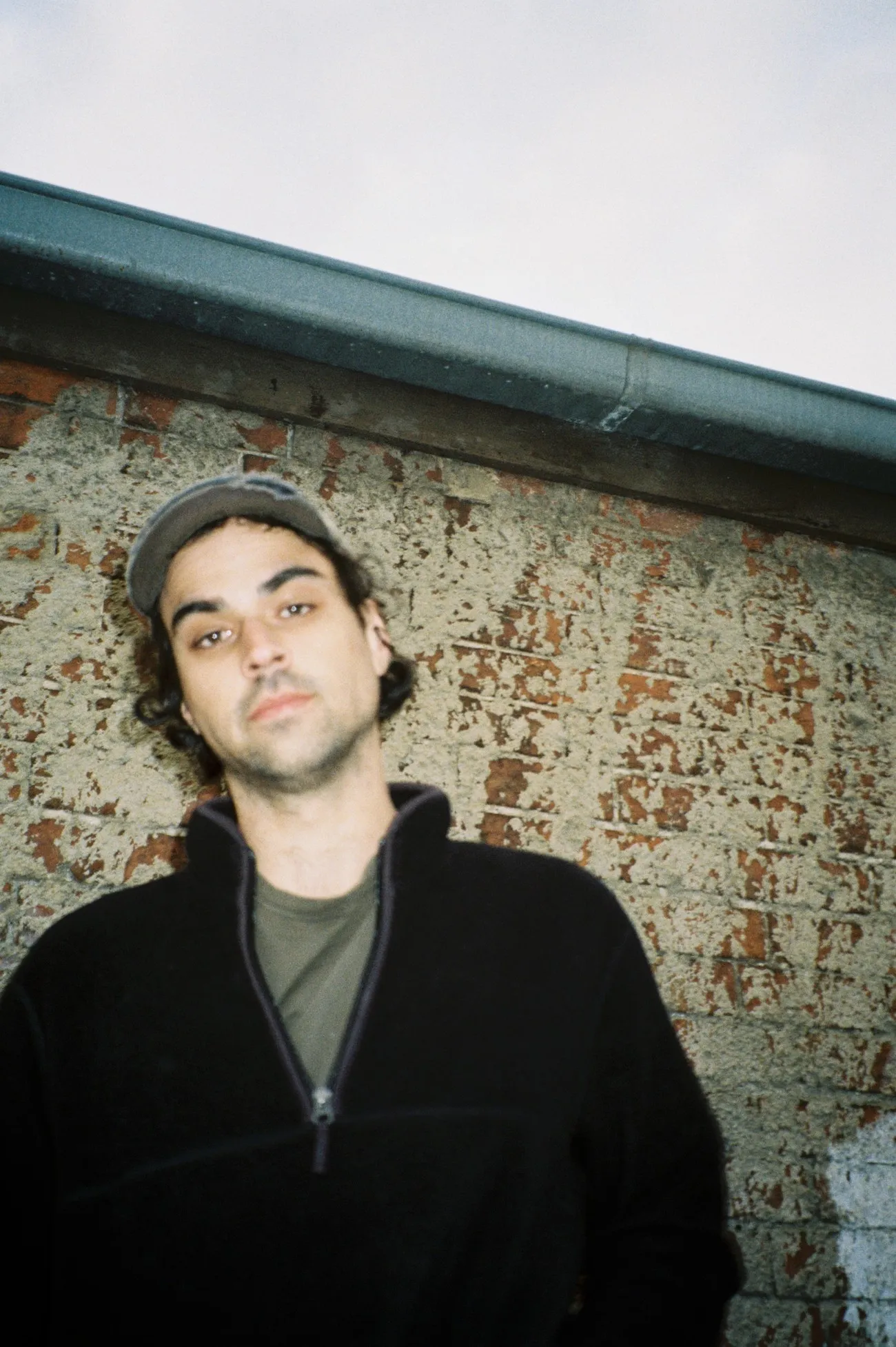
Way Dynamic is a laid‑back moniker that fits a band built for easygoing momentum. Dylan Young has been cutting records under that name since his university days at Melbourne’s RMIT about a decade ago, and the project has grown through the 2020s with a trio of albums produced in collaboration with Good Morning’s Stefan Blair. Yet the momentum really accelerated with last year’s Massive Shoe, a casual but outstanding throwback to the 1960s and 1970s that channels vibes from Paul McCartney, Nick Drake, and Talking Heads alike.
In contemporary terms, Way Dynamic feels like a cross between Tobias Jesso Jr.’s heartfelt Nilsson/Newman pastiche and Mac DeMarco’s breezy, loosely vibey indie soft rock. He was slated to tour the States with Star Moles this autumn, and there’s a shared thread between the two acts: they both bend retro influences into modern music that sits a touch outside of time. But the more you immerse yourself in Massive Shoe, the more you hear Young emerging as a distinct voice—anchored in the classics yet unmistakably his own. His plainspoken lyricism, the dreamlike focus, and a devotion to analog recording combine into an utterly listenable, even addictive experience. This is an album you can truly living with.
Plenty of listeners are already living with it. Initially issued via Melbourne’s Spoilsport Records, Massive Shoe exploded on streaming platforms and drew the attention of Jagjaguwar, the large American indie, which reissues the record today with a fresh bonus track, “Officially.” Way Dynamic was meant to be deeply touring the United States right now, but visa complications have pushed that to the beginning of next year. While American audiences will have to wait to hear Young and his band deliver these loose, buoyant, and refreshingly unpretentious songs in person, you’d do well to dive into the record as you read my recent chat with Young below.
Your earliest Bandcamp releases date back to 2018. What can you tell me about your life in music before that? Do you have a musical origin story or any bands you played with prior to Way Dynamic?
DYLAN YOUNG: Actually, there was a time when I had a handful of other EPs on Bandcamp that have since vanished. But Way Dynamic was always the umbrella name for whatever I was doing at the time. It began as a singular project meant to push us to create without constraints. I’ve been playing guitar since I was about eight, fronting bands in high school from around fourteen onward, and continuing through my adult years in Melbourne across different projects. Some of those outfits I’m still part of, like Cool Sounds—the guitarist in my band Dainis [Lacey] leads that project.
What were your teenage bands like? What styles were you exploring then?
YOUNG: One of my first outfits was Natural Mess, a name I might even revive someday—it’s kind of a strange one. We wrote originals, and I don’t know that there were specific influences—just the sounds you make when you first pick up a guitar, a drum, or a bass. It’s hard to say if that has a label. Later on, there was another band inspired a bit by Foals, and eventually another group that leaned more toward the Kinks, so I’ve always wandered across a spectrum.
Did you say Way Dynamic began as a university project?
YOUNG: Yes, it grew out of a music industry degree, though I didn’t find it as practical as I’d hoped. But in one class, an arts‑focused segment encouraged us to start something, and I did—giving it the name Way Dynamic.
In your music, I hear a rotating cast of influences from track to track, yet there’s a remarkably steady vibe throughout. Did you have a clear vision for what Way Dynamic should be, or is it more about what emerges organically?
YOUNG: It’s mostly what emerges. I’m a straightforward guy with simple tastes, though I do push myself to explore new ground occasionally. I hope the fourth record will feel the most different, though we’ll see. I can’t help but be shaped by the kind of songwriting I gravitate toward and the type of sounds I pursue, which tends to favor raw, immediate textures over heavy production.
Many artists wrestle with the challenge of expanding their sound without losing the soul of the project. How do you approach keeping Way Dynamic’s essence intact as you experiment?
YOUNG: I’m not worried about that at all. I like the idea that it could shift entirely; so far, though, it hasn’t changed drastically. If you go by the last eight years, I’ve stayed fairly consistent, and if you look back to eight years before that, you’ll see I was a very different person with different interests. The core remains intact, but it’s natural that it evolves over time.
You’ve long been a co‑producer with Stefan from Good Morning, and you’ve also participated in their band at times. How did your path cross with them, and what’s your relationship like?
YOUNG: It started within Melbourne’s scene. Stefan and Liam Parsons, the other songwriter in Good Morning, produced my first album. Liam moved to London, so he hasn’t been around for the later work. I’d known them for years and admired their music; they taught me a lot about recording on tape, which is now my method. Stefan is endlessly stimulating to bounce ideas off in the studio. They’ve taught me everything.
What makes him such a good collaborator in those moments?
YOUNG: He tends to be open and intuitive. Rather than chasing a preconceived plan, he nudges toward experimentation—adjusting knobs, moving with impulse, and then running with whatever clicks. It’s a kind of spontaneity that works because you trust the person you’re working with. Both of them operate that way.
From interviews you’ve given, it seems you prize a loose, free‑flowing studio vibe. Is that a central part of what you’re after?
YOUNG: Absolutely. Even when I bring a fairly formed arrangement, if something better surfaces during recording, we should follow that rather than cling to the original plan. That’s the spirit of a free‑flowing approach, and I think it serves the music well.
It’s easier to pivot when you’re not locked to a rigid plan. There’s a saying about steering a moving ship—
YOUNG: I’ve heard something along the lines of, “To direct well you need a clear vision and the ability to communicate it.” If you can adjust that plan on the fly without losing why you started in the first place, you’re onto something. That’s how it feels for me.
Besides finishing a song on the same day you begin it, what other tricks help you maintain that loose feel?
YOUNG: Not much in the way of tricks. Don’t rely on a formula, or you’ll lose spontaneity. But if you trust the people you’re with, you’ll naturally make interesting, even strange choices together. You’ll lift each other up.
You’ve acknowledged your instinct to be a control freak who wants to handle every instrument, yet Massive Shoe features a lot of contributors. Are you learning to loosen that grip?
YOUNG: Yes, gradually. Most of what others play is beyond my own chops anyway, so I have to let it happen. And I’m making a point to invite more spontaneity into the process. Some of my favorite tracks on the record are the ones where I wasn’t handling the entire rhythm section, even though I was part of it. I’d like to keep inviting more people into the studio and allow things to morph as we go, as long as I trust the people involved—the trust is essential.
Has the growing visibility of the project helped you connect with more interesting collaborators you want to work with?
YOUNG: So far I’m still in that world where I’m close to my crew. I’d love to work with people I admire, but I can be quiet and shy around those I truly respect, which isn’t always freeing. It’s hard‑won experience—decades of learning how to be playful with these other artists.
You’ve spoken about aiming for a balance between precise, concrete specifics and broader, more philosophical statements to make the songs feel universal. Why does that approach resonate so strongly?
YOUNG: Those are two powerful storytelling routes. The very specific details can become universal when listeners project themselves into the scene; the exactness is almost a doorway. Conversely, broad existential ideas by themselves can feel distant. When you blend the two, they amplify each other and add depth. I’ve noticed this pairing in music I love, time and again.
Were there particular songs or artists that sparked that balance for you?
YOUNG: A few years ago I had a big moment with Andy Shauf’s storytelling—remarkably specific and vividly told. I think Dylan himself has that capability as well. Maybe he can do both, which is what I’m aiming for.
I must admit I hadn’t connected to Andy Shauf until now—that makes sense. In “Interview,” you sing, “Flying to space in a massive shoe/ And I’m still the one who wakes up next to you.” Is there a personal backstory behind that image? I’m curious about where that line came from.
YOUNG: I’m not great at recalling why I write things, but I’ll try. It’s likely about looking back on a relationship that’s no longer there, or has moved on. “Flying to space in a massive shoe” is abstract imagery about what you could have achieved together, while “wake up next to you” provides a contrast between the surreal and the grounded. It’s more about mood than a specific incident.
So there wasn’t an inside joke about space travel in a shoe?
YOUNG: No—just imagery. I strive for something specific enough to anchor a feeling, yet vague enough to let people read their own meanings into it.
In “Mercy Town,” there’s a quirky piano break with a gnarly bass line in the middle. Where did that moment come from?
YOUNG: A lot of writing for me is improvisational in the moment. You try something and follow your ears until something clicks. It feels like a Brian Wilson‑type melodic moment, perhaps with a little Harry Nilsson in its spirit. I was drafting it with a friend, and we built that section together, pushing one another to energize the track.
Is “Ibiza” drawn from an actual trip, or is it more of a symbol you’re using?
YOUNG: I’ve never been to Ibiza, though I’d love to go. The song isn’t about a real trip so much as exploring a sun‑soaked club fantasy and interrogating what feels genuinely legitimate in that realm. It’s really about questioning aesthetics and what lies beyond surface coolness, more as a rumination than a fully worked concept.
“Officially” was added to this reissue. Was it an outtake or a newer piece finished more recently?
YOUNG: It’s a somewhat newer addition, but not so new that I’d save it for the next record. It felt right to place it here, as it speaks to relationships and to the arc of Shoe. It provides a fitting closing note to the whole collection.
So it’s about starting anew while the other songs mark endings?
YOUNG: Exactly.
How did you land with Jagjaguwar?
YOUNG: It wasn’t a dramatic tale. The chance to join a new label came along, and after meeting several labels, Jagjaguwar felt right—calm, straightforward, and aligned with how I like to present myself. I appreciate their roster and how they talk about music; they understand how I want to be perceived—neither overly serious nor flippant—and we’re finding a balance together.
Is it odd to be promoting the same album for a second year in a row?
YOUNG: It’s a little odd, yes, but we didn’t really promote it the first time around. It mostly found its rhythm in the streaming algorithms. I hope word of mouth has played a role too. We’re not done with it yet; we’re still playing many of the songs live for the first time, so it still feels vital. We’re close to turning the page toward the next record and finishing its writing.
So you’re nearly done with the new batch, but you haven’t hit the studio yet?
YOUNG: We’ll be in the studio very soon.
Any sense of how the forthcoming songs might differ from what you’ve done?
YOUNG: I’ve been listening to more rock and expecting a bit more mayhem. I’d like to involve more people—letting the same players contribute more often or inviting new hands—to embrace more risk and to lean into tape with fewer corrections. I’m aiming for something that sits between the abstract and the narrative, and I find myself picking up the electric guitar a lot more lately.
You’ve mentioned recording to tape before. Is it about the texture and feel, or is the tape aspect more about limiting editing and punch‑ins?
YOUNG: The texture is nice, but the real value is in preserving realness—letting takes stand without heavy comping or overpolish, so what you hear is a genuine snapshot of that day’s performance. That raw honesty is what this project is about.