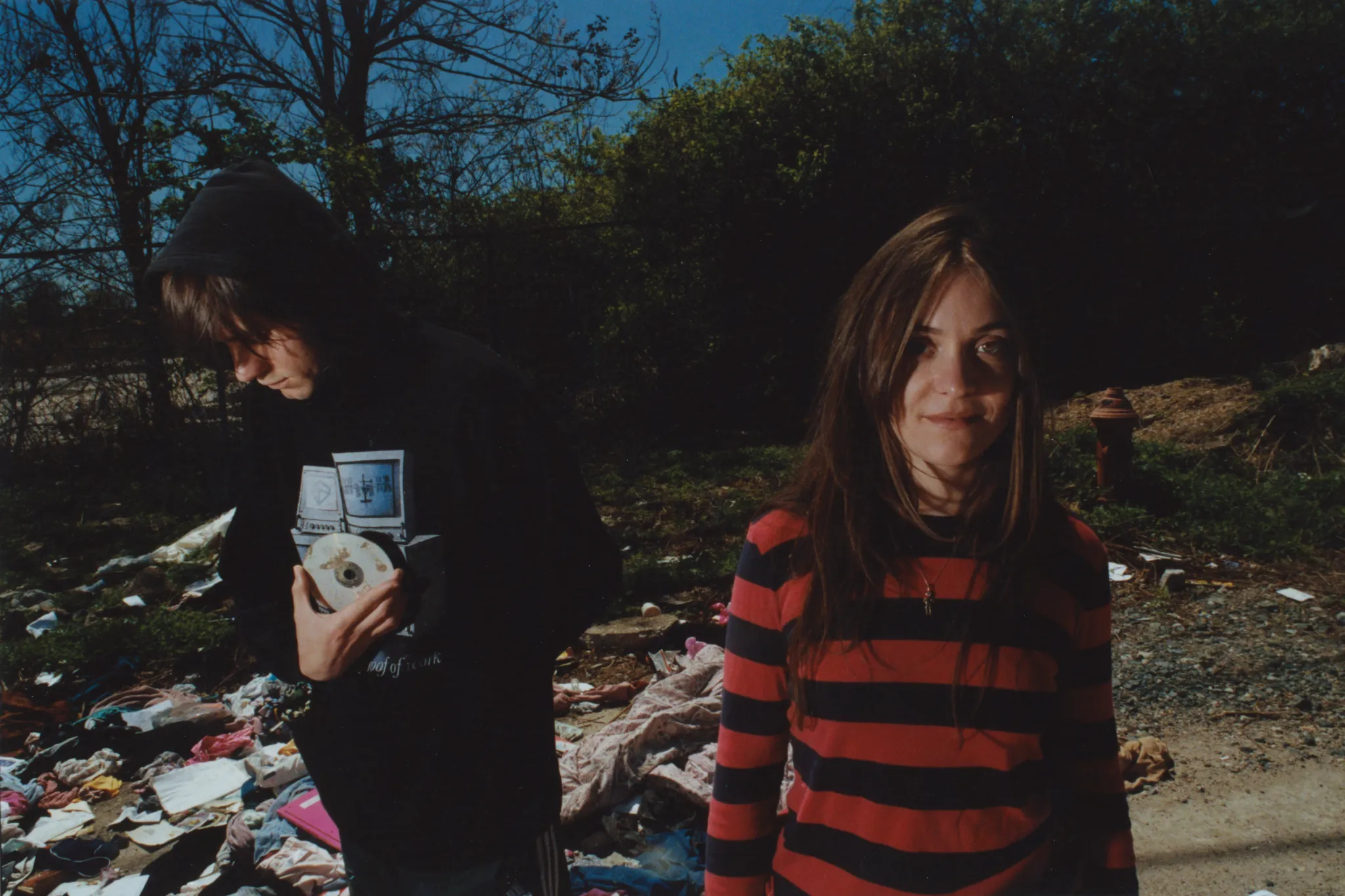
The Philadelphia duo @ has entranced listeners with a time-bending take on folk ever since joining forces in the early days of the pandemic. With Autosmile, their second full-length and debut on the storied 4AD label, they push their sharply modern yet enduring songwriting to new limits, venturing into darker corners of their sound without ever losing sight of the luminance.
The new record presents singer‑songwriters Victoria Rose and Stone Filipczak continuing to fuse influences in compelling, invigorating ways, weaving elements of avant-folk, grunge, psych, prog, indie-pop, and subtle electronics into a shifting, unmistakable style all their own. I detect hints of Alice In Chains, Elliott Smith, Animal Collective, and a broad array of 1960s and 1970s oddballs. Yet mostly I hear @ seizing clearer command of a framework that feels like summoning ancient magic.
“When I try to calm my mind, I dream of an alternate timeline,” they chant on “Punish My Mind,” a line that fits an album straddling several lineages without fully aligning with any single one. The lyrics mirror the duo’s yearnings, struggles, and revelations in vivid, poetic strokes while remaining just elusive enough to invite ongoing contemplation. Even when baring their souls, the pair remains intriguingly difficult to pin down.
In conversation as well, Rose and Filipczak strike a balance between candor and mystery, keeping a sense of intrigue about their songs. On a video call this week, they walked through Autosmile track by track, shedding light on one of the year’s most provocative and thought‑provoking new musical statements. Below, dive into the album while following our interview.
1. “Bird” — Origins and Omens
Stone, in the note you released with this track you mentioned inspiration from the baby birds that kept turning up lifeless on your deck. Was it a recurring occurrence?
STONE FILIPCZAK: Yes, it happened several times. It recurred annually at a particular season. It drew from a specific year and was, in its own way, fascinating.
What was fascinating about it?
FILIPCZAK: It felt like a dark omen. I spent a lot of time on the porch, stepping out to a fresh little corpse each midmorning. It seemed like a natural process going awry, perhaps as if they were being pushed out of the nest or something similarly odd. It was a peculiar period.
You described it as a dark omen. Overall, compared with the previous album and EP, Autosmile reads as a darker record. So that feels like a natural opener. Yet the songs themselves aren’t strictly binary in mood. They carry more ambiguity than outright gloom. Am I on the right track?
VICTORIA ROSE: Definitely, yes. For sure.
Is this a conscious aim for you as songwriters, or more a reflection of life on Earth as it unfolds?
ROSE: It’s more a reflection of Earth’s natural state. It’s hard to enter a piece with the intention of making it “really dark.” You just let the song emerge as it does.
FILIPCZAK: During the process we realized this album carries a noticeably darker tone than the debut. It wasn’t a deliberate choice, though. Mind Palace Music captured a specific moment—COVID’s gloom, but also a strange levity and joy in many people’s lives, a time when hobbies and even some spare cash flourished. It felt energetic and prolific, and we poured a lot of energy into finishing it quickly. This new record, by contrast, reflects the starker doldrums and the various pressures that have shaped the last five years.
Personal, perhaps, more so than societal?
FILIPCZAK: Probably a mix, but more on the personal side. I’d call it a very intimate album.
2. “Love In The Dark” — The “Hey” Motif, Intimacy, and Fate
I was struck by the use of “Hey” to usher in verses. In terms of personal songwriting, does that add a sense of immediacy or informality to the track? Did the lyric begin with “Hey”? How did it end up becoming this motif?
ROSE: Often I’m writing to a person or figure, and adding “Hey” gives it a casual, conversational edge—perhaps how I feel while crafting the lyric. Rhythmically, it’s a handy, single word to introduce a line and buy an extra beat.
FILIPCZAK: It’s a staple on all of our releases so far—there’s a song that begins with “Hey” on each project.
I hadn’t noticed that.
ROSE: It’s basically a habit.
There are intriguing tensions in this track between plans and destiny, between yielding to nature and striving toward an outcome. Do you feel you plant a flag at the close with the “line in the sand,” suggesting we retain some agency? Am I reading it right?
ROSE: Absolutely. We do have agency and the choice to lead with love, connection, and empathy where appropriate, regardless of what might follow in a relationship. Certainty isn’t a prerequisite for taking that path.
Musically, the ending features a chaotic guitar flourish—acoustic and electric—with a distinctive approach. Is there anything special about the instruments used on this track?
FILIPCZAK: The ending layers at least three guitars: Victoria’s rhythm guitar, an electric guitar that’s tapping along with the keyboard’s melody, and a 12‑string guitar solo that’s doubled and harmonized with itself. It’s probably my favorite guitar part on the track because it’s pushed to the point of distortion—cranked through a mic preamp so the signal becomes a huge, blown‑out texture without any pedal involved. The intro uses a fuzzy electric guitar achieved by running a cheap interface input at full tilt, which digitally distorts rather than via a pedal.
For live shows, do you prefer set‑ups that translate easily, or do you treat the studio version as a separate creation?
FILIPCZAK: It varies by song. Some tracks we can arrange in advance for live performance, so those versions stay closer to the studio. Others, like “Love In The Dark,” we let roam and figure out how to perform afterward. In live renditions, I use a distortion pedal for those sections, and the live version often diverges from the record. We aim to convey the song and its core writing rather than replicate the studio arrangement.
3. “I Know You Are (But What Am I Thinking)” — Emo Peaks and Classical Reveries
You’ve called this the most emo track on the record. What prompted that?
ROSE: It’s in the melodies and the lyrics, really.
FILIPCZAK: It’s the lyric weight, but the center section—especially the bridge—feels exceptionally emo. We were working on it and Victoria warned me, “This might be as emo as @ can get.”
ROSE: [Sigh] Yes.
There are almost classical or baroque touches in the melodies. What inspires you to weave those elements into the writing?
ROSE: Classical influences show up—though I hadn’t intended to frame it that way. I did choir for a decade, so some of that training leaks into my melodic sense. It’s also a deliberately heightened, emo‑tinged melodic line that I introduced.
FILIPCZAK: I hear a Beach Boys‑like vibe in the melody as well.
ROSE: It all depends on how the rest of the song feels.
And Brian Wilson’s own emo side, right?
ROSE: He’s definitely a piece of that.
FILIPCZAK: Indeed.
4. “Earthly Love” — Three‑Part Harmonies and a Simple Live Soul
This one features backing vocals from Nina Ryser. How did you connect with her?
ROSE: Nina is a close friend and an immensely talented musician from Philadelphia. She played drums with our touring band for a couple of runs and sang harmonies in our live version of the track before the studio cut existed. Since it worked so well, we kept her harmonies intact for the recording.
FILIPCZAK: This one may be the track closest to our live sound; we actually recorded the vocals with the three of us in the same room. It’s somewhat unusual for us, to be honest.
Is the song more about ambiguity—whether you win or lose, it feels like a path forward?
ROSE: It’s about the tension between transcending longing and choosing love or a spiritual path, versus the pull of wanting the thing you deeply desire. There’s a playful irony in how the song navigates those wants and the work involved in pursuing them. It’s the core idea here.
5. “Your Dog” — Echoes of a Legacy and a Literal Perspective
The line of thought here makes me think of a lineage of dog‑themed songs—“I Wanna Be Your Dog” and “I Don’t Want to Be Your Dog.” Yet the lyric about waiting to evolve until you can say how you feel makes me wonder if this could be written from a dog’s viewpoint. How should I read it?
FILIPCZAK: You’re not wrong. The song is about a dog that grows into a speaking being—all metaphorical, of course, but it’s open to interpretation.
There’s a sense of it being concise—like a few lines, followed by extended instrumental passages. How did you decide on a shorter form?
FILIPCZAK: There wasn’t a deliberate decision; it simply unfolded quickly—the kind of track you write and record in a morning. It’s more pared down than most on the record, which otherwise aims for more substantial, fully realized tracks rather than an album full of tight little fragments. It’s very much a direct, linear piece without a traditional verse‑chorus structure.
6. “Untitled” — Wordlessness and Musical Seeds
“Untitled” waits a while before any lyrics arrive. It feels almost instrumental in its opening, and it’s beautiful before the words show up. What sparked it?
ROSE: That track is more of a musical concept—the lyrics are more word‑salad than narrative, not essential. The guitar and vocal melody came first, with Stone and our friend Nino [Soberon] shaping the arrangement. It was among the first pieces we worked on, though not the absolute first, and we’ve performed it for a while.
FILIPCZAK: It’s also very close to our live arrangements. It’s one of the earlier songs to take shape, and it’s relatively simple to adapt for a live setting because of its basic guitar structure, yet it remains deeply musical. I’m not sure I have better vocabulary for it.
To you, what was the impulse behind making the album avoid a collection of tiny pieces?
ROSE: The aim was to craft songs with substantial weight and presence. With 4AD on board, we wanted a coherent, capital‑S Song collection rather than a handful of short experiments. We brought to the project material that felt fully formed and ready to stand as a complete track.
Was the broad streaming era’s taste for quick, chorus‑driven hooks something you were reacting against?
ROSE: There’s some truth in that. We’re not consciously muting the impulse to be concise, but we stay true to what naturally inspires us, drawing from older music rather than chasing a streamlined format. Short songs can be great if they serve the track; otherwise, we go with what feels right.
FILIPCZAK: Each track has its own length and shape, and forcing a time constraint is not the goal. It’s about what the song needs to be.
7. “I’m Not In Pain” — Cello, Chaos, and Humanity in Union
This one foregrounds the cello yet sits within a full rock rhythm section. Was that juxtaposition intentional?
ROSE: Absolutely. From its inception I pictured both these textures together—the cello’s melancholy against the punch of a rock ensemble. It channels ’90s grunge cello energy, and I’ve leaned into that in the writing.
In terms of dramatic relationships, it seems to argue that two people may be better apart overall, letting each live more fully. Am I reading the idea correctly?
ROSE: Yes, that’s a common thread for many people who find independence and self‑care more enabling than staying mired in a toxic setup. It’s not just about personal happiness; it’s about becoming a more generous, healthier person overall.
The track also undergoes a shift in texture—how did you approach that sonically?
FILIPCZAK: This piece went through several iterations, including one with a live drum kit. Garrett Burke learned a part I’d previously programmed, and we even experimented with a version driven by electronic rhythms. In the final cut we kept only the live drums and bass, discarding the rest, and added the guitars to paint a bigger picture. It was a first for us to record a section with a live rhythm section—something we’d like to explore again in the future.
ROSE: I could even imagine future records with more live percussion.
FILIPCZAK: The shift toward live drums and bass has become a kind of signature for experimentation—our approach to shaking things up.
It’s interesting to think of live drums as a destabilizing influence for your process; you seem to enjoy the change it brings.
ROSE: Yes, it’s a refreshing difference. We don’t usually record with a kit, so when we do, it feels transformative—though you can still craft something convincingly “live” within the studio’s confines.
FILIPCZAK: There are moments where listeners might mistake programmed drums for a live kit, but the truth is often more cunning—subtle real percussion smears the lines just enough to keep things interesting.
“Love In The Dark” there’s enough varied percussion that it could read as a real kit, or a tapestry of separate pieces.
FILIPCZAK: The trick is to blend elements—shaker and bongos alongside a kick—so the ear accepts the rhythm as organic, even when the source is synthesized. We enjoy fooling the audience sometimes.
ROSE: We’re pulling a few fast ones on the listener.
8. “Punish My Mind” — The Shriek of the Monkey and the Mind’s Echo
What’s up with the shrieking monkey? Why that sound?
FILIPCZAK: It was simply the right sound for the moment.
Where did you source it?
FILIPCZAK: All the nature samples come from YouTube.
Was it a question of “This song needs a shrieking monkey,” or more like, “I’ve got this shrieking monkey, and we should write a song around it?”
FILIPCZAK: More the former: we add sounds where they seem to enhance a section, not always to fulfill a preconceived idea. Samples are a fun tool to experiment with, and this one happened to land well.
ROSE: You can’t overthink the samples—just search, try, and see what sticks.
FILIPCZAK: It’s about entering a non‑judgmental space and dropping a monkey into the arrangement. Sometimes it works; sometimes not. This time it did.
And is there a sense that this track feeds into the same exploration of accepting love that you pursued in “I Know You Are” — a continuation or a separate thread?
FILIPCZAK: It’s plausible they touch on similar ideas, but the tracks were written years apart and aren’t intended as a pair. “Punish My Mind” was among the earliest songs written for the album, while “I Know You Are” arrived later. Still, their thematic resonance is perceptible and thoughtful.
9. “Judgement Farmer” — A Fragmented, Spiritual Soundscape
This track stands out for its looseness; it feels less tactile, perhaps more ethereal or spiritual. What are your thoughts on its origin?
FILIPCZAK: It’s deliberately formless, a kind of vaporware in song form. It’s almost a chimera, a collection of ideas fused together, with its ending lines—“Going to be a judgment farmer / Plant ’em and let ’em grow / Reap ’em and let ’em go”—serving as the grounding metaphor. The biblical imagery isn’t dragged hard; it sits within the texture rather than dictating it. The weight of the piece lands at the end.
When you place “Cain and Abel” beside “farmer,” I think of the biblical duo’s roles—one tending livestock, the other crops. Was that intentional or mere coincidence?
FILIPCZAK: It’s a credible reading and something I enjoy hearing; it’s certainly a viable layer to the song’s symbolism.
10. “Autosmile” — A Love Song with Melancholy and Momentum
This one feels like a love song on the surface, yet it also nods to a breakup vibe—almost like a “thank u, next” moment.
ROSE: Not exactly a breakup anthem, but I’m notoriously lovelorn. A lot of my songs end up in a space where happiness and heartbreak coexist, and this track embodies those two sides: attachment alongside disempowerment, with a path to reclaiming that part of myself.
Why did you choose this as the album’s title track?
ROSE: There wasn’t a concrete reason behind naming it that. The label didn’t push for it, either. It simply arose as a unifying idea, and when the album title came together, we decided to make Autosmile the central track. It fit as the dominant statement for the record’s mood and message.
Was there a deliberate choice to keep the arrangement relatively spare given its seven‑plus minutes, or did it evolve that way?
ROSE: The main body is relatively minimalist, which is part of its hypnotic effect. The piece features several distinct sections and an almost mantra-like chorus that repeats to build momentum. The arrangement’s evolving nature helps sustain interest across a long runtime, and some listeners have called it repetitive—though I see it as a deliberate design that grows with repetition.
FILIPCZAK: The track begins with a chorus and gradually expands, allowing the textures to shift around the vocal line. We explored harmonies that evoke a quasi‑Animal Collective ambience before the piece breaks into its expansive finale. The process of layering harmonies was a high point in the arrangement, and we loved seeing how it unfolded.
It’s a bold choice to begin a long song with the chorus, a decision which some artists famously warn against because it can overexpose the hook. Yet here it works beautifully. What drew you to that approach?
ROSE: It felt like pressing the core idea from the outset and letting the rest of the track make sense around it. The hook comes early to anchor the listener, while the subsequent sections explore how the concept reframes itself in different musical colors. It’s a bold, but intentional, choice.
11. “Amity” — The Concluding Thread and an Open Ending
This piece flows into the finale, a sparser offering, yet you still sense a convergence of genres and ideas even when the instrumentation is minimal. Is part of its eerie, singular character rooted in the song’s bones rather than how you dress it musically?
FILIPCZAK: Yes, I’d say so. The song’s backbone—its chords and progressions—helps fuse the disparate influences into something that feels both timeless and contemporary without leaning too hard on any single past era.
Are you aiming to merge different song‑craft traditions here? Is there a conscious intention to blend sounds from varied sources?
FILIPCZAK: Not in a heavy‑handed way. We’re drawn to many eras of music, and we try to write songs that reflect the breadth of our tastes rather than replicating one specific genre or era.
ROSE: I’m always pulled toward music that sounds comforting to me, and that inevitably brings together a mix of guitar styles and textures formed by what I loved growing up. The blend comes from our shared history and tastes rather than a strict plan.
FILIPCZAK: We often point to two reference frames for our songwriting: the ’60s–’70s folk and singer‑songwriter strand, and the ’90s‑’00s grunge/alternative vein. Those two streams have shaped our sensibilities in distinct but complementary ways, and they continue to haunt our approach.
ROSE: That’s right. The ’90s indeed carried forward some ’70s ideas, providing a bridge that suits our sound. Given what we create, these two eras remain prime reference points, even as our arrangements diverge in unexpected directions.
And as for the album’s end—an open, undecided note, perhaps a form of ellipsis—should listeners take it as a hint of possibilities, or a necessary pause?
FILIPCZAK: It’s not designed to serve a single function. It carries room for interpretation, from quiet emptiness to hopeful renewal. I felt more emptiness while writing it, yet I also sense there’s potential and hope within the final lines. It isn’t meant to be strictly sad or strictly uplifting; it’s intentionally open to multiple readings.