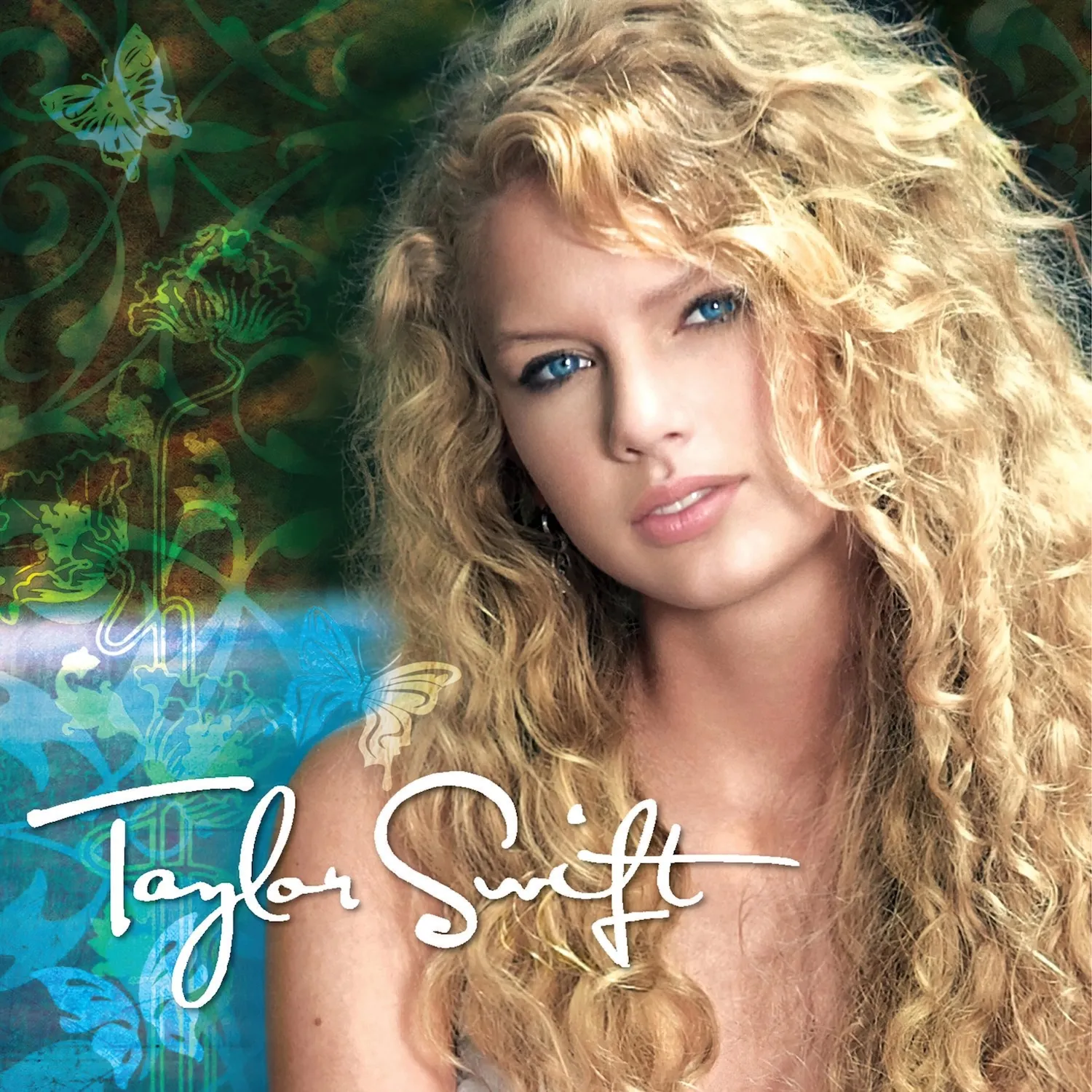
“Hello, I’m Taylor.” That line turned out to be the sudden twist. Before Taylor Swift stepped forward to introduce herself to Tim McGraw, right after delivering the tune “Tim McGraw” to him, I hadn’t even considered the possibility that Swift might not have met McGraw yet. To me, the song “Tim McGraw” could have been nothing more than a branding ploy connected to McGraw, the person. But evidently, that wasn’t the case.
In 2007, Tim McGraw sat at the pinnacle of the country-music world. He had spent more than ten years in the business, already compiling two greatest-hits collections. He was married to fellow superstar Faith Hill, and the two of them filled arenas together. He’d already crossed over with Nelly, and he’d made his cinematic debut in Friday Night Lights. And he had the opportunity to witness, from the front row, a rising star whose career would soon overshadow his own in every imaginable way, turning his name into a reference point. We’d all be so fortunate.
Taylor Swift encountered Tim McGraw in May 2007 at the ACM Awards, the less prestigious of the two major annual country ceremonies. Both Swift and McGraw returned home empty-handed that night. McGraw lost the Entertainer Of The Year award, the event’s grand prize, to Kenny Chesney. Swift missed out on Top New Female Vocalist Of The Year, an award that could exist only on a show like the ACMs, to Miranda Lambert, who deserved her win. (I didn’t write an Anniversary piece about Lambert’s 2005 debut Kerosene, but it’s a finer album than the very good one I’m discussing today.) Swift clearly should have met McGraw before that evening. They lived in the same town and worked in the same industry. She had already named her debut single after him, and it had already become a Top 10 country hit. If someone named a hit after me, I would likely make a point of meeting that person. Tim McGraw didn’t.
The on-camera meeting between Swift and McGraw could, of course, be a fabrication, a cute showbiz anecdote. Swift and McGraw could have met years earlier — perhaps in 2004, when Swift, still a ninth-grader, convinced her family to relocate from the Philadelphia suburbs to Nashville to pursue her country-music dream. But I believe the tale. We have the moment captured on tape, immortalized in countless YouTube clips. I’ve seen Swift’s acting, and I don’t think she could convincingly portray the nervy mixture of insecurity and audacious confidence that radiates when that scene is rewatched.
Here’s how it unfolds: Swift takes the stage alone at the MGM Grand in Las Vegas, playing an acoustic 12-string guitar and singing into a headset mic strapped to her head. Her hair is enormous, curly, and glossy. You can hear a faint tremor in her voice, despite the fact that she’s clearly poured all her considerable performance talents into concealing it. The crowd cheers at every big moment — when she hits the chorus, when she descends the staircase into the audience, when the spotlights land on McGraw and Hill in the front row. McGraw and Hill clap along through every chorus as Swift hovers above them the entire time. It’s awkward, yet endearing.
When the song ends, with her guitar still buzzing, Swift introduces herself to McGraw and then to Hill, extending her hand as if a student president meeting a state representative on a field trip. McGraw pulls her in for a hug, and Hill does the same. Swift turns to the camera, her finger jabbing at the space between herself and McGraw, and stage-whispers, “That’s Tim McGraw!” She repeats it twice. McGraw wears a serene smile, as if to say, “Yes, I am Tim McGraw.” And thus begins a long career of mugging for award-show cameras.
I watched all of this unfold live on television. I’d been a full-time music critic for a year and a half, and I regarded it as my duty to watch and blog about every awards show that involved music. That night, more than 500,000 Americans already owned copies of Taylor Swift, the debut album from the eponymous singer. Within a few weeks, that number would climb to a million. I probably wasn’t among those Americans yet. I certainly bought the CD eventually, but it took time. Five different songs from Taylor Swift became country radio hits between 2006 and 2008. I liked all of them. At some point, it seemed foolish not to own the album.
That’s how it used to be with major records. You’d hear them one tune at a time, as the singles rotated on radio stations and music-video channels. Maybe one song was enough to persuade you to buy the CD, or perhaps it took three or four. Taylor Swift arrived in stores twenty years ago this Saturday. A decent handful of people bought Taylor Swift right away. The record sold 40,000 copies in its first week, debuting at #19 on the Billboard album chart. “Tim McGraw” was already starting to bubble on country radio, though it would peak a few months later. For a debuting teenage country singer, Swift was doing surprisingly well. Still, no one could have predicted the avalanche of hits that would come from Taylor Swift, or from Swift herself.
“Tim McGraw” was the first of those hits, and likely the best of the lot. It’s sly, graceful, sincere, and spare. It feels like young love, even though the feeling is worlds away from most listeners’ experiences. Swift packed everything you could want into that opening line: a setting, a moment, aching romance, and a sly self-awareness. She was sixteen when she released the song, and she already had the ability to convey the peculiar nostalgia that genuinely young people feel more acutely than anyone. Swift and her soon-to-be-ex were waking up to a summer that had slipped away, and in his mind of McGraw, she hoped he’d remember the song they danced to all night, the moonlit lake catching the spotlight.
All of this carries a tinge of bittersweetness. Before she became a benignly fearsome cultural force, Taylor Swift was a strikingly mature teenage songwriter. The legend goes that she started writing “Tim McGraw” one day in math class, then finished it at an after-school session with Nashville pro Liz Rose, still the best co-writer Swift ever had. Swift was in ninth grade and dating a senior who was about to leave for college. They weren’t broken up yet, but she already knew it would happen. “Tim McGraw” was her keepsake from that moment, a small reminder of a short romance. (Supposedly, the specific Tim McGraw song Swift had in mind was “Can’t Tell Me Nothin’,” a 2004 deep cut that Travis Tritt had recorded two years earlier. Imagine: “Tim McGraw” could’ve been “Travis Tritt.”)
“Tim McGraw” served as the calling card. By the time she wrote that track, Swift had already become the youngest songwriter ever to sign with Sony/ATV Publishing, and she’d walked away from an RCA development deal when she realized the label wasn’t keen on her writing her own material. Swift had always been precocious and drawn to theater as a child, and she later fell in love with country after someone gave her a LeAnn Rimes CD as a gift. Rimes, another precocious teenage superstar who crossed over, was the blueprint for Swift, at least at first. Swift’s parents had money and supported her clearly evident talents, but they weren’t pushy stage parents. Instead, Swift acted as her own stage parent. As a child, she pushed herself into a position where she could write and release a song like “Tim McGraw.”
Swift maintained a presence on MySpace. This was quietly transformative at the time. Country singers weren’t on MySpace. I doubt McGraw had a MySpace page. Maybe a label set one up for him, but even then, I’m confident he didn’t actually use it. Swift had a profile, and she used it to mobilize her “friends” to call radio stations and request “Tim McGraw,” leveraging the parasocial bonds she began forming with her fans from the outset. She also personally mailed copies of “Tim McGraw” to country stations, along with handwritten notes. She didn’t need to do that. Labels paid people to handle it. But Swift understood how crucial it was to involve people in her ascent, to make them feel like participants in something. “Tim McGraw” was a strong first impression.
“Teardrops On My Guitar” followed as the second impression. Swift also wrote the follow-up single with Liz Rose. It’s not as elegant as “Tim McGraw,” but it does the clever trick of reminding you that Swift has a guitar. At the time, the dominant young blonde in country was Carrie Underwood, who’d won American Idol the previous year. Swift didn’t possess Underwood’s big voice, but if Underwood owned a guitar, she didn’t sing about it. Swift wrote (or co-wrote) her own songs. That set her apart. She had a guitar, and the guitar bore teardrops. This was the song where she told us why.
“Teardrops On My Guitar” isn’t about Swift’s ninth-grade boyfriend. It’s about another guy who, deliberately or not, pushed Swift into the friend zone. We know his name was Drew because Swift wrote it right into the song. Like most of her early singles, it’s classic high-school romance material, and it speaks the language of mid-2000s pop-country so fluently. The traditional instruments on the track, the banjo, fiddle, and pedal steel, are pure adornment. They aren’t strictly necessary, perhaps, but they’re pretty. The track doesn’t announce itself as a country song; it’s merely that country is the idiom that made the most sense to Swift at that moment. She didn’t need to fake a Southern accent on that one. Maybe she didn’t even intend it for country fans. Perhaps she sang it mainly for the kids.
I still recall seeing Swift’s face next to Miley Cyrus and the Jonas Brothers on a Radio Disney billboard in Brooklyn’s Sunset Park neighborhood. It struck me at the time. I already knew who Swift was because I had a peripheral interest in big-time Nashville country, the sort of thing most of my Brooklyn music-critic peers dismissed. New York, as a city, wasn’t a country-town; that’s part of why I enjoyed writing about the genre. The city famously lacked a country radio station. Brad Paisley would headline arenas everywhere else in the U.S., but when he played New York, he’d pack his touring spectacle into a mid-sized club.
Country stars simply didn’t appear on New York billboards. Yet the wistful ache of a song like “Teardrops On My Guitar” could resonate beyond country audiences. It could strike a chord with middle-schoolers who were already nostalgic for teenage romances they hadn’t yet experienced. “Teardrops” was for them, and the tune evolved into a genuine pop crossover, a rarity for country at the time. In time, “Teardrops” rose to #2 on the country chart and #13 on the Hot 100. Nashville tends to discard artists who seem too hungry for pop crossover, so Swift had to hold her country base close. She needed a true country hit, and she found one in “Our Song.”
Just like “Tim McGraw,” “Our Song” is a song about songs. More precisely, it’s about the absence of a song for a couple. Swift contemplates that her boyfriend doesn’t have a tune of their own, and he counters with the perfect reply: “Our song is a slammin’ door, sneakin’ out late, tapping on your window/ When we’re alone and you talk real slow/ ’Cause it’s late and your mom doesn’t know.” Swift’s real boyfriend probably never spoke those lines. Instead, she wrote them into his mouth, composing what she wanted to hear. She penned “Our Song” entirely by herself, with no co-writers, specifically for a ninth-grade talent show.
On “Our Song,” Swift leans intensely into the faux Southern accent, and the production follows suit with lots of banjo and fiddle. The track is too bright and expansive to be traditional old-timey country, and its drums sound fully programmed. Yet the song’s arrangement, storytelling, and worldview carry traditionalist threads. After all, Swift even sings some of the track to God, asking Him to play that song again. In the waning years of George W. Bush’s presidency, Swift embraced the persona audiences wanted to see from her. More than a year after Taylor Swift released, “Our Song” became her first No. 1 hit on the country chart.
The banjo on “Our Song,” as well as the electric guitar, were played by Nathan Chapman, the guitarist-producer behind Taylor Swift. Chapman hadn’t produced a big country album before that moment. He had been cutting demos for Nashville songwriters. He was in his twenties at the time. Scott Borchetta, the executive who founded the indie label Big Machine to serve as Swift’s primary vehicle, wasn’t sure about the decision. But Swift liked working with Chapman, and she had the final say. She often made the decisions. She wrote songs about teenage romantic ambivalence and confusion, yet she knew exactly how she wanted to present those songs to the world. From the outset, her vision was razor-focused. She knew precisely what she was doing. It’s almost a little unsettling.
Take, for instance, “Picture To Burn.” If memory serves, that was the one that finally pushed me to break down and buy the Taylor Swift CD, which means I was rather late to the party. The “Picture To Burn” single didn’t hit the shelves until February 2008, which means I probably purchased the album long after it had been released and had already gone multi-platinum. (Today it sits at octuple platinum.) Back then, a big album could stay culturally current for quite a while; you wouldn’t forget about it a couple of weeks after its release. Part of the reason Swift can still move such numbers now is that she’s a relic of a time when new artists could remain in the public’s eye for longer and repeatedly remind you that they deserved attention. Before “Picture To Burn,” I liked all of Swift’s singles, but that one pushed me over the edge.
Trivia: Nashville teens and future collaborators Taylor Swift and Paramore were both nominated for Best New Artist at the 2008 Grammys. (Amy Winehouse ultimately took the prize, as did Feist and Ledisi.) “Picture To Burn” bore the clearest evidence that Swift absorbed the brighter, catchier pop-punk sensibilities that were steering the teen-cultural scene when she exploded. A Liz Rose co-write, it features twangy guitars and a brisk banjo-and-tiddle delivery, but it’s arguably a pop-punk tune at heart, right down to the cringe-worthy lyric Swift later found embarrassing. (By the time the single was released, Swift had replaced the line “Go and tell your friends that I’m obsessive and crazy/ That’s fine, I’ll tell mine you’re gay.”)
The post-breakup anthem is a familiar trope that crosses genres well beyond pop-punk and country; it’s one of the threads that binds almost every version of popular music. What makes “Picture To Burn” pop-punk, as much as the punchy guitar hook, is the exuberant energy Swift brings to the track. She clearly relishes venting her anger at the guy. She’s excited to tell him how much he stinks. The emotion rings out as pure exhilaration. At the time, the prevailing story was that Swift chose to release the song as a single after seeing how much fans enjoyed singing along at her shows. (By then, she had already opened for several arena-level country stars, including McGraw himself.) I don’t buy that narrative. Some people accidentally write hits and then are surprised when the world embraces them. Taylor Swift isn’t one of those people. When she writes a hit, she knows it.
There’s a hint of pop-punk bite in the fifth and final single from Taylor Swift, too. “Should’ve Said No” is another post-breakup diss, this time shaming the guy who cheated on her in a moment of vulnerability. It was another No. 1 country hit for Swift, but she was already operating beyond country by that point — touring with the Jonas Brothers, dating one of them, and preparing to unleash another blockbuster album that would blend pop and country even more tightly on the wider stage.
So that’s Taylor Swift: five singles, all colossal, plus a slew of other potential hits that could have been massive, from a terrifyingly precocious genius who was only beginning her meticulously planned takeover of the public imagination. (That album cycle could have stretched even longer. “I’m Only Me When I’m With You” was right there.) Kanye West’s line about “I made that bitch famous” rang true only in the sense of his personal fame. Perhaps this is a case of “Choosin’ Texas,” where something dominates in one region and remains a rumor elsewhere. But when we talk raw numbers, Swift was already outselling West before her first album cycle reached its end.
It’s wild to realize that Taylor Swift was released twenty years ago. Not long ago I scoffed at a magazine with a “20 years of Taylor Swift” cover at the supermarket, and my daughter had to correct me, saying, “Dad, it was 2006.” She’s right. Taylor Swift was issued just about six weeks before Swift would turn 17. That means the album marked twenty years, yet Swift herself was still a long way from turning twenty when the album appeared.
It’s worth noting that Taylor Swift remains the sole early-country-era album of hers that she has not re-recorded and released again amid the legal and public-opinion wrangling over her Big Machine masters. Perhaps she recognized that she wouldn’t be able to recapture the old fake Southern inflection after all those years, or perhaps she simply felt estranged from the raw teenage energy driving those songs. Now, more than two decades later, Swift has been an unbelievable superstar for more than half of her life. I just wish she could still write tunes as strong as those early ones, back when she was babysitting Jeff Jarrett’s kids and Tim McGraw hadn’t yet learned who she was.