By now I’ve watched Brendan Yates climb onto a stack of speakers at Turnstile shows from more angles than I can tally. In the midst of Turnstile’s massive, free Saturday afternoon set on the National Mall in Washington, D.C., Yates hauled himself up onto a speaker tower that put him roughly seven or eight feet above the stage. As the band slammed into “Sunshower,” one of the more straightforward old-school hardcore scorchers off last year’s Never Enough, Yates launched himself outward, tucked into a cannonball pose, and held that shape until the instant before he landed. It looked insanely cool in the moment, and it looked even cooler in a still picture. When he’s airborne, suspended in time before that sea of people, Yates seems poised to shoot across the sky, like Neo at the end of The Matrix.
To anyone who’s seen a Turnstile show, that bold leap wasn’t surprising. He does stuff like that all the time. All five members of Turnstile are athletes. I’ve watched drummer Daniel Fang unroll resistance bands after a set, winding down with them in hand. Yates isn’t the most talkative between songs, but Turnstile performances are marathons of physical expression. He never stops moving—running, jumping, twirling. None of them do. It’s a forceful spectacle that pulls you in. You see what they’re doing, and you want to be part of it. Eight years ago, at a church hall less than three miles from the Washington Monument, I witnessed Yates execute the most impressive stagedive I’ve ever seen—a front-flip during the first song of their Time & Space release-show. The rotation, the hang time—it was astounding. He couldn’t pull off anything like that on Saturday. The days of no-barricade Turnstile shows are over; they’ve simply grown too big for that now. Yet that enormous jump carried its own kind of drama, in its own way.
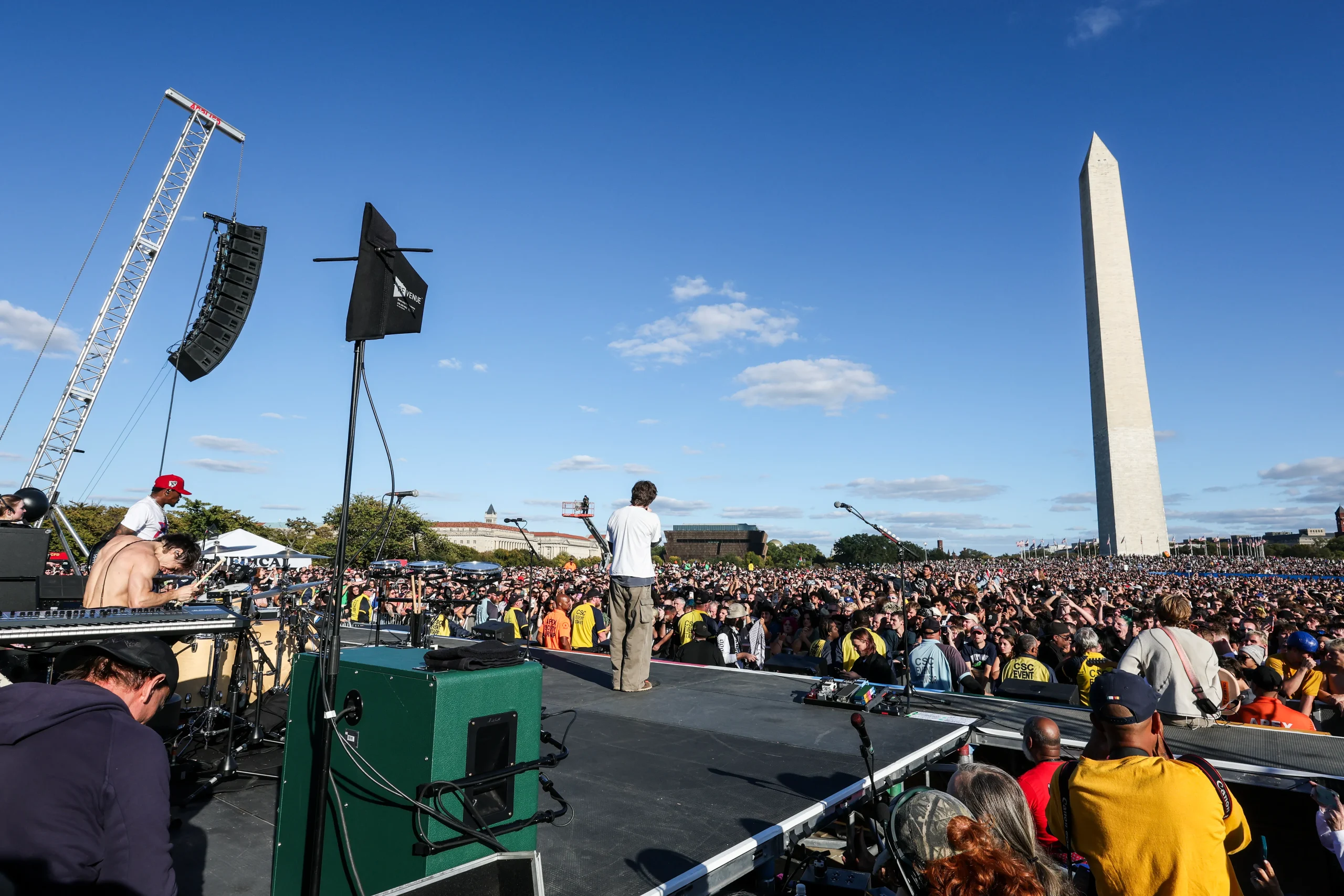
Somewhere around 60,000 people reportedly turned out to see Turnstile perform near the Washington Monument on Saturday. Hassan Wadi, the global director of the Canadian relief outfit Human Concern International, announced that number when he introduced Turnstile. It sounds credible. It was a stadium-scale crowd. Turnstile’s set occurred inside a corral on the National Mall, and it allegedly hit capacity before the first note, though thousands more appeared to watch from the incline leading to the Monument. I’ve heard some call Turnstile’s performance the biggest non-festival hardcore show in history, and that feels right to me, even if I have no precise way to quantify it. The scale of it was bewildering. I still can hardly believe it happened.
How did it come together, in the end? It’s a question I can’t quite shake. This show was my first return to D.C. since Donald Trump installed a palpable National Guard presence. Police were everywhere, some on horseback. Helicopters buzzed overhead. I can’t imagine the bureaucratic labyrinth Turnstile navigated to make this happen, nor can I fathom how many people would have loved to derail it. When Turnstile announced the event a few weeks back, I genuinely doubted that it would go forward. But no, there was Brendan Yates, onstage with a Palestinian flag, within sight of the White House. This occurs at a peculiar crossroads where Turnstile sits as a bona fide pop-culture moment while the current fascist-leaning administration remains in a defensive posture, waiting to be undone at the polls in the midterms. Perhaps they simply couldn’t stop it.
The show was a fundraiser, not a protest, and I’m not naïve enough to think it marks some tipping point. (The money raised is real—up to $261,000 as of press time—and I’d urge you to donate any extra you have to relief efforts.) Instead, it feels more like Turnstile slipped one past the referees—like the people who would have tried to stop it were otherwise occupied. A lot was happening in D.C. that day. Meanwhile, the Chainsmokers were headlining a GLOW Block Party outside the Capitol, and you could hear their beat drifting as you walked away from the Turnstile show. Was it all just another mass gathering in a city that hosts them all the time? Maybe curious onlookers wandered in, dropped a few bucks if they felt like it, and then carried on with their day. Yet the sheer scale of what Turnstile pulled off hardly felt real.
Turnstile’s touring approach aims to immerse the crowd in the experience. As a headlining hardcore band on gigantic stages, they’re in a nearly unprecedented position, and they’ve invested real effort into shaping how that presentation should feel. The legendary skate photographer Atiba Jefferson is deeply involved in their video production. They perform before a massive screen, and most of the time, that screen broadcasts live footage of the audience rather than the band. Wherever you look, you see humanity. In D.C., that wasn’t the setup. Instead, it was Turnstile on the same rainbow-striped stage they used for a guerrilla-style free show in Baltimore’s park when Never Enough came out last year. That show, which seemed to unfold without formal organization, drew about 10,000 people, with no barrier and nonstop stagedives from dawn to dusk. The D.C. show couldn’t replicate that—security was in play. Still, presented without frills or openers or screens, the performance felt like a celebration of community rather than a spectacle tied to spectacle.
That sense of community runs deep. Just southeast of the Washington Monument, there’s an amphitheater called the Sylvan Theater; it primarily hosts the U.S. Military Band and an annual rendition of the 1812 Overture. Fugazi played that venue for the first time in 1993, when most Turnstile members were still kids and guitarist Meg Mills hadn’t been born yet. Fugazi’s set was in honor of the 30th anniversary of Martin Luther King Jr.’s March on Washington—King himself spoke at the Sylvan Theater as well—and around 5,000 people showed up to see Fugazi. I wasn’t there, but photos from that show captured my imagination as a kid. Fortunately, Fugazi played a lot of free shows in D.C., and I got to see them several times. Their Fort Reno Park annual sets felt monumental as they happened, even if they never achieved the scale of Turnstile’s Saturday gig.
As Zachary Lipez notes, Pat Graham, the photographer who captured the Brendan Yates speaker-stack leap above, also shot Fugazi’s 1993 Sylvan set. Ian MacKaye was at the Turnstile show as well. I didn’t spot him in the crowd, but photos I’ve seen show him looking pleased. (I did glimpse Justice Tripp of Trapped Under Ice and Angel Du$t in the crowd, and he looked incredibly pumped.) A bit of trivia: MacKaye was one of the kids stagediving in Studio 8H when Fear became the fiercest punk band to perform on Saturday Night Live. Turnstile, who recently played SNL, aren’t scary at all. Neither is MacKaye. The idea of scariness isn’t the point, if it ever truly was.
I don’t know if Saturday felt like participating in history, exactly. It was more like a joyful way to spend a perfect day in a place we, as Americans, supposedly own. The crowd didn’t fit into any single box. I saw parents with kids perched on shoulders, teenage skaters, fists-raised metalheads, gray-haired retirees, and folks in banana costumes. (On the way out, I joked with one of the banana-clad people that we’re natural enemies; he didn’t think it was funny. Maybe my delivery was off.) There were Chainsmokers fans there too. Afterward, I shared Vietnamese food with a couple of guys who played in Richmond punk bands in the ’90s, and they brought their middle-school kids, who seemed to have a good time. One of them said he’d always wanted to take his daughter to a hardcore show. I’d have taken my own kids, too, but they didn’t feel like trekking from Charlottesville to D.C.—and I don’t blame them. Driving into D.C. can be brutal.
No need to sentimentalize or gush about the show itself, but it was tremendously enjoyable. Turnstile delivered a version of the Never Enough set that I’ve seen them perform a few times now, and they executed it with conviction. They hurled themselves around with complete abandon, injecting joy, energy, bounce, and swagger into those colossal riffs and the sunny, shimmering choruses. Brendan Yates’ mic cut out a few times. He managed to coax the crowd to take a step back a couple of times to prevent the front area from becoming too packed. I adore that band and those songs, and I moshed a little at the end, but I never fully lost myself in the experience the way I have at past Turnstile shows. This wasn’t a mosh-to-survive moment. It was a pleasant afternoon accompanied by great music.
But maybe that’s just how it unfolds. Perhaps Fugazi’s 1993 Washington Monument show felt like a pleasant afternoon with excellent music. Perhaps the day’s triumph was symbolic more than anything. Since Turnstile’s set ended, my feed has been flooded with videos and photos from the performance, and they all look stunning. Get ready to see that image of Brendan Yates suspended in midair, seemingly hovering above the Washington Monument’s pointed tip. That jump wasn’t necessarily a statement or a preordained iconic moment. Yates simply did the kind of thing he does at every Turnstile show. Still, whatever it may symbolize, the image is bound to linger in memory for a long time.