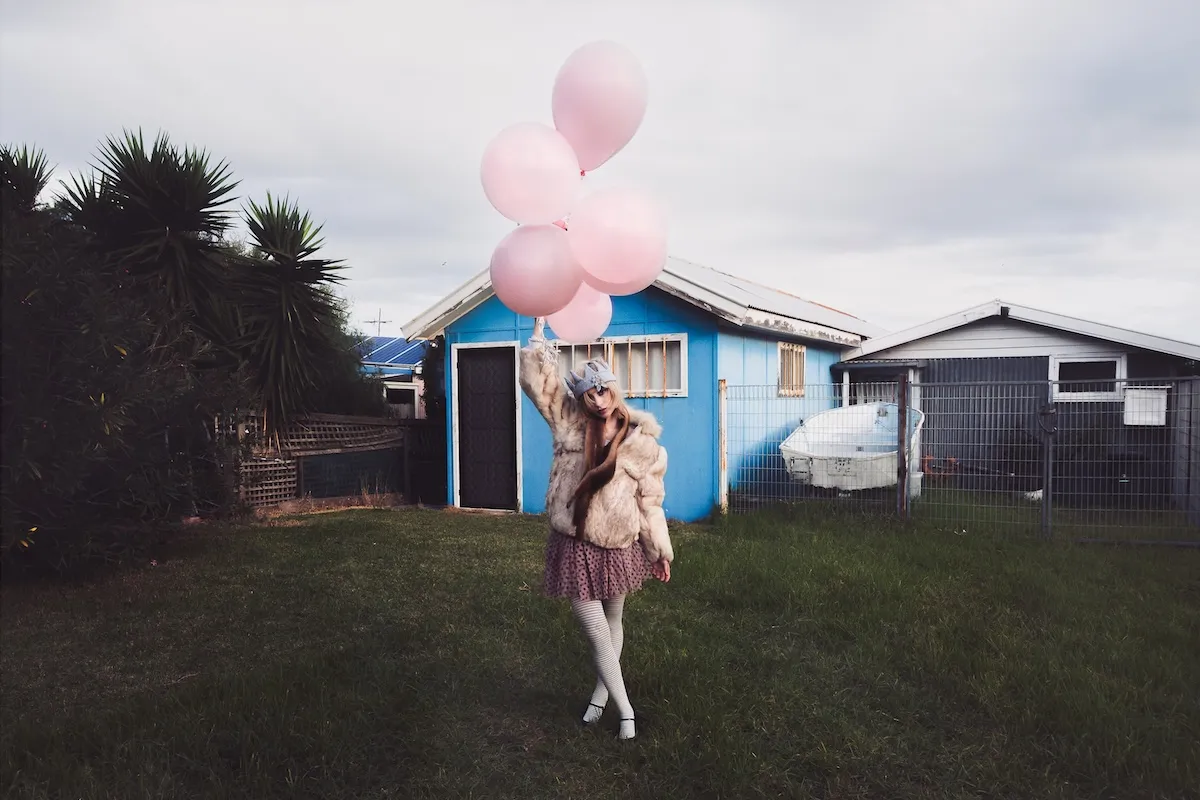
The glockenspiel glints with a candy-coated sheen, even as the mood Daine builds on their debut album In Endless Awe & Agony leans into unease. The Melbourne-based alt-pop artist surveys a landscape where culture is flattened, where class rivalries throttle creativity, and where subconscious cravings pull at the edges of what they can safely reveal. In the chorus of the abrasive single “Product Of Profit (P.O.P),” they stage a stark confession about being defined by profit and devouring what fuels it. Synth textures murmur beneath, while the drums provide a patient, almost obedient march to their spoken-still vocals. Yet the glockenspiel keeps a fragile, nostalgic sparkle, even as the voice sharpens into a mordant scream in the chorus. It’s an image of someone flashing a sparkling smile while concealing a knife, a paradox that sits at the center of the album’s mood.
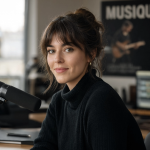
My plan was to sit down with Daine for a midday chat, but a cold nudges the meeting into a Zoom call as they recuperate. They’re gearing up for a listening party later at the Carriage House in lower Manhattan, telling me with a calm sort of tremor, “I’ve got to lock it in and pretend I’m totally fine.” There’s a casual enthusiasm about reuniting with friends, tempered by the awareness that energy will be scarce. The moment feels symbolic, marking a shift from an industry’s harsh pressures and artificialities toward a candid conversation about the rough edges of modern artistry—how to navigate a business that is both expansive and spiritually exhausting, and how to keep momentum when the system seems to demand you shrink yourself to fit a brand.
The Filipino-Australian artist stepped onto the music scene in 2020 as a teenager. They’ve collaborated with Oli Sykes of Bring Me The Horizon, Ericdoa, and Ninajirachi, and have opened for Yeule, 100 gecs, and Charli XCX. Their 11-track album—crafted with former partner Curtis Pawley, Simon Lam of Armlock, and Darcy Baylis—acts as a map of the industry they’ve learned to navigate in recent years. Daine characterizes it as a “Jungian individuation arc,” where the creative process uncovers deeper meditations that had lived in the subconscious, now brought into the light of song.
In Endless Awe & Agony traverses the entwining of ecstasy and violence, alongside the hard truth that nothing endures. It reads as both intricate and offbeat, echoing the sonic spectrum of Midwest screamo, the Pixies, Alex G, Soccer Mommy, Architecture In Helsinki, and Hello, Goodbye. It’s a soundscape of plush textures interwoven with glints of danger—a drift between comfort and threat, and an invitation that’s at once alluring and unsettling.
“I think there’s a balancing act between indulging in the fantasy that this life is all glitter and fun,” Daine reflects, “and maintaining a level of irony that leaves room for a listener to ask themselves, Is this the life I want to chase? Is it okay that I’m drawn to this and aspire to this level of visibility?”
Listen to In Endless Awe & Agony and read our conversation below.
How has the period leading up to the album unfolded?
DAINE: It’s been a whirlwind in the best possible way. It marked my first full album rollout, so the scale of what’s required surprised me. Explaining the pressure to people around me has been tricky—friends reaching out as if nothing has changed, while I’m emotionally drained by the process. I hadn’t fully grasped how resilient and formidable pop stardom is. It’s not a glamorous, effortless path; it’s a high-stakes, continuous performance that demands a ton of character. The expectation that pop stars have an easy life has been shattered for me. It’s a revelation to realize that the job resembles a CEO role under constant scrutiny, complete with a public-facing front and a team behind it that’s steering a much larger enterprise. And yet the lion’s share of the spotlight lands on the artist, with the weight of responsibility and scrutiny landing squarely on their shoulders. It’s a complicated, often contradictory vocation.
No, absolutely. I find myself thinking about that every time I talk to someone—if you were always presenting and defending your work, it must feel exhausting.
DAINE: It’s a cascade of decisions in a single day.
Do you see yourself more as a pop star or a pop artist?
DAINE: It’s a hybrid in many respects. That label has, in a way, found me, and I suppose it fits. The concept carries its own logic, even if it’s not entirely straightforward.
Some argue that being labeled a pop artist grants the freedom to move through different scenes, while others point to the constraints—the expectation that you exist primarily as a product for an audience rather than as part of a broader community or genre. It can feel like the ultimate emancipation in one sense and a confining cage in another.
DAINE: Any role that centers on commercializing your image is, by its nature, a cage. But music, modeling, and being an influencer are among the rare careers where that dynamic becomes so pronounced. It’s difficult to disentangle what you’re creating for the company from what you’re expressing as an artist, and at the end of the day, a multi-million-dollar enterprise is steering it all. You’re not just the figurehead; you’re also bearing the public’s opinion of the enterprise’s success or failure. That pressure is truly daunting. The project isn’t a solitary effort; it involves a constellation of people, each contributing, all while the artist receives the lion’s share of praise, and the burden of responsibility, and the sometimes fierce critique. It’s a strange, paradoxical arrangement.
You stepped into this world at a very young age. Did you understand what you were signing up for when you started making music? Now that you’re launching a debut, how do you maintain balance and stay grounded in the joy of creation while acknowledging the industry’s monstrous tendencies?
DAINE: Certainly. The album helped me surface feelings about industry mechanics I hadn’t recognized, but it also highlighted how unprepared I was as a kid. Entering a major label as a minor framed my development in particular ways. The upside is growth—being thrust into the deep end has accelerated personal and artistic evolution. The downside is that my early development was not the gradual kind—there wasn’t a slow unlock of skills but rather a sudden flood of demands. In my mid-twenties I’ve found a more normal path with indie collaborators, varied jobs, and more room to breathe. That shift has made the art feel more honest, with fewer external voices shaping it and more clarity about what I truly want to say.
Can you share what kinds of jobs you held?
DAINE: I did coat-check at a club for three years, spent time babysitting—my favorite gig was babysitting—did a stint in a call center. This year has been the first where I haven’t needed to work another job, which is a relief. And I still live with my parents, which makes things a little easier to navigate.
This kind of real-world experience—does it fuel your creativity, or does it compete with it?
DAINE: It’s essential for character development, but it’s not always conducive to writing great music. The grind can sap energy and time, especially when debt and exhaustion frame daily life. It’s a stark reminder of privilege—how some peers can spend time in studios writing and navigating feelings, while others have to scramble for money and balance. I’ve reflected on this dynamic in the record. It’s a brutally honest look at who gets to make art and when.
Did the process of writing the album shape your sense of what you wanted the debut to be, or did the ideas crystallize as you went?
DAINE: I went into it without a fixed blueprint, terrified and unsure. I let my subconscious lead the way, and the songs began to reveal a throughline quickly. They range in tone, but there’s an underlying thread. The album became a kind of Jungian journey, a map of inner processes and a reflection of how I was navigating emotions at the time. If you hand someone a blank slate, what emerges is likely a true portrait of their inner world, their desires, and their concerns. It felt like a deliberate, though unplanned, arc—an exploration of self through art.
That phrase you used—“Jungian individuation arc”—came up in a press release. What do you mean by that, and how much does psychology influence your work?
DAINE: Not in a clinical sense. I connect with Jung philosophically and symbolically, rather than adopting psychology as a manual. Jung’s idea is that the subconscious governs much of what we do and that individuation is the process of integrating the different parts of the self. When you create, you watch those hidden aspects surface in real time, and the act becomes a healing practice. If you skip that, you risk losing touch with an essential part of yourself. It’s not about following a specific doctrine so much as engaging with these archetypal patterns as they arise in art.
There’s a sense of a cultural moment where artists talk about authenticity and more direct lyrics. Do you sense a tension between presenting something that feels “real” and the scrutiny of public (and digital) audiences?
DAINE: I think that tension is very much alive. There’s a stream-of-consciousness honesty in some contemporary pop that feels necessary—people want a human voice in an era of AI and hyper-polish. Charli XCX’s latest work springs to mind for that sense of unvarnished openness. The moment asks for something more human and less curated, and I think that’s a trend we’ll see continue. The ego and desire in pop are potent forces, and the question of what is authentic versus performative remains a compelling conversation.
Speaking of the sounds of the record—there’s a contrast of roughness and delicacy, a sweetness counterpointed by aggression. Was the production approach intentional, or did it emerge from the writing itself?
DAINE: It wasn’t a conscious plan to balance those elements; it emerged naturally from the material. The glockenspiel provides a tender shimmer, while voice and guitar push into sharper textures. The album contains moments of melodic sweetness alongside more aggressive, even weapon-referencing imagery. I wouldn’t call those decisions purely intentional; they feel like a harmonic convergence of what the music and the feelings were telling me to do in the moment. The motifs recur because they spoke to something primal—the artist’s hunger, ambition, and the fear of losing oneself in the machinery of fame.
Would you say the album represents your full self, or are the different characters you conjure in the songs distinct facets rather than a single narrator?
DAINE: It’s a kind of time- and place-specific self-portrait, with a few external lenses—culture and the collective unconscious—shaping what you hear. The work captures a period in my life and a set of cultural currents that felt especially resonant at the moment. I hope the through-line feels honest and timely, while also offering a universal thread that might endure beyond the moment.
When did you feel the album was finally complete?
DAINE: I wrapped it up in March. It began with a handful of demos in Melbourne, then we took the material to LA and refined it with two close collaborators and a longtime friend. We spent thirty consecutive days in the studio, tying everything into a cohesive record. The initial ideas I brought to LA barely resembled a finished album, which made the transformation all the more satisfying.
Was there a particular track that reshaped your sense of your own artistry or hinted at a future direction?
DAINE: Not exactly, since the tracks are so varied—yet one stands out as especially transformative: “PQC.” It felt unlike anything I’d created before, and it pointed toward a new sonic path that I hadn’t anticipated. In that sense, it was a kind of watershed moment for the project.
Was it the first song you worked on for the album?
DAINE: It started as an idea that came to me early on, but I didn’t know it would become the seed of the entire project. I dismissed it as a random demo, something inconsequential. But it turned out to be foundational—the spark that set the whole album in motion.
Some of the lyrics touch on time, nostalgia, and the pull of the past. Do those themes sit differently in your mind now that you’ve created this with someone you were romantically involved with, who is no longer a partner?
DAINE: Not particularly. I initiated the breakup, so I’m not precious about the past. Their contributions were wonderful, and I’m grateful for them, but the lyrical focus at the time rested more on the flattening of culture and the way younger generations—Gen Z in particular—tizzle between a pervasive nostalgia and a sense that future possibilities feel uncertain. The past becomes a comforting mirror because the future feels so uncharted. Millennials had a more confident sense of a future; Gen Z lacks that shared aesthetic, drifting through cultural markers rather than coalescing around a single look. That sense of cultural atrophy was a driving theme in the record.
We’ve talked about pop stardom and guilt. How does faith fit into this, considering your Catholic background and spiritual sensibilities?
DAINE: The tension is real and specific. There’s a sense that beauty and sexiness in pop can feel sacrilegious, a kind of unholy glamour that earns rewards for self-display. It’s a paradox that can trigger Catholic guilt—the sense that you’re selling something sacred for public consumption. The industry itself feels like a marketplace, a corporate machine with a payroll of humans who are expected to perform. In songs like “White Collar,” I point to the idea that some people treat art as a sport rather than a craft. The scene is populated with folks who chase numbers and status, sometimes at the expense of authenticity. It’s not that these people are “bad,” but the system itself can be corrosive, and I want to push for a more nuanced discussion about privilege and access.
Some listeners throw the accusation of nepotism around as a blanket indictment. How do you respond to debates about whether having a privileged background should disqualify someone from making good music?
DAINE: I think the issue is more complicated than a binary verdict. Publicly available data shows striking disparities: top-selling musicians are several times more likely to have attended private schools; working-class youths are far less represented in creative industries; fewer than one in ten UK arts workers come from working-class roots. When I say I’m tired of “nepos,” it’s not that they can’t be good or that they don’t deserve success. It’s that there should be room for voices without that specific ladder of access—that there should be more pathways and more representation. The music world isn’t simply a meritocracy; it’s a complex ecosystem where luck, timing, resources, and resilience all collide. I want to see more people who don’t come from privileged backgrounds get opportunities to tell their stories too.
In Endless Awe & Agony is out now via Pack. Records.