
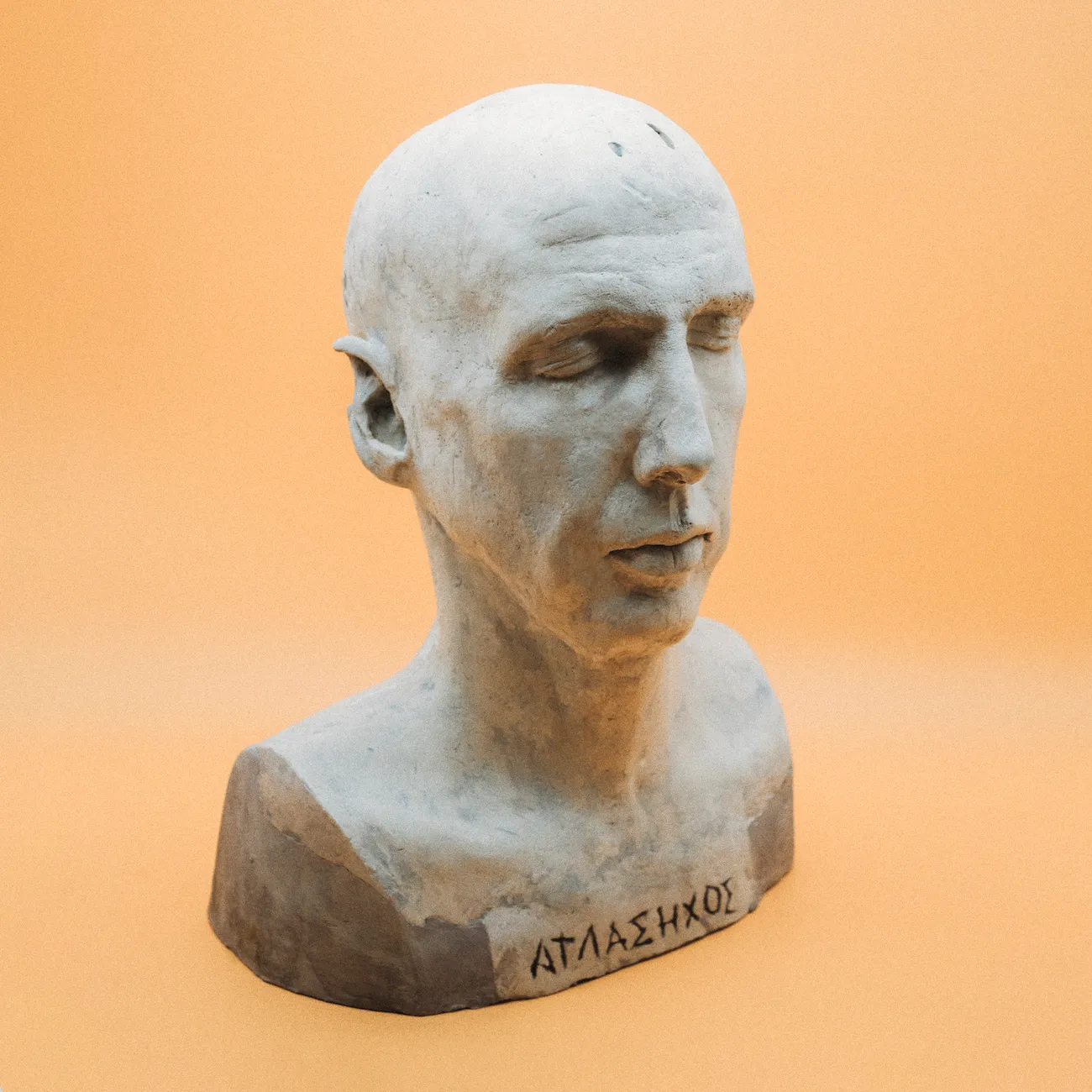
Is Bradford Cox confronting his own mortality? The deeper I wandered through Thanatos, the more that idea pressed in. Since the outbreak, Cox has kept to his Atlanta home, tending to himself out of the public eye. Deerhunter hasn’t released new music or performed since 2019, and Atlas Sound—his solo outlet—had paused for longer before quietly staging a return this autumn. Now he steps out from his attic with a collection of fragile, lo‑fi sketches about illness and the end of life, a record named for the mythic personification of death.
Cox has long spoken about his ardent admiration for David Bowie: “There isn’t anyone who has exerted a bigger influence on my entire life—not only on how I craft sounds but also on how I think and feel.” He penned a tribute to Leonard Cohen, suggesting Cohen’s passing came with “a very clear sound of the hammer driving another nail into the coffin of authentic culture.” It didn’t feel farfetched that he might release his own Blackstar or You Want It Darker. The idea that a “nightflight over Cleveland” could be a journey to a medical facility. That there could be something biographical in the talk of doctors, medicine, and blood, of radiation coursing through bone and skin, and of a sense of collision with fate; of color draining away, a procession of skeletons, dwindling flames; of a shallow grave and breaths that cannot be salvaged; of crows and withered branches; of tombs, broken bones, and praying for a cure. The closing line on the lyric sheet reads: “Last night I had a vision/ Of myself in strange clothes/ Walking into a crowded mall/ Right before it explodes.”
I’m not sure what to make of Cox’s situation. He might be, in the broader sense of someone distant from the modern world’s current arc, more or less all right. Perhaps he’s simply mourning the disappearance of his cherished 20th century—the era energized by static and detritus, suffocated by optimization and meticulously curated online personae. Perhaps Thanatos, with its foggy textures and bleak observations, is his manifesto on the decline of Western civilization. Maybe such spare, brittle music is a fitting response to a culture that becomes more grotesque with each new day. Or maybe it’s just a reminder that we’re all dying, bit by bit, all the time.
One striking facet of Thanatos is how such pared-down songs can unfold into vast, shadowy chambers of meaning. It’s easy to hear the record as one man’s death rattles, yet it’s equally natural to read it as that same man choosing to reject the world he knows. The album contains more explicit political readings than I anticipated: on “Akron,” Cox proclaims “Democracy molds in the basement of America,” following a nod to “the West’s failed promise.” “Day For Night” hints at recurrent right‑wing anxieties about mythical migrant caravans assembling at the border, while “Passing Strange” laments the consolidation of power among perpetual failures. Countless listeners have labeled Donald Trump a symptom of a sick, eroding society, but few records mirror that depleted state with such vivid force.
Yet there isn’t a single, one‑note reading of Thanatos that can do it justice. A line like “You are a member/ Of everything that you have ever dismembered” could refer to a DOGE-era country eating itself from within, but Cox is too deft a writer to let his work slip into a partisan television segment. Likewise, when he sings about grappling with depression and anxiety on “Passing Strange,” the feelings feel more contemplative than polemical. His songs function as prisms: at once crystalline in some respects and opaque in others, refracting beauty and ugliness in surprising angles. Prolonged exposure to this suite of anti‑pop gestures might utterly reframe how you perceive beauty and ugliness.
Despite the potential for broad interpretations, Cox’s output remains intensely personal. Alongside mortality, illness, and corruption, sexuality and spirituality—constants in his art—persist. Adrift within the meandering psych rock of “Arcadia,” the lyric “Beautiful but queer” subtly shifts to “Beautiful and queer.” I can’t help hearing that track in dialogue with the rough finale “Kora”: “Last night I was a Christian/ Praying for a cure/ This morning I woke up/ I said, ‘I can’t take this no more.’” In the stark, acoustic “Roots Without A Tree,” there’s almost a tentative love song—perhaps a portrait of nursing someone back to health as they fade away?
From that track’s raw, bluesy posture to the quieter funk of “Come And See” and the soulful falsetto he conjures on “The Property Is Condemned,” Cox continues to draw on his Southern roots. Here, instead of the roadhouse rockabilly of “Pensacola” or the snarling country funk of “Snakeskin,” these impulses merge into an electro‑organic terrain haunted by a ghostly echo of Alan Vega—sludgy, ringing, ticking, and hiccuping. Cox handled the recording solo on a portable 8‑track, and the otherworldly gloss that shadowed his Atlas Sound albums gives way to a handmade, DIY texture. Even the boldest, most lush and surreal passages shed Cox’s characteristic dreamy aura, adopting a more tangible, corporeal feel.
Beyond the lyrics, the sense of looming mortality is embedded in the music on a molecular level—“each instrument played as if it were the last night on earth,” as Cate Le Bon described it in her perceptive liner notes. Thanatos coalesced through nocturnal bursts of creativity, and more than any of Cox’s previous work, it evokes a dark, inward night of the soul. Yet the record isn’t consumed by despair. Despite its unsettling elements, I’m encouraged by the throughline about making the most of the time you have. It leaves me hopeful that Thanatos isn’t a farewell message from Cox but the opening chapter of a renewal in his art.
Thanatos is available now via 4AD.