Inside the Baltimore Arena on a Monday evening, a flock of youngsters sporting broccoli-cut hairstyles occupied the floor, passing the time with a game of duck duck goose. Why not? Those haircut-ed kids had plenty of space, and they had an abundance of time. Doors opened around 7 p.m., and A$AP Rocky, embarking on his first substantial tour in seven years, wouldn’t take the stage until nearly three hours later. If you’d shown up at the start, you needed to find a way to fill those hours. You could scroll your phone until the battery died, squabble with someone, or play a round of duck duck goose.
How does this happen? By now, the arena rap tour has evolved into a well-oiled live-entertainment machine. People generally know what works and what doesn’t. The Baltimore Arena—known technically as the CFG Bank Arena these days, though practically no one uses that name—has hosted more than its share of rap runs. When I was a kid, hip-hop under this roof featured bills that were almost comically packed with acts: Public Enemy, the Geto Boys, A Tribe Called Quest, Queen Latifah, Naughty By Nature, and MC Lyte, all on one bill. Over the years, big-ticket rap spectacles have grown more elaborate and polished, yet some core truths endure. One of them: you shouldn’t cram thousands of youngsters into a single room with hours of idleness ahead of them.
On his current Don’t Be Dumb arena tour, A$AP Rocky arrives without opening acts. There isn’t even a warmup DJ. Instead, a loop of ambient, hazy-keyboard, new-age aquarium music plays until the lights abruptly drop and the main event begins. That setup feels odd to me. Our own Chris DeVille noted that Jay-Z and Kanye West also went on without openers during their Watch The Throne run, suggesting Rocky may think that’s the proper move for a serious artist-turned-icon. But Rocky, try as he might, isn’t Jay-Z and Kanye West rolled into one in 2011.
Even accounting for the Thrones tour aside, there is a logic to how most tours are structured. Rising rappers gain crucial seasoning by serving as opening acts, exposing audiences to material that might have otherwise slipped by. Rocky himself has appeared as an opener before; he and Kendrick Lamar famously opened for Drake on the Club Paradise tour in 2012. When Rocky last mounted a proper tour in 2019, one of his openers was Playboi Carti, who has since become an arena headliner himself. Even when one isn’t trying to foster a new superstar, opening acts play a vital role: they raise the energy level and provide something visible for the crowd to watch.
According to Setlist.fm, most of Rocky’s sets on this tour began around 9 p.m.; in Baltimore, it stretched closer to 10. That Monday happened to be the night Madison Square Garden hosted its first NBA Finals game in over a quarter century. Rocky, who had been out on the New York streets after the Knicks’ dramatic Game 2 win, kicked off his show near halftime, and I doubt that was an accident. I get it, but still—I wanted to watch that game, too. If you’re going to keep everyone waiting, the least you could do is show the game on the jumbotron, game rights permitting, of course.
Can A$AP Rocky really afford to keep people waiting so long, when his uneven comeback album didn’t exactly set the world on fire, and his reputation largely rests on the confidently woozy cloud-rap bangers he made more than a decade ago? Apparently so. I was surprised. In recent years, Rocky has mostly inhabited the public eye as Rihanna’s partner and a sidelined figure in the Drake/Kendrick saga that just won’t die. He’s a 37-year-old dad now, his baby mama hasn’t even promoted his single yet, etc. But Rocky still packed the Baltimore Arena with broccoli-cut kids and makeup-streaked fans. I was there because my 13-year-old son—who doesn’t have a broccoli haircut, though I wouldn’t fault him if he did—wanted to see Rocky. It was my child’s second concert ever, after Kendrick Lamar and SZA last year. I’d heard secondary-market tickets were cheap, but I didn’t notice a lot of empty seats. Apparently, this man still has real juice.
My son drives Rocky in the car pretty much nonstop, and he says he discovered Rocky through “TikTok, probably.” That checks out. As I write this, the most-streamed track on Rocky’s Don’t Be Dumb album on Spotify isn’t something newly minted; it’s a remix of the 2011 mixtape cut “Demons,” now mashed with the Clams Casino beat from Lil B’s “I’m God” and appended to a deluxe edition. Other older Rocky tracks continue to pull big numbers. The enthusiastic fans behind us knew every word and yelled along with gusto. (I spent most of the show perched on an armrest to avoid blocking the view of the very small girl directly behind me—call that responsible tallness.) Rocky’s entire discography doesn’t seem to matter as much as his vibe—a warm, magnetic, stylish, spacey friendliness that none of his peers quite replicate.
So Rocky filled a Monday-night arena with genuinely younger, exhilarated crowds whose energy survived the long, grueling wait that left many in the venue grumbling. That’s half the battle. And when the show finally began, the absence of an opening act made more sense. This may be purely speculative, but perhaps Rocky burned through the tour’s entire budget by turning his own set into a riotous spectacle. In that sense, the Don’t Be Dumb Tour is a sight to behold.
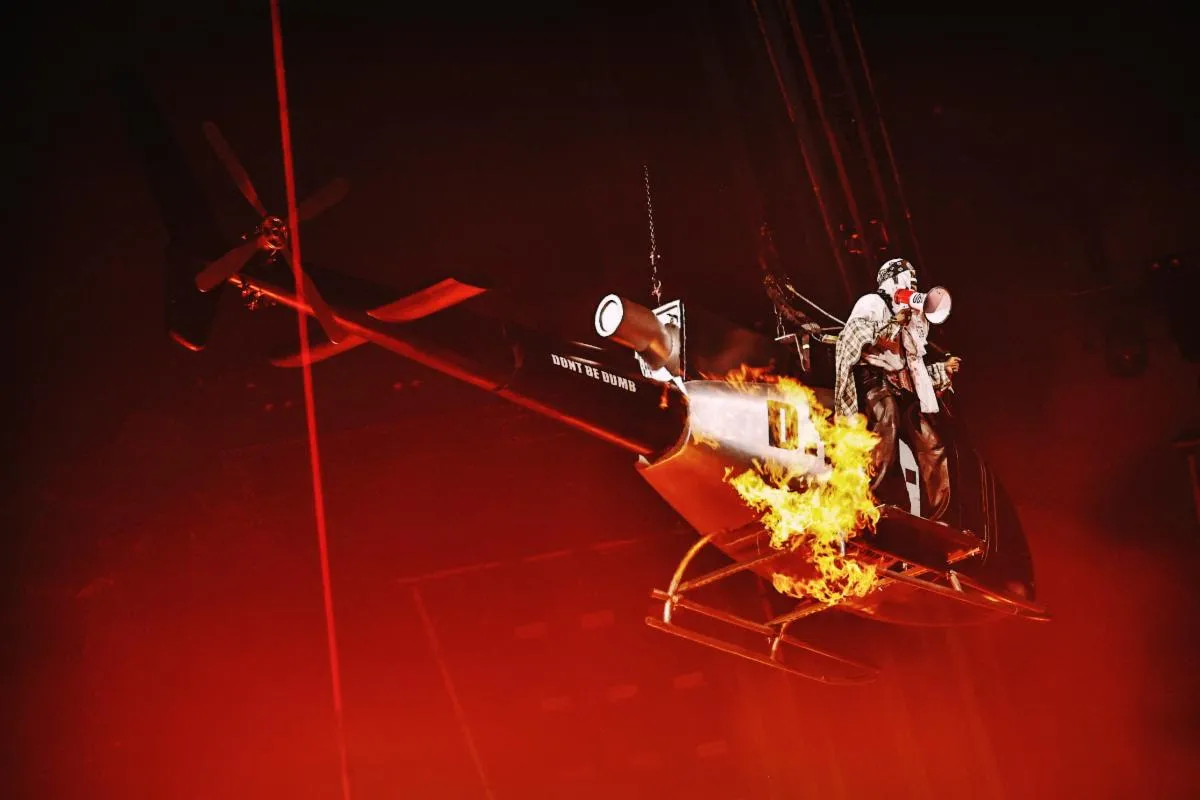
The tour’s aesthetic leans toward a totalitarian chic—a visual drama of a world constantly at odds with a pervasive security state. Rocky’s stage show opens with a series of extended vignettes designed to evoke the epic chaos of a ’90s action movie. (Someone clearly pinned the opening scenes from Demolition Man to a moodboard.) Blacked-out American flags and banners reading “Big Brother is always watching” decorate the stage, and a prop police helicopter hangs from the ceiling. As the lights drop, the chopper descends and scans the crowd before locking onto Rocky and his crew thrashing in the audience.
Apparently, Rocky enters at different locations within the arena on different tour stops. In Baltimore, he sprinted onto the floor surrounded by his “shirtheads”—lads with white shirts tied around their heads who danced in circular formations throughout the show, nearly functioning as a second act. It wasn’t entirely clear whether the shirtheads were dancers, Rocky’s friends, or simply fans temporarily drafted for the moment. The chaos was the point. Soon after that, Rocky shot overhead in a second prop helicopter, gripping the landing skis and chanting into a megaphone, while a third, apparently inflatable helicopter circled the airspace. At times, a small squad of krumping SWAT-team types would stage a mini on-stage assault, reminiscent of Public Enemy’s S1Ws reimagined for a militarized era. There were flames, lasers, and explosions. It was a lot to take in.
I don’t think most of Rocky’s newer songs carry enough fire to soundtrack those moments effectively. At times, the music itself felt like the weakest link in the overwhelming spectacle. Rocky mostly rapped over pre-recorded vocals, and the megaphone mic he used for the entire set probably didn’t help with any athletic, full-throated rapping he might have wanted to pull off. But that isn’t really what the arena-rap show is about today. It’s about vibe-curation, a specialty Rocky has long mastered. He managed to turn the arena into a chaotic, unpredictable experience that felt genuine—no small feat.
This was my second time seeing A$AP Rocky live. The first had been decades earlier, when my son was still a few months from birth. At SXSW in 2012, Rocky headlined a late-night Vice party after Trash Talk, and the crowd was buzzing and volatile—trash barrels flying, beer being hurled, and Rocky taking it in stride. He pleaded with the crowd to stop, then insisted, then pointed out who in the audience was throwing beer. A nearby incident escalated into a brawl, and the show shut down abruptly. I left briefly and returned to find the chaos over. I still recall that combustible tension, and I’d bet Rocky does too. That night’s stage show felt like an attempt to recapture that feeling in a safer setting, and it worked better than I expected. Once Rocky cleared those opening theatrics, a fairly conventional rap concert—only with a lot of dramatic pyrotechnics—took over. Rocky spent most of the evening masked, though you could tell it was unmistakably him even with the disguise.
The core rap-show portion was solid, though not flawless. Rocky kept urging the crowd toward a mosh pit, which reminded me of a Warped Tour side stage in the early days of punk rather than a contemporary arena scene. It wasn’t terrifying. He kept imploring the crowd to pray for the Knicks, which didn’t pan out, and the helicopter sound effects made it hard to hear some stage patter. I’m pretty sure he also apologized to a kid for not signing sneakers because of some branding arrangement. And I’m not sure how you leave off anthems like “Lord Pretty Flacko Jodye 2.”
Yet Rocky does have hits. There are tracks I hadn’t realized were crowd-shapers. “Everyday,” the Rod Stewart/Mark Ronson/Miguel collaboration from 2015, surprisingly shines as a full-arena sing-along. Psych-pop tunes like “Sundress” still elicit big reactions in this setting. I leapt to my feet for “Peso” and “Goldie” like the nostalgic old guy I am. Near the end, “L$D” slides into familiar melancholy, while the crowd—too young to feel full nostalgia for the era these songs originally embodied—embraces them as party anthems that remain relevant to new fans discovering them through younger media ecosystems.
Maybe that’s TikTok doing what TikTok does: a potent, stylish track from the past can resurface with uncanny force and become omnipresent again. That’s good news for A$AP Rocky, a artist whose empire was built on evocative, stylish music. Rocky should probably avoid runs like this lengthening wait in the future, but he remains a hot draw capable of financing that kind of indulgence. It’s striking, really—a power where fans are so excited by the illusion of chaos that they don’t spark a real riot at all.