During one of Lily Allen’s early American performances, my brother turned to me and muttered with a mix of awe and amusement that she “dances like Karl Rove.” I cracked up then, and the memory still makes me laugh today. It was spring 2007, and Allen had already become a pop sensation back home in the UK. Her debut album, Alright, Still, had exploded there the previous summer. Months later it finally landed in the United States, triggering a fresh wave of critical buzz around her. She appeared on MTV a lot, and US pop radio began to latch onto tracks that had been circulating on MP3 blogs for ages. The venue in New York—Irving Plaza—was stacked with music-industry folks, and this show could have been pivotal for Allen. Yet she didn’t exactly cement her rising-star status that night, because she was visibly drunk and moving in a way that looked like this.
Still, she could get away with it. Lily Allen came across as a charming, chaotic mess at that time—and she remains a charming, chaotic mess now. Messiness was woven into her version of pop stardom. She sang about lousy exes, sly pick-up artists, and nightclub brawls with breezy, sardonic flair. She relished gossip and trash talk, and she brought that relish to the stage. She moved with a kind of clumsy swagger. She giggled through her stage patter. She didn’t seem to take her own burgeoning pop-star status too seriously. Just before covering “Naive”—a track from fellow hyped-up UK act the Kooks—Allen quipped, “It’s actually quite rubbish, but I make it sound quite good.”
That night, every music-industry hand in the room showed up because Allen felt like she might be the future of pop. Her take on pop was sly, funny, and conversational. She painted gritty nightclub scenes with a diaristic immediacy, convincingly inhabiting someone who’d seen a lot of grimy clubs and who still planned to see a lot more. She sang over ska samples and rap breakbeats with bright, effortless joy, even as she punctured one ex after another with sarcasm. Most importantly, she rose to stardom without smoothing her edge for radio. In other words, she was the kid who figured out MySpace.
It wasn’t solely MySpace that propelled Lily Allen to prominence. She already had a record deal before she started posting tracks on the flagship website of the Web 2.0 revolution. And she carried a famous surname. Her father, Keith Allen, is an actor, comedian, and “professional geezer,” as described by The Guardian—a quintessential UK celebrity who, like his daughter, navigates fame with charm. Her mother, Allison Owen, is a film producer, which helps explain Allen’s brief child-acting stint in the 1998 costume drama Elizabeth, a film produced by her mother. (Owen continues to produce films, and I’ve just learned her latest project is Back To Black, the 2024 Amy Winehouse biopic—that’s pretty strange!) Joe Strummer was a family friend. Allen’s show-business roots ran deep.
Later, Allen bristled at the notion that she’d benefited from a career edge because her parents were famous and successful. In 2007, she told The Guardian, “It’s funny when Lady Sovereign said that thing about me, ‘She doesn’t have to work as hard as me because her dad’s Keith Allen.’ Do you know what, Lady Sovereign? Have my dad. Go on! I’d love to see how many people buy your records. Go on! Take him!” Yet part of Allen’s magic was that she didn’t seem to work all that hard at all. She treated pop stardom as a hobby, a joke. That’s part of why she danced on stage like Karl Rove. Her superpower was not giving a damn.
Lily dropped out at 15 after apparently being expelled from several schools for smoking, and she met her first manager while partying in Ibiza. At 17 she landed a deal with London Records and recorded a handful of folk songs written by her father for her. Those songs never saw the light of day, and she got dropped. Some time after, she began recording with Future Cut, a Manchester-based production duo with roots in the jungle underground. Their demos led to another record deal, this time with Parlophone, but the label brass didn’t pay attention until she began posting songs and mixtapes on MySpace.
The idea of being “famous on the internet” was still new in 2006. Around the same period, Arctic Monkeys—bandmates roughly Allen’s age who sang laid-back lyrics about the same rough nightclub culture—were racing to the top of the UK charts. The Streets’ Mike Skinner, from a slightly earlier generation but sharing a similar club-culture, conversational storytelling gene, was another major precedent. And while Allen didn’t rap, she did make mixtapes. Sometimes she flipped a hit, using its instrumental for her own ends. One of her early viral tracks was “Nan, You’re A Window Shopper”, a spoof of a 2005 50 Cent hit that teased her grandmother for being old.
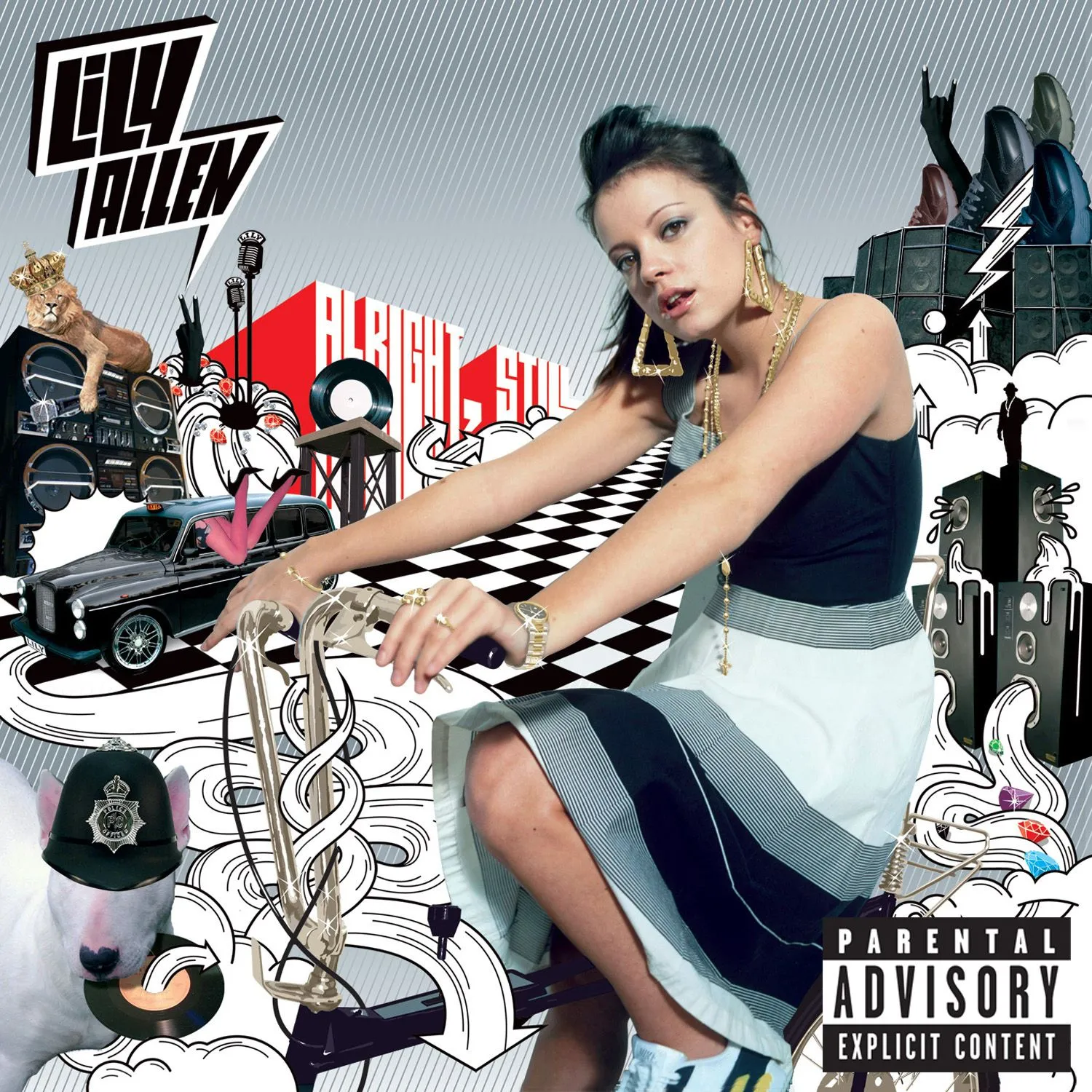
Thanks to those early hits, Parlophone rushed the release of Alright, Still, an album that turns twenty this Friday. In the UK, the record resonated with the culture at large. Allen shot straight to #1 with “Smile,” a deliriously joyful put-down of an unfaithful ex. She quickly became a fixture in tabloids, and her distinctive look—TopShop dresses, doorknocker earrings, sneakers—spawned a wave of imitators. So did her sound. She enjoyed pairing old reggae and soul samples with a bright, contemporary sensibility, a profile that likely helped open the door for the UK’s retro-soul surge that was already gathering momentum. Amy Winehouse released her breakout Back To Black a few months after Allen’s Alright, Still, and both records bore Mark Ronson’s production touch. Allen also collaborated with the esteemed producer Greg Kurstin before Kurstin’s later work with Adele.
Yet Allen never had a voice that could blast like a bazooka. Instead, she sidestepped vocal prowess, using the songs as vessels for her personality. The first Lily Allen track I heard was “LDN,” and it remains one of my favorites. Its lyric conceit is simple and buoyant: a girl bikes through London, noting the city’s veneer of civility while the underbelly—the petty crime, the pimp and his crack-whore—lives just beneath. But Allen sings about the city with such sunny affection that the jokes never become grating. She clearly loves what she’s doing, and that contagious joy is part of the appeal.
Allen sang about her real life and the real people in it, and her fame-adjacent status gave the songs an extra spark. The album’s most irritating track is “Alfie,” a gleeful music-hall number in which Allen ribs her younger brother for staying in and getting high while watching television. Alfie Allen apparently disliked being caricatured on the track to such an extent that he refused to appear in the video, with Lily acting opposite a puppet so grotesque that it became a running joke. That song was funny at the time, and it’s even funnier now that Alfie Allen has become more famous for his role as Reek in Game of Thrones, or as the fictional Russian mobster son who killed John Wick’s dog.
If I were Alfie Allen, I’d probably feel a bit irked too. Lily has never stopped singing about the personal, embarrassing details of the people in her life. She’s arguably the author of her own most infamous targets. Alright, Still is a tour de force of petty, and a large portion of its songs revolve around minor exes; Allen typically seems more chaotic than triumphant in those stories. One track deals with girl-on-girl scuffles in clubs, another with the frustration of too many guys vying for her attention. She doesn’t spare her own grandmother, either. The sheer messiness is a cornerstone of the appeal, to the point where it’s almost shocking when she admits to missing someone on “Littlest Things,” the album’s lone genuinely vulnerable moment. (Allen and Mark Ronson co-wrote that one with a then-not-yet-famous Santigold.)
“Smile,” “LDN,” “Alfie,” and “Littlest Things” were all big hits in the UK. The album itself became a cultural touchstone and achieved triple-platinum sales there. A year later, Allen returned to the top ten in the UK alongside Mark Ronson for a cover of the Kaiser Chiefs’ “Oh My God.” In the US, Allen was more of a critical phenomenon. Because of the staggered release dates in the two countries, Alright, Still and “Smile” landed on two consecutive Pazz & Jop critics’ polls. The record and its single both eventually went gold stateside as well. It’s unlikely Allen could have become a larger figure in America, given how quintessentially British her sensibility is, yet the concept of a glamorous pop star who casually dishes on exes and well-known acquaintances clearly left a mark.
Allen remains a major figure today, especially after returning with last year’s gossip-forward breakup album West End Girls. She released more UK hits afterward, but I don’t hear the same effortless charm in her later work. Alright, Still captured a moment, and moments don’t last. Allen has also weathered a number of publicly documented struggles—from mental health to substance use, from body image concerns to friction with record labels and even a cameo by Hopper from Stranger Things. Yet it’s hard to imagine modern pop’s landscape without her influence.
There’s no Charli XCX without Lily Allen, to name one obvious descendant of her style. Charli continues to mine the “messy, glamorous British girl who speaks candidly about her public life” vein. Sabrina Carpenter has covered “Smile.” So has Olivia Rodrigo. Today, the backstories behind pop songs are almost as important as the hooks themselves. Pop stars are broadly expected to be a certain degree of petty. No one in Irving Plaza could have predicted that night how prescient Lily Allen would be—she was the future, in ways that had little to do with MySpace or even her famously clumsy dancing.