Sonny Rollins has passed away at the age of 95. A monumental figure, he stood as the last surviving pillar of his cohort of bebop and hard bop musicians, and although he stepped back from live performances several years ago due to illness, his standard of excellence continued to cast a long shadow over the art form.
I had the honor of speaking with Rollins twice, in 2009 and 2010, and I came away with the sense of a remarkably humble individual. When I asked him how he avoided leaning on ready-made lines during improvisation, he replied, “I’m not that skilled a musician… it takes a certain skill to be able to play the same way every night. That takes skill. And I don’t have that skill, I can’t play the same thing every night. So it’s just my lot in life that I’m going to change, and what I play isn’t going to be the same.”
Although his youth included struggles with drugs, Rollins became intensely focused on his mental, emotional and physical health as he grew older. He largely followed a vegetarian regimen (“I do eat fish and yogurt, and other than that, vegetables”), practiced yoga, and cultivated a deeply spiritual outlook that fed into his music. He spoke of leaving his body behind during improvisation. “I remember that I used to be able to float,” he told me. “I would be meditating and my spirit or my soul, my mind, whatever you want to call it, would ascend to the ceiling and drift about. It was an exhilarating sensation. So there are many ways to depart from the body. But when I’m playing, I leave my body in the sense that when I’m really in the middle of a solo, I try to forget all the things I’ve learned about the music, I try to forget where I am, the audience, everything. Be oblivious to everything. So I leave my body in that sense, and the music is playing me. I’m not up there thinking, ‘I’ll play this next, and then that.’ I’m simply present, and the music is guiding me, so to speak.”
I witnessed Rollins in concert twice — once at Tramps in the late 1990s, and again at his 80th birthday celebration in 2010, at the Beacon Theatre. That evening, Ornette Coleman joined him onstage; the two men had been close friends for decades and had even rehearsed together in the 1960s, but their onstage collaboration that night was a singular event. Seeing Rollins’ grin when Ornette stepped out was priceless, and hearing them play together for more than twenty minutes was truly a once-in-a-lifetime experience.
If you’ve never explored his discography, choosing a starting point can be daunting. He recorded for numerous labels from the 1950s through the 2000s. If I had to pick a handful of entry points, I’d suggest Saxophone Colossus and Freedom Suite, both from 1957; Our Man In Jazz, from 1962; Alfie, from 1966; and Nucleus, from 1975. Each one showcases a distinct facet of his artistry, and together they offer a window into the breadth of what Rollins achieved. Sonny Rollins was among the greatest players to ever lift a horn to his lips, and his absence will be felt.
***
“You have to remember that the trumpet is a mean instrument, the meanest there is. It’s a damn monster. Sometimes I feel like throwing it out the window, it’s such a beast. There are times when it treats you so sweet and nice that everything comes out just perfect. Then you come back to it the next night, rub your hands together and say to yourself you’re going to do it all over again. You pick up the horn, put it to your chops, and the son of a bitch says, ‘Screw you.’” — Roy Eldridge
“Some days you get up and put the horn to your chops and it sounds pretty good and you win. Some days you try and nothing works and the horn wins. This goes on and on and then you die and the horn wins.” — Dizzy Gillespie
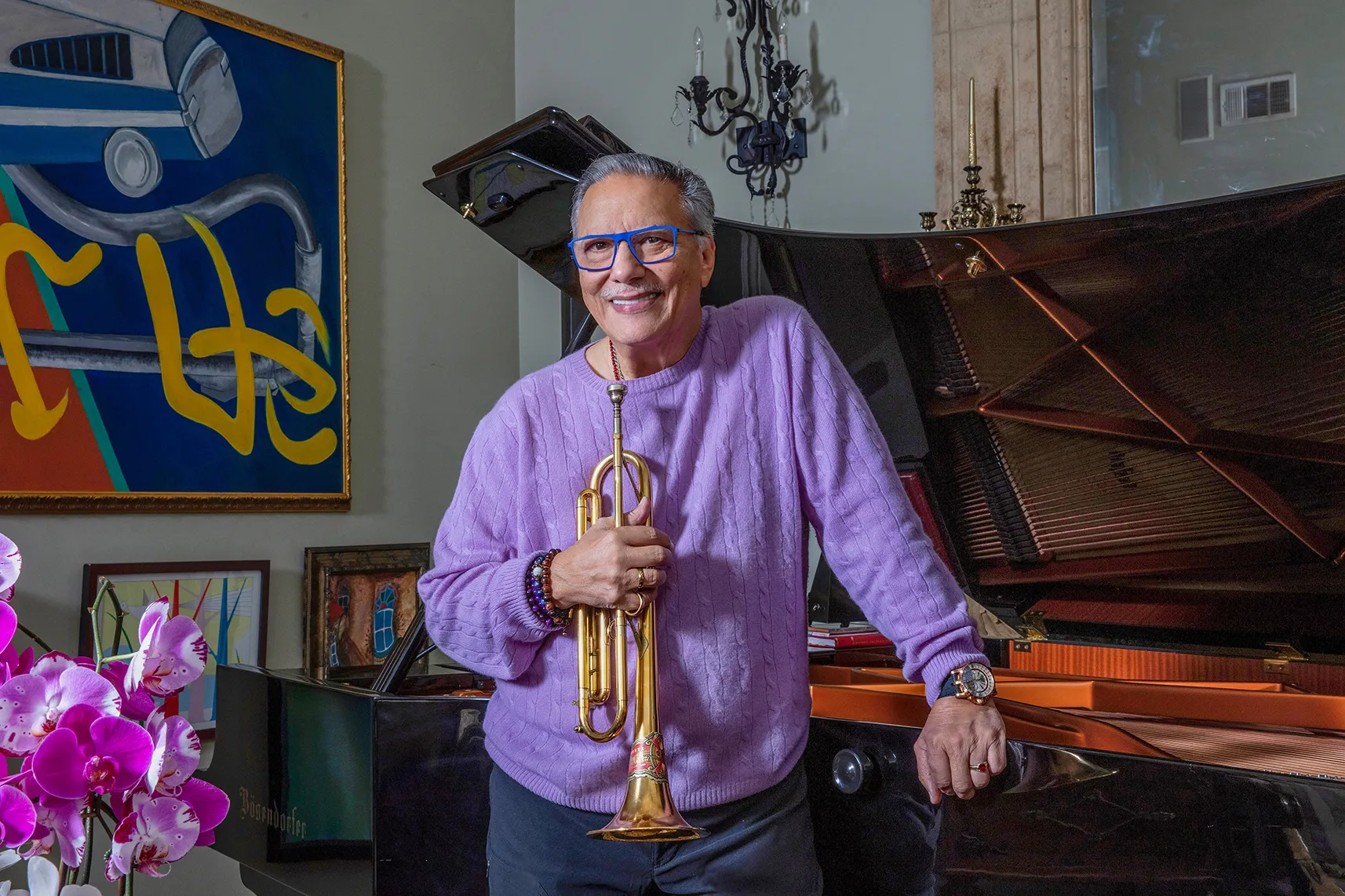
Arturo Sandoval is a trumpet legend. He began his career in his native Cuba, as one of the founding members of Irakere, a legendary Afro-Cuban jazz-funk group that evolved out of the Orquesta Cubana de Música Moderna in the early 1970s. After recording several albums with them, he went solo in 1981 and forged a friendship with fellow trumpeter Dizzy Gillespie, a relationship that would steer the next phase of his life and career.
In 1989, Gillespie invited Sandoval to join the United Nations Orchestra, and during a world tour, brought him to the US embassy in Athens, Greece, where he defected. Sandoval became a United States citizen in 1998 and has since resided in Florida. He’s earned an Emmy and a Grammy, was a Kennedy Center Honors recipient in 2024, and received the Presidential Medal of Freedom from Barack Obama in 2013.
Growing up as a jazz fan in Cuba, where American culture was banned after 1959, presented its own set of hurdles. “I listened every day from Monday to Friday on the shortwave [radio] the Voice of America,” Sandoval recalled. “There was a program called the Jazz Hour, hosted by the late Willis Conover, and I never missed any of those broadcasts. And during my compulsory military service, a sergeant caught me in the corner of the barracks listening to that show, and they jailed me for three and a half months because I was listening to the voice of the enemy.”
That deliberate cultural separation even seeped into Irakere’s music. Sandoval explained, “One of the funny things about Irakere is that, at the outset we weren’t allowed to use cymbals on the drums because they were deemed too American. We had to swap in cowbells and other items for that reason, but in the end we hid bebop and jazz on top of a Cuban rhythm, an Afro-Cuban rhythm or whatever. When we improvised, though, it was 100 percent jazz, just with a different groove.”
Since then Sandoval’s music has traversed a wide spectrum, from Irakere’s Latin-infused grooves to classical forms to blistering bebop. He has issued tribute albums to Clifford Brown and Gillespie, as well as a particularly striking album discussed below. He composed the music for a biographical film in which Andy Garcia portrayed him and has scored numerous other movies, including two directed by Clint Eastwood.
His latest record, Sangú, marks his 49th album by his count and stands apart from the expansive palette he’s explored before. It features his touring ensemble with no guest stars, and was executive produced by his son, Arturo Sandoval III, and by his daughter-in-law and manager, Melody Lisman.
“When the pandemic hit, I was just like everyone else, stuck at home,” Sandoval recalled. “I stayed in for a bit more than two years, and I grew so frustrated that I decided I had to do something instead of just sitting there. So I started writing new music and sharing videos online. Eventually, my son and daughter-in-law suggested that I turn that material into a new album. What surprised me was that they wanted to produce it. They’re not musicians themselves and they had no prior experience in music, and I thought, ‘You want to produce this?’ They said, ‘Yes, we want to,’ and then they picked out 100 tunes… and told me to listen to those 100 and choose 12 to redo, and that’s how the album took shape.”
Sandoval’s solo on Sangú’s opening track, “Scat,” showcases a piercing top-end line — a hallmark of his playing that remains evident at 77. I asked him for the secret, and he replied, “There’s only one way. Discipline, consistency, passion, and more discipline, because you cannot take anything for granted, especially with a trumpet. It doesn’t matter how old you are, but in the late seventies it becomes even more demanding in that regard.”
He quickly added that he is much more than a high-note specialist. “To be honest, I’ll tell you something — it always irritated me when people focused on my high notes and said, ‘Man, that’s amazing.’ That used to annoy me because I can also play with heart. When I perform a ballad you’ll hear genuine feeling and emotion, and I prefer that someone notice that instead of fixating on the upper register.” (For the record, “New Paradise” and “Red Trumpet” on Sangú are beautiful ballad performances.) “I know, you know, it’s okay. All of those elements belong to the music. It’s a matter of how you use them, whether as effect or something deeper. I’ve been practicing like crazy all my life, because I believe there are two ways to approach an instrument. You can play what you can, or you can play what you want, and I want to belong to the latter.”
He talked about his 2003 album Trumpet Evolution, in which he paid homage to players across jazz and even classical figures like Maurice Andre, Rafael Méndez, and Timofei Dokschitser. “I did around 20 tunes there, mimicking 20 different trumpet players from across the spectrum from the early 20th century to today… I did King Oliver, Louis Armstrong, Miles, Clifford Brown, Clark Terry, Dizzy Gillespie, you name it — 20 of them — and that’s my tribute and admiration for all of them, but, setting modesty aside, it also demonstrates that I absorbed many techniques from all of them and could replicate them.”
For five decades Sandoval has toured the globe, from intimate clubs to grand concert halls. Recently he appeared at Coachella as a guest of Karol G, performing on the track “Ivonny Bonita” from her album Tropicoqueta. “She called me out of nowhere… we performed on two Sundays, April 12 and 19, and a rehearsal a few days earlier. Then she invited me to perform that track with her at Coachella. I never imagined, at 77, that I’d be at Coachella — it’s something unbelievable, a dream I could hardly have had.”
TEN PICKS
10
Kazuki Yamanaka – “Flare”
Alto and soprano saxophonist Kazuki Yamanaka’s third album teams him with three players much older than himself: pianist Russ Lossing, bassist Cameron Brown, and drummer Billy Mintz. It collects largely gentle, drifting pieces with a chamber-jazz feel — track titles such as “Inner Space,” “Finding Peace,” “Humanity,” and “Divinity” signal the mood you’re in for. There are a few exceptions, of course. “Amalgamator” is a freely improvised piece that never resolves into a full scream, instead writhing with nervous energy as musicians weave around each other. And the title track “Flare” pulses with a swinging energy and a hypnotic melody, Lossing laying out a mosaic of notes before Yamanaka takes over, softly chanting and sighing over bass and drums. (From Humanity, out now via Whirlwind.)
9
Jeff Parker ETA IVtet – “Like Swimwear (Part Two)”
Guitarist Jeff Parker’s ETA Ivtet — joined by saxophonist Josh Johnson, bassist Anna Butterss, and drummer Jay Bellerose — could easily release every one of their hypnotic live performances as limited-run vinyl and digital editions, and fans would snap them up, cementing their status as L.A.-based post-jazz pioneers. This record was captured live at Lodge Room in Highland Park last August, and comprises two long tracks: the 23-minute “Like Swimwear” and the 20-minute “Happy Today.” The former immediately leans into groove, while the latter gradually takes shape into a mantra-like zone, with Parker and Johnson trading motifs while Butterss drives the center, occasionally bowing to lift the intensity. The video shows a crowd close around them, cheering and savoring every note. (From Happy Today, out now via International Anthem/Nonesuch.)
8
Altin Sencalar – “In Walked Horace”
Trombonist Altin Sencalar has been issuing a year-by-year sequence of records for Posi-Tone since 2023. His fourth release is a Latin jazz date featuring trumpeter Alex Norris, Sharel Cassity on alto and soprano saxes and flute, Michael Dease on the baritone sax, Art Hirahara on piano, Boris Kozlov on bass, Gary Kerkezou on drums, and Alex Acuña on percussion. “In Walked Horace” is a brisk, upbeat tribute to Horace Silver, one of the era’s most inventive hard-bop leaders. It’s a lively, catchy tune with a big, infectious melody that invites Sencalar and Dease to engage in a lively back-and-forth, while the rhythm section—Hirahara, Kozlov, Kerkezou, and Acuña—drives a tight, supple groove. You’ll find yourself tapping along. (From Natural Rhythm, out now via Posi-Tone.)
7
Joe Lovano – “Lady Day”
Joe Lovano has been recording for more than 40 years and has more than 40 albums as a leader. I’ve sampled only a portion of his output, but I’ve consistently admired his thoughtful, soulful approach to the tenor with a tenderness and romance that color his playing. His latest release introduces a new group featuring guitarist Julian Lage, bassist Asante Santi Debriano, and drummer Will Calhoun — yes, the Living Colour drummer. This ECM release keeps Calhoun’s explosive energy in check, but there are intense moments, such as “Fanfare For Unity” and “The Great Outdoors.” Lovano’s rendition of Wayne Shorter’s “Lady Day,” originally found on Shorter’s The Soothsayer (1965), conveys the overall mood of the album. It’s a tender ballad with a memorable melody laid out by Lage and expanded with Lovano’s graceful touch. (From Paramount Quartet, out May 29 via ECM.)
6
Kasper Bjørke Quartet – “Passage III (slow days of togetherness)”
I’m not entirely sure why Danish electronic artist Kasper Bjørke refers to this unit as a quartet since the lineup has shifted across its three albums. The first two — 2018’s The Fifty Eleven Project and 2022’s Mother — appeared on Kompakt and leaned toward an ambient, near-classical outlook. On this outing, Bjørke collaborates with Claus Norreen on synths, Anna Roemer on guitar, Oilly Wallace on saxophone and flute, Malthe Kaptain on trumpet and flugelhorn, and Katie Buckley on harp. It’s a nine-track suite titled “Passage,” with parenthetical titles like “(slow days of togetherness)” or “(listening to lullabies while holding hands)” or “(watching you quietly eat an apple in the shade).” If you imagined a hybrid between Floating Points’ and Pharoah Sanders’ album Promises and a meditative three-hour YouTube session designed to align your chakras, you’d be right — and it’s absolutely captivating. (From Passages In Time, out now via Sensitive Records.)
5
Vladislav Delay Quintet – “twelve”
Finnish electronic musician Vladislav Delay, who often works solo but has collaborated with reggae legends Sly & Robbie and trumpeter Nils Petter Molvaer (on the same album!), and who was a member of the Moritz Von Oswald Trio, has assembled a group for this record that includes Maria Bertel on trombone, Lucio Capece on soprano and slide saxophones and khene (a bamboo mouth organ from Laos), Max Loderbauer on piano and synth, and Derek Shirley on bass. Delay supplies the wiry electronics and abrasive programmed beats, shaping a spectrum that ranges from plaintive drones with occasional subaqueous bass thumps (“fourteen”) to Pan Sonic–like minimal techno pulses with horn murmurs (“thirteen”) to colossal electronic roars (“three”). The track “twelve” features staccato horns that sound subtly distorted by the electronics, riding over a heavy bass pulse from Shirley. The textures wobble, clang and crash like giant gongs fed through a pedal; it’s disorienting yet beautiful. (From VD5, out now via We Jazz.)
4
Chris Potter – “Osawatomie Brown”
Saxophonist Chris Potter is renowned for his thematic and conceptual depth; his 2013 ECM release The Sirens drew inspiration from The Odyssey. His current project, Alive With Ghosts Today, is a suite of pieces inspired by the abolitionist John Brown and his raid on Harper’s Ferry. The ensemble features Potter on tenor and soprano, Zekkereya El-Magharbel on trombone, Rane Moore on clarinet, Sara Caswell on violin, Bill Frisell on guitar, Burniss Travis on bass, and Nate Smith on drums. Described by the press as an unusual combination intended to evoke “a small-town band with limited resources but deep character,” the music tightens into a 1970s-style Lalo Schifrin movie score in its groove and energy. Frisell’s guitar adds a sting, and Potter owns the performance throughout. (From Alive With Ghosts Today, out now via Edition.)
3
Matthew Stevens – “Who Does She Hope To Be?”
I first encountered guitarist Matthew Stevens as a collaborator in trumpeter Christian Scott’s circle; they worked together for more than a decade. His work with saxophonist Walter Smith III on the In Common albums left a strong impression, but I had not heard that much from him as a leader until now. This record, his fourth under his own name, features a host of guests, including vibraphonist Joel Ross, saxophonist Josh Johnson, drummer Terri Lyne Carrington, and fellow guitarist Jeff Parker. Johnson, Carrington, and Parker appear alongside keyboardist Chris Fishman and bassist Kyle Miles on a reading of Sonny Sharrock’s plaintive ballad “Who Does She Hope To Be?”, from Sharrock’s 1991 album Ask The Ages. The guitar work is the centerpiece at first, and Stevens and Parker play together with a beauty that’s enhanced by Fishman’s squirrely synth solo that takes the piece in a fascinating direction midway through. (From Matthew Stevens, out now via Candid.)
2
Olivia Murphy Jazz Orchestra – “Honey Thieves (Part 1)”
Big-band music fascinates me because it seems almost impossible to pull off. Writing so many parts, crafting intricate arrangements, and then conducting it all is no small feat. Olivia Murphy wrote and arranged all but one track on this record and led a 16-member ensemble (plus two vocalists and one synth player on one track). The music isn’t straight-ahead Count Basie/Duke Ellington-style big band; it sits in the realm of avant-garde large-ensemble writing à la Carla Bley, Maria Schneider, and Darcy James Argue. Two vocalists, Becca Wilkins and Rebecka Edlund, murmur and recite and sing as the ensemble gradually comes together behind them. By the time you reach “Honey Thieves (Part 1),” the music blooms fully. (From Fateful Birds & Fledgling Stories, out now via Olivia Murphy.)
1
Tyshawn Sorey – “Abstrusions”
Tyshawn Sorey wears many hats. He’s an extraordinary drummer, capable of both delicate nuance and a thunderous assault that even nods to death metal; he’s a composer who writes for solos, duos, chamber groups and large ensembles; and he’s an adept interpreter of others’ music. He’s released a project for John Zorn’s Tzadik label in which a chamber ensemble performed a scored piece while he improvised his own part, and he’s recorded a triple CD with an eight-member ensemble that sits somewhere between an Anna Thorvaldsdottir-like orchestral work and an Art Ensemble of Chicago record; he’s also written pieces for others to perform.
The breadth of his activities invites questions about Sorey’s philosophical stance toward jazz. He frequently records on traditional “jazz” records with players like Vijay Iyer, Roscoe Mitchell, Angelika Niescier, Lage Lund, Steve Lehman, and many others. Yet when he leads, his albums often sit just to the left of mainstream jazz as it’s typically understood. Whether due to instrumentation or the song forms (his debut, That/Not, even includes a track called “That’s A Blues, Right?”), he consistently challenges accepted rules, often from a perspective that asks, ‘Why can’t you do X and still call it jazz?’
In recent years he’s explicitly addressed the jazz tradition in provocative, compelling ways. Between 2022 and 2024, he formed a trio with pianist Aaron Diehl and various bassists — Matt Brewer, Russell Hall, or Harish Raghavan — and released four albums reinterpreting standards. (One of these, the triple disc The Off-Off Broadway Guide To Synergism, also featured alto saxophonist Greg Osby.) Each project took a mix of well-known tunes and relative obscurities, transformed and stretched to radical lengths: a twenty-minute version of “Three Little Words,” nearly fourteen minutes of “Angel Eyes,” a fifteen-minute reading of McCoy Tyner’s “Peresina.” He often slows the pieces to Feldman-like tempos, allowing Diehl to hold every note of the melody almost on its own, signaling to listeners that this is serious, beautifully crafted music deserving of focused attention.
His latest release, an equally expansive reimagining of Max Roach’s 1968 album Members, Don’t Git Weary, performed live at the Jazz Gallery, continues this mode of deep inquiry into the material and its meaning. He reorders the sequence so the title track closes the set, and brings in vocalist Fay Victor for a striking guest appearance, extending the original’s duration. The Roach original ran about 31 minutes; Sorey’s version spans three times that length, drawing on two CDs and 95 minutes of statement. The group features Adam O’Farrill on trumpet and electronics, Mark Shim on tenor, Lex Korten on piano, and Tyrone Allen II on bass, with many solos that read as fanfares or overtures rather than straightforward extensions of the compositions. One wonders what Roach — who sought jazz to be recognized as serious, challenging music — would think of this radical reimagining of his work. (From Members…Don’t!, out May 29 via Pi Recordings.)
OUTWARD BOUND
Giant Reps: