“Little Green Bolt” gave me a jolt. Awning’s latest single pulls you into motion from the start, riding a punchy bass-backed groove with staccato guitar accents that feel almost borrowed from “Everlong.” The rhythm surges with a propulsion that reminds me of Radiohead or Tokyo Police Club, yet it carries a natural swagger and an edge that hints it could spin out at any moment. And when the chorus arrives, it doesn’t crumble; it detonates. Amid fuzz blasts and a crawling drone, Christian Dimick cries out with reckless urgency and raw throat, “I want to remember what you said! I want to remember every word!” It’s one of those holy shit moments that rock fans chase, the instant a band really commits to the moment.
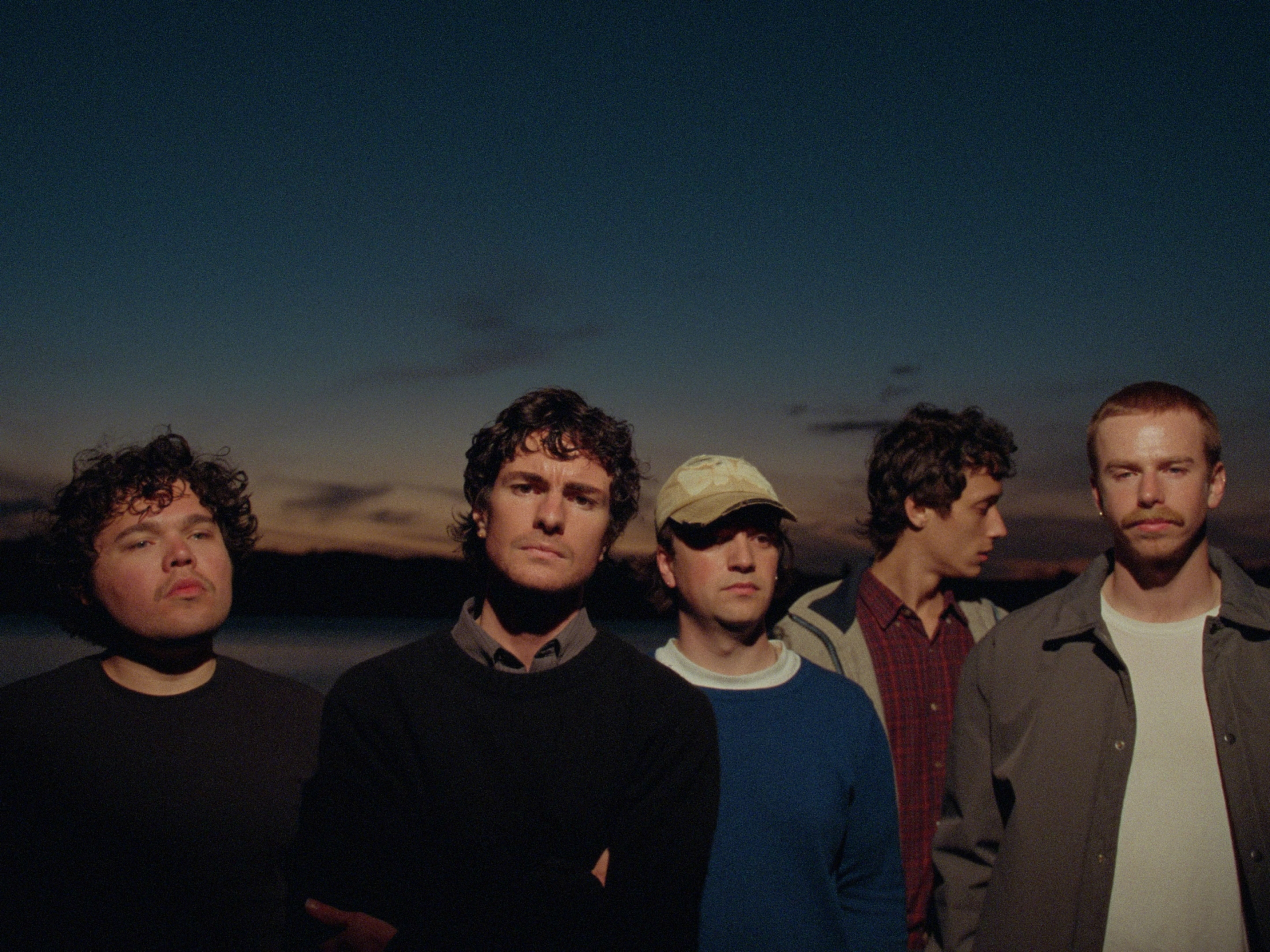
The Auckland indie-rock outfit Awning’s debut LP How many angels can dance on the head of a pin? is packed with moments like that. Backed by his childhood friend Riley Noonan on drums, Damin McCabe on bass, and Eli Chamberlain and Ethan Broughton on guitar, Dimick unleashes a fearless volatility that mates perfectly with the music, funneling grief, unease, and elation into anthemic howls and roars. Even a track like the opener “I’m Up,” which begins with an acoustic intro and deliberately slow verses, eventually climbs into racket. “This is both a love song and a meditation on how life slows down, in a threadbare kind of way, when you are isolated from your loved ones,” Dimick explains about the song.
Awning release “I’m Up” today along with news of the forthcoming album. Slotted for a January release on Winspear, the record evokes the hard-hitting spirit of indie rock through the decades: the pop-turned-grunge sensibility of Pixies and their imitators, the rough-and-ready rock and roll of Divine Fits’ Dan Boeckner and Britt Daniel, and the hazy post-punk charm of Iceage or King Krule. Dimick, who first gained attention as a visual artist, also demonstrates a formidable talent for fronting a rock band, and his bandmates feed off each other’s energy to striking effect.
Below, you can watch the “I’m Up” video, read my recent chat with Dimick, and view the tracklist for How many angels can dance on the head of a pin?
Awning is billed as a project led by Christian Dimick, a recognized visual artist. Do you think your visual work came before your music in terms of recognition?
CHRISTIAN DIMICK: I’m not sure. I’ve been making music since I was little, and I only started painting or drawing after finishing high school. But I don’t know which you were known for first.
Describe your journey as an artist. How did you break through? What do you think draws people to your art? What do they tend to notice and value?
DIMICK: About both mediums, or…?
Sure, it can be either. I meant your visual art, but I’m open to hearing about the music too.
DIMICK: I think people respond to the way I work intuitively in both fields. That’s something painting and drawing has taught me—how to trust my own judgment, when to hold on and when to let go, and when an idea is working and when it isn’t. You aren’t surrounded by others guiding your decisions, so you have to become adept at deciding quickly and confidently on your own.
Yeah, I think that’s what people respond to. If someone has said something kind after a show, it’s that I’m operating from an immediate space. I don’t walk on stage planning every move. I try to do the opposite. It’s a realm where spontaneity is valued. The same goes for painting—the more I practice, the easier it is not to overthink. That mindset has migrated from drawing and painting into my music over the years. Being a visual artist has shaped me into a different kind of musician than I used to be.
You said you started with music first?
DIMICK: When I was a kid, my grandfather—he was a concert violinist, not as his sole job, but he played the violin. So I learned the violin as a youngster. Then, around six, I began learning guitar too. I played in various punk outfits through my teens, and then I found myself—I was studying music, but grew disenchanted with that path. So I started painting and drawing constantly, swapped degrees at university, and spent years not playing much music while focusing on visual art. Now it’s all come full circle.
Why did you grow disenchanted with formal music studies?
DIMICK: This was when I was about 18 or 19. I studied composition, which leaned heavily on theory and reading charts—highly theoretical, and it felt stiflingly uncreative. I felt I needed to go out and play with other people. But leaving high school, you think you should go to university because that’s what everyone else does, so I enrolled and was unhappy. Yet I found my path and it led me to something I truly love, something I’d never imagined.
You’re part of Grace Gallery. What does that entail?
DIMICK: It means I’m represented by that gallery and, more or less, part of the family. We try to avoid a traditional gallery setup; I’m more like a friend of the gallery than a typical client, if that makes sense.
Is it the same as being signed to a record label or not?
DIMICK: There are similarities, perhaps. With Grace, it’s a professional relationship, but my friend Emil [Scheffmann] runs it and the vibe is relaxed and friendly. Signing with a label felt more serious and intense—you need an entertainment lawyer, deal with other formalities, and especially when dealing with someone overseas you haven’t met. Still, the core parallel exists: loyalty, opportunities granted in exchange for your work. It’s a trade-off, and there are common threads for sure.
Speaking of signing with a label, how did Winspear come into the picture?
DIMICK: It happened in a pretty odd way. I was in Melbourne on a painting residency when a friend of a friend, Emma, who’s now our manager, got involved after our bassist Damon sent her the record. Emma liked it and decided to come on board to manage us. She began circulating the album, and Winspear picked it up. We had no expectations at all. If you had asked me a year ago whether this would happen, I’d have said no. But Winspear listened, dug it, and we had a few casual Zoom chats. Jared Jones, who leads the label, kept things cool and it was hard to tell whether he was into it or not.
Then, perhaps a month or two later, they proposed releasing the record through Winspear. And here we are. We’ve since formed a wonderfully warm friendship with Jared and everyone there. They’re incredibly kind, and as a relatively new band, it’s flattering that they chose to back the record purely because they liked the music.
Did you know the label before?
DIMICK: I didn’t know the label deeply as an entity, but I’ve genuinely admired several of its artists—like Slow Pulp and Teethe—without realizing they were on Winspear. I love those bands, though I hadn’t connected them to the label until now.
You’re not the type to chase label lore, right?
DIMICK: No, unless there’s a local equivalent like Flying Nun here in New Zealand. Maybe I’m exposing myself, but I’ve only truly dove into Flying Nun’s catalog. Still, I’ve become more label-focused since all this began.
Yeah, it’s taken on a personal significance for you.
DIMICK: Absolutely. You can sense a label’s taste once you start filtering through their roster and recognizing the threads that connect artists.
Your bio notes 2023 as the start of this five-piece lineup. Did Awning exist in another form before that?
DIMICK: Before 2023 it was just me in a shed, crafting demos on my laptop. Eventually, a few friends joined to play shows, Riley Noonan remained on drums, Eli Chamberlain joined on guitar, Baxter Perry played bass for a spell, and Tharushi Bowatte also contributed. The lineup shifted, I moved to a new city, and we began performing as a band around 2023. It became something more concrete than a solo project.
How did the music evolve when you became a proper band? Was it similar to your solo work?
DIMICK: Not at all. When it was just me, the sound leaned toward lo-fi, folk-leaning textures. I was absorbing the Microphones and Elliott Smith, among others. Over time the band grew louder, rougher, with fewer folk elements and more abrasive textures.
Indeed, compared to last year’s self-titled release, this new one feels markedly raw and heavier. What kicked off that shift?
DIMICK: Each release has involved more in-room, group writing—responding to one another’s energy, playing in a louder space, and letting the vocals rise to match that energy. The songwriting gains a different vitality when you write with others present. That’s why the newest record sounds so much more unpolished—because of the collaborative setup.
Did you know you could hit that range before writing these songs? It sounds pretty striking.
DIMICK: Not really. With singing, you don’t typically reach that in a solitary bedroom setting. Sometimes I surprise myself—realizing I can sing in that register. You figure it out, I suppose. So that’s one way the music has developed.
How have you grown as a songwriter since starting this project?
DIMICK: I think I’ve become better at collaborating. As the band has grown toward the forthcoming release, I’ve learned to write more effectively with others and to listen more intently as a musician. You pick things up through practice or osmosis. I can’t pinpoint a single thing, but I know I’ve gained confidence and, as I said earlier, a bit more trust in my ideas—even realizing when they’re weak or strong. I’m not sure I’m a better musician per se, but I’ve grown more confident in my writing instincts. I’d call that a form of growth.
When you released “Little Green Book,” you described it as a grief too heavy to sing about in a song. Is it too heavy to discuss in an interview?
DIMICK: Yeah, perhaps, if that’s okay. I think that’s precisely what the music is for—a conduit for catharsis in a public, somewhat controlled form. It lets me be expressive without unloading my entire life story. Not everyone needs to know your private affairs. It’s healthy to leave something for yourself, I think.
That’s fair, but there are other songs on the album that feel less abstract. For example, that track sits between “I’m Up” and “Play Dumb,” and those two feel unusually direct and relatable, almost universal.
DIMICK: Completely. I agree.
I can see what you mean about maintaining some distance, but several tracks convey a plainspoken honesty that makes it easy to connect. Some writers might lean toward oblique phrasing, but you give listeners a lot to project themselves onto in the song. “Play Dumb” is exactly the kind of track many people will shout along to.
DIMICK: I hear you. For certain topics there’s a need to create distance through the lyric style. For others, it feels right to be direct because listeners can readily relate to your experience. It varies by subject.
“How many angels can dance on the head of a pin?” Where did that track originate, and why is it the title track?
DIMICK: That song is a bundle of ideas. It centers on a dream I had of my mother, who passed away when I was a child. I’ve only had a handful of dreams about her, but the verse lyrics draw from the dream’s imagery. The chorus line, meanwhile, reflects where I’m at in life now. The line basically asks, “How many more conflicts with myself can we endure before we move on?” When you braid those two strands together, it’s odd but it works for me, with much of the imagery drawn from the dream.
I’m sorry about your mom. I imagine that loss casts a shadow over much of what you create.
DIMICK: Yes, definitely. These are universal themes—things many people will experience at some point. They linger and shape what you make, especially as an artist. Some folks with keen creative sensibilities feel drawn to connect with those who aren’t here anymore. I definitely sense that at times.
TRACKLIST:
01 “I’m Up”
02 “Little Green Book”
03 “Play Dumb”
04 “The Thing”
05 “Novotel”
06 “How many angels can dance on the head of a pin?”
07 “We are going somewhere strange”
08 “Washhouse/Glasshouse”
09 “Videotape”
10 “Birds”
TOUR DATES:
02/20 – Brisbane, AU @ Valley Crawl
03/15-21 – Austin, TX @ SXSW 2027
05/12-15 – Brighton, UK @ The Great Escape Festival
How many angels can dance on the head of a pin? is out 1/29 on Winspear. Pre-order it here.