
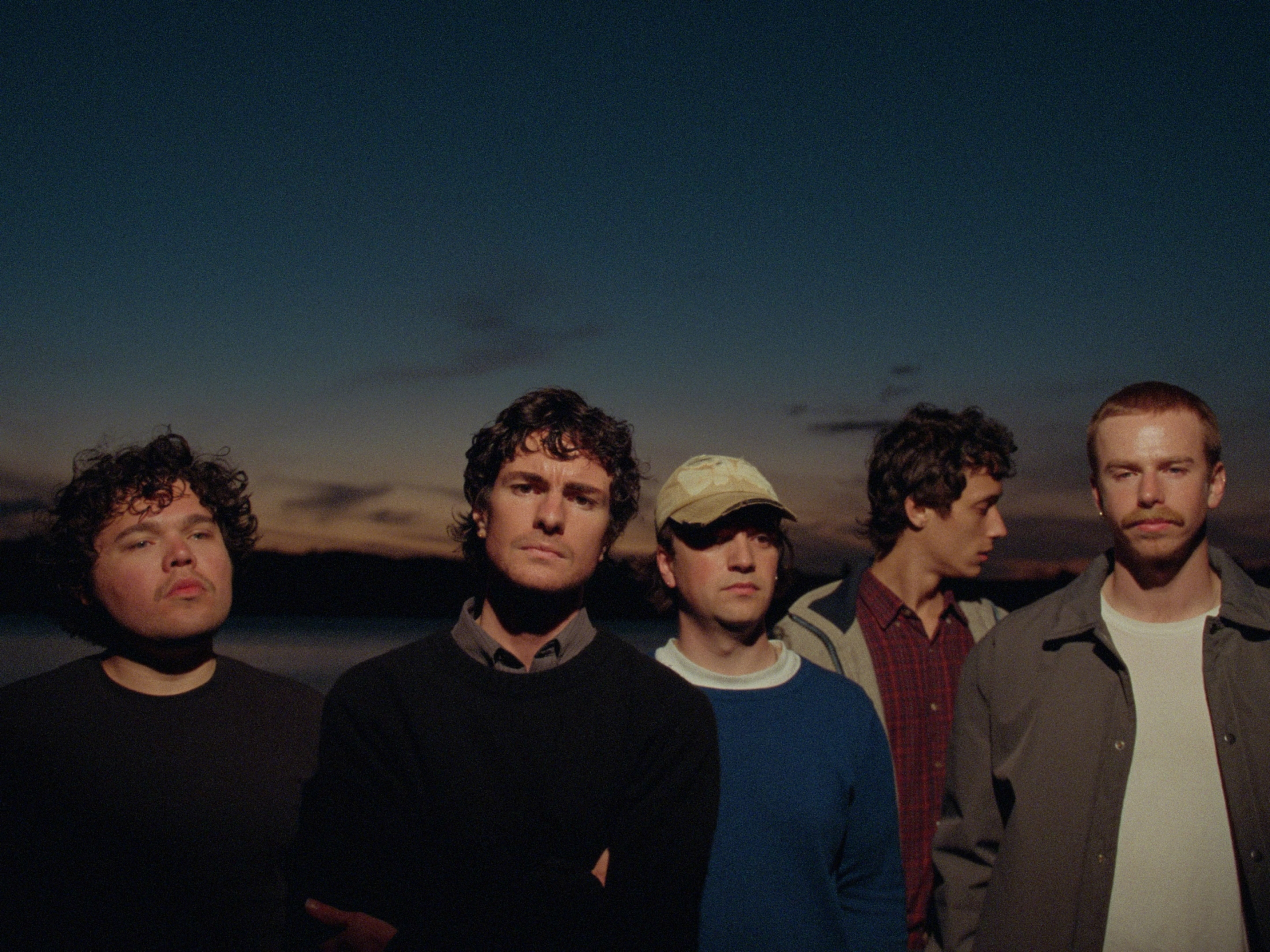
The track “Little Green Book” took me by surprise. Awning’s latest single sweeps you away at once with a brisk, bass-forward pulse and jagged guitar stabs that feel like they were stitched in from “Everlong.” The groove is driving in a way that recalls Radiohead or Tokyo Police Club, yet it carries a natural, swaggering looseness that hints it could derail at any moment. And when the chorus hits, instead of derailing, the momentum erupts. Amid blasts of distortion and a moaning roar, Christian Dimick delivers with reckless urgency and a raw throatiness: “I want to remember what you said! I want to remember every word!” It’s one of those holy-shit moments that rock fans crave, when a band truly goes for it.
The Auckland outfit Awning’s debut LP How many angels can dance on the head of a pin? is studded with moments like that. Backed by his longtime friend Riley Noonan on drums, Damin McCabe on bass, and Eli Chamberlain and Ethan Broughton handling guitar, Dimick unleashes a fearless volatility that translates grief, tension, and elation into anthemic shrieks and bellows. Even a track like the opener “I’m Up,” which begins with an acoustic tease and a slowed tempo, eventually climbs into a roar. “This is both a love song and a meditation on how life slows down, in a threadbare sort of way, when you are cut off from the people you care about,” Dimick explains about the song.
Awning are presenting “I’m Up” today alongside news about the forthcoming album. Scheduled for a January release on Winspear, the project evokes echoes of hard-hitting indie rock across the years: the combustible tunefulness of Pixies and their grunge descendants, the ragged rock ’n’ roll glory of Divine Fits duo Dan Boeckner and Britt Daniel, and the bleary post-punk elegance of Iceage or King Krule. Dimick, who initially earned recognition as a visual artist, proves equally adept at fronting a rock band, and his bandmates feed off one another’s energy to striking effect.
Below, you’ll find the “I’m Up” video, along with a transcript of my recent talk with Dimick, and the tracklist for How many angels can dance on the head of a pin?
Awning is pitched as a project led by Christian Dimick, a noted visual artist. Is it fair to say your art predates your music in terms of public recognition?
CHRISTIAN DIMICK: I’m not sure. I’ve been making music since I was a kid, and painting or drawing only picked up after high school. It’s not easy to say which came first in people’s minds.
Tell me about your journey as an artist. How did you break through, and what do you think people respond to in your art? What tends to stand out for audiences?
DIMICK: About both mediums, or…?
Sure, either one. I’m curious about your visual art, but I’m also interested in the music.
DIMICK: I think people respond to how I work instinctively in both visual art and music. One thing painting and drawing has taught me over the years—spending long stretches alone in a studio—is to trust my own judgment and be confident about when to cling to an idea and when to let it go, and when something is working and when it isn’t. You’re not surrounded by others to steer your choices, so you have to become adept at decisions on the fly. I think that authenticity resonates. If people have given me kind comments after a show, they often mention that I’m performing from a place that feels immediate. I don’t step onstage planning exactly what I’ll do; I try to act in reverse—embrace spontaneity as a virtue. It’s the same with painting: the more I work, the less I overthink, and that flow has bled into my music. Becoming a visual artist has made me a different kind of musician than I was before.
You mentioned you started with music first?
DIMICK: As a kid, my grandfather played violin professionally on the side—he was a concert violinist. I learned the violin early, then picked up the guitar around six. I played music through my teenage years in various punk outfits. Later, I was in the middle of music studies and grew disenchanted, which led me to painting and drawing, and I switched degrees at university. A number of years passed with me focusing more on visual art, and now everything is looping back together.
What prompted your disenchantment with formal music study?
DIMICK: I was around 18 or 19, studying composition, which was heavily theory- and chart-based, rather than creative. It felt stifling. I longed to play with others, to jam and improvise. Yet, as a recent high-school graduate, I felt compelled to pursue university because that’s what everyone did, even though I wasn’t happy. Eventually, I found my own path, which led me to something I truly love—something I wouldn’t have imagined pursuing.
You’re part of the Grace Gallery family. What does that entail?
DIMICK: It means I’m represented by the gallery and considered part of their circle. We try to break away from a traditional gallery model, functioning more like a community rather than a line of clients.
Is it similar to being signed to a label?
DIMICK: There are some parallels. The relationship with Grace Gallery is professional but informal—my friend Emil Scheffmann runs it, and the dynamic is relaxed yet serious. Signing with a label felt more formal and intimidating; there’s more red tape and legal work, especially when dealing with an overseas partner you haven’t met in person. Still, there are overlaps: loyalty, opportunities given, and the exchange of work for support. It’s a trade in its own right, with shared sensibilities.
Speaking of a label deal, how did Winspear come into the picture?
DIMICK: It happened in a somewhat odd way. I was in Melbourne on a painting residency when a mutual acquaintance connected us with Emma, who now runs our management. Our bassist Damon sent her the record, knowing she worked in music and could steer it to someone who might be interested. Emma decided to come aboard as our manager, and she began circulating the music. Winspear ended up picking it up. We had no real expectations about anyone taking an interest. If you’d asked me a year ago if this was possible, I’d have said no. But Winspear listened, liked what they heard, and after a couple casual Zoom chats, they proposed releasing the record through the label. Since then, we’ve formed a genuine and supportive friendship with Jared Jones and the rest of the Winspear team. They’re incredibly kind, and for a band that’s still relatively fresh—people didn’t know much about us—the fact that they chose to work with us based purely on the music feels like a meaningful compliment.
Did you know the Winspear roster beforehand?
DIMICK: I wasn’t deeply familiar with the label as a label, though I admired several of its artists—Slow Pulp and Teethe, in particular. I enjoyed those bands without realizing they were already linked to Winspear. This whole experience has made me more label-aware, in a good way.
So you weren’t walking around hoping to find a specific label?
DIMICK: Not really, unless you count Flying Nun in New Zealand as a familiar thread. I’ve mostly delved into Flying Nun’s catalog rather than chasing a label’s identity. But this experience has sparked a deeper interest in labels in general.
All of this suddenly feels personally meaningful for you.
DIMICK: Absolutely. You can sense a label’s taste when you look across their roster, and once you start digging, you can spot the common threads linking different artists and bands.
Your bio notes that 2023 marked the launch of the current five-piece version of the band. Was Awning something else before that?
DIMICK: Before that, Awning was basically me in a shed making laptop demos. Eventually I invited friends to play live with me, so Riley Noonan joined on drums, Eli Chamberlain came aboard, and Baxter Perry and Tharushi Bowatte filled out the early lineup. The lineup shifted when I moved to another city, but we started playing as a proper band around 2023, turning something solo into a real, performing unit.
How did the music shift once you became a fully staffed band? Was it similar to your solo work?
DIMICK: Not at all. When it was just me, the sound leaned toward lo-fi folk. I drew heavily from the Microphones and Elliott Smith, among others. As the group coalesced, the music grew louder and rougher—less folk-oriented, with fewer acoustic elements.
Even compared to your self-titled release last year, this new material feels more aggressive. What sparked that change?
DIMICK: Each release has involved more collaborative writing in a room with the band. You feed off one another’s energy, push the volume, and respond to the dynamics in real time. Writing in a shared space is a different animal from drafting songs alone in a bedroom, and the process becomes more about presence and reaction. That’s why the latest record lands with a rawer edge—it’s a different setup entirely.
Did you realize your voice could carry that much range before you started crafting these songs?
DIMICK: Not fully. You can’t inhabit that register when you’re solo in a room, so there are moments that surprise me. You learn you can push into new vocal territory, and that realization is part of the band’s evolution.
In what ways do you feel you’ve grown as a songwriter since starting this project?
DIMICK: I’ve become better at collaborating and listening within a group setting. The more the band grew, the more confident I became in my ideas and in knowing when they work or when they don’t. I wouldn’t claim I’ve become a virtuoso musician, but I’ve certainly grown more adept at trusting my instincts when writing with others.
When you released “Little Green Book,” you said it centered on a grief too heavy to bear in a song. Is the topic too heavy to discuss in this interview as well?
DIMICK: It might be, if that’s alright. The music exists as a cathartic outlet—a way to express something intensely without laying out all of your private history. It’s healthy to keep some aspects private, to reserve a piece of yourself for personal reflection.
That makes sense, though there are other tracks on the album that feel more direct and accessible. For instance, “I’m Up” and “Play Dumb” feel straightforward and broadly relatable, almost universal.
DIMICK: Absolutely. Some songs need distance in their language, while others can be more plainly expressed. It varies from track to track, depending on the subject matter.
“How many angels can dance on the head of a pin?” What sparked that song, and why is it the album’s title?
DIMICK: The song is a fusion of several ideas. One strand comes from a dream I had about my mother, who passed away when I was young. The verses borrow imagery from that dream, while the chorus contemplates a personal life moment—how many exchanges with oneself can one endure before moving forward. Put together, the fusion feels odd but right for me, largely built from dream imagery.
I’m sorry about your mom; I imagine that loss lingers in your work.
DIMICK: It does—these are universal concerns eventually faced by everyone. The idea of people lingering in memory, and their influence on what you create, shapes how I approach art. Some artists with heightened sensitivity seem drawn to connecting with those who aren’t here, and I definitely feel that pull sometimes.
TRACKLIST:
01 “I’m Up”
02 “Little Green Book”
03 “Play Dumb”
04 “The Thing”
05 “Novotel”
06 “How many angels can dance on the head of a pin?”
07 “We are going somewhere strange”
08 “Washhouse/Glasshouse”
09 “Videotape”
10 “Birds”
TOUR DATES:
02/20 – Brisbane, AU @ Valley Crawl
03/15-21 – Austin, TX @ SXSW 2027
05/12-15 – Brighton, UK @ The Great Escape Festival
How many angels can dance on the head of a pin? is out 1/29 on Winspear. Pre-order it here.