We’ve Got A File On You features conversations in which artists reveal the offbeat chapters that populate their careers: acting gigs, guest appearances, random internet ephemera, and more.
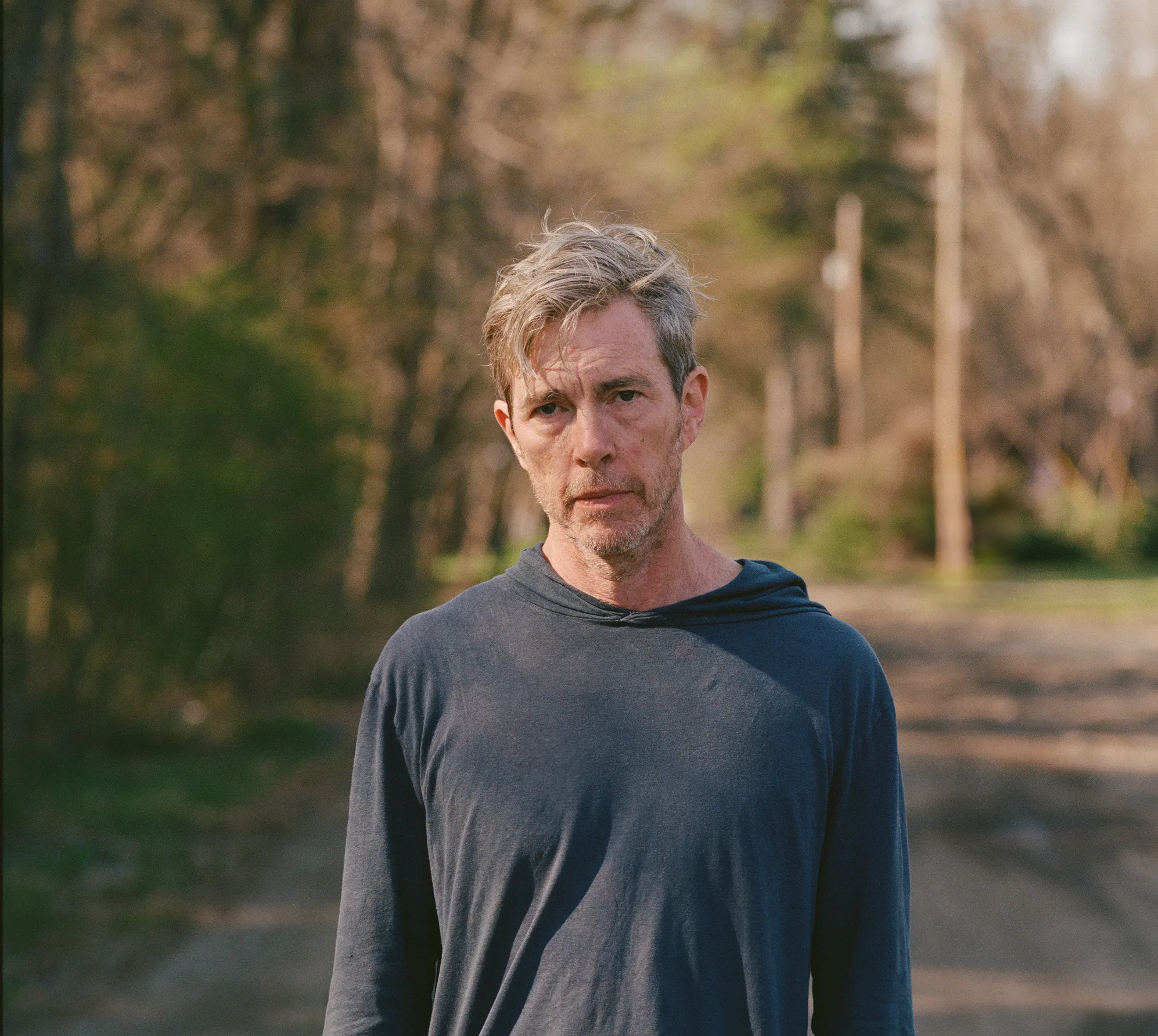
Bill Callahan has softened with age. Among the pantheon of enigmatic indie icons, the veteran singer-songwriter stands as a figure worthy of a Mount Rushmore-legend label. From his early, lo-fi outings as Smog to the more grounded records released under his own name, he has managed a delicate balance between sincere conviction and emotional distance. That stance places him in the same neighborhood as timeless names like Bob Dylan and Leonard Cohen, and his discography deserves to be spoken of in the same breath. Yet domestic life has mellowed him.
Since tying the knot and becoming a father, the Austin-based artist’s records have taken on a warmer, more candid tone. He resurfaced after a lengthy hiatus with the 2019 double LP Shepherd In A Sheepskin Vest, then quickly followed with 2020’s Gold Record and 2022’s YTI⅃AƎЯ. He spent a little more time on the next one, which finds him opening up even further.
My Days Of 58, released this Friday, stands among Callahan’s most vulnerable offerings — not least of all on “Empathy,” a song addressed to his late father, and “Lake Winnebago,” with its lyrics about burying his parents. Callahan explains that the album’s straightforward songwriting was shaped by a scare with cancer. Last year he had a Stage One tumor removed, which thankfully hadn’t spread. He’s OK now, but for a few weeks he worried that he might be near the end, which pushed him into a creative overdrive. You can hear how these songs could have served as a final testament.
On tracks like the opener “Why Do Men Sing,” with its imagined scene of Lou Reed greeting him at the pearly gates, and the roaming, almost childlike “Highway Born,” he contemplates his chosen life as a performer. “Pathol O.G.” offers his thoughts on songwriting: “I wouldn’t say it saved my life, but it gave me a life.” The lead single “Man I’m Supposed To Be,” the first track he wrote after the cancer diagnosis, dives even deeper into the core of his identity. Even songs that might be read as cultural critique — like “Computer,” a plainly spoken critique of how modern technology can poison as it connects — probe what it means to be alive. “It’s funny, kind of sad,” the album’s weathered baritone suggests, “how easily we accept the question: Are you human?”
In keeping with that embrace of human, fallible flesh, Callahan sought a lived-in feel for these tunes. He achieved it with free-flowing takes recorded with his touring band — Matt Kinsey (guitar), Dustin Laurenzi (saxophone), and Jim White (drums) — joined by guests Richard Bowden (fiddle), Pat Thrasher (piano), Chris Vreeland (bass), Mike St. Clair (trombone), Bill McCullough (pedal steel), Eve Searls (backing vocals), and Jerry DeCicca (tambourine). The result is a batch of raw, vibrant readings of meticulously crafted songs — sometimes stark and intimate, other times lush as a forest in spring.
In a wide-ranging video chat last month, Callahan discussed My Days Of 58 and wandered through the corners of his remarkable career. Read our dialogue below.
My Days Of 58 (2026)
Being from Columbus, I’m acquainted with Jerry DeCicca, who used to lead Black Swans when he lived here. I was thrilled to have him and his partner Eve Searls involved in the creative process for this new album. –
BILL CALLAHAN: Yes. Jerry acted as a sounding board for us. He spent roughly half of the tracking days and half of the mixing days in the studio, and he’s got a producer’s ear.
The promo materials for the new album describe a desire for a “living room” vibe. What draws you to that approach at this juncture?
CALLAHAN: Essentially, there are two main ways records get made. There’s the heady, inward-facing approach where the entire universe lives inside the mind, a method that’s dominated recording and mixing since the late ’60s and ’70s. I often call that airless because you can’t really hear any space, any room. It lives in your head. I’ve used that technique on YTI⅃AƎЯ too. The other method mirrors early jazz recordings, where you can hear chairs squeaking and breaths between notes. Michael Hurley’s records, for instance, feel as if he’s right there in the room with you. This felt appropriate for this record.
You sense a more homespun quality to these songs? Whatever that means.
CALLAHAN: I suppose I wanted something genuinely human and approachable, and sometimes the cerebral, plug-and-play method can feel a bit contrived. I wanted the recordings to feel real, untricked, as if you were sitting in a real space hearing the performers. I aimed to keep it authentic on this record, so perhaps it aligned with the album’s themes.
One track that seems to embody that approach is “Computer.” You sing about not being a robot and the toll of constant online activity. And just this morning I revisited your lyric about free speech being challenged, then learned TikTok reportedly began silencing anti-ICE and anti-Trump messages. It feels increasingly relevant each time I re-listen. Is that track a broad meditation on how technology shapes society right now?
CALLAHAN: Right now technology — AI in particular — shifts daily, growing more complex and more widely applied. I sense the song’s shelf life: in five years it might sound quaint. But the bigger point is that no one really analyzes these shifts. We’ve all accepted this tech, and now it’s hard to function without a smartphone, because commerce dictates it. And the free-speech issue is tricky because both sides of the political spectrum seem to want compliance rather than genuine debate. So I wanted that critique to be accessible to anyone, regardless of political leaning.
Yet the core of the track is more about a lack of discussion around these forces. People imitate or generate images or even portraits of musicians with AI — it’s more than a novelty, and the risk rises as technology evolves. There are warnings, but the scale feels small compared to the threat, to me.
You mentioned that the album’s songs might not have a long shelf life because they’re so tied to this moment in your life. Even the title feels timestamped, with lines like “Now I’m pushing 60.” Do you think these pieces are particularly personal, perhaps less likely to be covered by others?
CALLAHAN: There’s a question of whether a 16-year-old would pick up an album titled My Days Of 58. When I was that age, this would probably be the last thing I’d buy. Still, the later audience might receive it differently, and some listeners will find it resonates now. A significant portion of the record feels time-bound, and I wasn’t aiming to rewrite that. It’s simply what I made this time, and I hope some people will connect with it.
I was struck by how intimate you get on songs like “Empathy” and to a lesser extent “Lake Winnebago.” What motivated you to share this portion of your life now, including the songs addressed to your father and your family?
CALLAHAN: Both of my parents are gone, so the concern about their reactions isn’t an issue anymore. Yet I’ve sensed that, with my father especially, his presence persists in a new form — a feeling of him being with me in the spiritual sense, where there are no barriers. A psychic advised me to forgive my parents and to look out at water and forgive, and that guidance helped me. It broke down that wall. As for “Empathy,” that track was something I needed to say aloud to move forward. I wanted to get the difficult stuff out first so I could say more later, as part of processing. My approach to songwriting is not to claim finality in a single moment; I’m always trying to present where I am now and leave room for subsequent parts to unfold. If I’m ever unhappy with someone, I’ll acknowledge it first and then work toward resolution, to keep growing beyond one definitive statement.
When you released “Stepping Out For Air,” you said it had been intended for a different project years earlier with Jim White and Warren Ellis. Was that the first time any of you discussed that idea? Did you have a band name, or would it have been a Bill Callahan project?
CALLAHAN: It probably would have carried a different name. I think I’ve mentioned this publicly for the first time. I wrote a four-song demo for those collaborators, and Warren contributed violin on some of it. Then everyone’s schedules exploded: he teamed up with Nick Cave, Jim teamed with Cat Power for years, and the project simply drifted away. It faded into the background.
“One Fine Morning” Appears In HBO’s Station Eleven (2021)
Did you happen to see that scene? I assume you watched it to approve.
CALLAHAN: It’s odd — I usually request to see a scene before approving, or at least get a written summary. But I skipped that with this one. I haven’t watched the episode yet; my wife and I started watching the show, but it scared her, so we paused. I don’t watch TV alone, so I haven’t seen it. I’ve heard it’s good, though.
When I spoke with Will Oldham, we discussed licensing his songs. He argues that hearing a familiar song in a film makes you drift from the movie into the world of the song, if you already know it. Do you have misgivings about your music appearing in film or TV?
CALLAHAN: In my younger days I was pickier, but now I’m more open. I don’t see a commercial or a scene automatically ruining a song; if the song is strong, it can endure any context. I’m less concerned with the fit than with whether the track remains itself in the new setting.
Will’s point wasn’t only about the song; it was about the use of a needle-drop potentially undermining a film’s narrative. He mentioned Wes Anderson films and the way certain familiar songs can steal focus from the movie itself, becoming about the track rather than the scene.
CALLAHAN: I’m reminded of Scorsese’s films, where a doo-wop cut can punctuate a beat-down in a way that’s darkly funny. Music and cinema fuse so naturally; they’re not separate experiences but rather parts of a whole. It’s transformative — the image, the song, and the moment together can transport you. A recent airport layover found me wearing headphones and letting music guide the way, turning a dull delay into a moment of beauty as I watched people flow by.
Do you recall what you were listening to in the airport that day?
CALLAHAN: It was Shida Shahabi, an Iranian pianist and composer — mostly instrumental — whose work I’d just discovered nearby.
Collaborations With Will Oldham (1994-Present)
Speaking of Will Oldham, you two have a long history together, dating back to the Sundowners, and you did numerous covers during the COVID period. What distinguishes working with him? What does he contribute to the process?
CALLAHAN: His vocal prowess is striking. For much of his career, he sang with an almost uncanny ease, and then he blossomed into a truly multifaceted vocalist. When we did a duet album, he raised the bar for me to explore different ways of singing. I usually focus on getting the words across and moving on, but this project demanded a broader range. Covers are themselves a challenge because many of the originals are already strong; the question becomes what I can add to make it worthwhile and comparable to the source.
Do you have a favorite among the duo’s covers?
CALLAHAN: I’m fond of the Little Feat cover — it owes a strong debt to a version done by a singer named Judy Mayhan in the ‘70s. She was a bit obscure, but her interpretation shaped the arrangement here. It’s a beautiful tune, and that one stands out for me.
Collaborations With Noah Cyrus (2024-Present)
You’ve released a couple of tracks with Noah Cyrus — “Porcupine Tattoo” for last year’s Everything Is Recorded project, and “XXX” for Noah’s own album. The press release notes that when Richard Russell asked you who you’d want to write for, you singled out Noah Cyrus. Why did she stand out?
CALLAHAN: She struck me as a contemporary songwriter and singer who embodies a timeless sensibility. She seemed to have a natural command of her craft and wasn’t simply aiming for rock-star status. It felt rare to encounter someone with that kind of clarity and presence these days.
Two tracks have emerged so far. Were they from the same session, or has the collaboration taken on a broader life?
CALLAHAN: The Everything Is Recorded track began as a rough demo on my phone, later finished in L.A., with my voice treated down to fit the project. I started talking with Noah and we decided to make an EP together. We traveled to L.A. for sessions to kick things off, and when she loved “XXX” enough to consider placing it on her album, I re-entered the studio with the team she was working with to align the sound with her record. We have at least three other songs that are nearly finished, and I hope to expand the collaboration later this year.
Covering Versus’ “Santa Maria” For The Merge Records 20th Anniversary Compilation Score! (2009)
What drew you to that particular track?
CALLAHAN: A close friend of mine used to date one of the folks in Versus and was in a band with another member’s brother, who was also in Versus. I approached the cover as a surprise for my friend — a kind of musical wink — and I’m not sure if she ever heard it.
Covering “Lapse” For The Chris Knox Benefit Comp Stroke (2010)
What’s your history with Chris Knox’s music?
CALLAHAN: My first European foray happened in the Netherlands at a lo-fi/home-recording festival that celebrated Flying Nun acts. There I met Chris Knox and Alec Bathgate, and we got along well. Chris was already a fan of my work, and we later performed together in various places in Europe and beyond. He’s also one of those writers who enjoys correspondence — back when emails weren’t a thing, we exchanged letters, and he made cartoons for me. I visited him during a stop in New Zealand; he was a genuine, kind presence.
Guest Appearances On Old Fire’s Voids (2022)
More recently, you contributed to John Mark Lapham’s Old Fire project on a handful of tracks. How did that come about?
CALLAHAN: He’s an old friend of Thor Harris, whom you may know. They’ve collaborated for a long time, and John Mark often seeks vocalists for his projects. Since Thor knew we were friends, he connected us, and that opened the door for me to participate.
Do you usually take a collaborative approach, or are you selective?
CALLAHAN: There’s a lot of outreach these days. I’m open to collaboration when we actually work side by side — I’ve learned that working in the same room can bring out the best in both participants. With Noah, I discovered that inviting someone into the process can strengthen what I already have. It’s not just someone adding their part remotely; it’s a real joint effort. I’ve grown more receptive to collaboration, especially when it feels genuine and involve real time co-creation, rather than something dropped on top of a track someone else finished in isolation. That said, I’m not as interested in the online, largely remote kind of collaboration, though I know it’s a common method these days. The real room chemistry is what I’m drawn to now.
As a teaser for a potential future collaboration — not sure if you know Meshell Ndegeocello — I met her at a festival long ago. She slept in a tent after her set, and when I performed later she peeked out and asked about my voice. A decade later she invited me to sing on a track of hers. It’s slated to come out later this year.
Bob Dylan Narrates Cadillac Ad Set To Smog’s “Held” (2007)
Sometime in the 2000s, Bob Dylan lent narration to a Cadillac commercial that used your song “Held.” Is that story accurate?
CALLAHAN: It sounds unbelievable, but it’s true.
I imagine that must have been a surreal moment — a major ad agency proposing to pair your track with Bob Dylan. Was that the extent of it?
CALLAHAN: I didn’t question it much. They described the scene, and it felt so bizarre that I couldn’t say no. It is a strange setup — one of the most iconic figures in music listening to one of the least famous artists in a car. People respond to the song’s rhythm and its groove, which is what drew them to it in the first place.
What’s the appeal of the rhythm?
CALLAHAN: We were aiming to recreate the feel of Queen’s “We Will Rock You” — stomping on wooden pallets, then adding a touch of reverb. That rhythm is what lingers for many listeners and, I suspect, what ad executives first heard.
Have you heard Spoon’s cover of that song?
CALLAHAN: Yes, I have.
Do you have much history with Britt [Daniel] from the Texas scene or the broader indie circle?
CALLAHAN: A little. The first time we crossed paths, we opened for Spoon in Arizona because I couldn’t secure a headline slot. I used to travel more before I settled down — I’d see him more often back then, but not so much in recent years.
Guesting On Joanna Newsom’s “Only Skin” (2006)
She has a distinctive working method. What was that experience like?
CALLAHAN: I can barely recall the session’s details, though I think we did it in Los Angeles. It happened quickly — I likely nailed it in the first take, and she didn’t offer many notes. She simply asked me to deliver in the way I felt most comfortable. I don’t remember much beyond that day, which was around 20 years ago. I do remember, however, that I was in the vicinity while Van Dyke Parks was adding string overdubs, and there was a guy on the couch who they called Lee. Later I learned that it was the renowned session bassist Leland Sklar, which was one of those moments you realize you were in the presence of greatness without fully recognizing it at the time.
There was a similar moment later at Steve Albini’s Electrical Audio studio. He sometimes invites prospective clients to take a quick tour; I was in the middle of a session with another engineer when he brought in a visitor who looked around and then left. My mind flashed: was that Tom Verlaine standing inches away? A moment I would have loved to acknowledge, perhaps even invite to join. Verlaine’s Marquee Moon ranks among my all-time favorites, and I wish I’d said so. More broadly, I’ve long thought about asking him to contribute to my own record. The moment reminded me how tempting it is to invite the iconic to play, even when practicality or timing prevents it.
My Days Of 58 drops 2/27 on Drag City. Pre-order it here.