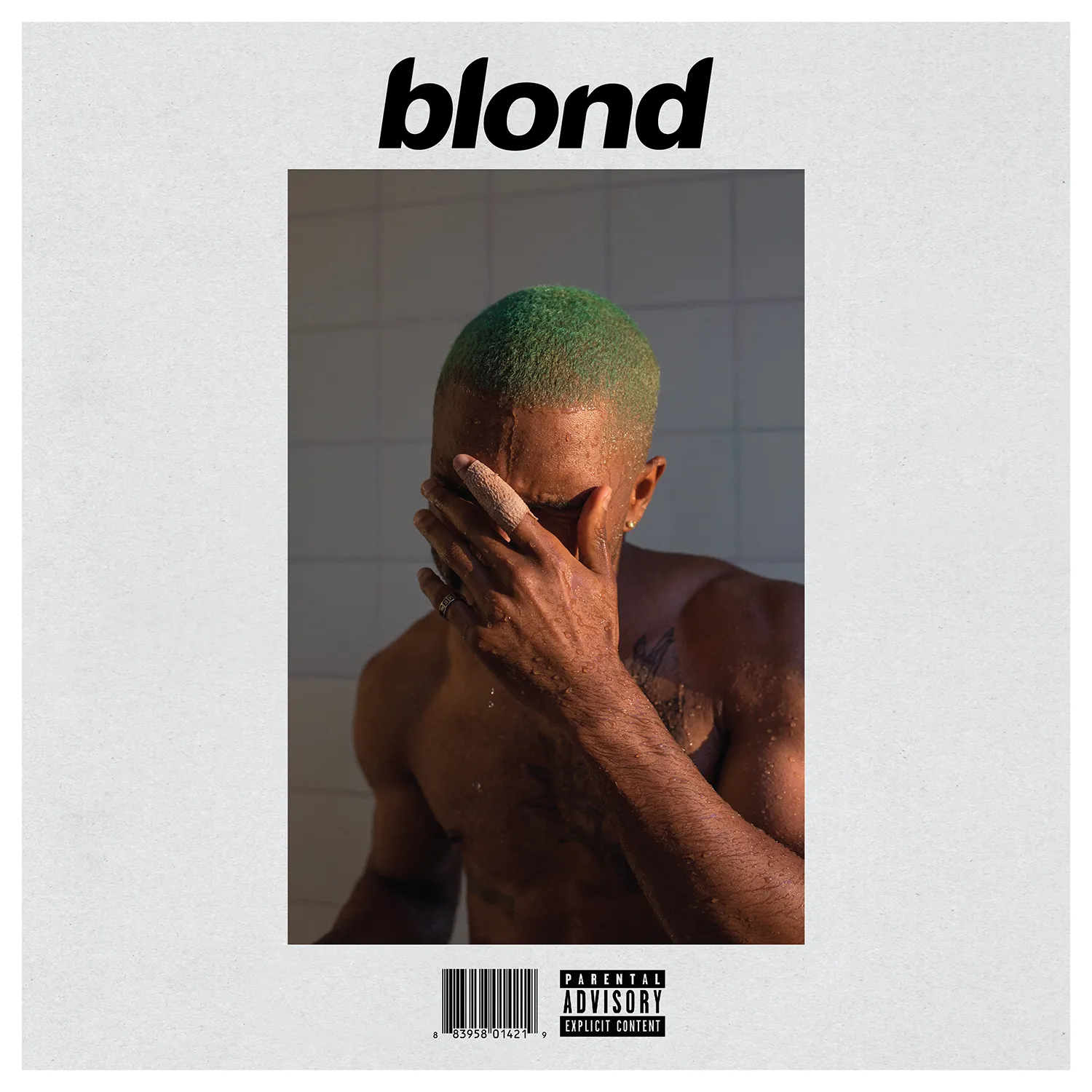
The terrain felt slick from the start—the fall as well as the sound of it. Just when you thought you could hold on to Frank Ocean, he slipped away, leaving nothing but a haze of smoke and light trails. Elusiveness defines him, yet so does a deep, resonant emotion. That tension is what made Blonde so captivating back then, and it is precisely why an album built on transience has endured with such force.
When Ocean unveiled Blonde ten years ago today, he closed a four-year gap since Channel Orange, the debut LP that propelled him from an online-blip sensation to a Grammy-nominated star. He also executed a clever bait-and-switch that kept Def Jam and Universal Music Group out of stake in the landmark record, leaving his major-label past in the dark about Blonde while he fulfilled his contract with Endless, a cryptic visual album playable only as a 45-minute Apple Music video. It wasn’t offered for sale.
The Blonde pivot proved an extraordinary win for Ocean. Reports suggest he boosted his potential take from 14% to 70% by releasing it on his own imprint Boys Don’t Cry, a label that had even been expected to be the album’s title for a long stretch. The stealth move also doubled as a pointed rebuke to the major label that, years earlier, left this modern icon on the shelf until his buzz from the self-released mixtape Nostalgia, Ultra became impossible to ignore. It felt especially sharp that the accompanying visuals for Endless consisted of unedited black-and-white footage of Ocean constructing a stairway to nowhere. Fueled by insecurities, a fierce need for privacy, and a stubborn commitment to doing things on his own terms, he has increasingly stepped off the conventional ladder to fame that the industry typically prescribes.
“I’ve always been reluctant to do those things unless they carried nostalgic weight for me,” he told the New York Times after Blonde appeared. “Things like performing at the VMAs or being invited to the Grammys. My yes to those moments was tied to how they felt before I actually joined the business, and I wanted to be seen in those rooms. I still felt uneasy and skeptical because I questioned whether I was truly ready.”
You can picture a similar logic at work when the man who sang about Coachella in his breakout hit agreed to headline the desert festival in 2023, only to buckle under pressure, scrap his large-scale plans at the last moment due to an injury, and ultimately withdraw from the second weekend. Those types of mainstream spotlight moments have never been Ocean’s forte. He emerged from the blog era, with much of his greatest triumphs coming from off the grid, starting with the star-making mixtape released as a free download via Tumblr.
Ocean’s recurring scarcity ensures that when he surfaces in unexpected places—dropping a rap verse on the era-ending Odd Future crew cut “Oldie,” or showing up on a Calvin Harris beach-party track with Migos—his presence feels all the more electric. Writing for the Times in 2016, Jon Caramanica argued that Ocean’s absence in the three years leading up to Blonde served as a stance against celebrity culture. Looking back, it’s hard to imagine Ocean ever releasing a physical album through traditional channels and participating in that kind of ceremony. These days, the notion of him appearing on Watch The Throne seems almost surreal; once you’ve seen him in that role, he’s moved on to other avenues.
Rather than marching upward within the industry, Ocean has always favored venturing outward. Sometimes that meant roaming the globe with a backpack full of hard drives, seeking the world beyond the spotlight instead of publicly navigating a heavily mediated internet. (That may be why a track like “Facebook Story,” with its disdain for virtual connection, found its way onto this record.) Other times it meant cruising in one of his cherished cars. “How much of my life has happened inside a car?” he wondered in a note that accompanied Blonde. “I’m curious if the odds say I’ll die in one.” While crafting the album, he moved frequently, living out of hotels. That peripatetic existence shines through in the ghostly textures of both Blonde and Endless: the sense of a spiritual presence without a physical form, a heart opened in the heat of the moment and then evaporating in an instant.
The first thing most listeners noticed about Blonde was its frequent absence of drums. Many tracks drifted in space, untethered to live or programmed rhythms, as if he were stripping everything down to give us a more intense, intimate close-up. Even some of the heavier tracks, like the grand, helium-soaked opening “Nikes,” felt wavering and free-form. One could argue that, mirroring Ocean’s tendency toward seclusion, the continual void of rhythm made more standard songs like the glide-smooth “Pink + White” hit with more impact. But that would be to miss the point. When you’re attuned to Ocean’s wavelength, the quiet moments are rewards in themselves, not tests meant to cast his brighter songs in a flattering light.
The production choices sparked debate, and some corners greeted them with a shrug. Critics labeled the songs as unfinished, sloppy, or inert. To skeptics, Ocean’s opus seemed to be a “hookless morass,” a “trickling bubble bath that ultimately lands lukewarm.” At times, Ocean could command a breathtaking gospel ballad like “Godspeed,” and his reluctance to deploy that weapon more often frustrated some listeners. Like Radiohead’s Kid A, another eagerly awaited successor that shattered expectations, Blonde is now widely regarded as a classic, though it was far more divisive at release before listeners acclimated to its textures. I even drew a parallel that week of release, and a decade on, that comparison still holds up better than I would have guessed. (In this analogy, Nostalgia, Ultra is The Bends, Channel Orange is OK Computer, and Endless is Amnesiac.)
Even if some listeners felt he kept his cards close to the chest sonically, Blonde marked Ocean’s effort to open up more as a songwriter, shifting away from the character sketches of Channel Orange toward autobiography. This time the vignettes offered a glimpse into the real Lonny Breaux, both then and now, revealing his flaws and vulnerabilities alongside his prodigious talent. “I’m just a guy, not a god,” he reassured us on the closing track “Futura Free,” before admitting to himself and the audience, “Sometimes I feel like a god, but I’m not one.” The track layers the familiar rags-to-riches arc with lore—like the revelation that Tyler, The Creator used to crash on his couch. In the Nostalgia, Ultra cut “Songs For Women,” Ocean had already positioned his music in dialogue with Drake’s, and he’s never seemed more Aubrey-than-on-“Nights,” with its beat-switching backdrop and memoir verses about earlier days—Acura days, no less.
Yet beyond the trivia Ocean offered, Blonde connected because it conveyed the intensity of his inner world so effectively. The spare guitar reverie “Ivy,” which one colleague once likened to Usher singing for Deerhunter, opens a series of windows into ecstasy giving way to heartbreak: “I thought I was dreaming when you said you loved me / The start of nothing.” The ache becomes even more overwhelming on “Solo,” which depicts arriving in Colorado for a date that never happened, the sweetness of James Blake’s organ lingering as Ocean laments getting stood up, before a stark detail—“Stayed up ’til my phone died.”
The intricacies of Frank Ocean were laid bare here—his passions, tastes, and hangups distilled into music that refused to follow pop stardom’s rigid rules. Some of the album’s most abstract moments, including the glassy “White Ferrari,” were among its most tender. Ocean explained to the Times that he altered his vocal tracks to create several voices on certain songs because he felt the listener wasn’t hearing enough versions of him within a single tune. In the 360-page Boys Don’t Cry zine released alongside Blonde and Endless, he famously described his sexuality as “a little bent.” (The zine also featured an interview with Lil B and a Kanye West poem about McDonald’s.) I still haven’t quite figured out what Ocean was aiming to convey with an anti-drug voicemail from someone else’s mother floating in the mix.
This man refused to be pinned down, and some tracks on Blonde felt as if they might drift away, not least of all the opening overture. “Nikes” opens the record with a queasy blur of sex and drugs, swagger and doubt, humor and grief, setting a mood for the sounds and stories to come. He touches briefly on a turbulent world (“R.I.P. Trayvon, that guy looked just like me”) but mostly trusts listeners to find the universal within the personal from that point onward. That approach also included a constellation of collaborators and reference points that turned the liner notes into a treasure for music nerds.
This era was a golden moment for blockbuster rap and R&B records with eclectic guest lists, but truly, who else could match the unique chemistry achieved by pairing Pharrell, Alex G, Kanye, Kim Burrell, Rostam, Yung Lean, Vegyn, Michael Uzowuru, Jon Brion, James Blake, Malay, Buddy Ross, Om’Mas, a friend from Slow Hollow, and a pre-colonoscopy André 3000? If Blonde is a soup, it’s a recipe crafted by a chef with a taste for jagged rhythms that could sample Gang Of Four. If it’s avant-garde, it also comes from a man who honors pop craftsmanship by borrowing from Bacharach & David, the Beatles, and Elliott Smith on successive tracks. If it’s ephemeral, well, so was the love that inspired much of it.
Meanwhile, the affection for Blonde has only deepened. A decade on, it’s not merely canonized but emulated at every turn. (“We’ll let you prophesize / We’ll see the future first.”) Minimalist ballads have always been a staple of the music industry, yet on Blonde Ocean seemed to conjure a new sonic language for these bleary confessions, a production style that felt almost verité and subtly surreal. Once listeners adjusted to that surprising mood shift, it proved incredibly influential. From Halsey and Haim to Mk.gee and L’Rain, I keep hearing Ocean’s radical minimalism echo across the 2020s music landscape. But regardless of how many artists attempt the Blonde aesthetic, the album’s peculiar alchemy remains as elusive as the man who wrote it.