Bruce Springsteen begins his concerts with a quiet, almost meditative prayer, the E Street Band moving onstage behind him as the room fills with ambient sound. He steps to the microphone and addresses the crowd before a note is struck. “We start tonight with a prayer for our service members stationed abroad. We hope for an end to the conflict and for their safe return,” he says, laying out a sentiment that many can rally to. He continues: “The E Street Band is here tonight to honor and defend the enduring American ideals and values that have sustained our nation for 250 years. We gather to invoke the healing power of art, music, and rock ’n’ roll in these unsettled times.” Then his tone grows sharper:
“Our democracy, our constitution, and the rule of law are being challenged like never before by a reckless, racist, incompetent, treasonous administration and its misguided crew. Tonight, we invite you to join us in choosing hope over fear, democracy over authoritarian rule, legal order over chaos, ethical conduct over raw corruption, resistance over resignation, truth over falsehoods, unity over division, and peace over war.”
Just as he nears the word “war,” there is a deliberate pause—a charged moment—before his voice swells into a shout. The sermon seamlessly spills into the night’s opening number, the Vietnam-era protest song “War,” first brought to prominence by Edwin Starr though initially written by the Temptations’ era. It’s a quintessential piece of the E Street stagecraft, and it lands with undeniable force. From the outset, Springsteen’s current touring show carries a viewpoint, a mission, and a performative intensity that’s hard to ignore.
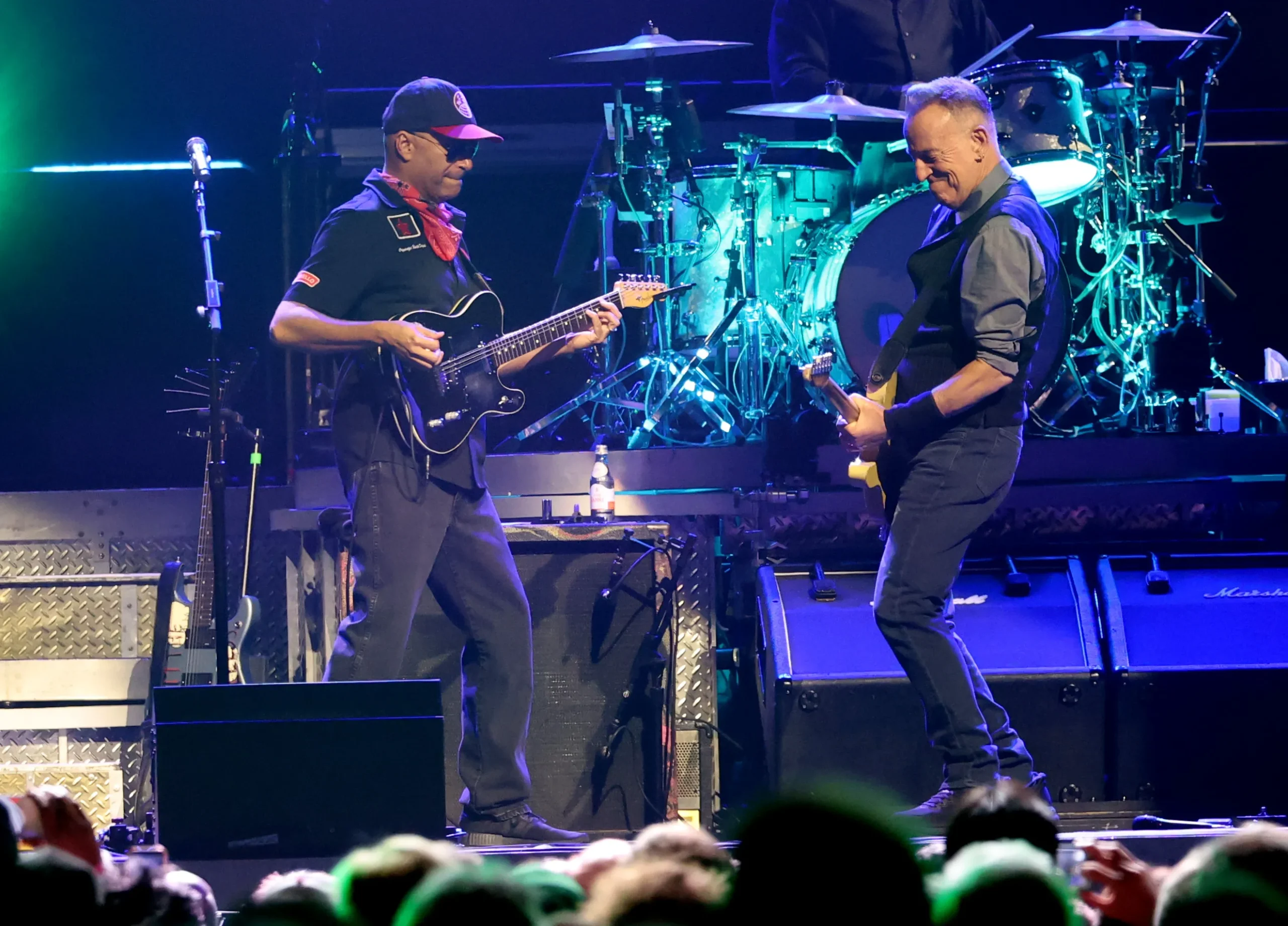
When the Land Of Hope & Dreams Tour was announced in February, it felt like it emerged from the volatile fuse of nationwide demonstrations against ICE enforcement and the killings of Renée Good and Alex Pretti at ICE custody sites. Springsteen had already used his platform to voice opposition to ICE, even sharing a protest ballad called “Streets Of Minneapolis.” The tour—paired with a manifesto that spoke to a more enduring American identity and carried a “NO KINGS” subtitle—arrived with a thesis. This track record lined up with E Street’s 2023 comeback, a blend of Letter To You promotion and a celebration of a career’s legacy, inviting Springsteen to ponder legacy and mortality. Now, welcoming Tom Morello back into the fold for his first E Street run in over ten years, Springsteen pledged that a “cavalry” would come to illuminate the path and push back in these fraught times.
As expected, the introduction cast the tour’s debut on a more divisive note than the 2023 revival. A familiar chorus has long existed among some of Springsteen’s more affluent, conservative devotees who argue he should leave politics out of his performances. Yet younger attendees—skeptical about the premium-ticket, hyper-corporate nature of modern arena rock, wary of rock as a vehicle for protest in the 21st century, and perhaps unconvinced by the core American project—might find themselves pondering, “I enjoy the music, but I’m not sure I want the political stance.”
In the early portion of the set, the political frame felt almost invisible. After the opening “War,” the night leapt into “Born In The U.S.A.,” a track I’ve long sought to experience live and seldom heard in the U.S.—not out of avoidance but because its message was routinely misread in the eighties. Its meaning was unmistakable this time. Then came “Death To My Hometown,” pulled from Wrecking Ball, followed by a cover of the Clash’s “Clampdown,” and then “No Surrender.” Some songs carried explicit messages, others refracted under a new light; the refrain “No retreat, baby, no surrender” lands with a different weight here. In 2023, the sprawling E Street shows began with momentum but only gradually ignited; this night, the energy surged early. Springsteen and his core E Street cohort—all veterans in their mid-seventies—felt indifferent to fatigue, delivering a three-hour odyssey that rarely paused for an acoustic interlude or a second prayer, and the crowd responded with a feeling of exhilaration and catharsis that spoke to a shared moment rather than party lines.
From there, Springsteen crafted musical arcs that wove through his catalog in ways that felt uniquely suited to a freeform, all-ages set. “Darkness On The Edge Of Town,” paired with “Streets Of Minneapolis” and “The Promised Land,” formed a compact triptych. The gangster-tale resonance of “Murder Incorporated” was repurposed as a tense lead-in to the somber, reflective “American Skin (41 Shots),” a piece centered on Amadou Diallo’s killing that subsequently flowed into the weary optimism of the Iraq-War era’s Magic track “Long Walk Home.” By set’s end, resilience and righteous anger fused in songs like “The Rising”—now recontextualized as a post-9/11 beacon—alongside a volcanic “The Ghost Of Tom Joad,” propelled by Morello’s staggering solos, into “Badlands” and the closing “Land Of Hope And Dreams.” In the middle lay Springsteen’s most enduring piece of gospel-inflected Americana: “My City Of Ruins,” a song born of a blighted Asbury Park, reborn as a post-9/11 anthem, then reinterpreted again for the recession, for the MAGA era, and now for a new wave of transgressions.
Before that hymn-like moment, Springsteen offered another address. He invoked the latest Middle East debacle as an “incompetent and illegal war,” pressed the urgency of voting rights, highlighted the detention centers holding immigrants for profit, and called out the ongoing corruption at the top. Each point landed with a crisp, stark refrain: “This is happening now.” It wasn’t just politics; it was a direct gut-punch—signaling that the music, the speeches, and the concerns were all of a piece with the show’s larger purpose.
From a purely musical standpoint, a 76-year-old icon of rock should be hard-pressed to pull off such a feat. The encore parade of familiar hits was present, of course, and the night maintained the customary E Street energy. Yet the emphasis tilted away from the old bravado and seaside-breezy anthems toward a program heavy on material from the 1990s onward, particularly the late-era ascent into a vocal-historic American bard in a volatile early-21st century. Very few artists of his generation could command a stage with this kind of intent and breadth, and yet in the moment it was clear that Wrecking Ball has become as defining as any of the traditional staples. Look around and you’ll notice the audience still clapping and cheering for “American Land” with the same fervor as the classics. Watching Springsteen perform, you realize he can hold a crowd of sixty thousand and guide them through a set that blends time-honored hits with deeper cuts, delivering both the raw energy of youth and the seasoned precision of a master. As he edges toward eighty, he remains among the most compelling live performers you’ll ever see.
In writing about music, I’ve spent years moving between cities that often feel at odds with one another. A stint in Florida brought me into contact with retirees and locals whose conversations often circled right-wing frames, a pattern I observed while listening to the hum of a coastwise culture. Pennsylvania’s building sites exposed me to workers whose grievances were blamed on immigration (and, occasionally, on more fantastical conspiracies). Now I reside in Nashville, a city that sometimes proclaims itself a “blue island” in a red state.
Back in New York, I might have dismissed my own hometown’s viewpoints as naive or disingenuous. Returning to America’s interior, though, I found a different sort of humanity: fear and anger, yes, but also a shared weight of struggle under a political system that often seems bent toward fracture. I’m not claiming moral elevation or a perfect political vantage; rather, I’m saying that Springsteen’s calls for unity—his insistence that there remains a fundamental American bond that can prevail—stopped sounding hollow.
Maybe the music itself carried me there. Maybe it won’t for you. You might feel the rot in the system is too deep, or doubt that a generation of center-left Baby Boomers has the prescription to guide us forward. “America renews itself, I believe in that,” Springsteen said, settling on the stage’s lip with a quiet gravity, just before the band closed with Bob Dylan’s “Chimes Of Freedom.” “The hardest thing is feeling the distance between you and your neighbors,” he offered, then added: “But America was born from disagreement. America is an argument.” He spoke with such quiet hope that, for a moment, it felt possible to believe again in the country’s capacity to heal. There are times when I’ve doubted that renewal, and times when I feared the entropy of decaying empires; but if there is any artist capable of rekindling that belief, it’s Bruce Springsteen. Tonight, I heard where his heart was coming from.