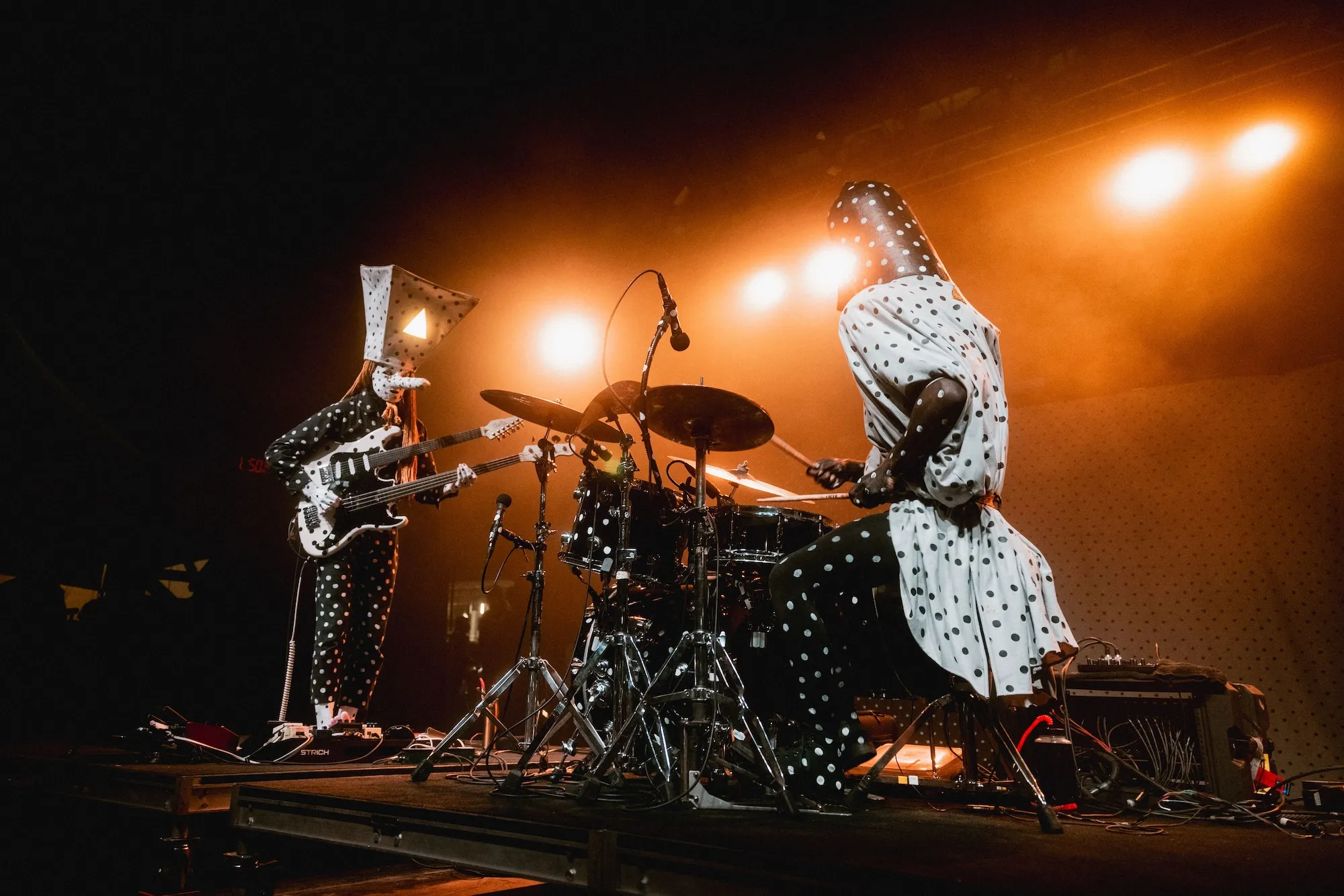
Festival-goers arrived wearing polka dots, and the looks came in many guises. There were homemade T‑shirts, hoodies worn with facemasks, and a surprisingly large number of kids who painted themselves white and then dotted themselves with black spots. Angine de Poitrine, the gimmicky and otherworldly Quebec math-rock duo who sparked those outfits, have been virally famous for only a few months, as far as I can tell. Their KEXP appearance, which has racked up about 19 million views and rising since it went online in February, helped seed the craze. Seven months later, teenagers in dalmatian outfits populate a rock festival crowd. It’s a steep climb from viral clip to festival fashion, and it seems to say something—I just haven’t pinned down what yet.
What exactly is hype? I ought to have a handle on it by now. I’ve spent my entire adult life inside the hype machine. I once held a full-time gig at Pitchfork Media Dot Com in 2009, right at the eye of the storm. The center of hype, the unpredictable current that keeps the music world afloat, is a force that humans try to steer yet also seems to move independently of us. People experiment with psyops to conjure hype, but consensus on whether that works remains elusive. You don’t realize how fast you’re moving when you’re aboard the hype train, baby.
Speaking of psyops: Geese played the festival as well. The crowd didn’t arrive in Geese cosplay, though I suppose I wouldn’t have noticed if they had. What would a Geese costume even entail—shaggy hair, plain black tank tops, brows grown out? This was my first time seeing Geese, almost exactly a year after their own peak moment of hype receded with the release of Getting Killed. I know folks who saw them at last year’s Hopscotch Fest in Raleigh, which would have been the perfect time to witness the hype atom fracture. A year later, Geese have weathered backlash and backlash-to-backlash, and they’ve become festival staples. Our own Chris DeVille recently wrote about catching another Geese festival set in June, and I’m with him: Geese aren’t a psyop. They’re genuinely, ferociously good.
The festival in question was Iron Blossom, a mid-sized two-stage affair in the heart of Richmond, Virginia. It leans toward a mainstream crowd, as festivals go. Not long ago the same event welcomed comfortable folk‑rock names like Hozier, Lord Huron, and Noah Kahan as headliners. But the 2026 edition steered toward the buzz-band ecosystem. I skipped the first night to catch Militarie Gun, though that day still boasted LCD Soundsystem, Dijon, and Die Spitz—acts who have ridden different generations of hype to reach their place in the lineup. The Sunday bill worked similarly, weaving several permutations of the buzz-band cycle into one day.
The Geese buzz-band moment was basically exactly the kind of thing I’d hoped for. Midway through their set, Cameron Winter riffed that he loves festivals where there’s only one act on stage at a time, joking that Geese draw bigger crowds when there’s no competition. He was kidding, of course. In reality, Geese don’t play to crickets, no matter who happens to be on another stage at the same time. On a big-stage slot with them as the immediate‑support, Geese played to a blend of the faithful and the curious, and they rose to the occasion. At times they echo the Velvet Underground trying to morph into Pink Floyd in 1968. At other moments they sound like Rufus Wainwright’s imagined Strokes tribute band. And at others still they feel like a modern, ultra‑tight reimagining of ’70s hard rock, with riffing that’s been rebuilt into a language of kling-klang and bing-bang. When the hammer fell on “Taxes,” I felt as if I’d ascended to a different plane of listening altogether.
As best as I can tell, Angine de Poitrine’s entire pitch is that they exist on a plane of reality all their own. They aren’t a buzz-band in the Geese mold. In another era, Angine de Poitrine might have been a warehouse art-noise project, though their commitment to the bit is so total that they probably would have caught attention regardless. Today, they’re tailor-made for Instagram Reels or YouTube Shorts. You’re scrolling through vertical clips, and you glimpse a couple of masked freaks hammering out twitchy, off-kilter microtonal stompers, and you pause—perhaps long enough to marvel at how they use looping to layer riffs on top of each other, or to laugh at their nonverbal ping‑and‑grunts that feel like R2-D2 and Chewbacca communicating. There’s no press-release manifesto to explain Angine de Poitrine’s entire mythology, and thank goodness for that. They simply are what they are. You fill in the rest.
Gimmick bands aren’t inherently bad; they’re just a different kind of beast from “buzz bands.” They can achieve extraordinary things. Kraftwerk were a gimmick. So were Daft Punk. Some might argue the early Beatles were a gimmick band, their legend cemented the day they settled on matching cuts. Gimmick bands can endure for generations—Slipknot and Mudvayne still fill arenas at racetrack festivals; Gwar’s fake‑blood supply never seems to go dry; Devo still wears those energetic domes on their heads. In a few decades, we might remember Angine de Poitrine as a quirky fad or as beloved outliers—Wyld Stallyns for a peculiar future. That’s the hype lottery: it can go in any direction.
Angine de Poitrine landed in Richmond just as their own momentum was nearing escape velocity. Nostalgia for the buzz-bands of the past often rises at moments like this—this crest is when people remember the wave. The duo played the smaller of the two festival stages, tucked between Geese and Jack White, which felt like a perfect moment to see them. If you weren’t already in the know about Angine de Poitrine, you’d at least have noticed the polka-dot look all day, which aroused curiosity. At one point, a bearded man in his sixties leaned over and murmured, “Kinda sounds like Mars Attacks.” The tone wasn’t judgmental; it was more like: “Well, I’ll be damned, would you look at that.”
The rougher part of Angine de Poitrine’s set came when a roadie stepped out to address a drum issue mid-song. He fixed it quickly and slipped offstage, but the mere fact of a normal, human person being there briefly punctured the illusion. The guy who changes Jack White’s guitars wears a stylish hat, so a Angine de Poitrine technician ought to at least don a prosthetic nose to keep the gag rolling.
Angine de Poitrine are a damn good show to watch. The drummer’s eyes light up with a spark you hadn’t noticed before—cool to witness. Their approach to song structure—layering more riffs, then peeling everything back to drive home a climactic hit—keeps the crowd engaged. It’s also striking to see how the audience cheers those breaks and attempts to clap along, a challenge when the band refuses to stay in a single tempo. But despite the complexity, their music lands with a direct punch. It feels closer to Primus than to Lightning Bolt—both of whom have their own gimmick-styled cred. In fact, many Angine de Poitrine tracks include sections that could function as pro-wrestler entrances, with a build-up that’s as theatrical as it is musical.
Yet what’s even more entertaining than watching Angine de Poitrine is watching the audience react to them. I spent the second half of their set toward the back, inside that boundary between the blanket-sitters and the friends dancing. If hype hadn’t landed, that section would’ve been filled with people scrolling on their phones and muttering about the act. Instead, people were feeling it—here are some scenes I won’t forget: a tipsy middle-aged couple two-stepping as if they were at a country bar; a guy inventing orc-spider dances to crack his date up; kids running around waving glow sticks and making wild-animal faces. Imagine being a kid at a festival, waving glow sticks and making goofy animal faces to Angine de Poitrine—at that moment, hype isn’t what’s driving anything anymore.
My Iron Blossom experience kept circling back to the mystery of hype, and it pushed me to think about how hype manifests in different ways. Take Portugal. The Man, who stepped on stage just as I entered the park. They’re not exactly a hype-band—or at least not for me. They feel like a radio-alternate rock act from a decade ago, the sort of act that sits outside the buzz-band cohort. Yet they produced “Feel It Still,” a track that became a bigger pop hit than anything else on the lineup, a moment that soared above most of their peers. (I’m pretty sure they didn’t perform it, thankfully.) Chris DeVille caught Portugal. The Man on Modest Mouse’s cruise earlier this year and summed it up as “pretty good.” I didn’t pay it a ton of attention, to be honest.
The Stews, another band I caught, are emphatically not a hype-band. We never cover them on this site. Perhaps we should! I found them compelling. They’re a touring regional indie rock act that started at Alabama’s Auburn University and have built up solid Spotify numbers. They’ve got a rough-edged Southern-Strokes vibe, a bit like Kings of Leon in their prime. But Kings of Leon had the look and the backstory to become a buzz-band, while the Stews don’t, so they’re simply a band existing outside that hype machine. It’s genuinely refreshing to see a group thrive entirely without chasing the hype.
Jack White, the night’s headliner, might be the quintessential case of where hype can lead. Booking ’00s buzz-bands for the top slot and ’20s buzzers for the undercard is a shrewd business model. The White Stripes used to be the pinnacle of gimmick acts in the early-2000s garage-rock surge. If the term “psyop” had been a common phrase in 2001, people would have used it to dissect White Blood Cells. But that album rocks. All of the Stripes’ records rock. When the fizz of hype fades, the White Stripes become legends. White has become a legacy‑act titan who can headline festivals like this for a long time to come.
As a legacy‑act titan, Jack White gets to do what these veterans love: play scorching blues solos and sing his songs in a voice that’s jagged and off‑kilter, not always inviting a chorus to join in. He’s a superb showman who can dazzle even when he’s indulging himself, and whenever the crowd starts to drift, he can always pull them back with “Dead Leaves On The Dirty Ground” or “Steady As She Goes.” His live show sometimes feels like late-period Prince—an expert, high-spirited display that uses hits as secret weapons.
One funny thing about Jack White’s current live setup: his keyboardist, Bobby Emmett, from a distance resembles Julian Casablancas. That alignment is weird, a little galaxy-brain for the buzz‑band scholars. It’s the sort of observation that makes you wonder: what if Nirvana hired a backup singer who looked like Chris Cornell? What if Blur recruited a Jarvis Cocker lookalike to play the bongos? I’m not saying Emmett doesn’t shred on the keys—he does. I’m merely noting the odd parallel.
Nowadays, White tours with a lean trio and looks to be having a great time onstage. If his performance ever unravels, he still has “Seven Nation Army” up his sleeve to rally the crowd. Earlier in the day, I heard the M&T Bank Stadium crowd chant that exact riff on my TV speakers as the refs bungled a Ravens game in the Saints’ favor. I wore a Ravens jersey to the festival, and every conversation I had with strangers that day ended up circling back to the Ravens. That iconic riff has transcended time and space as a shared memory. Hyped energy might spark the journey, but it can’t guarantee the destination. After that, anything can happen.