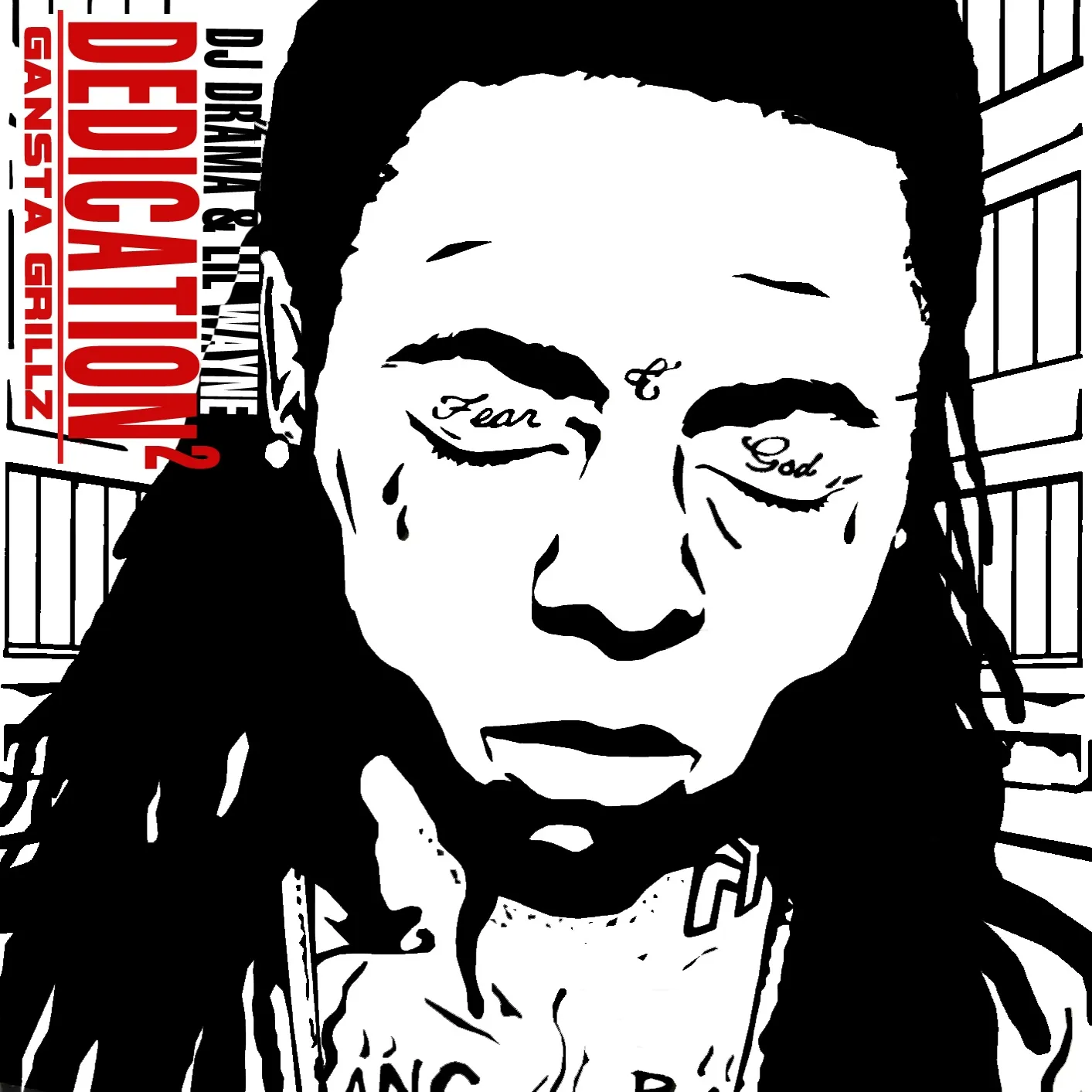
It wasn’t a studio record. It wasn’t meant to be one. In its conception and its execution, nothing about it suggested the polish of a conventional album. Instead, Lil Wayne and DJ Drama’s Dedication 2, which turns twenty this Friday, belongs to a far more specific lineage. It was a mixtape, an artifact meant to be bootlegged and spread through street channels. DJ Drama built his reputation on mixtapes, and that very tradition explains why people still hear him bellowing his echoed, catchphrase-heavy lines today. Lil Wayne wasn’t a stranger to mixtapes either. He had used the format to forge his voice and his method. Between 2002 and 2005, he released something like fourteen of them, tracing his path from a playful, kid-friendly bounce-rapper to a fearless, boundary-pushing savant. Yet Dedication 2 arrived as the right mixtape for the moment. It wasn’t an album, but it felt more vital than a proper album, and many fans treated it as if it were one.
The two collaborators issued the first Dedication tape in 2005, just before Wayne’s Tha Carter II cemented his ascent as a major artist. People can argue about this all they want, but from where I’m standing, Dedication and Tha Carter II signaled the start of The Run — a period when Lil Wayne existed in a wild, largely uncharted flow state, holding the world spellbound with his outrageous linguistic mutations, otherworldly pockets, and outsized, slick talk. Plenty of emcees had remarkable stretches before Wayne, but The Run was more chaotic and abundant than anything that came before. He worked with astonishing speed, paying little heed to pacing or career strategy. He rapped over everything, all the time. Nobody could keep up.
Even for someone who tracked both Wayne and the mixtape world closely, Dedication 2 was a puzzling beast. Others had achieved greatness with mixtapes, but the paths they took varied. About six months prior, for instance, Wayne’s rivals Clipse released We Got It 4 Cheap, Vol. 2, an enduring classic of the form. Clipse and their Re-Up Gang allies Ab-Liva and Sandman treated that tape like a proper album. They locked in, living in Pharrell’s guest house together, and they methodically soared over a stellar blend of contemporary and classic beats. Wayne, by contrast, didn’t approach anything methodically, so Dedication 2 operated in markedly different ways.
There isn’t much order to Dedication 2. Tracks end abruptly in the middle of a verse. They rewind, vanish, and then reappear later in the tape. Drama’s voice cuts through everything. Wayne interrupts the festivities to clarify things. He believes he’s the best rapper alive because every rapper ought to think they’re the best rapper alive. And he’s obsessed with sports on television. Sports, sports, sports — that’s all he watches. They weren’t best friends yet with Skip Bayless, but perhaps that was just destiny. Some songs on Dedication 2 are one-off freestyles. Others were probably meant to be singles at some point, or verses for official remixes with other artists. It doesn’t matter. It’s all Dedication 2 now.
The opening track on Dedication 2 isn’t music in the strict sense. It’s Wayne introducing himself, rambling joyfully for a few seconds. The second track, “Get Em,” is Wayne hijacking “Get From Round Me,” a deeper cut from the Diplomats’ independently released 2004 double album Diplomatic Immunity 2. Wayne was tight with the Dipset crew, appearing on their records frequently. He boasted about being so Dipset, Dip-South, baby. He and Juelz Santana kept promising I Can’t Feel My Face, a collaborative tape that never came out. Juelz is on Dedication 2, pledging to fish filet you and then tell your moms to fetch the paper. Yet those connections didn’t stop Wayne from taking “Get From Round Me” and making it his own. Instantly, “Get From Round Me” became the overlooked footnote, and that beat became the Dedication 2 intro beat, now and forever. “Get Em” keeps rewinding, Wayne repeating himself until Drama interrupts the moment and just lets Wayne go. And then he takes off.
At the start of “Get Em,” the first voice you hear isn’t Wayne or Drama. It’s a deep, resonant white man’s voice — Doug Copsey, narrator of the straight-to-video 2000 documentary Bruce Lee: A Warrior’s Journey. Copsey’s line is this: “You are watching a master at work.” That kind of proclamation begs to be used as a DJ drop, and that’s exactly how Drama treats it. A DJ drop is supposed to be pure hype. It doesn’t have to be true. In this case, though, it is.
On Dedication 2, we glimpse Lil Wayne, the master. He’s Luke Skywalker entering Jabba’s palace, presenting himself as a Jedi. We’d already witnessed the arc — a kid from nowhere discovering his talent and gaining confidence in what he could do. Then we saw the ultimate form. There’s no polish on Dedication 2. It’s Wayne in a free-association zone, composing or reconstructing songs on the fly. He’ll latch onto a rhythm, a cadence, or even a single vowel sound, and let it direct whatever he’s about to say. “N—as know I don’t spit, I vomit, got it? / One egg short of the omelet.” “I’m back on defense, back in the zone / I eat rappers and go in my yard and bury their bones.” “Fuck me? Fuck you / What it is? What it do? / I was ready in ’81, and I was born in ’82.” (Wayne was only 23 when Dedication 2 dropped, yet he’d already been recording professionally for half his life.)
It’s entertaining to quote Wayne’s lyrics from The Run, but they don’t always convey the full scope of what he was doing. Wayne’s presence exceeded his words. He seemed to inhabit a zone where creation never ceased, letting his brain roam freely whenever a beat played in his headphones. He didn’t sing — not at that moment, anyway — but there was a melodic bounce in his delivery. He slipped naturally from one flow to the next, and his hesitations and pauses carried more weight than the sharpest punchlines from his peers. He made it look easy, as if rapping demanded less effort than talking, or eating, or even breathing.
Other artists show up on Dedication 2. The aforementioned Juelz Santana. A blazing Freeway. Willie The Kid, a Drama protégé at the time and today a veteran of abstract underground sensibilities. Remy Ma, as tough and dependable as ever. Pharrell, delivering what could be the finest rap verse of his entire career on Shawnna’s “Gettin’ Some” remix. Curren$y and Mack Maine, the first talents signed to Wayne’s Young Money imprint. (Nicki Minaj and Drake, the two megastars who later rose from Young Money, were around the corner but hadn’t quite arrived yet.) The other emcees on Dedication 2 are all solid, yet they mostly serve as points of comparison. They can’t do what Wayne does. They’re earthbound, while Wayne is so elevated he could devour a star.
Some of the beats Wayne decimates on Dedication 2, like Little Brother’s “Lovin’ It” or the Diplomats’ “Get From Round Me,” are obscure relics. Others are the moment’s big hits: T.I.’s “What You Know,” Big Boi’s “Kryptonite.” Dem Franchize Boyz’ “I Think They Like Me.” Some are even canonical classics from the prior decade, like OutKast’s “Player’s Ball” or 2Pac’s “Ambitionz Az A Ridah.” It doesn’t matter. For Wayne, those beats are raw material. They’re canvases. There’s even a beat made from the sound of basketball thuds and sneaker squeaks, and that, too, is canvas.
What transformed Dedication 2 from a mixtape into something that could pass for an album — the freely borrowed beats, the rewinds, the drop-outs, the constant interjections from Drama — might irritate purists who didn’t experience it in 2006, and who are hearing it anew for the first time. If that’s you, I hate to be the bearer of bad news, but you really did have to be there. Part of the thrill lay in watching Wayne pluck these sounds that were floating in the air at the moment and twist them into electrifying forms in real time. Nothing else in the era matched it, and nothing else matches it now.
The single moment on Dedication 2 where a discernible structure emerges is near the end, on “Georgia Bush.” Wayne had nearly completed Tha Carter II when Hurricane Katrina devastated his hometown, which is why the track only features a handful of throwaway references on the album. With “Georgia Bush,” Wayne channels his anger. He flips Field Mob’s regional pride anthem “Georgia” (which itself interpolated Ray Charles’s version of “Georgia On My Mind,” which itself referenced Hoagy Carmichael’s original song) into a vehement, purposeful condemnation of the president who allowed the tragedy to unfold. Lil Wayne will never be a protest artist. Years later, he publicly supported Donald Trump, likely in exchange for a presidential pardon on one of the federal charges he faced at the time. But on “Georgia Bush,” Wayne tapped into levels of rage and focus he wouldn’t revisit again.
I believe “Georgia Bush” is the main reason rock critics ultimately began to take Wayne seriously. It unquestionably made it much easier for me to explain why he mattered. Dedication 2 earned glowing notices in outlets that had never previously reckoned with Wayne’s artistry. People started manufacturing CD copies of Dedication 2 with barcodes to sell in record stores, as if it were an album. Later on, Drama asserted that Dedication 2 grew too big — that it became the principal reason federal agents raided his office and slapped him with RICO bootlegging and racketeering charges less than a year later. The mixtape format evolved. It became an online phenomenon. Wayne changed too. Dedication 2 might have been semi-illicit cult material at the time, but it did a great deal to cultivate the goodwill that would soon propel Wayne to mainstream superstardom.
During The Run, I played the role of an evangelist. I kept insisting to people, again and again, that we would be discussing Wayne’s moment for decades into the future, that we were witnessing forms break and legends form right before our eyes. I’m wrong quite often, but I was right about that. Greatness doesn’t always resemble the form it’s expected to take. The finest albums aren’t always albums. It’s essential to recognize when you’re watching a master at work.