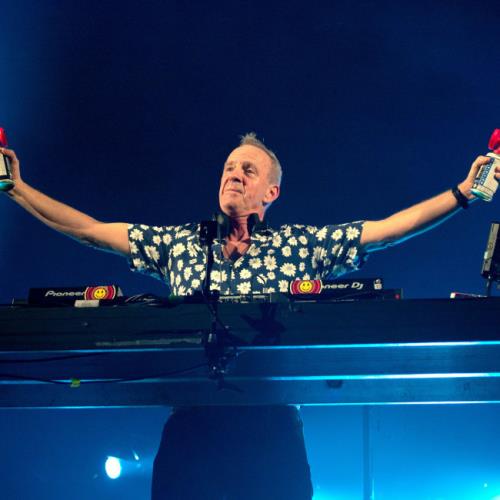
Fatboy Slim has never received payment for performing at Glastonbury.
The renowned DJ, famous for tracks such as Praise You and Right Here, Right Now, has repeatedly played at the festival without charging a fee, saying he’s happy to accept complimentary tickets each year.
In an interview with Metro, he clarified that he has never been paid to perform there.
Yet he also noted that he has never paid to attend; Emily and Michael Eavis, the festival’s organisers, provide him with free tickets and permit him to do small, low‑key shows in unusual venues.
He added that he has played at the festival countless times even when he isn’t officially on the bill; some years he appears on the official lineup and at other times he attends as a casual spectator.
For him, Glastonbury represents the most enjoyable, forward‑thinking, and beautifully human expression of alternative culture.
Fatboy Slim, whose real name is Norman Cook, first appeared on the Pyramid Stage in 1986 with his former band The Housemartins.
Last year he celebrated reaching 100 Glastonbury appearances, though he later admitted he doesn’t actually know the exact tally of his moments on Worthy Farm’s stages.
He spoke to BANG Showbiz, recalling that his first appearance was in 1986; they marked his 100th show this year, but the precise number remains uncertain, as many Glastonbury gigs leave no paper trail and no one can definitively verify them.
He estimated that since 1996 he has performed at every Glastonbury, typically twice but up to six times in a single festival, which leads to a rough total around a hundred.
He joked that musicians like Billy Bragg and a Hawkwind member may have more appearances, but they tend to play only one gig, whereas if he played six times he would have likely surpassed them.
Nevertheless, he emphasized that he wasn’t making a formal claim; the figure is unofficial.
When the organizers announced the 100th Glastonbury gig, he anticipated someone might question it, but he noted that he cannot prove it any more than others can disprove it.
Among his favourite moments at the festival was the decision to perform a song backwards in a bid to make the audience dance in reverse.
He recalled performing Sunday Best with Rob Da Bank and The Cuban Brothers, and there is a photograph of him watching The Cuban Brothers. It was Sunday tea time, and they had been there since Thursday (perhaps Wednesday), so he jokes that he had lost his marbles, his scruples, and perhaps his intelligence.
He remembered deciding that playing a track backwards might prompt the crowd to dance in reverse, a theory he wanted to test on one of the major stages.
He believed the track should be well known so that listeners could recognise it even when played backwards, and he suspected it was a Chemical Brothers track, likely Hey Boy Hey Girl.
As he played the record in reverse, about half of the audience reportedly began dancing backwards. Ed from the Chemical Brothers approached him and asked what he was doing; he explained that he was testing whether people would dance backwards, to which Ed reportedly replied that it was brilliant and that they could see the crowd doing it.
That moment stands out as probably his favourite set—an experience far removed from reality, yet wonderfully liberating, as if life itself could be experimented with in the same way as music or even drugs.