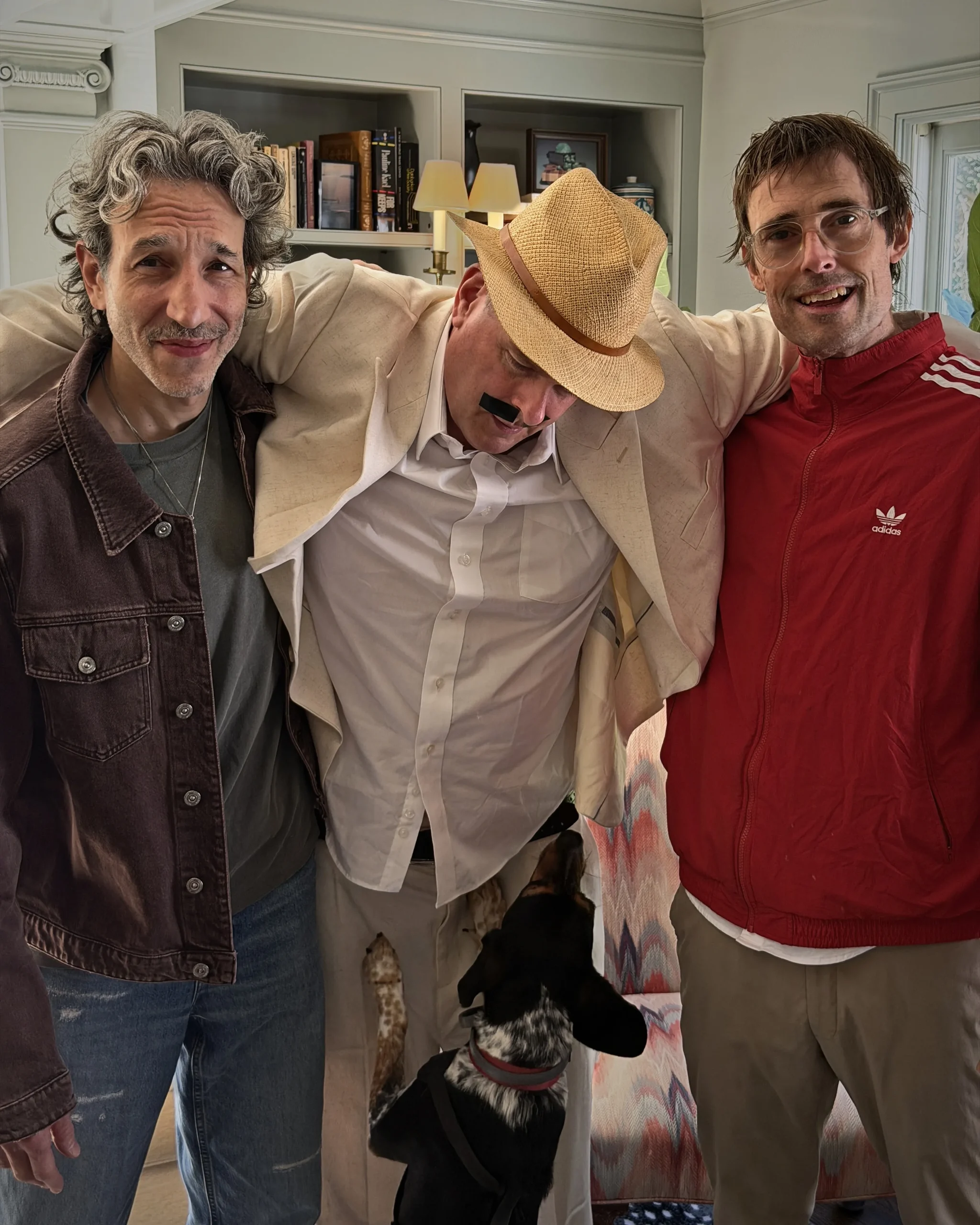
Don Caballero are back in the conversation. The Pittsburgh-based instrumental outfit that helped seed and later refine math rock during their original 1991–2000 stretch confirmed a reunion of the lineup from the Y2K era, answering years’ worth of devoted fans’ prayers. A few weeks earlier, as they girded for a busy 2027 that would include a stop at Primavera Sound, the members gathered at bassist Eric Emm’s home in a quiet Connecticut suburb to swap tour tales from a quarter of a century ago.
There’s the Atlanta night when drummer Damon Che swung a cymbal stand into a wall, punching a sizable gap in the plaster. The venue’s owner—who also happened to be the sound engineer—spent the rest of the set taunting them from the mixing booth.
“That was a good song,” the owner reportedly muttered into the mic, audible to both band and crowd. “Too bad you folks are assholes.”
Then there was the Los Angeles festival where they exceeded their allotted time; stagehands tried to cut them off, but the trio kept playing, producing a surreal, sonic pileup.
“They booked Granddaddy to go on right next to us while we were still on,” Williams recalls. “The PA went off, yet we just kept at it, and the audience went ballistic.”
In the autumn of 2000, shortly after the episodes above and merely a month after releasing American Don—an exceptional, Steve Albini–engineered fourth LP that braided glassy guitar loops with inventive future-prog riffs and Che’s thunderous yet flexible drumming—the band unraveled. The final pressure point was a brutal van crash on an icy highway from Toledo toward Detroit, when two tractor-trailers hammered into their vehicle after a skid.
In revisiting the chaos that lingered over the project and eventually fractured their musical and personal ties, the members now find humor in it all.
“There was always a comic edge to our doom,” Williams says.
“It’s some funny shit,” Emm agrees.
Even Che, the lone surviving founder and most reserved of the trio, can’t help but crack the merest hint of a smile.
After the split, Williams and Emm—who had played together in the avant-rock band Storm & Stress prior to and during Don Cab’s era—stayed friends. But for nearly two decades following that disastrous 2000 tour, Che was estranged from his former bandmates. Williams went on to establish Battles, expanding on the looping approach of American Don, while Che later reassembled Don Caballero with new players. (When the two outfits briefly crossed paths at Austin’s Fun Fun Fun Fest in 2007, Williams recalls Che sending an ironic air-kiss his way.) Beginning in 2008, Emm stayed active with the beloved indie-pop outfit Tanlines.
Attuned to one another again in the late 2010s, the ex-bandmates reconnected via an email thread about licensing one of their tracks for a film and then continued corresponding about a forthcoming documentary and a book on Don Cab’s history. It wasn’t long before Zoom calls revealed what Che describes as a growing ache for one another’s company.
“It’s the people you knew in your twenties—the formative years—that you want back in your life,” Williams notes, “and having those folks back around felt gratifying.”
A pivotal shift was Che’s sobriety in the intervening years. He’s the first to credit his years of heavy drinking as a major catalyst for the volatility of the American Don era, saying, “Alcoholism is a constant roadside IED.”
By the time Emm reconnected with Che, he found a transformed version of the drummer.
“When we started doing video calls, you could tell Damon had a different aura,” Emm says. “There was a new energy.”
An Instagram post showing the American Don lineup joyfully reunited at a 2025 New York show with Che’s current band Yesness signaled to fans that the channels were open. When we visited the group in September, the ease and camaraderie among the three fifty-somethings was tangible, as they sat in Emm’s quiet, sunlit library with Che’s beagle mix Harvey snoozing contentedly on the couch beside the bassist.
One lingering sore spot remained with American Don itself, which, despite its revered status, left some in the band dissatisfied. In live settings, Williams and Emm had stacked loops to perform the tracks; yet when they went to Albini’s Electrical Audio studio to track the album—Che had insisted on recording there because of a newly opened Studio A that would give the drums their colossal sound—they discovered their pedals only output mono signals. To achieve the immersive stereo blend heard on the final record, overdubs became necessary.
“That shift yielded some magical improvisational moments,” Emm wrote in the liner notes to a recent 25th-anniversary reissue from Touch and Go, “but once the record was finished, we felt the result was bloated and the performances somewhat listless.”
(A live-in-the-room version of the album’s tracks, recorded after the original sessions by Albini’s longtime associate Greg Norman, is included on the reissue as True Live Tapes.)
At first, the three were simply glad to be in contact again, but the question of playing together soon resurfaced.
“I didn’t want to pick up the instrument again for a spell; we were just friends,” Williams says. “But when the idea of reuniting kept coming up, I began to see it could be interesting.”
“I was truly satisfied with where we sat musically at the time,” he adds about American Don. “Yet it felt like a chance to revisit that moment and try it once more.”
Emm shared a similar impulse for a fresh start.
“Somewhere there’s always been a sense that you don’t want to end things on an unsatisfying note,” he asserts.
For fans wondering about guitarist Mike Banfield and bassist Pat Morris, the original members who left before American Don, they aren’t included in the current reunion. Still, they remain on good terms with Don Caballero, and Che says it’s not outside the realm of possibility that they could join in future activities: “That’s something to be decided later—potentially.”
In a cosmic twist, Don Caballero convened during the same week that the subgenre they’re forever linked to enjoyed a strange surge of mainstream exposure, thanks to Angine de Poitrine—the costumed Canadian duo and fellow 2027 Primavera Sound performers—making a viral splash with looping math rock earlier this year on Tonight Show clips.
“I caught a clip of it,” says Emm, who had seen the duo perform live in Los Angeles the prior month. “It felt like, ‘Canadian math-rock duo Angine de Poitrine makes their Fallon debut.’ It’s perhaps the highest visibility math rock has ever enjoyed.”
Che sees the coincidence as a boon. “If more water floods into the harbor, it will buoy our small boat as well,” he mutters.
“I think their outfits are clever,” Williams adds.
For Don Cab, looping began as a coping mechanism after Banfield left in 1999. Based in Chicago, Williams, Emm, and Che were unsure about continuing as a trio until Che brought out a Boss DD-5 delay pedal, and they began jamming around it.
“I asked him to bring the pedal to the next rehearsal,” Emm recalls. “We started playing and looked at each other, realizing something was there.”
Tortoise’s John McEntire introduced the Akai Headrush, a pedal capable of storing a loop up to 12 seconds. (Che would later argue that the device “saved Don Cab.”)
At the time, the band welcomed the comparatively primitive gear with open arms.
“There was no quantization or synchronization,” Williams notes. “Sometimes it’s off-kilter and sometimes you reset it, and sometimes you don’t. Damon could adapt to any imperfect loop you threw at him, and it hardly mattered.”
“Loops take on a life of their own,” Che adds, describing how the first loop can feel a touch awkward, only to be reshaped by a second loop, and then possibly a third, gradually steering the music in a new direction.
Even in the studio, the looping interweaving remains audible in the unsettlingly beautiful textures on American Don—tracks such as “Haven’t Lived Afro Pop” and “Details on How to Get ICEMAN on Your License Plate.”
“The project had moved away from metal influences; the guitar started to veer into a post-blues, non-rock vibe—perhaps akin to Steve Reich’s repeating patterns—and the rhythms drifted out of conventional time signatures,” Williams reflects. “To me, it felt like music driven by pulse, with Damon able to ride any time signature, and that flexibility mattered less.”
Albini himself noted the sense of material “all over the place,” which became one of the song titles. Emm conceived many other titles, drawing on the band’s fond sense of absurd humor and occasionally drawing on real-life observations (their name itself traces back to a character from SCTV).
On “You Drink a Lot of Coffee for a Teenager,” Emm recalls, “I definitely pictured a teenager lugging one of those enormous Starbucks cups.” And one of the album’s most infamous titles, “Fire Back About Your New Baby’s Sex,” sprang from a tabloid report claiming Madonna had publicly denied the gender of her unborn child. “The wording came straight from Inside Edition or a similar show,” Emm remembers. “I could only hear the poetry in it.”
The band still champions its quarter-century-old goofs—a comedic sensibility that has equally influenced many later math-rock acts as much as Don Caballero’s own music.
“I’m not crazy about ‘ICEMAN,’ but ‘You Drink A Lot Of Coffee For A Teenager’ still tickles me,” Che says. “And ‘Let’s Face It Pal, You Didn’t Need That Eye Surgery’ is hilarious.”
Relishing the creative chemistry they share, both musically and personally, remains the overarching motivation behind reuniting.
“The Albini era was a shock—his passing, and at such a young age, shocked us all,” Emm says. “We can’t help but feel that a part of why we’re doing this now stems from recognizing how many people we’ve known who are leaving.”
“We’re wisely aware that if we want to attempt this again, we should act sooner rather than later,” Che adds.
“I wouldn’t want to push it if I were too old,” Emm continues. “This music demands athleticism.”
If Angine de Poitrine’s viral surge is any indication, there’s healthy appetite today for the athleticism at the core of math rock.
While acknowledging their place in that lineage, the band also harbors a nuanced relationship with the label, which, as Williams notes, grew out of a détente between punk and prog around the turn of the 1990s.
“It felt like healing the divisions of the ’70s—Yes is fine, but the Sex Pistols are also great—and a generation later we could all be friends,” he jokes.
As he indicates, Don Cab’s commitment to prog-adjacent rhythmic exploration was relatively brief, cresting with their second LP, 1995’s Don Caballero 2.
“Don Caballero 2 was math rock; we embraced the time-signatures,” Williams notes. “Then what Burns Never Returns (1998) pushed beyond math rock. American Don took that further, with rhythms that felt increasingly unhooked. It was a remarkably narrow window for a full-on math-rock identity.”
Equally, the members are lucid about the inescapable label’s weight.
“There’s no escaping Don Caballero’s connection to that scene,” Emm says. “No reason to deny it. Sure, call us the fathers of math rock at this point.”
As our conversation wound toward its close, the trio prepared to retreat to Emm’s basement studio—home to those vintage Headrush pedals and Che’s hefty mid-’80s Pearl Export Series drum kit—so they could rehearse the songs that helped define the subgenre. Che had one final caveat regarding the term they’d long been associated with.
“We did contribute quite a bit to the range of genres that ultimately got called math rock, so it isn’t wrong to call us that,” he concedes. He only asks that the tag not be lazily applied to any of his other musical endeavors, past, present, or future.
“If I start a rockabilly band,” he adds, “I don’t want to hear a single word about math rock.”