A charmingly imperfect wedding singer has already inspired a movie about chasing originality over the necessary retro covers of big ’80s tunes. That film is The Wedding Singer, and it remains a blast. You might assume one wedding-singer comedy would be plenty, especially since that particular movie became a blockbuster hit and later a cable mainstay. You might think there’s no need for another wedding-singer comedy, particularly when wedding bands aren’t as common these days. (Someone would hire them, but I haven’t attended a reception with a live band since my aunt’s wedding in the late ’90s.) Yet Irish writer-director John Carney’s latest effort, Power Ballad, ventures back into this terrain and asks a timely question: what if a wedding singer penned a song and someone else stole it?
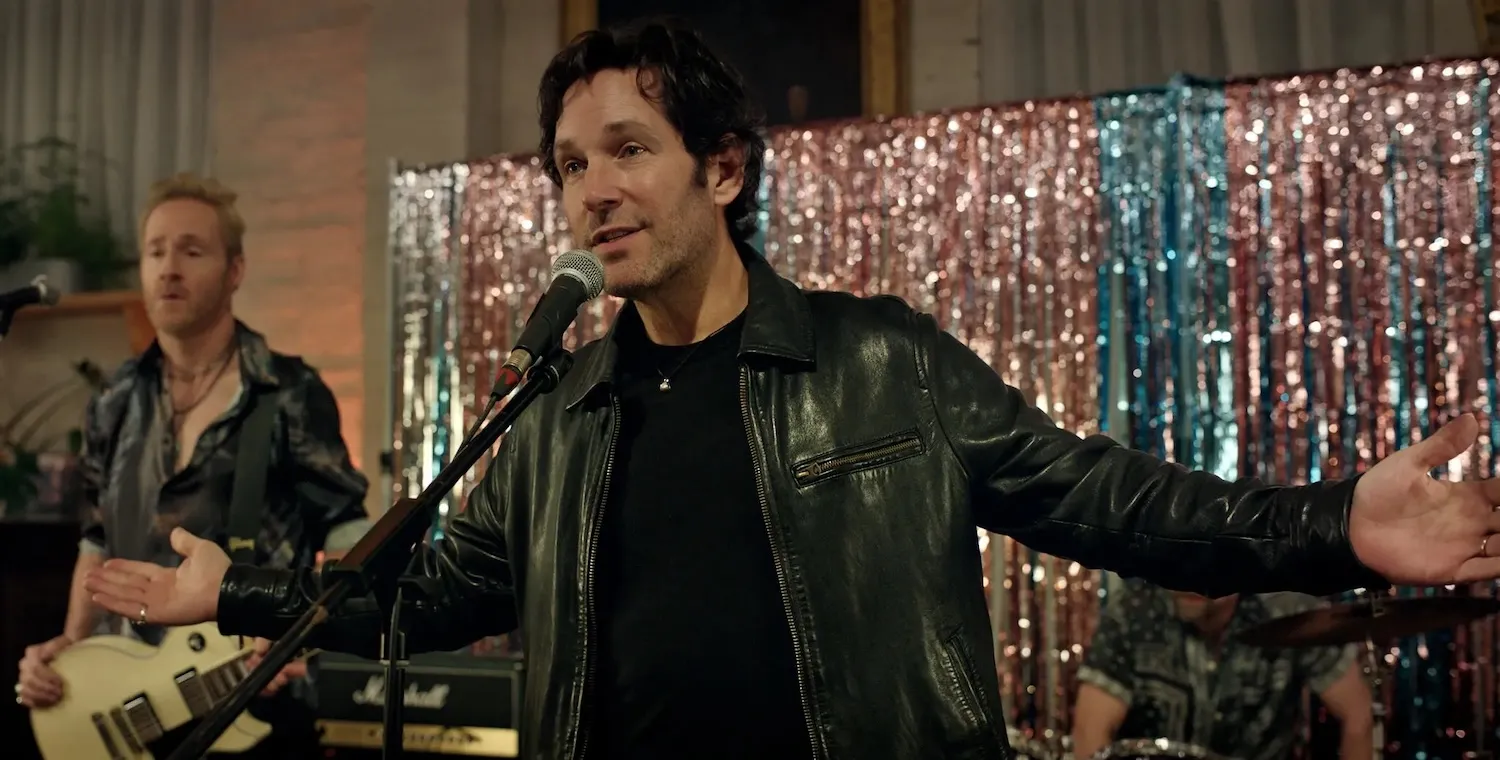
In Power Ballad, the wedding singer is a gentleman bearing the ill-suited name Rick Power, played by the consistently affable Paul Rudd. Our hero used to tour in a ’90s band, but a Dublin gig led to a one-night stand, a pregnancy, and a whole new life in Ireland. We know Power Ballad unfolds in a make-believe world because this musician’s shotgun wedding blossoms into a loving, enduring marriage. In real life, that couple probably wouldn’t make it to their first Christmas.
Rick still dreams of the stardom he never achieved, yet he loves his wife and daughter, and he gets by with occasional weed and singing “The Boys Are Back In Town” at receptions near Dublin. (Rick’s otherwise-Irish group goes by Bride And Groove, which is about the level of humor you get from Power Ballad.) Occasionally Rick will reach into his bag and perform one of his own songs, clearing the dance floor and riling up his bandmates. It marks the first of many party fouls Rick commits over the course of the film.
One night, Rick and his band are performing at a wedding when the couple requests a guest to sit in. That guest is Danny Wilson, a former member of a wildly popular boy band. His ex-bandmates have pursued solo paths, but he’s floundering. He longs to play his expensive acoustic guitars and craft his own songs, yet his label hasn’t landed a single hit. Essentially, Danny is a fictional version of Niall Horan from One Direction, portrayed by Nick Jonas, another millennial heartthrob with a boy-band past.
Rick isn’t thrilled about giving someone else a turn onstage, but he agrees to it. Danny sings Stevie Wonder’s “I Wish” with the band and immediately wows Rick. A bit later, Danny catches Rick smoking a joint and invites him to hang out. He’s got a room full of priceless instruments and is trying to write the tunes that will prove he’s more than a washed-up boy-band guy. They exchange a few of their own songs, suggest minor tweaks, and discover a natural chemistry. Six months later, Rick hears one of his songs playing over a mall speaker. There it is. That’s your movie.
The song itself is good. That single quality is really the most crucial test for the whole film. If the track were poor or merely adequate, nothing else would hold together. In a film about fictional songwriters, that’s the acid test. The enduring charm of That Thing You Do! rests on how deftly it passes that test. Adam Schlesinger’s titular song sounds plausible as a period hit, recurs throughout the movie, and you’re delighted every time it comes back on. Few pictures manage to conjure that kind of magic.
“How To Write A Song Without You,” the power ballad at the center of Power Ballad, accomplishes what it needs to do. It sounds strong when Paul Rudd performs it and when Nick Jonas handles it. It sounds good when Rick Power’s daughter hears it on the radio and sings along. It works well in montage form too. “How To Write A Song” is a slowly mounting, sincerely crafted number—a song about writing songs, a meta-structure that should feel self-evident but still lands, and it has a chorus that happily lodges itself in your memory. Last night I left the cinema with “How To Write A Song” looping in my head. But when I later played the track in the car, it didn’t sound half as lively. Unlike That Thing You Do!, it doesn’t stand on its own. That’s a little bit of movie magic, darling. Power Ballad gives its power ballad a purpose, a reason to exist. The songs elsewhere in Power Ballad are fairly rough, and asking Paul Rudd to perform a Lou Reed–style spoken-rap is not advisable, but “How To Write A Song” fulfills its function.
John Carney, the writer-director behind Power Ballad, has worn this hat before. Before turning to cinema, Carney spent years as the bassist in the Frames, a Dublin rock outfit. He broke onto the scene with Once in 2007, casting former Frames member Glen Hansard in the lead. It tells the story of two Dublin street musicians who fall for one another and write songs together, and its success stemmed mainly from “Falling Slowly,” the timeless track Hansard and Markéta Irglová wrote and performed in tandem. That ballad won an Oscar, Once became a modest hit, and later a Broadway musical. Hansard and Irglová eventually married and then split, yet they continue to collaborate musically as the Swell Season.
That kind of narrative—Carney’s preferred mode—is right in his wheelhouse. He leans into the magical moment when a song appears from nowhere. The song might not change the world, but it can alter the lives of the people who wrote it. Whenever Carney shows that moment on screen, he revels in the romance of it. He didn’t participate in writing Falling Slowly, but often the songs in Carney’s films are composed by Carney and Gary Clark (not the Texan bluesman). That’s where the snag lies. Carney’s own compositions tend to be expansive, gleaming middle-of-the-road pop-rock that often evokes Keane. I was thoroughly charmed by Sing Street, Carney’s 2016 film about Irish teens who start a band in the 1980s, save for the moments when that band performed their Keane-like tunes.
“How To Write A Song About You” benefits from being a solid Keane-style track, especially within the Power Ballad framework. The scene where Rick and Danny swap songs is where Power Ballad shines the most. Carney lingers, taking pleasure in the chemistry that happens when two musicians click—an effect so engaging that you could imagine him completely grasping that dynamic even if he doesn’t fully understand the music business on the inside.
Everything about Power Ballad feels improbable. Entire systems exist to prevent exactly this scenario from occurring. If anything, the present climate tends to push the opposite direction: artists, labels, and publishers resist risk, so they award credits and percentages to people who wrote songs that echo their latest outputs. You can find Beyoncé tracks with dozens of credited writers. Even if Rick is a small-time player with no manager and little knowledge of the industry, he’d still document his work in some form. The movie presents him as a complete naive, a bumpkin with no respect for his own creations, yet you’re asked to root for him anyway.
Paul Rudd is capable of that, right? He’s endlessly charming. He’s been charming since his turn as Alicia Silverstone’s stepbrother-flame in Clueless three decades ago. He’s been Ant-Man. He’s been the earnest, all-around guy in This Is 40, a comedy steeped in a similarly tangled view of the music industry. Power Ballad serves as one more showcase for that Rudd persona. He delivers sturdy, capable performances of familiar songs. He dresses the part in a way that nods to real-life rock stardom; he underplays enough to avoid too many Adam Sandler vibes, except during the melodramatic moments when he has to pretend to be deeply miserable mid-performance. He softens his glare and crinkles his eyes with sincerity.
Yet Rudd’s charm feels somewhat sharper when he’s among fellow Americans. Put him among actual Irish people, and the entire rhythm shifts. Carney’s films are tuned to the peculiar quirks and cadences of Ireland. Tonally, Power Ballad could pass for a gentle Miramax comedy from the ’90s, and Rudd doesn’t quite fit that niche, despite his background in indie fare from that era. The Irish characters in Power Ballad tend to be more vivid than the American lead, even when they’re written as broad caricatures. Peter McDonald gives Max’s stoner guitarist Sandy some bite, and at one point offers a long monologue about not being merely a sidekick but possessing his own inner life. Then Max shrugs and says, in essence, that he’s right to feel that way, and Sandy promptly retreats back into the supporting role. I’d probably rather watch a whole film centered on Sandy.
Paul Rudd remains Paul Rudd, though Nick Jonas does not quite fill the same shoes. Jonas registers well in his scenes of shared music-making with Rick, but as a leading man he reads more as a likable boy-band alumnus than a desperate, career-threatening supernova who would steal a song to rescue his standing. The sense that Jonas could embody a predatory star feels missing here. It’s easier to buy him as Joe Jonas than as Nick’s screen replacement for that mercenary edge.
Among the cast, Nick Jonas isn’t the only American presence to stand out. Havana Rose Liu is underutilized, but she shines in a crucial moment. Jack Reynor plays Danny’s slick American manager, yet his Irishness still peeks through. The movie does lean on a few broad American-set situational bits that don’t quite land. A version with a fully Irish cast might have felt truer—perhaps with someone like Niall Horan stepping into the analogous role.
To make the plot work, Power Ballad has Rick fall into a stalking-type fixation, prompting plenty of foolish behavior. Those moments might land as big gags for a full house, but in the screening I attended, there were only two other patrons and no one laughed. The tonal gap between this movie and another like it is wide enough that the two obviously disparate projects could hardly be more different. Still, Rick’s arc reminded me of a vibe from Alex Russell’s 2025 indie thriller Lurker, which also tracks a clueless outsider trying to latch onto a pop star. Lurker feels more authentic about the music business and is even funnier.
All the same, Power Ballad manages to win you over a few times. Carney’s overarching theory is that music-making’s moments of magic are sacred and beautiful. The film aims a touch lower than Once or Sing Street, and it lacks the same radiant glow, yet a handful of sequences still sparkle. You don’t need to sprint to the cinema to see this one. A few months down the line, on a lazy Sunday morning with someone you love, you might want to watch it together before starting your day. If that moment arrives, you could do a lot worse than Power Ballad. You could always revisit The Wedding Singer. It’s your call.