CONTENT WARNING: Sexual violence, sexual assault, and discussions of trauma.
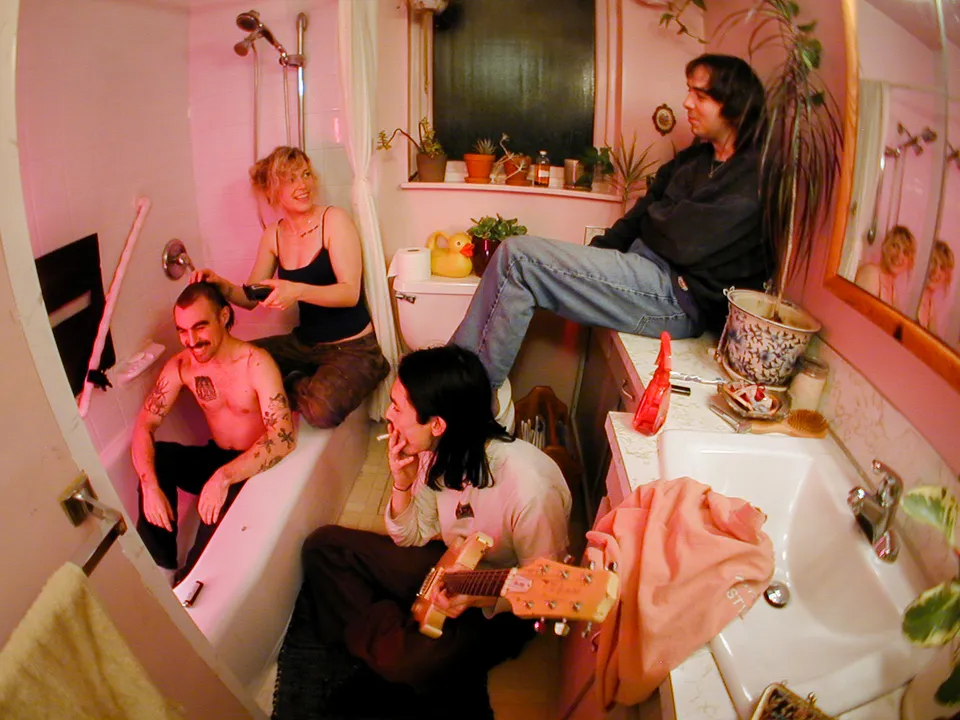
What does it mean for art to land successfully? That question is almost comically self-evident, yet the Vancouver quartet PISS — frontperson Taylor Zantingh, guitarist Tyler Patterson, bassist Gavin Moya, and drummer Garreth Roberts — along with their inaugural record you made me / skin on linen has me considering some grand, almost absurd ideas. Why does a jagged scream paired with abrasive guitars hit so hard? Why do we transmute hurt into sound? Why do we experience pain at all? Why would we inflict pain? What do I gain from witnessing the suffering of others? These are merely a few of the weighty inquiries that PISS’ music inevitably raises.
you made me / skin on linen halted me in my tracks. It’s a mosaic of guttural outbursts, powerful verse, samples drawn from feminist thinkers and activists, a formidable bass line, stubbornly tight percussion, and incendiary guitar work. In a little over half an hour, the album traces how a person comes into being in a world that often seems to tolerate sexual violence, the social norms that have allowed that violence to endure through time, and the divergent opinions on how to act to halt this injustice from persisting.
Every sample feels like a doorway opening onto a new layer of understanding and unraveling. The record begins with the voices of children expressing what they want to become when they grow up. On the following track, “i wanted to be a singer,” Zantingh conveys a line about how every future possibility — and who can occupy it — shifts in response to someone else’s abhorrent actions: “I wanted to write romance novels/ Now I crave absolute control over my victim narrative/ The tale of a girl who was silent and powerless/ But it’s cliché to write about being powerless as a girl.” The album then oscillates between voices from different feminist perspectives: Andrea Dworkin arguing that pornography constitutes a violation of human rights; Manon Garcia reflecting on the Gisèle Pelicot case and the breadth of sexual violence; Toni Morrison contemplating morality, self-forgiveness, and grace.
PISS reveal the manifold approaches one can take toward pain and injustice. It is more than mere noise. It is an aggressive response to violence inflicted on a body, a person, a future, a life. It’s a work defined by paradox and tension, and how existence continues to move forward amid friction.
For two years, PISS toured with the same set. Now a version of that material has become their Sub Pop debut. What began as a project grounded in one artistic vision has expanded into a broader conversation about personal autonomy and structural violence. It feels almost audacious to treat this as a standalone piece, and I was reminded, while speaking with the band over Zoom before they embarked on a nine-hour road trip for a tour, that it’s also a bit ridiculous to demand clarifications for something that feels most potent when it’s experienced — either in concert or through headphones. Perhaps that is precisely when art carries the greatest weight.
Preview you made me / skin on linen below and read an edited version of our chat below.
Are you excited to go on tour? When was the last show or shows you played?
TAYLOR ZANTINGH: We did a quick weekend run in Toronto, and we were slated to appear at a festival in Windsor — or was it actually in Kitchener, Ontario? Both Canadian stops. I blew out my voice at the opening show, so I’m a bit anxious. I’ve been doing a lot of vocal work and trying to stay in peak health to avoid falling ill. I love touring, but it demands constant vigilance — I’m always listening to the breathing of the room, and if someone sniffs or coughs, I’m on alert, like, “Ugh!”
Your vocal stamina is insanely impressive. I’ve always admired how some singers can scream for long stretches. I’m curious about your background and how you found your voice as a performer.
ZANTINGH: I never had formal voice training. I did some singing lessons as a kid, but it didn’t take long for my teacher to pivot toward guitar lessons instead. For me, discovering my vocal identity felt instinctive — it was always natural to raise my voice. In high school I joined my boyfriend’s punk band and found joy in yelling along. Over the years, my approach became less about technique and more about letting the moment carry me; the process of crafting words and lyrics in college, where I studied creative writing, gave shape to how I deliver lines. The voice in this project is largely intuitive. I spend energy elsewhere while the voice comes through almost automatically, so the delivery isn’t something I strain over.
But the body as instrument has been a revealing relationship within this project: my voice has opened doors and empowered me, yet it also humbles me when it falters because you can’t simply take your instrument to a shop if it breaks. The obsession with my voice and my body has led me to routine warmups, cool-downs, and care routines like physiotherapy and massage when we’re off the road, plus ongoing therapy. This project centers so much on my body that caring for it becomes essential.
I keep returning to the tension between body and mind, the way they clash and, at times, harmonize. I’m drawn to the record because it conveys weighty themes with a sense of breaking, while still maintaining a controlled, almost chaotic energy.
ZANTINGH: It’s indeed been a fascinating process. While we were writing and continuing to perform, I pondered my relationship to the music as a character within the world of the record. The music acts as the environment that surrounds my story, which sometimes makes the violence feel explicit. On stage we invest heavily in precision and safety, continuing to perform despite any technical hiccups so that I can focus on the connection with the audience and reach a kind of energetic exchange. I’ll even remove ear protection at moments for effect, because exposing the audience to a higher intensity is a component of the performance for some listeners — it’s a disturbing thing to admit, but that discomfort is part of what people find compelling.
This album has really pushed me to think about how a narrative is performed and how audiences respond to art. Is there art or an album that feels essential yet nearly impossible to listen to every day? There’s a tension between acknowledging something as vital and sacred and recognizing that you still need space from it, to not have it be purely pleasurable all the time.
ZANTINGH: A close parallel would be Mount Eerie’s A Crow Looked At Me, a record that confronts the death of a partner in a way that refuses to let the listener commodify the grief. It’s a direct address to the listener — the artist insists on your presence with a blunt honesty, not a comfortable consumption. That approach influenced me as I created this record, shaping a stance against trivializing such experiences for commercial purposes. The project confronts the listener with a raw truth rather than providing a sanitized experience.
GAVIN MOYA: I’m reminded of Mount Eerie too, though another example that comes to mind is Carrie & Lowell by Sufjan Stevens, which handles grief in a way that’s deeply painful and not meant for casual listening.
What about the tension between releasing these emotions and shaping them into a creative form, with the added challenge of revisiting them on tour?
ZANTINGH: It’s a bit of everything at once. This project has taught me to detach from any expectations about what the experience should feel like, embracing it as a unique occurrence in the moment. There are days when the drive to a city is joyful and I’m filled with gratitude, and there are days when I worry about my voice and fear the show’s toll on my body. There are nights when I’m terrified to tell strangers about personal trauma and to face the potential scrutiny of fans and critics. The feedback loop — how people interpret the work, and how that shapes the meaning for me — is something I’ve learned to accept rather than attempt to control. Somatic therapy has helped me sit with feelings instead of constantly asking, “What does this mean?” There’s a continuously evolving process at work, and I’ve learned to let it unfold rather than forcing a fixed path.
I find that perspective beautiful, because it suggests you inhabit the project as much as the machine that supports it. The collage-like approach feels alive, and it seems every part of the work is always talking to something else. Could you elaborate on your relationship with collage and why it felt right for structuring the record?
ZANTINGH: I treated the idea of assemblage as a metaphor for sculpting your own identity. Environments shape you, especially during childhood, and the collage method — assembling fragments, found objects, and snippets — mirrors the way I wanted to discuss womanhood in a way that avoids cliché. It also allowed for an extra dimension: as a performer, you’re constantly negotiating between being an autonomous artist and the impulse to be objectified by others. The piece can remain incomplete, always evolving. While the term “collage” suits what I was aiming for, I was thinking in terms of assemblage as a broader art form. I favored the word because it captures the process of combining disparate influences — a deliberate, ongoing operation rather than a finished product. The layering of voices from feminist thinkers who sometimes disagree with one another is essential; their conflicting ideas are not contradictory to progress but rather part of a necessary tension in building a movement and a self that can hold both vulnerability and aggression. If I could neatly summarize the record in a single sentence, I’d still fail to capture it completely, because the work lives in the interplay of those tensions.
From what you’ve shared, it seems that some of the samples shifted in your live performances. Is that accurate?
ZANTINGH: The live set itself didn’t rely on changes to the samples, but the studio version required modifications due to legal constraints. Early on we learned that certain voices we used wouldn’t clear for release, and a handful of samples on the record had to be swapped for legally permissible alternatives. Three samples changed because we couldn’t obtain clearance.
That’s fascinating. Did those changes alter how you relate to the album?
ZANTINGH: Yes, in a meaningful way. For a long time I had carefully curated a library of YouTube clips that resonated with the record’s themes, collecting material that felt aligned with its atmosphere. Some of the changes forced me to rethink certain choices that I’d saved for future records. One sample I’d earmarked for a second album remained within a related universe, and in the end we had to recalibrate quickly as time ran short for clearance. The tension was amplified by the fact that one voice representing nonviolence chose not to participate, which shifted the tonal balance. Without that perspective, the record began leaning in a more militant direction, which sparked a broader debate about whether the project should foreground nonviolence or militant activism. It’s a paradoxical puzzle, and it underscored how many elements must align for a single piece to feel right.
That sense of open-ended conversation across voices seems central to your approach. It’s almost counterintuitive, in a way, yet it’s exactly what makes the work compelling.
ZANTINGH: Exactly. The outcome is as strong as it could be given the hurdles we faced. We’ve learned to live with imperfections tied to the reality of releasing music under Sub Pop and using samples that aren’t cleared in advance, and most listeners seem to respond positively. I know what I wanted to accomplish and the constraints that prevented me from achieving a perfect version, but I’m grateful for the result nonetheless.
You mentioned you’re already thinking about a follow-up. How are you envisioning moving ahead as a collective when this project began as a single, self-contained idea?
ZANTINGH: We’ll continue along the same trajectory that yielded the first record, exploring new sonic terrain while staying attentive to the core themes. But for me, writing demands quiet and solitude; I can’t conjure meaningful songs without that space. We’re not in a rush to produce again, because meaningful work rarely emerges on demand. We’re absorbing the experience of touring this record while creating a large window for reflection and reading, so the next phase comes when it’s ready to arrive rather than when it’s demanded. The plan is to let the process unfold at its own pace.
At this point in the conversation, the full band gathers on the couch post-coffee run.
When you initially formed the group, what was the moment that convinced you this could actually work?
ZANTINGH: I’d say it started the moment I drafted the plan for the project.
TYLER PATERSON: Right. I think Tay and I met first, and after bringing Garreth and Gavin into the fold, Tay laid out a comprehensive outline of the album’s concept — with abstract prompts and directional energies for each track. That framework solidified the idea and helped us lock in a shared direction. But even in the rehearsal room, you know quickly if dynamics will click. We all felt an immediate resonance once we began playing together.
ROBERTS: Did that outline exist before we ever practiced with you?
ZANTINGH: It may have existed before our first rehearsal, especially during Halloween week when I was cat-sitting solo. We hit the first jam in early November.
ROBERTS: Yeah.
ZANTINGH: In the early days, Ty and I wrote the bulk of the songs; later, the last three or four were created collectively once we’d started playing shows. I still remember the first gig and how overwhelmed I was by the genuine attention and engagement after the set — that moment stands out as a milestone.
ROBERTS: The first show, and Music Waste, were two of those pivotal early moments.
What’s something the other members introduced you to that reshaped your view of art or music?
ROBERTS: That’s an easy one. I never imagined myself drawn to noise or the more radical experimental approaches Ty and Tay were pursuing. When Ty sent over the sonic blueprint, I thought, “This is unlike anything I’ve heard.” During our first rehearsals, I was urged to bring every pedal I owned, which opened up opportunities to create sounds I hadn’t previously imagined. It was electrifying to explore harsh, discordant textures that felt almost impossibly loud.
ROBERTS: I also found a particular artist that really resonated with me — a band named Women — and that discovery anchored a shift in my perspective, along with other inspirations.
ZANTINGH: Women — both the band and the dialogue around them. [Laughs].
ROBERTS: The gendered dynamics and social expectations they critique were huge for me. It was a major onboarding moment.
PATERSON: For me, it was attending Tay’s poetry reading. That moment clarified a path for us to explore a particular direction, and after that the project seemed to explode in scope and energy.
ZANTINGH: Ty’s taste in music is wonderfully broad, and through our friendship and collaboration I’ve discovered artists I wouldn’t have encountered otherwise. We complement each other in a way that feels almost improvisational — I bring abstract ideas and he translates them into concrete sounds, enabling me to focus on my own contribution and trust he’ll handle the rest. That synergy was a driving force behind the record.
What’s the most surprising disagreement you’ve ever had as a band?
ZANTINGH: The disagreements tend to be subtle rather than loud, and we’ve got a fairly clear decision-making process. If I’m enthusiastic about an idea, the others will present their views in due course. We don’t typically clash in obvious ways.
PATERSON: I can’t think of a standout dispute offhand.
ROBERTS: Most of our disagreements revolve around tastes or pop culture rather than musical direction.
ZANTINGH: There was a moment when Gary wanted to use more toms and the rest of us weren’t sure.
ROBERTS: Oh! [Laughs].
PATERSON: You sneaked them in, didn’t you?
ROBERTS: I did. But I’m not sure it was a real conflict.
MOYA: It could’ve been a misunderstanding or a genuine disagreement.
ZANTINGH: There was also a late-stage argument about the final track’s drum part — I’d been listening to a demo where Garreth played a particular approach, and I kept nudging him to stick with it; he kept following a different path. We ended up with a bit of a spat in the studio.
ROBERTS: I recall that moment; you wanted the approach we’d practiced, but the demo reflected a different arrangement. It was a small misalignment in memory, nothing more.
ZANTINGH: Garreth and I have our own kind of Donkey/Krecn relationship. [Everyone laughs].
PATERSON: She’s the one who did it.
ROBERTS: She did.
ZANTINGH: Disagreements happen, but I wouldn’t be able to do this without him. Still, we butt heads more from personalities than principles.
MOYA: Usually it’s by accident.
ZANTINGH: We’ll realize we’re on the same side and keep going.
ROBERTS: Absolutely.
In what ways has making this album shifted the way you listen to music or engage with art?
ZANTINGH: It’s changed me, though perhaps not in the exact manner I expected. On tour I’ve found myself resisting the detachment that used to come with consuming performances. I once watched a saxophonist named Jairus Sharif in Calgary play in a church and found myself moved to tears. At another Calgary festival, Sled Island, I felt the same intensity watching Jed Arbor. It made me question whether I still genuinely connect with music. In performance I’ve learned to dissociate as a survival tactic to get through, but I’m now pursuing ways to feel more fully again through somatic therapy and related work, so I can truly experience the art I’m making and encountering.
PATERSON: I approached our writing with a different mindset. I wanted to push the form: to explore more expansive possibilities for how songs could exist, bending structure and sound without losing the emotional core. Tay provided a blueprint that promised freedom, and that sense of open potential kept fueling our work.
ROBERTS: Being in a live environment so often has genuinely altered how I experience performances as an audience member. I’ve started noticing that, despite my own evolving taste, it’s still possible to encounter something truly transformative in a concert setting, even if I’m surrounded by a landscape of constant exposure. There are evenings when something clicks, and I feel that immediate, visceral rush that still matters, even in a crowded room.
you made me / skin on linen drops 10/30 via Sub Pop.