
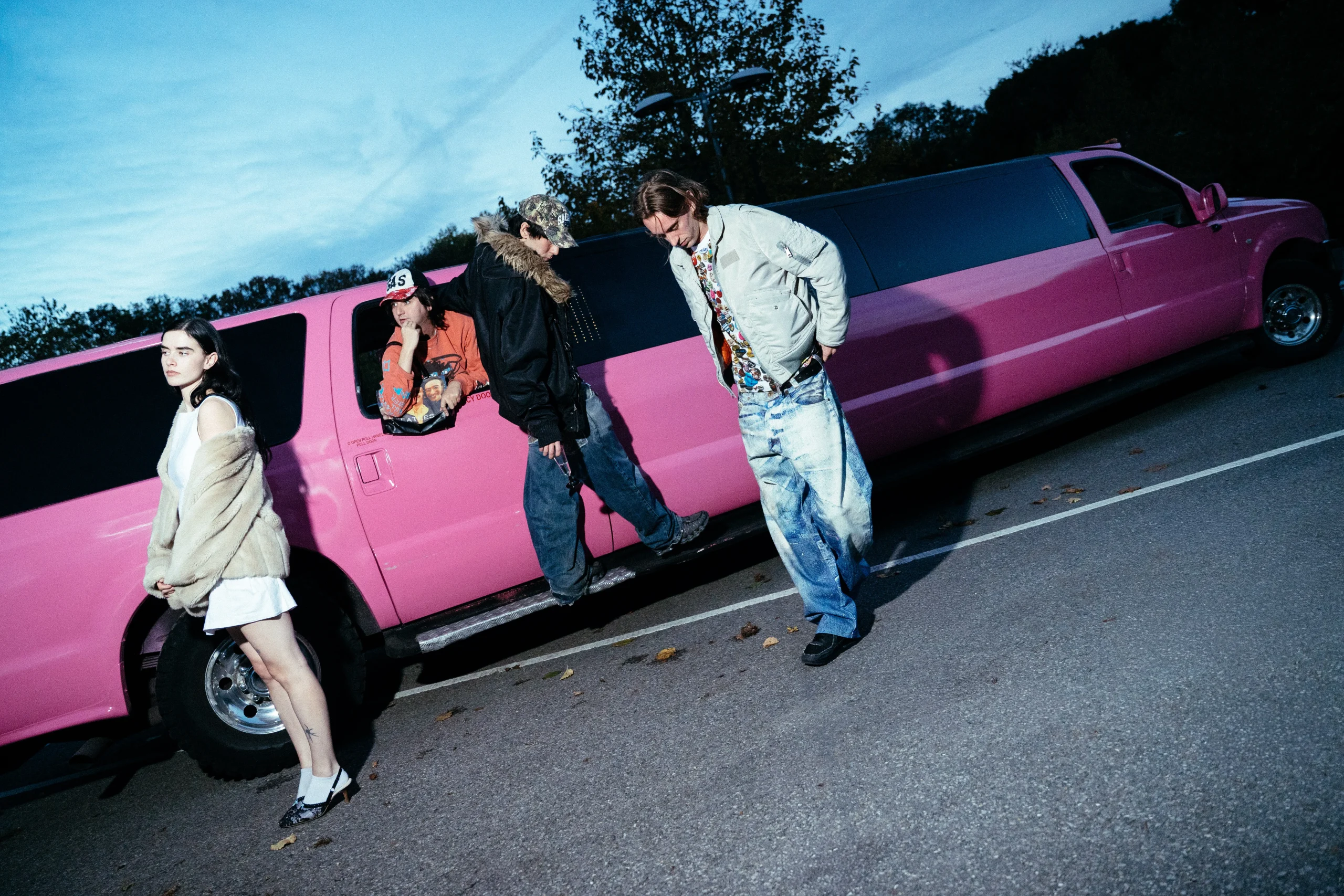
The press bio for RIP Magic, a rising four-person collective from London, speaks in a language of visuals rather than words. The quartet—Beth Boswell-Knight on drums, Felix Bayley-Higgins handling audio-visual duties, Marco Pini as a DJ and sound designer, and Pedro Takahashi on bass—chose to describe their world through imagery that distorts and saturates in technicolor. Their shared Dropbox folder of photos features children tumbling inside a neon inflatable castle, frames from Sissel Morell Dargis’ Balomania, mischievous devils from cartoons, radiant bursts of color, parade balloons from Macy’s Thanksgiving Day Parade, Kim Kardashian with a sunburn from sunglasses, Pope Leo XIV gripping an old baseball bat on a plane, and a Garfield facepaint that adds a playful edge—even when the visuals veer into the surreal.
Their debut LP, 1,2,3, released on Friday roughly a year after their earliest singles Loot and Dox, merges an array of eccentric samples, soft-focus rhythmic tangles, muffled vocals, and immersive noise. It channels the grand, kaleidoscopic spirit of acts like the Chemical Brothers and Animal Collective. Over the last year, the quartet has drawn fans in high places—from Tyler, The Creator, who was on board when they were still developing demos, to LCD Soundsystem’s James Murphy, who produced their single 5words, and to Tame Impala, whom they opened for in UK arenas this past spring.
Whether through unconventional sonic choices or bold strategic shifts, the four are confidently forging a new sonic language for an age of sensory overload. It’s the sound of languid summer heat inside a car—unhurried, a little disorienting, yet oddly comforting. That vibe comes through most clearly on the laid-back tracks “11:30” and “Rock,” where Boswell-Knight’s drumming and Takahashi’s bass lock into a nearly magical synchronicity. Across 1,2,3, samples wander with endless detours, their buried screams and muffled conversations mingling with laser-like synths, acrylic guitars, and jaunty percussion. I even laughed when I recognized a sample of Lissie introducing her cover of “Pursuit Of Happiness” at Great Escape 2010, which closes the album’s standout “Loverboy.” It’s a quirky, fun inclusion that doesn’t appear to be anchored to any heavy meaning.
I spoke with the band a couple of weeks prior to the album’s release. They were weary after a long day spent in front of the lens for a photoshoot, but our chat quickly shifted to the universe they’ve built around RIP Magic. Listen to 1,2,3 and read our conversation below.
Is it difficult to balance your live sound with all the samples, and how do you decide what should come through clearly versus what remains more enigmatic? Even on the album, the vocals carry a hazy quality, as if it’s not always obvious what’s a sample and what isn’t, or perhaps the vocals feel more connected to the samples because of that noise veil.
MARCO PINI: We spent a long time trying to determine where the track should sit, since we’re big fans of using a track as a modular element—something that resonates with DJ culture. We all do a bit of DJing, so we wanted to fuse that mindset with the band dynamics and ride the groove a little.
FELIX BAYLEY-HIGGINS: A lot of people shy away from that approach. In the early days of live shows, the emphasis was on having the most fun on stage rather than on flawless technical performance.
PINI: I’d say these guys provide the bulk of the live-band swing.
PEDRO TAKAHASHI: The result might feel punchier in a live setting. Some tracks take on a different character when performed live, with certain elements more prominent than on the recorded versions, which can feel a bit “headphone-y.” There’s more bite to some songs.
PINI: Some listeners initially pegged us as a more hardcore act when we started performing the album material. That wasn’t deliberate; it’s just what happens when you’re allowed to let loose on stage.
TAKAHASHI: There’s a certain rush involved.
PINI: It’s the only chance you get to truly unleash in a setting like this.
Do you draw inspiration from particular artists who shape the way you present yourselves or fuel a sense of wildness?
TAKAHASHI: I grew up immersed in hardcore shows, and in a live context, that energy tends to leak out, skewing toward the playful end of the spectrum, always with a sense of fun.
BAYLEY-HIGGINS: We’re just excited to be playing with each other.
PINI: I don’t point to any single artist, but audiences generally respond well when there’s genuine catharsis on stage. Watching dancers express themselves is especially inspiring—dance can convey emotion in a way that feels almost unintelligible.
Do you think about how people will dance to your music while you’re composing?
BAYLEY-HIGGINS: In a way, yes. We use dance as a method to figure out the groove.
PINI: The process is very improvisational. We’ll spend hours in a studio, reaching into directions we can only understand in the moment, and then emerge with the groove intact.
BAYLEY-HIGGINS: We even debate what the swing should be—whether to lean one way or another.
PINI: There’s a constant conversation about rhythm and swing.
When did you realize you wanted to work together?
PINI: It started as a vibe-driven collaboration; we didn’t know each other that well at first.
BAYLEY-HIGGINS: We came together specifically to form the band.
PINI: Felix and I were involved in visual work and music, respectively, but not in a traditional musician’s sense. We assembled a group of people whose vibe felt right, and that energy naturally shaped the music. I’m not sure I can fully answer your question, but that’s the gist.
You were closer as friends than as people chasing a specific sound?
PINI: Absolutely. The friendship came first, and we also respected each other’s different visual disciplines—Beth’s photography, Pedro’s filmmaking, and Felix’s video work. That mutual respect for the visual world helped shape how we talk about music in a naive, exploratory way.
That visual bio you created is unusually striking. How do your individual relationships with imagery and your multidisciplinary approach shape the songwriting?
BAYLEY-HIGGINS: [Laughs] It’s hard to pin down. When we started, I was making visuals as an instrument, and I didn’t come from formal musical training. That background gives me freedom to approach music without being constrained by traditional theory, letting the visuals guide a different metric for creativity.
TAKAHASHI: My own background is image-based—music videos, commercials—so entering a project with such a pronounced visual world felt like unlearning some of my usual processes. But it’s liberating. We speak of an RIP vibe, a term that captures a shared, intangible sensibility that resonates with imagery we’re drawn to. Visual roots help propel the band beyond a pure-music project into a broader universe.
PINI: The visual dimension expands the range of possibilities. We often weigh decisions by, “Wouldn’t it be cool to do this?” Even the bio, while it may seem unconventional, mirrors our preference for experimentation. We don’t feel bound by a rigid formula in music, so we lean into the stranger, more playful ideas because they feel true to us.
BAYLEY-HIGGINS: The way people receive music depends on how it’s presented. Not embracing those channels would seem odd to me; the way a piece is packaged is part of its identity.
PINI: I recall growing up that the cover art could pull you into an album even before you heard a note, and that memory still guides our choices—sometimes leading us toward more exploratory directions that later inform the sound itself. The visual impulse often steers the music as well.
TAKAHASHI: Imagery and music aren’t separate; they braid together in a way that shapes how the work lands with an audience.
BETH BOSWELL-KNIGHT: I tend to judge things by their visuals, a habit that colors how we approach every project. The visuals are deeply entwined with what we sound like.
PINI: The images we share help us calibrate the mood we want to convey in sound, and they serve as a mnemonic for the energy we’re chasing in a track. It’s a collaborative, visual language that keeps evolving.
Do you consider what people might project onto RIP Magic?
PINI: We try not to overthink that, though it’s natural to worry about outside perceptions. In the end, we follow what excites or unsettles us most.
BAYLEY-HIGGINS: External expectations aren’t our compass; our internal compass is the true guide.
How did you approach the album cover for 1,2,3?
BAYLEY-HIGGINS: We sifted through a wave of potential images, and many we wanted to license proved unavailable. The visuals we did consider were very RIP in spirit, and ultimately a simple line drawing became the cover—an outcome none of us predicted.
PINI: We had late-night moments of clarity about the design: it should be stark black and white, with ample white space to invite listeners to fill it with their own color. Since the singles leaned on photography tied to the RIP world, it felt fitting to distill that into a more minimal album cover. We also invited multiple artists to reinterpret the cover for each song, which has been a playful aspect of the project.
BAYLEY-HIGGINS: The image still carries a punch, a sort of framework rather than a fixed meaning, inviting various readings from listeners.
There’s a tension between defining your identity and constantly rebelling against it. How would you articulate a RIP Magic vibe beyond intuition?
PINI: That tension is precisely why the visual bio exists. In truth, it doesn’t. When we spoke with our publicists about what to write, words didn’t feel adequate, and that remains the case.
PINI: It’s not that we disdain words, but we prefer not to fall into conventional templates. The project is about subverting expectations and letting the strange ideas flourish.
And when you talk about the visual bio, it seems to connect a lot of dots, yet you end up with a chorus of balloons and inflatable forms.
PINI: Incredible that you picked up on that. We indeed explored a broad range of inflatable imagery for the record.
BAYLEY-HIGGINS: [Laughing].
PINI: It started with watching Macy’s parade footage and the absurd grandeur of those floats—
Have you seen the moments when those inflatables deflate?
PINI: Absolutely. The idea of a colossal, surreal inflatable parade traversing urban spaces struck both of us as brilliant and a little uncanny. There’s a brashness to those shapes that seems to echo the album’s attitude.
That brashness feels like it could reflect in your music as well.
BAYLEY-HIGGINS: It does seem aligned with the energy of our approach.
In your creative process, do the images drive the sound, or do you compose and then search for imagery that captures the song’s essence?
PINI: We don’t intentionally pair a song with a particular image. That would be a dull way to work.
BAYLEY-HIGGINS: It wouldn’t feel right to me to write music and then simply hand it to imagery. The two streams coexist and influence each other in a dynamic way.
PINI: We often exchange images and use them to spark a vibe. Felix might drop a picture that resonates, and we chase that energy until a track feels complete. The visuals help shape its sonic character without dictating a single path.
BAYLEY-HIGGINS: Imagery is a way to articulate what words can’t quite capture—an energy you sense in a photo that you want to translate into sound.
PINI: Think of imagery as joints—a way to mark moods for different parts of a track, like a certain feel for a car-chase sequence or a city-streets vibe reminiscent of Batman: The Animated Series. It’s a language that helps us map tone and tempo.
When you approached the album as a project, did you aim for a cohesive sound for your first LP?
BAYLEY-HIGGINS: It didn’t start with a single holistic plan. It began as a process of making songs from a place of genuine feeling and gradually broadening the lens as the project evolved.
PINI: We recognized the vibe early and wound up assembling ten tracks over two weekends, which became the backbone of the album.
BAYLEY-HIGGINS: We tend to favor first-thoughts, best thoughts. Usually, the take that captures the part most authentically becomes the part that makes the final mix.
PINI: The demos and the live arrangements are deeply interwoven; the performances in rehearsal often shape the final track, with the players’ instinctive choices driving the outcome.
TAKAHASHI: Sometimes a demo evolves when we bring it to the live setting. The process of playing it with the band reveals new possibilities that become part of the finished song. The recorded and live forms inform one another in a satisfying exchange.
PINI: Each member’s musical language can diverge from the demo, but the end results are usually more compelling. Hearing how others interpret the same material yields fresh directions that enrich the track.
TAKAHASHI: There’s a track on the album that began as a dubby demo and ended up as something closer to hardcore. It’s thrilling to see Beth and Pedro intuitively sense the space and weave around it.
Do you have an editing process?
PINI: We’re meticulous editors. The “first thought, best thought” principle is followed by a long editing phase where new layers can be added or removed. It’s like a collage that evolves—sometimes a segment gets pasted over, sometimes a new layer replaces an old one. It can go on almost indefinitely.
Sometimes changes become central, as with “Stadium Drive,” where a vocal sample we call “The Billboard” overtakes the track and shifts its entire dynamic. We love moments when someone adds a wild extra bit that redefines the song in a surprising way, and we often stop only when it feels right to stop.
TAKAHASHI: Listening to the live versions of the songs reveals how they can still grow after the album is finished. Some tracks evolve in performance, and that fluidity makes the music feel more like a living thing than a fixed recording.
Do you perform the songs differently on stage to keep things fresh, or is it mainly a translation from studio to live?
PINI: Some songs lend themselves to improvisation, particularly the vocal lines on “Slacker,” which shift with each performance. It becomes a different show every night, and that unpredictability is part of the appeal for us. The live chemistry keeps the energy alive.
BOSWELL-KNIGHT: The same goes for the drums—sometimes a spontaneous fill or accent just feels right in the moment, and it becomes a defining moment of the performance.
BAYLEY-HIGGINS: We’re constantly tweaking what we do in rehearsal; a moment can feel amazing, and you’ll wonder why you didn’t plan it that way from the start.
PINI: The experience is highly intuitive. We don’t give ourselves credit enough for how natural it feels to improvise—every show is different, and that variety is part of the joy of playing with tracks underneath.
Some have joked that your sound occasionally leans toward a jam-band sensibility, though in a positive sense—impressionistic and expansive rather than rigid. How would you characterize that facet?
BAYLEY-HIGGINS: There is a recognizable moment of that vibe, but we also aim to keep the album lean and purposeful. Each element earns its place, ensuring the whole remains concise and potent rather than indulgent. We wanted the album to feel controlled and purposeful even as we explore broad textures.
When did the album reach its final state relative to when most of the songs were conceived?
PINI: The clock ran in the summer. We embarked on a lengthy LA run to find a producer who could provide cohesive glue for the entire project, but the feedback we received was that no outside producer was necessary—the sound already had its own glue. We then worked with an engineer to finalize the mix and add subtle touches, which turned the process into another round of editing.
BAYLEY-HIGGINS: The idea that music is produced and then mastered is not how we operate. The stages can be interchangeable, and working with Bob Mackenzie, our engineer, allowed us to fluidly move through tracking, producing, and mixing in a short span of time.
PINI: It’s expensive to hire a producer and do sessions within a tight window. If a project doesn’t require that model, you reinvent the workflow to keep the integrity of the sound intact.
Is intuition something you learned to trust, or does it come naturally?
BAYLEY-HIGGINS: For me, intuition is the only reliable anchor. I don’t rely on contrived formulas; I follow the felt sense of what works.
PINI: Our arts-school backgrounds fuse into a blend of obsession and creativity across many influences. The urge to create is powerful, a drive that began in childhood and hasn’t faded. It’s a compulsion to manifest something new and magical.
BOSWELL-KNIGHT: Music is a way for us to connect with the world, a synthesis of years of curiosity and immersion that surfaces as a complex puzzle when fully articulated.
TAKAHASHI: A warning sign for any artist is trying to mold something to a preconceived idea. True expression often comes from an intangible pull that you can’t fully explain, and following that pull is where authenticity lies.
PINI: Copying songs can teach you a great deal, but the real progress comes when you let intuition lead rather than imitate. Our work benefits from influences that aren’t tied to specific tracks or genres.
BOSWELL-KNIGHT: When you begin writing, simply starting can unlock new paths you’d never have imagined, even if the starting point is modest.
Do you have rituals or methods to open channels for creativity?
[Everyone laughs.]
PINI: I won’t claim any special ritual. No.
BAYLEY-HIGGINS: I’d describe it as a constant, around-the-clock practice. Creativity requires ongoing attention.
PINI: The challenge is maintaining a ritual amidst daily life. The discipline—and the occasional chaos—can be the magic that keeps the well from drying up.
BAYLEY-HIGGINS: In our workflow, a typical pattern involves a London block of heavy writing followed by a Hastings retreat. We call that a residency, and it seems to be the only workable method for us to lock in.
What’s special about Hastings, besides escaping London?
BAYLEY-HIGGINS: It’s the flat—a single room that becomes our nerve center for several days. A compact studio and living space where we can seamlessly switch between watching films, binging trash TV, cooking, and making music. That concentration in one small space is essential to how we operate.
What would your teenage selves think of this album or the band?
BAYLEY-HIGGINS: They’d probably be pretty thrilled.
PINI: The past couple of years have been beyond our wildest dreams.
TAKAHASHI: The band’s journey feels almost surreal—the dream we carried as teens is now our lived reality, and it’s a whirlwind worth savoring.
BAYLEY-HIGGINS: It’s a guiding force to keep pushing forward, even when things get intense.
PINI: We’ve surprised ourselves by actually releasing a full album. It’s astonishing to think we’ve reached a milestone we once believed was almost impossible.
Do you expect friends from your teenage years to hear the music?
BAYLEY-HIGGINS: I hope they’ll be impressed by what we’ve done.
PINI: They’ve followed us along for the ride, so it would be meaningful for them to hear it in full.
BOSWELL-KNIGHT: It’s easy to get swept up in all the excitement, but it helps to step back and appreciate how far we’ve come since our earlier days.
TAKAHASHI: It’s the first project where our parents can understand the scale—sharing a moment of seeing us perform with Tame Impala at the O2 makes the journey feel more tangible. Before this, it was a leap of faith with limited external validation.
PINI: I’m waiting for someone to joke that we’ve been pranked or that the music is somehow flawed. It would be a shock, because we never expected this to become a big thing. We’re all huge music fans, and that passion is what carried us through.
BAYLEY-HIGGINS: I know plenty of friends who stopped creating, but we’ve chosen to keep going, no matter what.
TAKAHASHI: Tenacity is essential—keep pushing forward.
PINI: Even if the reception isn’t ideal, we love the album and enjoy playing it live. We’ve just happened to do a lot of the things we’ve always wanted to do along the way.
TOUR DATES:
11/07 – Bristol, UK @ The Mount Within // Simple Things
11/12 – Nightclub 101 – NYC
11/18 – Los Angeles, CA @ Oblivion
11/20 – Mexico City, MX @ Corona Capital
1,2,3 is out now via section1.