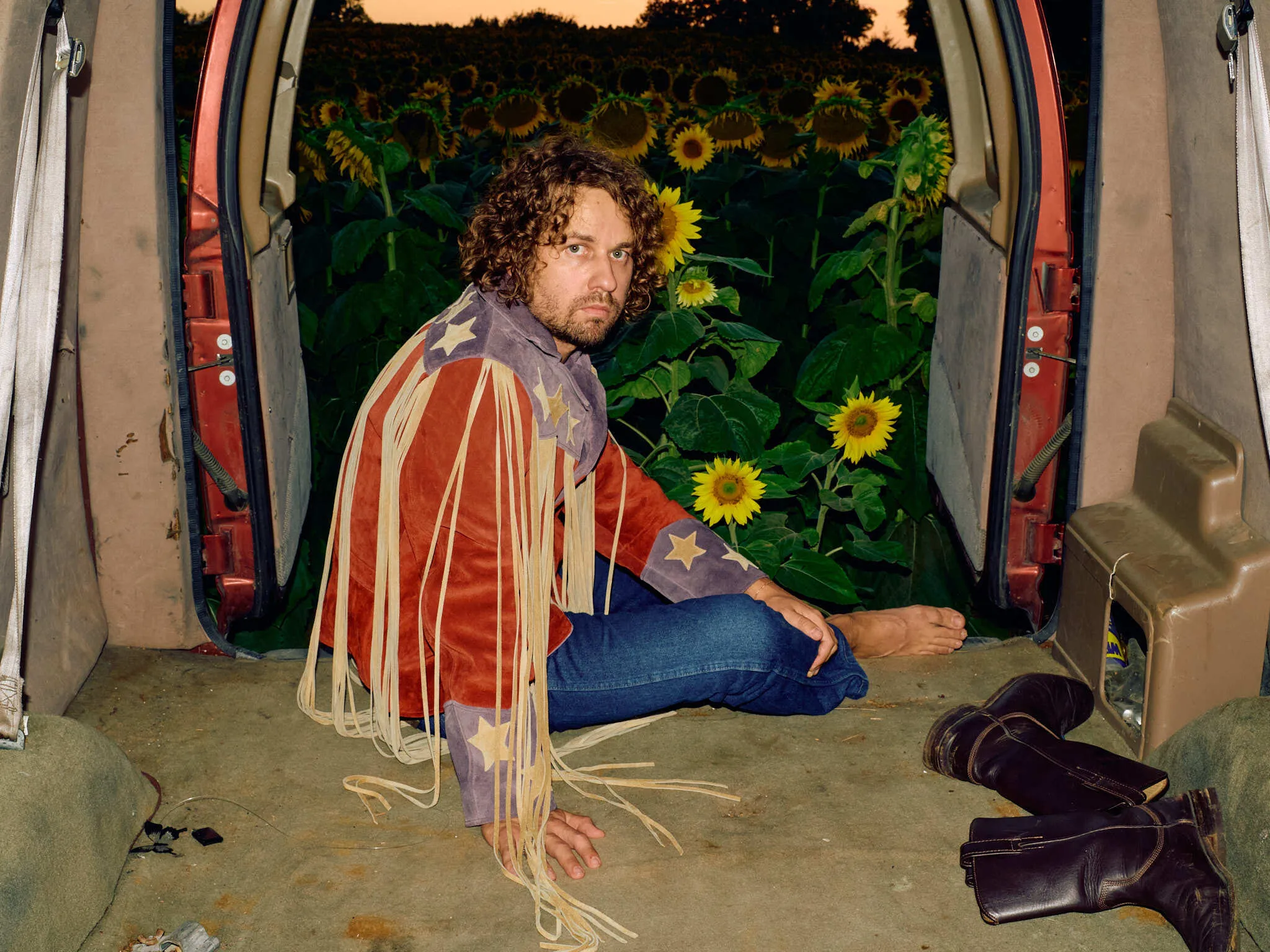
Kevin Morby has unveiled a new masterwork. Little Wide Open, released today, stands as the folk-rock songwriter’s strongest collection to date. The record stitches together a series of meditations: on his Midwestern homeland, the journeys that have carried him afar, on solitude and kinship, on reckless youth and the discipline of experience, on how to navigate this life and what lends it meaning.
Crafted on the road and amid long solo drives across the American heartland, the album brims with astute observations, striking imagery, and witty turns of phrase. Recurring motifs accumulate into a visual language: dandelions and butterflies, natural disasters and Bible Belt towns, the vast sky and the open road, riding shotgun as time hurtles forward. Morby’s delivery, with a hint of Dylan in its timber, has never sounded more natural or lived-in, and the lyrics here are fragile enough to wound you, even as he preserves a certain mystique.
Music that accompanies those lines casts them in a radiant glow. Morby cut Little Wide Open with producer Aaron Dessner at Long Pond Studio in upstate New York. Together they forged a dusk-lit sonic palette that heightens each song’s aching beauty, a restrained, rustic take on the lush textures Dessner has long summoned with the National. It echoes the sun setting over Morby’s Kansas City home, and at times it sounds like that same sun rising again, bringing forth a world of possibility.
Additional help came from a wide circle of collaborators. Core influence Lucinda Williams shines through on “Natural Disaster” like a visiting spirit. Meg Duffy’s guitar heroics on “100,000” provide a spark amid the track’s often hushed, minimalist terrain. Amelia Meath’s voice recurs throughout, sweetening and enlivening every track it touches. When Justin Vernon’s unmistakable voice enters on “Badlands,” it feels like a designed tornado siren.
When I connected with Morby via video to talk about Little Wide Open, he was in Kansas City at the ranch house he shares with his partner, Waxahatchee’s Katie Crutchfield, during breaks from touring or while split between their other base in Los Angeles. They hadn’t publicly announced the news that they’re expecting their first child, but Morby’s imminent fatherhood feels fitting after hearing these songs. Little Wide Open marks the work of a writer moving from one phase to another, grateful for luck and lessons that have brought him here. I enjoyed our conversation about it and hope you do as well.
1. “Badlands”
From the title onward, the album is full of expansive spaces. Touring America clearly fed that, but you also wrote on the road by yourself. What drew you to that mode of writing, to being out there in the wide open?
KEVIN MORBY: A lot of this record sprang from touring—whether across the States, Europe, or Australia—and from juxtaposing those trips with returns to the Midwest. The contrast is striking: visiting far-flung places, then landing back in Kansas City, which can feel like a culture shock in itself. I gathered ideas while traveling and then let the Midwest serve as the backdrop for them. For “Badlands” specifically, I’m drawn to the Terrence Malick film, a bottomless well of inspiration, and I also love Bruce Springsteen’s “Badlands” and the song “Nebraska,” which himself drew from that film. It’s funny: on this record I’ve sometimes borrowed classic American titles and placed them over the Midwest, not singing about the literal Badlands but about Kansas City and the broader Midwest in that frame.
Is that heavenly place you sing about—“Heaven is a place on earth”—the home you’ve built and the life you lead?
MORBY: An odd moment around the making of this record involved buying a new house with Katie. It’s a stylish midcentury place without a basement, which is unusual in the Midwest where basements are almost a given for tornado safety. When we toured with my family, my mom warned against buying a place without a basement. Yet we hadn’t actually faced direct danger in a tornado before. I bought the house, then went on a European tour. On the third night back, jet-lagged, the tornado sirens wailed in the middle of the night—three in the morning—and our glass-walled home felt almost like an aquarium. We didn’t have a basement, so we hid in a closet as the meteorologists warned of danger nearby. The tornado passed within a few blocks and ripped a church roof off in another neighborhood. In that moment the song explores the Midwest’s beauty and serenity, which can flip to a hellish landscape in an instant—especially for someone not from here. Heaven can feel heavenly, but the Midwest can also feel like a force of nature that’s both sublime and terrifying.
Interesting that you’re calling from Columbus, Ohio, and your place there also lacks a basement. I’ve had a similar scare in the past few years.
MORBY: Yeah, you hide in the closet or the bathtub if you’ve got one. When that happened, I’d just moved to a new neighborhood and felt unprepared. I walked into the living room to switch on the lights as if a neighbor might come to rescue us, only to realize, jet-lagged, that I wasn’t in France—I was in the Midwest, and the alarms were real. I’d even seen a viral clip of a kid joking that the tornado sirens were harmonizing. It’s just the moodiness of the Midwest—never dull, always something. Kansas City, for me, is a place to retreat after a tour to rest, but not for social life or partying; it’s the storms and the stillness that stand out.
And having Justin Vernon as the tornado siren—brilliant.
MORBY: Absolutely. Justin has become a close friend since we both split time between L.A. We’ve been playing tennis together, which has been wonderful. He also collaborated with Aaron a lot. So when we needed that siren sound, Justin was the obvious choice. Amelia Meath’s contribution across the record helps fill the sonic space beautifully.
She’s all over the album, isn’t she?
MORBY: Yes, it happened organically. She came in to sing on one track and proved so compelling that she kept returning, bringing new energy to several songs. Her presence in the vocal booth—she moved with such intensity that the moment felt electric. It became a recurring feature of the record.
2. “Die Young”
There’s an uplifting thread in darkness—gratitude amid tough times. That’s what resonated with me about this track personally.
MORBY: People have asked if the song harbors survivor’s guilt; I think it’s more about survivor’s gratitude. I’m 38, which can feel both ancient and still quite young, depending on who you ask. The song reflects my twenties—the reckless habits and the circle I ran with. Many friends didn’t make it, while some did; it’s a tribute to those who survived, and to those who didn’t.
Katie has spoken about sobriety. Your lifestyle now seems quite different from back then.
MORBY: I’ve been fortunate not to be hooked by addictive tendencies. I quit cigarettes long ago, and my drinking has shifted over time. In my early thirties I faced a crossroads—either keep living as I have or start taking better care of myself. Each new year I invest more in mental and physical health, which has been a healthy direction.
3. “Javelin”
The groove on this track is infectious—almost a sunny “Sympathy For The Devil.” The line about being alone in the middle of America—was that drawn from a real moment?
MORBY: That line isn’t tied to a specific memory so much as a sense from the pandemic period. Katie and I ran a weekly “rodeo” on Instagram, a little talk show where people could watch us in our Kansas life. There was a demand to know what living in the Midwest feels like, especially during the quarantine era. Those rodeos shaped the song’s vibe—the idea that people were curious about us in Kansas and the Midwest. So the track is tied to those moments more than to a single incident.
This was the lead single. Why did you choose it to introduce the project?
MORBY: We’d planned to lead with “Badlands,” but every time I shared the record with a friend, I’d play them “Javelin” first. It felt more effective as an intro, and our publicist agreed. It was a late decision, but I’m glad we switched—“Javelin” keeps sounding stronger as time goes by.
4. “All Sinners”
You’ve got a passenger-by-time stance here, a recurring idea on the record. Can you discuss that theme?
MORBY: On my previous album This Is A Photograph, I wrestled with time as an adversary. Since then I’ve softened that view, seeing time as a traveling companion rather than an enemy—an ongoing ride where time might steer, but we’re still alongside it. The concept of being a passenger to time—sharing the journey with it, acting like Bonnie and Clyde rather than being captive—felt fitting for this track.
Nice to see Ohio flavor creeping in with the “O-H-I-O.”
MORBY: Aaron loves this song; he’s from Ohio, so he’s perhaps biased, but he’s genuinely into it. It wasn’t planned as a single, yet he recently texted me saying he’s surprised it isn’t.
Aaron’s role keeps coming up. How did you end up working with him?
MORBY: This record was my most uncertain about collaborators in a long time. I’d enjoyed working with several producers, but I felt these songs needed a different approach. So in 2024 I said yes to every opportunity, hoping one would click. Opening for the National introduced me to Aaron—though I’d never fully explored their music before, I was struck by the vocal texture of their thing. When Aaron reached out afterward, I realized I’d found my match. It was a perfect, almost serendipitous fit that only happened because I kept saying yes to opportunities.
You’ve got strong Christian imagery on the record—“Bible Belt,” “All Sinners,” references to heaven and forgiveness. How does spirituality sit with your worldview?
MORBY: It’s a secular take on Christianity. Spiritually, I’m drawn to the natural world and to the universe, and I see spirituality as woven into that appreciation. The Christian vocabulary around the record feels instrumental rather than devotional. I grew up amid evangelical signage and bold proclamations; those words became part of my expressive toolkit. When I sing about sinners and forgiveness on “All Sinners,” I’m not directing that toward a specific Christian figure; it’s an emotional language that fits the moment. My personal faith isn’t present in a conventional sense, but my sense of spirituality grows stronger every day.
5. “Natural Disaster”
This is the big Lucinda moment. Was she the intended presence from the start?
MORBY: While writing this, I realized the track was influenced in part by Lou Reed’s Street Hassle, especially the discreet Bruce Springsteen moment in that piece. I wondered who could provide a similar force in the same spirit as Springsteen. Lucinda Williams immediately came to mind—the idea of inviting her felt natural, given how much I admire her and how World Without Tears has shaped my approach to this record. It felt like a perfect fit. We’ve become acquainted through mutual friends and at occasional festivals, and the prospect of working with her was an exhilarating prospect. She agreed, which thrilled me. She also enjoys a good rapport with Katie, which helped. And she delivered a powerful contribution from Nashville before sending it along. It felt like the final piece that completed the record’s arc.
The line “When I find a good thing, I don’t feel deserving” adds a new wrinkle to the gratitude theme—an anxious gratitude, perhaps. Do you find it lands more powerfully when stated plainly?
MORBY: I think so. Sometimes lyric moments feel too direct, and I try to cloak them. But there are times when a blunt statement lands more effectively—imagine a songwriter you admire delivering it plainly; that clarity can hit harder. I wanted this line to be straightforward, almost naked, and I aimed for a stark delivery that matched the feeling.
You’ve got more tornado imagery across the album. Was the interconnected nature of the songs a deliberate plan, or did these ideas simply keep surfacing?
MORBY: It happened more organically. These ideas kept bubbling up, and once you notice a pattern—several songs speaking to one another—it becomes clear you’ve got an album’s core. That realization—these songs as companions—made the process exciting.
6. “100,000”
As the track nears its end, the guitars burst open. Do you have plans to perform this live?
MORBY: Not yet, outside the studio. This one wasn’t tracked entirely at Long Pond. Meg Duffy from Hand Habits, a close collaborator and friend who used to be in my band, suggested it after we wrote it together in Los Angeles with a drummer, Tim Carr, who also works with Meg. It was a project that predated meeting Aaron; they shaped it, then Aaron gave it his Long Pond treatment later. Meg’s contribution is pivotal, and I’m excited to bring this one to life on stage. The guitar work Meg conjures is extraordinary, and the ending—Meg’s moments—felt like a triumph when I watched it unfold in the studio. I’m eager to perform it live.
There are Metallica-like references in that track, a riff that feels right for its mood.
MORBY: It’s very much intentional. The lyric about the neighbors—who look rough but are probably just ordinary Midwestern guys—paired with a riff that nods to heavier rock, anchors the song in a stark, grounded reality. The idea of young people as butterflies along the highway—delicate but fleeting—lives in this piece as well.
7. “Little Wide Open”
This is the album’s centerpiece in many ways. It’s the title track and runs about eight minutes. Is it meant to serve as a manifesto for the record?
MORBY: The irony is that for the longest time I envisioned naming the album I Ride Passenger. That phrase carried through the entire process and kept guiding what followed. It even shaped conversations about the title—people would ask what the record would be called, and I kept returning to that line. The song itself is part of a larger journey, but I’d say the heart of the album lies in Little Wide Open. It’s as if the record’s middle marks a shift—two halves that feel distinct from one another yet connected by this central piece. The cover shoot finally clarified the title alignment for me, making the record feel like a natural, evolving whole. It’s the centerpiece in more ways than one.
Would you say the first half is more inward, and the second half opens outward?
MORBY: I’d frame it as a contrast between a busy, ensemble-driven first act and a second half that opens into vast, expansive space. Picture playing the record in a city or small town and then driving out into the plains; that transition mirrors the track’s arc. Some listeners hear a twilight mood across the album, with the second half feeling like the sun setting and the day giving way to possibility. It’s a nice way to think about the flow, and I’m glad that interpretation resonates with you.
8. “Cowtown”
That track also seems to evoke a mood. You wrote about the Long Pond process on your Substack—could you share a bit about how you and Aaron built the songs together?
MORBY: I’d enter the vocal booth with just an acoustic guitar and typically lay down one to three takes. A lot of the time we used that initial take. Then Aaron and Bella Blasko—the studio’s engineer—set to work in real time, layering instruments as quickly as a kitchen orchestra. It’s a well-oiled system. A key thing Aaron did for me on this record was to temper my impulse to go big with strings and studio tricks. He kept us aligned with the songs’ core. In “Cowtown,” I even echo a line about “no one making a sound except for me and this guitar,” and then I add a little acoustic ditty. I love that moment. It’s almost like the record is asking for restraint even as I wanted larger, more flamboyant touches. Aaron kept me true to the song’s spirit. And I’m fond of that opening line I wrote when I was eighteen—“Write my name in mud”—and the fact that after all these years it finally found its place. I always imagined a character who never left his small town, and this track speaks through that lens. For a long time “Cowtown” and the following track “Bible Belt” nearly didn’t make the cut because the album felt too long, but eventually we decided to include them as a paired sequence. The record ends up at thirteen tracks, a length that clearly echoes Paul Westerberg’s Stereo, a Midwest classic that inspired me to keep to thirteen songs as well.
You’ve got overt Christian imagery here too—“Bible Belt” and the references to heaven and forgiveness. How do you relate to spirituality or Christianity?
MORBY: My approach is largely secular in regard to Christianity. Spirituality, though, is becoming more central as I grow older; I’m more attuned to the natural world and the universe, and that curiosity shapes my sense of reverence. The Christian vocabulary on the record serves as a kind of emotional shorthand, not a doctrinal stance. I grew up amid evangelical signage and florid declarations, which left a linguistic imprint that I pull from when expressing feeling. So while my personal Christianity isn’t a practice, my sense of spirituality continues to deepen.
9. “Bible Belt”
The vocal production on this one is striking—are the parts doubled or layered in a special way?
MORBY: Yes, we doubled the vocal take. It’s a classic studio trick—two takes that feel like a cohesive whole, and then maybe doubling again to create a fuller thickness. This track began as one of the first songs I wrote for the record, a piece I started on the tour bus in 2021 after the pandemic. A couple who were driving from Santa Fe to Denver to see my show were tragically in an accident, and one person died. That event lingered in my mind as I wrote, using the bus as a kind of soundproof chamber for memory and reflection. It was a strange return to the road after a long pause, and the sense of moving through life and travel with fear and awe colored the writing. I found an old, cheap guitar on the tour—a small instrument I’d carry around—that allowed me to craft the song in that intimate space.
That song grew out of the feeling of being back on the road after a long pause and the sense of fear that comes with movement. The gas fumes in the bus and the realization of how moving through the country can feel both intimate and staggering shaped the mood. It’s a human, relatable moment—like describing the simple, concrete things that anchor us while the larger world hums around us.
10. “I Ride Passenger”
You mentioned this as a potential title track. Was it the recurring idea that ultimately redirected the album’s naming?
MORBY: The phrase simply spoke to the album’s central theme of riding along with time. It’s a strong song, but not the one I wanted to bear the record’s entire message. That’s why I pivoted away from naming the album after it. It remains a solid track and the title embodies the broader idea of living in motion, which I also connect to a sense of travel at any cost. I’ve even found little Easter eggs from Lonesome Dove in the song—Larry McMurtry’s Western epic clearly influenced me here. If you know the book well, you’ll catch the echoes. I haven’t read it in years, but it sits in the back of my mind as a touchstone for this song’s mood.
People have noted links to Lonesome Dove in your writing. You’ve read it?
MORBY: I’ve read it a while back; it’s one of my favorites. It’s got that expansive, sweeping quality that fits the record’s scope. It’s a nice parallel to the journey in this track.
You’ve got a lot of Christian imagery on the album; you’ve described spirituality as something that deepens with age. How does that intersect with your personal beliefs?
MORBY: My approach is secular in terms of formal religion, but my sense of spirituality grows as my awareness of the natural world deepens. Christianity sits in the background as a language I occasionally lean on to express feeling, rather than as a doctrine I practice. I grew up in a landscape saturated with church signs and preaching, so those phrases have become tools for shaping emotion rather than beliefs I hold onto rigidly.
11. “Junebug”
Tom Moth contributed harp here. How did that come about?
MORBY: I wrote the song on piano, and Aaron later introduced a harp line inspired by a Florence + The Machine session he’d worked on. The arrangement needed something airy and celestial, and the harp perfectly delivered that warmth. Harp is a new texture for these tracks, and it suits the traveling and returning themes—light, uplifting, and almost otherworldly. The harp’s presence fits the sense of wonder I wanted for this piece.
12. “Dandelion”
Is this one aimed at someone specific, or more universal in its message of resilience?
MORBY: It’s a mosaic of scenes rather than a letter to a single person. I was driving solo through Oklahoma when I glimpsed a neon-lit gas station on a hot, still night and felt compelled to write a scene about young people lingering in such a place. The opening line—about my dog bounding through dandelion fields and the flowers exploding across her face—came from that moment. I’d just visited New Orleans, which informs the highway-waterline image. I wanted the song to feel almost human as if an observer were describing everyday moments—moments so ordinary yet so essential—so that an alien might understand what being human is like. Each verse sketches a small, intimate moment, connected by a human thread rather than a single recipient.
13. “Field Guide For The Butterflies”
The Midwest roots run through most of the album, and this track seems to look outward toward the wider world and its adventures. Is that a fair read?
MORBY: Yes—this was, for a long while, the opening track in my mind. I even had a demo I’d show people to set the vibe, imagining the record opening with a call to exploration. At some point Aaron suggested placing it last; it felt right, almost like a mission statement. The song captures the album’s essence: the urge to perform, to dream, to chase visions beyond anything safe, and to carry that dream into the world regardless of risk. While driving across Arkansas on a solo trip, butterflies became a symbol for me after my previous album; I began to notice butterflies whenever they appeared and even when their presence seemed fragile. I started equating musicians and creative souls with those fragile butterflies on the highway—an image that resonated across the record. A stop in Fayetteville, Arkansas, at a famous used bookstore called Dickson Street Books yielded a vintage butterfly field guide, which felt like a perfect, serendipitous convergence that shaped the song’s imagery.
You’ve spoken about roots and geography shaping your life and music. You could live anywhere, yet you remain tethered to Kansas City. How does that balance affect the album as a whole?
MORBY: A friend once said that where you’re born sets your body’s clock to that time zone for life, and whether you fully buy into that idea or not, it resonates as a concept. The Midwest and Kansas City in particular carry a complicated pull for me—a love-hate relationship. If you remove me from it, I would feel a compelling tug to return. We now split time between L.A. and here, but the Midwest calls me back. Kansas City serves as a place to decompress after tours and to regroup, and it also anchors the emotional center of these songs. When people slight Kansas City, I’ll defend it, because it’s home. The fires in L.A. a few years ago reinforced that pull: we left abruptly and headed back to the Midwest, where the land’s openness instantly steadies me. The arrangement of my life now is a rough split—roughly 60/40 toward L.A.—with touring acting as a third base. I value the community I have out west, but I always need that Midwest grounding to feel complete.
So you’re living between two poles, with touring as a perpetual third base?
MORBY: Exactly. The road is the third place that defines us, but Kansas City remains where I land to decompress and reconstruct. I’ll always crave a rooted, grounded home, even as the life of a traveling artist pulls me outward.
Kevin Morby – Little Wide Open [2xLP]
Amazon
Little Wide Open is available now via Dead Oceans.