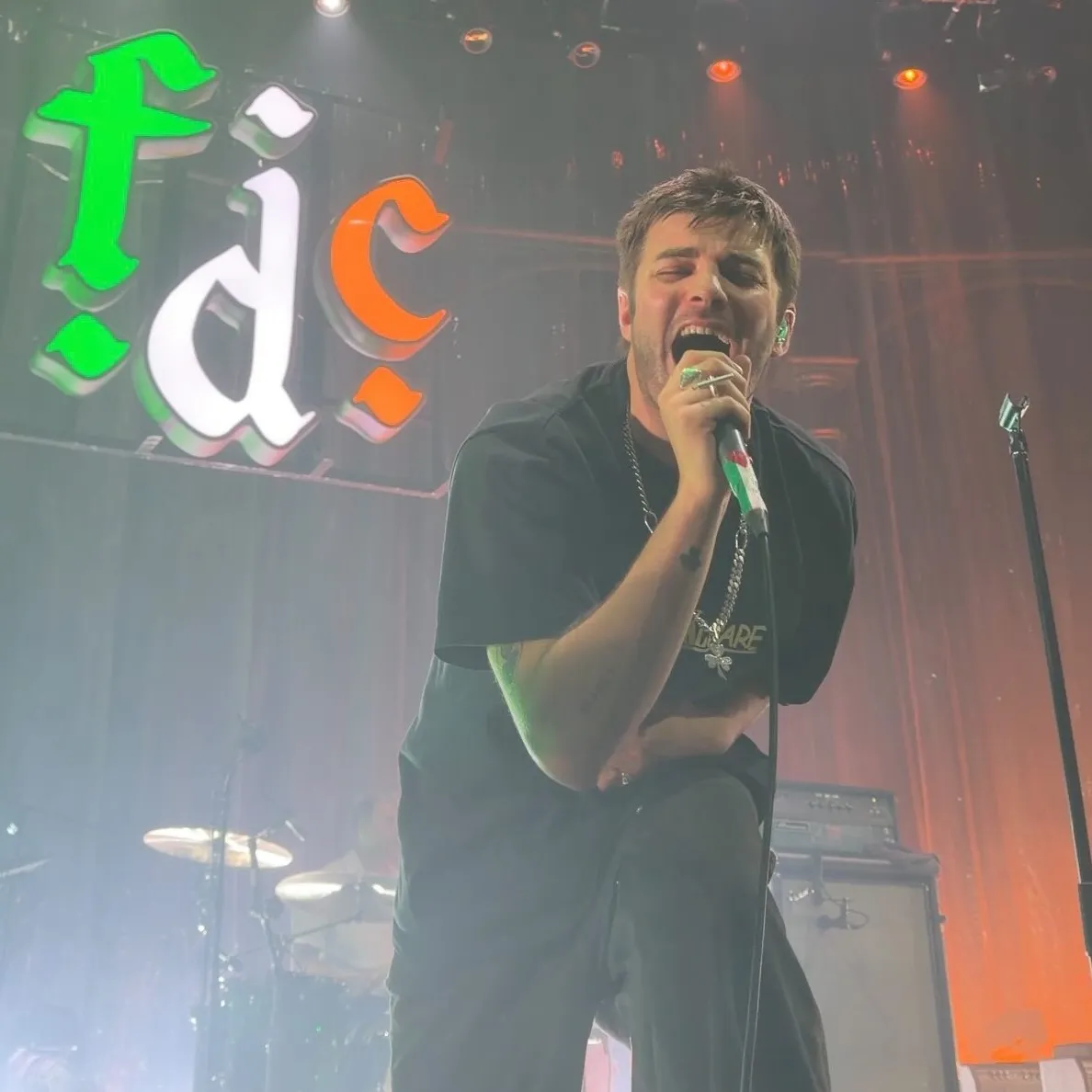
The Roundhouse nearly couldn’t hold the volume. On the eve of releasing their fifth album, Dopamine Chamber, Fontaines D.C. staged a charity show in partnership with CALM, the suicide-prevention charity, at the 1,500-capacity London venue—a quiet prelude to the Irish band’s release. The crowd’s urgency was palpable, a craving for closeness to the group and their music that threatened to overwhelm the room.
From the balcony, a balaclava-clad fan surged with excitement. A figure at the front wore devil horns—apt for the band’s increasingly sly sound, perhaps a nod to the headgear guitarist Carlos O’Connell wore in recent promotional photos. The stage carried a gigantic F.T.D.C. sign that shifted through colors during the set, and a massive silver curtain that looked like a piece of ruffled aluminum foil.
Watching the five-piece evolve from gray post-punk to neon-inflected new wave has been a compelling arc. Dopamine Chamber isn’t as euphoric as its title suggests. It expands the cinematic breadth of 2024’s Romance, but without as many instant pop-release moments as “Starburster,” “Bug,” or “Favourite.” “Mimesis” comes closest: industrial clangs and garland-like synths announce a thrilling new path, only for the lyrics to turn that rush into something ominous. “The everlasting now / Eternity is real” reads less as a promise than a curse.
Where Romance made surrender feel almost thrillingly excessive, Dopamine Chamber strips away the illusion. Its synths shimmer, its vocals drift, and its songs seem to dissolve into a Lynchian dreamscape. But the longer you linger there, the less inviting it becomes. The pleasure curdles into paranoia. This is music that dazzles you until you realize you’re walking through shadows.
The album is solid, and I’m personally glad to see them linger in this territory where melancholic synths and capricious vocals swirl together like the aurora borealis. For a moment I’m swept up in the luxury of it all—the nihilistic possibility or “dream fog” on the stunning “Marianne” and the subsequent album highlight “Mimesis.” Yet that wooziness remains attractive only for so long. As the record unfolds, the electricity of blurred keyboards starts to feel like laughing faces, and the project begins to feel unsettled. It’s an album that dazzles you until you fall into the shadows. The yearning for “living for a million years” and eternity reads less as salvation and more as a threat. It may not be their most ambitious work, but its conciseness feels purposeful and effective.
After the suffocating density of Dopamine Chamber, the live show’s immediacy offered a reprieve. Around me, fans stamped their Converse into the floor, shouted along, and threw themselves into the music. The album’s morbid fixation on permanence gave way to something more fleeting and immediate—the pleasure of being here, together, right now.
The same could be said for witnessing the band’s palpable aliveness on stage. Vocalist Grian Chatten balanced the roles of jester and showman. At times he raised his arms in a V, urging the crowd to cheer while resembling a proud orchestra conductor. Other moments found him stalking the stage, his stride eager and almost vengeful. Still others had him letting the mic stand crash to the floor or tossing his tambourine aside as if discarding a stray piece of gum. Tom Coll’s drums sounded immaculate; it was a treat to see bandmate Chilli Jesson dance vigorously while manning the keyboards at one point.
There was little chatter from the group. They focused almost entirely on the music, with Chatten announcing when new songs arrived. Both “You Miss Me” and “Mimesis” had their live debuts. The members traded instruments during the set, transforming the band into a fluid, continually rearranging entity. Coll remained behind the kit, his drumming colossal and unyielding. The set largely spotlighted the new album, though they skipped “Demolition” and the closer “Intimate”—a regrettable omission, though understandable for a benefit honoring a suicide-prevention organization.
The contrast between newer material and older hits hit harder when juxtaposed. “Big Shot” sounded superb nestled between “Japan” and “Happy For You.” The venue’s acoustics made some songs feel expansive like vapor—the reverb on “Only One Man” is chilling live compared with the studio—while others buckled. The synths on “Japan” felt overpoweringly loud in the room.
The set’s most thrilling moments arrived when the band slipped into other musical worlds. The opening motif of the Replacements’ “Unsatisfied” surfaced before “Jackie Down The Line,” followed by the unmistakable gleam of Angelo Badalamenti’s Twin Peaks theme. Even the closing “Starburster” began with a fragment of “In Heaven” from David Lynch’s Eraserhead. These interludes extended the band’s fascination with the uncanny, turning the concert into another doorway into the dream logic of Dopamine Chamber.
Rather than dwelling on death, the night focused on moving through life. The main set concluded with the Rosalía collaboration “Where Is Gone,” a poignant choice even without Rosalía’s presence. “It’s just the start of another show to hurt you / And make you feel alive” serves as the song’s closing line. Chatten’s soft, low voice gave the final word a sense of mystery.
The band’s official bio for the new album described how overstimulation and the world’s growing hunger to become beautifully permanent fuel the album’s strange emotional clash. The flood of information—oscillating between terrifying and entertaining—leaves everything feeling hollow.
This idea functions like a stained-silk shroud over Dopamine Chamber, an album where the promise of eternity reads less as salvation than as a threat. Yet at the Roundhouse, the band made a persuasive case for the opposite: that feeling alive means embracing the possibility of an ending. No one in that crowd needed to live forever. For a few hours, simply being there was enough.
Dopamine Chamber is out now via XL.