I’ve been hooked on Jawdropped since Monday.
Honestly, it was a Wednesday when the group unveiled the world’s first teaser from their upcoming debut, back in May. They hadn’t yet dropped the album title Secret To Spare, but the track carried the punchy, lead-single vibe all the same.
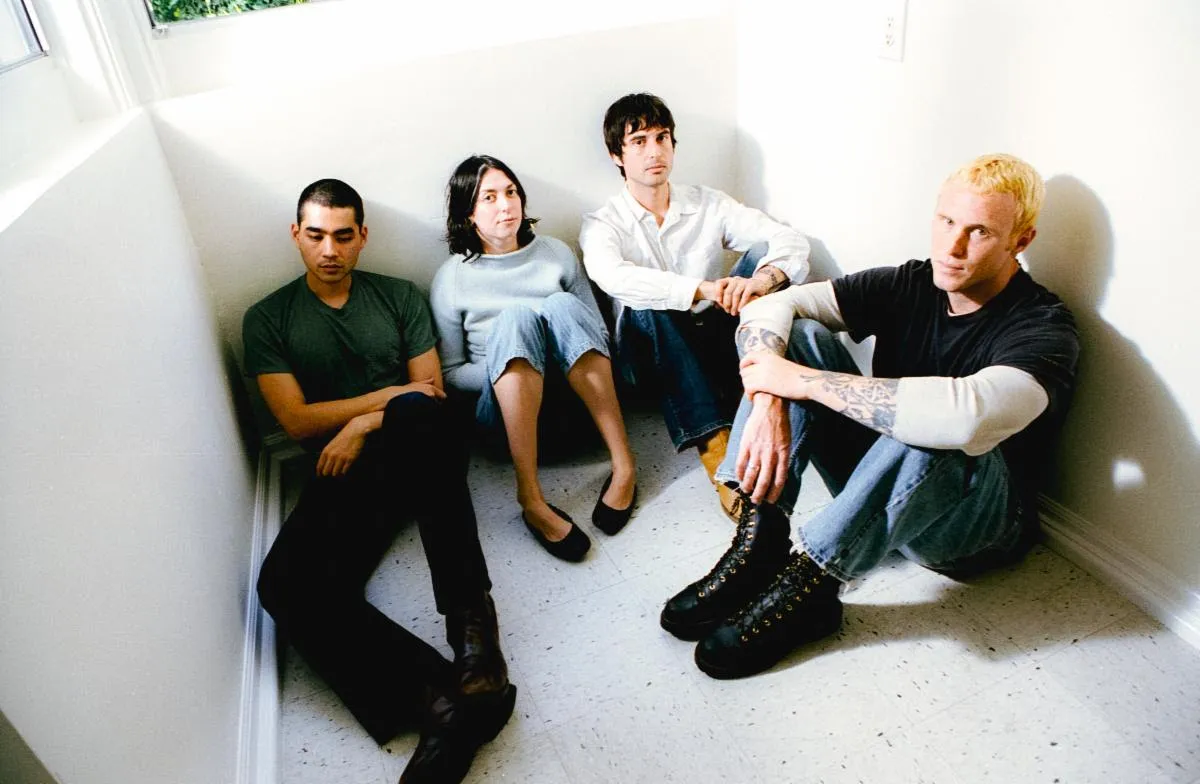
All the strengths Jawdropped has to offer were on display in those three-and-a-half minutes: the razor-sharp, sugar-kissed vocal back-and-forth between Roman Zangari and Kyra Morling, the irresistible push provided by bassist Sean Edwards and drummer Cook Lee-Chobanian, and the sense that a lot of the sharp, pop-minded alt-rock of the early ’90s had been distilled into a singular, melodic whole. The video was equally charming and hypnotic, mirroring the song’s savvy simplicity as it swept from one band member to the next.
Secret To Spare, due this Friday on Canvasback/Transgressive, is loaded with songs that hit that mark. Jawdropped deliver one gem after another, brimming with hooks and kinetic energy, so vibrant that it makes retro influences feel like the future. Listening straight through, you immediately grasp why Jawdropped is the quartet that finally gelled after a decade spent toiling in other LA projects.
It has been a pleasure to dive into the album in recent months, just as it was a treat getting to know the band during a recent video chat. We spoke about how Jawdropped came together, the shared love of classic American songwriting that drew them together, writing by overhearing conversations at a bar, and the local and national music communities the band calls home.
Today, Jawdropped are sharing one final advance single from the album. The opener, “The Line,” is another charming track with a deft sense of melody and momentum, a wistful nod to Teenage Fanclub’s jangly sensibility that gradually shifts toward a Pixies-esque punch as it unfolds. Below, watch the video and read my conversation with the band.
You guys have talked about how you’d been playing in bands for a long time when this project came along, and you were at a point where many musicians would bow out or deprioritize music in their lives. What about this venture made you want to push forward?
ROMAN ZANGARI: I think there was a shared spark. We discovered a lot of overlap in our tastes during the first couple of jams, which made it feel like we had a mission statement or a direction we all wanted to pursue. That isn’t always the case in prior projects I’ve been in, where different members’ tastes and goals pull in different directions. So, as cliché as it may sound, it was obvious from the outset that we’d hit upon something special. The early rehearsals and first shows felt incredibly natural and effortless, like we were finding something that fit us.
KYRA MORLING: I’d add that from those first gigs, even though you don’t want to rely on others’ reactions, we were getting solid feedback, which was encouraging to keep going. I’d reached a moment where I thought I might need a salaried job or a more conventional path, but outside momentum for the band—beneficial and uplifting—came along just at the right time.
SEAN EDWARDS: There was a moment fairly early on when we played a show—maybe our third or fourth—ending with the song “Outside.” People started singing along, and it caught us off guard. I think we bungled that outro because the crowd was singing with us. In that moment I realized, “Hey, maybe we should keep doing this. This feels special.” It’s rare to have an audience sing along to something you’ve written on the fly.
One of the first things you mentioned was a shared vision and a sense of identity for the band. Do you have any specific guiding principles for what makes a Jawdropped song or what you want the band to be?
ZANGARI: Absolutely—simplicity is central. We aim not to overcomplicate things. We also want the songs to stand on their own with just an acoustic guitar and a vocal, stripped of everything else. The essence of the song has to remain intact without extra frills or embellishments. That approach—crafting traditional pop songs—sits at the heart of everything we create together. It should be able to endure without any added adornments.
EDWARDS: There’s also a strong vein of American songwriting that we’re drawn to and study, a tradition we wanted to contribute to. We all love shoegaze and some noisier edges, but our real interest lies in tapping into that vibe associated with Springsteen, Paul Westerberg, Lucinda Williams—this certain je ne sais quoi of the American songwriting tradition—and making our own work from our perspective.
It’s interesting that you’re talking about singer–songwriter types. It isn’t the first thing that comes to mind when listening to your record, though it seems to drive the writing. Perhaps that’s part of what gives you your distinctive flavor, since there are a lot of power-pop outfits around these days.
ZANGARI: I’d say our take on power pop leans toward the Evan Dando/Big Star school rather than the garage-rock tilt you see in many contemporary bands. There’s a timeless, almost universal quality to the artists we admire, which is the direction we’re trying to head in—focusing on crafting enduring pop tunes rather than chasing a particular aesthetic associated with power pop.
COOK LEE-CHOBANIAN: It’s the same across those bands where there’s a single primary songwriter, yet the rest of the group contributed to the project—think Evan Dando and the Lemonheads, Paul Westerberg and the Replacements.
Were your previous bands anything like Jawdropped, or is this a major shift for you?
LEE-CHOBANIAN: Not for me, definitely not.
ZANGARI: It’s a pivot, I’d say, for everyone. But for me personally it feels truer to the music I love and to what comes naturally as a songwriter, rather than forcing past projects to wear a hat that doesn’t fit.
EDWARDS: We’re all gravitating toward it. In our respective bands we’d been moving toward something similar—rock in its truest sense. Roman was shaping those songs in his former group, I was doing the same in mine, and with Kyra’s writing and lyric sensibility added, it all clicked. We didn’t need to discuss a shared goal; we already knew what we wanted to make, and we started making it, which felt inevitable.
MORLING: We also connected with a concept: you go to your local bar, there’s a band playing—perhaps a bunch of older guys—so the vibe is familiar, and there’s a warmth to it. You have a memory tied to that moment if the song is recognizable, and you want to recapture that. I want to keep chasing that cozy, nostalgic feeling—the warmth you get when you’re in a small bar with a modest crowd, and a band is tearing it up.
That’s a great note. It’ll be interesting to see if your audience continues to grow and you can preserve that intimate vibe.
EDWARDS: I don’t want to keep playing to 12 people, though.
MORLING: I don’t want to play to 12 people, but I do want everyone there to feel like they’ve got their own show.
EDWARDS: We want songs that could walk into any bar in America and have people respond with, “Oh, that’s sick. We can all have a good time.” That’s part of the American songwriting tradition we’re drawn to—not aiming to imitate Paul Westerberg or Bruce Springsteen exactly, but to do our own version inspired by their spirit. They listened to Pete Seeger, but you wouldn’t mistake them for his sound.
You mostly self-produced the album. Was that mainly a financial decision, a creative one, or a bit of both?
ZANGARI: A bit of both, I’d say. We wanted to keep creative control within the four of us and preserve a raw, in-the-room energy. It also came down to budget and time. With day jobs, we could only gather on weekends or spare days, so the record came together over a few months as we booked slots here and there, stacking takes on Saturdays or Sundays or odd midweek sessions. It wasn’t ideal, but we made it work.
Did you have a lot of prior experience recording yourselves before tackling this album?
ZANGARI: I’d say we’d all done plenty of recording up to this point.
EDWARDS: We’ve been in studios, made records, and so on. This project may be the biggest, but it wasn’t a total departure from what we’d done before; we had a solid amount of studio experience.
LEE-CHOBANIAN: I’m not sure I know how to do much beyond pressing play. [Group laughs]
EDWARDS: I’ve hung out in control rooms, played around, and learned a few things the hard way.
ZANGARI: Our friend Colin engineered the whole album, and having him involved—both because it’s his studio and because he knows how to mic things up—was incredibly helpful.
MORLING: We did the EP with him too.
ZANGARI: So we already had a working relationship, and it felt very natural.
So if the goal was to capture the vibe of a band playing together in a room, did you mostly track live, or did you pull a few studio tricks?
ZANGARI: We recorded mostly live. There are a few vocal overdubs and a couple of guitar overdubs, but the core of every track was tracked live—no metronome. We played in the room until we got a take that felt right. That approach lends the record a looseness that we’re drawn to, a quality you’ll also hear in bands like the Replacements and Paul Westerberg, and even some Rolling Stones—an unpolished, reactive energy we wanted to translate to the record.
How did Canvasback/Transgressive end up releasing the record?
EDWARDS: They did a lot of the heavy lifting.
Like pursuing you?
ZANGARI: Jack Hedges from Canvasback came to see us; he flew to Asheville to check us out, and we hung out all night. He later joined us in Philadelphia on a tour, and then he and Mariah (a Canvasback staffer) traveled to New York. It started to feel like we were already on the label.
You just have to have the “define the relationship” talk.
MORLING: Exactly. Our EP had already yielded strong feedback—thanks in part to Stereogum—and we were weighing who could really support us and give us space. We’d also gone on tour with Greg Freeman in December and grew more confident after seeing his setup. It clicked when Transgressive and Canvasback aligned with his team. We also admired Rocket from LA and their approach to helping artists grow; it felt organic. Meeting Jack and Mariah in the UK during our tour sealed it. It felt right because they’re good people and we’re all moving in the same direction. It’s important to feel like you’re on the same team.
ZANGARI: We’re all music nerds and history buffs. There’s this romantic notion of a label being a little family, like Motown in the ’60s or Creation Records in the ’90s—everyone knows each other, there are parties, and a sense of shared purpose. It’s not always like that in reality, but it’s a fantasy we’ve carried with us. To actually find that with Transgressive and Canvasback—two labels with some of our favorite bands—is pretty special. It makes you feel you’re in good company.
EDWARDS: The Transgressive/Canvasback crew showed a lot of care and enthusiasm for who we are and what we’re trying to do. Traveling to the UK and hanging out with everyone there only amplified that sense of community. It’s thrilling to be on a label that has such a strong reputation and a roster we admire.
ZANGARI: They’ve released some incredible records, so being on a label with that track record is genuinely reassuring.
I heard the EP and liked it, but when I caught the “Monday” video, I thought, this band is amazing. The song sticks in your head, and the video’s concept is simple yet utterly captivating. How did that clip come about, and was it tricky to pull off?
ZANGARI: It was a tough shoot. [Everyone chuckles.]
EDWARDS: Shout out to Rob—the guy’s a legend.
MORLING: Rob Fraebel, who shot the video, had this idea he’d been itching to realize for ages. We trust him completely. He’d long wanted to do it, and we were game, though it wasn’t easy to pull off.
ZANGARI: It came down to coordinating four people in four separate spaces with a single, shared track. We shot in a noisy gallery, where the drums nearly drowned out everything. Rob was across the street on a truck, coordinating from there, which added to the chaos.
EDWARDS: Rob was on a speakerphone with our friend Polly in the room, memorizing the beats and giving cues. Polly had to start the track on speakerphone, and Rob could barely hear it while watching us perform. People kept strolling by, stopping to gawk, which made it entertaining—and a little chaotic. If someone stood in front of Roman’s window for 30 seconds, it was time to pause and wait for them to move.
ZANGARI: It felt a bit like a humiliation ritual, but in a good way.
MORLING: Someone even saw me in the window and asked what we were up to. I explained we were filming a music video because the street nearby is pretty busy. We shot it in the gallery Rob runs, which has four perfect, evenly sized square windows—ideal for the concept.
And then, the “Split Lip” video seemed like a chance to reunite a bunch of friends on screen. Who all appears?
ZANGARI: It’s everyone.
MORLING: They’re probably in “Cup” too. We basically hosted a barbecue and invited folks to be part of the shoot—with the promise of cameras rolling and beer on hand.
EDWARDS: I bought an absurd amount of fireworks from a vendor in South Central—what I thought was twelve mortars turned into seventy-two. Having all of that at home was a spectacle, but it helped capture the vibe we were aiming for. On the music-front, Semi Trucks and OutWest’s underground California scene were present, along with many other familiar LA acts.
ZANGARI: Fish Narc, too.
EDWARDS: Fish Narc.
ZANGARI: A lot of LA’s friend-circle in one place.
What’s your corner of the LA scene? Where do you guys play, and do you see yourselves as part of a local scene?
ZANGARI: LA is huge, with countless micro-scenes that sometimes overlap. I wouldn’t say we’re part of one single scene so much as a constellation of overlapping spaces.
EDWARDS: I’d say there is a scene—though perhaps not as clearly defined as in other cities. It’s like recognizing you’re in the wettest place on Earth once you’ve spent some time around—it’s all around you. We’re friends with a lot of bands, like Semi Trucks, Bondo, the Berries, and Fish Narc; we catch sets from various friends almost every week and feel the scene’s pulse in those moments. The connections span a wider network as we’ve toured and made friends across the country and beyond.
MORLING: It’s a constant conversation. Everyone we know lives in bands, yet I’m not sure there’s a single, defining scene we all feed off. When Jawdropped formed, it felt like we’d discovered something we’d been craving without realizing it—an orthogonally related but distinct path from what our friends were making. It’s good to exist within a network of peers without necessarily sharing one exact, uniform scene.
ZANGARI: And then again—what is a “scene”?
MORLING: [Laughs]
LEE-CHOBANIAN: LA has a lot of bands, but it’s still a smaller musical town than you’d expect. You end up crossing paths with everyone eventually. If you want to call that a scene, yes—but are we really feeding off one another? Probably not.
MORLING: Maybe that’s because we’re in it. A New York scene might feel more defined, but LA is sprawling and interconnected in a different way.
EDWARDS: I think the scene has grown more national lately. Consider the bands we’re connected with—Greg Freeman, Golomb, Graham Hunt—our circle has expanded as we’ve toured more and forged friendships across the country and abroad.
Roman, you’ve said some of your songs draw from stories of barflies. Are there any specific tales you can share that you wove into tracks on the album?
ZANGARI: Cup perhaps comes closest to literal experience. I can’t pinpoint a single incident, but everyone has run into that moment at a bar when the person a few stools over unloads their life story to the bartender—that bartender-as-therapist vibe.
MORLING: I’ve worked as a bartender at several LA wine bars, so I can vouch that such exchanges happen nightly.
ZANGARI: You meet people who once chased the arts—musicians, actors, people who had some moment of success—and you cross paths with them at different stages. It’s fascinating because, ultimately, we’re all chasing similar things, just at different degrees of success.
MORLING: Bars become an intimate space where people often reveal their life stories to strangers or to their closest confidants. It’s in that closeness that good tales emerge—stories you might later put into songs.
You mentioned multiple wine bars. Are you a wine expert?
MORLING: I am a little—my day job involves natural wine import work. So yes, I’m a wine expert, if you’re asking me about it. If you drink, I’m your person.
So what are people drinking these days?
MORLING: The younger crowd leans toward cider, with a splash of chilled red—anything that’s cool and not too heavy. Orange wine had its moment, but it’s cooled off a bit, though I suspect it’ll cycle back.
See, I wasn’t tuned into wine trends, so I didn’t even know orange wine existed.
MORLING: It had a real hold on people for a while.
ZANGARI: We’re beer fans, honestly, at heart.
MORLING: Hey, you’re allowed to partake sometimes!
ZANGARI: We all indulge.
EDWARDS: I’m partial to a chilled lager while touring—European vibes, you know?
I imagine it’s easier to default to beer on stage as a band.
ZANGARI: That said, there’ve been some nice detours on tour where Kyra finds a little local wine shop and we swing by to break up the beer heavy routine. It’s refreshing to switch things up occasionally.
MORLING: You’ve got to treat yourself a bit—keep it classy.
Secret To Spare is out 9/18 on Transgressive/Canvasback.