
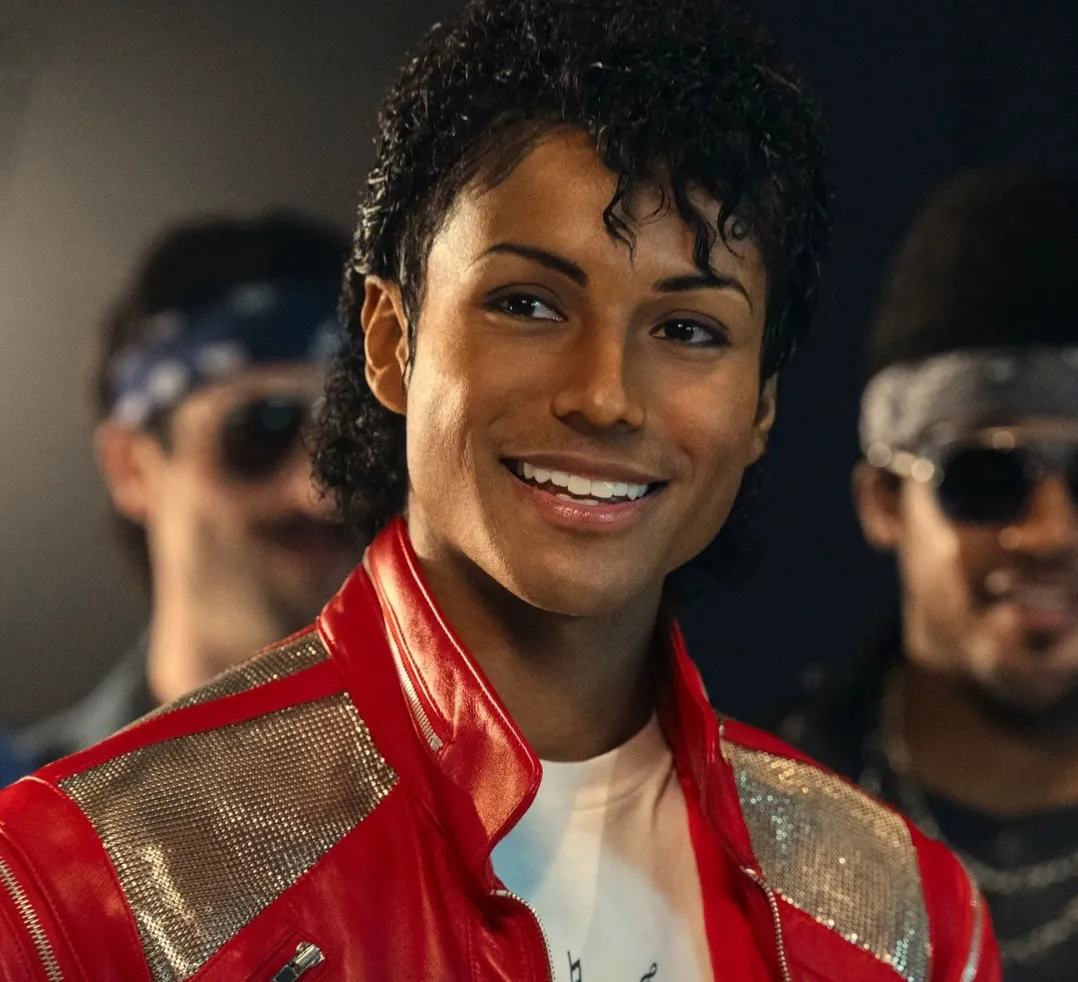
I released the “whoo.” You know the “whoo.” It marks the peak moment in Michael Jackson’s 1979 track “Don’t Stop ‘Til You Get Enough,” a pop masterpiece if one ever existed. It’s the moment of maximum lift. The guitars wail. The horns blare. In the famously shoestring video, three MJ clones dance in unison. Then all the instruments vanish, and Jackson emits a wordless yell of pure exhilaration. It may sound like an “ooh,” but in my head it remains the “whoo.” When that instant arrives in the aggressively offbeat biopic Michael, I shouted the “whoo” aloud in the theater, right alongside Michael Jackson.
I hadn’t planned to utter the “whoo.” I doubt I consciously decided to do it. If you’d told me yesterday that I would yell the “whoo” while watching the instantly notorious bad-idea movie Michael, I’d have called you a filthy liar and insisted I would never do such a thing. I am no mere pawn of the Michael Jackson estate. I am a grown man, a published critic, a person with agency. You can’t dangle these keys in front of me and turn me back into a hooting, childish Michael Jackson fan all over again. Yet in that moment, the “whoo” escaped my lips. It happened and I couldn’t stop it.
I wasn’t the only one in the theater letting out the “whoo.” Surrounding seats yielded four to six voices in unison with mine at precisely the same moment. Then a faint collective giggle, a moment of mutual recognition. Many audience members didn’t join in with the “whoo.” I attended with a couple of friends, including Slate critic Jack Hamilton, and Jack himself didn’t vocalize the line. It wasn’t a full crowd chorus. It wasn’t the whole theater, but it was a moment.
One could argue persuasively that it’s morally indefensible for me to do the “whoo.” It could signal that I’ve abandoned any sense of critical distance, that I’ve allowed myself to be swept up by a film that operates as pure revenue-gen booster and reputation-laundering propaganda for the Jackson estate, an advertisement for a back catalog that is already abundantly popular without such promotion. That argument would probably hit the mark. Michael almost certainly should not exist, in its current form or any other. It’s a cautious, oddly lopsided piece of storytelling. And yet, I still had a fantastic time.
I wandered into last night’s preview with a touch of inebriation, braced for a trainwreck of flaming proportions. The notion of a Michael Jackson biopic is inherently ridiculous. Jackson stands apart as a figure—historically and physically—and while plenty of people can imitate MJ, no one can truly inhabit the person without tipping into caricature. And there was never any real chance the film would probe Jackson’s humanity in any meaningful way. Jackson’s estate controls the rights to his music, and its beneficiaries were always going to permit a portrait that casts Jackson as an unambiguous, radiant human beacon.
When he was at the height of his fame, Jackson settled a civil suit with the family of a child who accused him of abuse. Other allegations surfaced during his life and after. His family has invested heavily in the belief that he was a victim of false charges, and a substantial portion of his fans have defended him over the years. But that outlook is not universal. It’s hard to digest the full range of evidence and to believe he didn’t engage in at least some disturbingly inappropriate behavior with minors. A Michael Jackson biopic that omits that part of his life would be as incomplete as a narrative about a murderer without ever showing a crime. It would be ridiculous.
Michael is a phenomenally silly biopic, but the original plan wasn’t for it to end before the first accusations came to light. Last year the news broke: Michael had wrapped principal photography, but its concluding act could not legally be shown to audiences. As originally shot, Michael was to feature a full third act in which Jackson makes the hard choice to settle the family’s lawsuit despite maintaining his innocence. But after filming those scenes, producers discovered that one part of that settlement obligated the estate never to depict that side of the story in a film. They specifically agreed to not make exactly that movie, and then they tried to do so anyway. I’ve honestly never encountered a Hollywood blunder this blatant.
Consequently, Michael required expensive reshoots, and its release—slated for last October—was delayed for months. Editors had to weave together the existing footage with the new material to craft an entirely different narrative arc, this one about Michael Jackson trying to break free from the grip of his domineering father, Joe. That conflict doesn’t supply a gripping dramatic spine. By the time the film finishes, the plot largely dissolves. The last half-hour devolves into a live-concert montage—first the Victory Tour closes, then Jackson delivers “Bad” in London in 1988. It ends abruptly with three onscreen words: “His story continues…”
That ending is, in retrospect, so much better than what they had planned. I can’t imagine a version of Michael that ends with the settlement. One of Jackson’s lawyers, John Branca, later became Jackson’s estate’s executor. Branca is one of the film’s producers and is presented as a secondary hero of sorts. Miles Teller portrays him, sporting a wispy wig and some very particular makeup. Someone—presumably Branca—demanded that they get Branca’s appearance just right. Whenever he’s onscreen, Teller is lit with a glow that seems almost AI-softened. If I had to sit through forty-five minutes of the man advising Michael to fight in court to clear his name, I would have peeled off my own skin.
There’s a sense of creeping menace in much of Michael too. Throughout, we see Jackson visiting sick children in hospitals. The film does document those acts, but it leans toward portraying him as a saintly figure, as if only a monster could read anything dark into his obsession with children. We repeatedly see him reading Peter Pan, and the character in the book bears a striking resemblance to late-’90s Michael. In one moment, his plastic surgeon tries to dissuade him from a nose job. His surgeries are framed as rebellion against his father. It’s odd, to say the least.
And then there are the moments that verge on the ridiculous. The filmmakers clearly thought they could turn Bubbles the chimp into Baby Yoda—their idea of a beloved pop-cultural mascot that every kid would want under the tree. There is a lot of CGI Bubbles in Michael, serving as the film’s comic relief. When Michael first arrives at the family home with CGI baby Bubbles, the joke rests on his family’s reaction; they think he’s lost his mind. Watching that scene, I found myself thinking the movie was the one that had truly lost it.
Things only escalate. Bubbles saunters into Michael’s bedroom, spots the cover of Off The Wall, and wears a look of awe while pointing at the real Michael. I’m pretty sure he mutters “ooh,” though it almost looks as if he’s trying to say “you”—like Caesar learning to speak at the end of Rise of the Planet of the Apes. There’s also an extended montage where Bubbles plays Twister. It felt like a hallucination. The ape looks rough, too. You could pair Michael with Nope or Primate for a bizarre double feature.
It isn’t only Bubbles. An uncanny AI-like glow hovers over the entire Michael world. The CGI crowds are patchy; a friend of mine compared them to Madden spectators. In the embarrassingly corny sequence where Jackson brings rival gangs together at the Beat It shoot, the gang members appear inexplicably middle-aged—around 52. Larenz Tate embodies Berry Gordy as a warm, protective uncle who disapproves of Joe’s abusive methods, rather than as another exploiter in a system that routinely consumes people. The movie skips large portions of Jackson’s actual life for reasons that read as business-driven rather than artistic.
For example: there’s no Janet Jackson in Michael. She doesn’t exist on screen. Nobody even says her name. LaToya Jackson appears, and the real LaToya carries an executive producer credit. Yet Janet’s biopic rights presumably belong to someone else, so the film pretends she never existed. There’s no nod to The Wiz, likely because another studio controls those rights and perhaps because Diana Ross might want her own film. We see Michael and Quincy Jones react to Eddie Van Halen’s solo on “Beat It,” but we don’t get the obvious studio session moment—someone in a fluffy wig shredding on guitar. My guess is someone else may end up making a Van Halen movie.
There’s no “We Are The World,” even though that song would fit neatly with the film’s timeline and with its messianic Jackson persona. A scene like that would require a dozen people who likely have their own biopics in development, plus others (Tina Turner, Ray Charles, Bob Dylan, Bruce Springsteen) who already have their own films. “The Girl Is Mine” is one of the few Thriller singles that never appears here, probably to avoid clashing with the Beatles projects in development. (I’m also fairly sure that “PYT (Pretty Young Thing)” isn’t included for the same obvious reasons.)
The filmmakers behind Michael are, for the most part, capable craftsmen. Director Antoine Fuqua isn’t a perfectly consistent auteur, but he’s helmed enjoyable pictures like Training Day, Shooter, and all three Equalizers. Screenwriter John Logan is a three-time Oscar nominee with credits on Gladiator, The Aviator, and Skyfall. Cinematographer Dion Beebe shot Collateral and Miami Vice. Colman Domingo embodies Joe Jackson, with Nia Long as MJ’s mother Katherine. Joe is the only character allowed to be openly evil, and Domingo—his face mostly hidden beneath makeup—might be a touch too familiar for the role. When he takes out his belt and disciplines little Michael, I found myself thinking, “Sure you wouldn’t do that, Colman Domingo is too sweet.” These are real filmmakers, but they’re not making a real film here. They’re here to perform the hits.
But here’s the key point: the hits are performed. The sequences without music in Michael are rough and testing. They don’t define the film, though; music underpins the entire affair. It unfolds as a single long montage, punctuated by odd interruptions. Fuqua and his team understand why audiences might be drawn to this movie. They treat Jackson’s first moonwalk with the reverence of Captain America lifting Thor’s hammer. In my theater, that’s precisely how it played.
I haven’t yet mentioned Jaafar Jackson, the actor who portrays the grown Michael. Jaafar is Michael’s nephew, Jermaine’s son, and this marks his screen debut. He isn’t really a trained actor, and I can’t imagine he’ll land many other prominent roles beyond Michael Jackson. In dramatic moments, he remains largely inert. He provides Michael’s speaking voice throughout, and there was a murmur in the theater when we first heard it. It isn’t pleasant to listen to someone speak that way for two hours. Yet Jaafar looks like Michael Jackson, and he moves like Michael Jackson—two things that are basically unthinkable. Fuqua relies on Jaafar to reenact countless iconic Jackson moments, and those performative passages are electric. Portions of Michael are so electrifying that I could hardly believe my eyes; other portions are so misjudged that I could hardly believe my eyes again.
We don’t reach Jaafar’s performance until later. A younger actor, Juliano Krue Valdi, plays the Michael during the Jackson 5 era, and he’s a revelation. He brings the same heartbreaking honesty that shines through in vintage Jackson 5 footage, and he can act. It’s a blast to see the old variety-show vibes carefully recreated on a colossal screen, and that same energy carries over when the story shifts to grown-up Michael.
We glimpse Jackson on the set of the “Thriller” video, instructing the crew to keep his entire body in frame, and then we see him execute the dance with every inch of him on screen. We witness him howl at the sky in a plume of steam. We watch the three Michaels dance together and perform the “whoo!” We even get multiple shots of him smiling while eating popcorn, like the animated GIF. Even the tragedy—the Pepsi commercial fire—unfolds largely through musical montage.
In my theater, the crowd was charged. People sang along. They stomped. In the dramatic beats, they loudly reacted to what characters said, like a moment in church. Despite some awkward shots of Michael uniting different fanbases, this is a film aimed squarely at Black audiences. The dialog even allows pauses for people to respond aloud to what they hear. If you have the option to view it in a predominantly Black theater, that’s the recommended experience.
Throughout the film, I knew I was being maneuvered for dubious purposes. Most of the time I didn’t care. If you don’t care about Michael Jackson’s music or iconography, there’s no reason to watch Michael. On its own merits, it’s barely a movie. But if you love his music—if it’s part of your life—then Michael is pure, effective fan service. I enjoyed it a great deal.
I didn’t expect to have a great time. On the contrary, I anticipated a disaster. The production history wasn’t simply a Hollywood farce you’d expect from The Studio; it looked like something genuinely sinister. The finished film isn’t the one the filmmakers intended to present, and thank goodness for that. It still radiates a murky vibe. Can you enjoy a film that exudes malevolence? I can. Dirty Harry? Red Dawn? It’s a thrill. Some moments in Michael feel like fever-dreams, but when everything aligns, the movie can truly hit.
So why are you reading this review? You know how you feel. If you loathe Michael Jackson and view him as an Epstein-like avatar of unchecked abuse, this film will horrify you. If you defend him and insist he was innocent, the movie was evidently made for you, and you’re probably already in a frenzy about critics who disliked it. Congratulations to you.
I don’t belong to either camp. I’m among the crowd that cherishes Michael Jackson’s music and suspects he was perhaps a monstrous figure as well. I can’t let the music go. It’s part of me. I also can’t pretend, as the film does, that the man who created that music was a perfectly luminous, blameless beacon in the universe. Michael isn’t the biopic that would offer a complete, unvarnished portrait of a life marked by immense contradictions and tragedy. That film will likely never exist. Instead, Michael is a cursed cultural object, and also a fairly enjoyable night at the cinema. Decide accordingly.