The alto saxophone has long drawn the gaze of jazz’s most daring minds—those who push ideas, craft unconventional frameworks, and imagine new possibilities. Figures such as Charlie Parker, Ornette Coleman, Eric Dolphy, Anthony Braxton, John Zorn, and Greg Osby all chose this horn at pivotal moments, bending the music’s limits with audacious visions.
Equally, jazz has boasted a lineage of accessible, listener-friendly alto players who connected with large audiences—Louis Jordan, Johnny Hodges, Cannonball Adderley, Lou Donaldson, Hank Crawford, and David Sanborn among them. These musicians understood that meeting audiences where they are can lift a project onto broader shoulders.
Immanuel Wilkins appears ready to crown himself the alto voice of the moment. (His nearest challenger for that title, if we insist on such terms, is Lakecia Benjamin, whom this page has profiled before.) He embodies a compelling synthesis of the two strands just described: a thoughtful, inventive composer and arranger who also carries a deep, intuitive feel for the blues, gospel, and jazz at its most celebratory, cathartic core.
Since signing with Blue Note, Wilkins has led three studio albums—Omega (2020), The 7th Hand (2022), and Blues Blood (2024)—and contributed to recordings by vibraphonist Joel Ross, drummer Johnathan Blake, keyboardist James Francies, and a host of others. He is also a member of the elite group Out Of/Into, joining Ross, pianist Gerald Clayton, bassist Matt Brewer, and drummer Kendrick Scott.
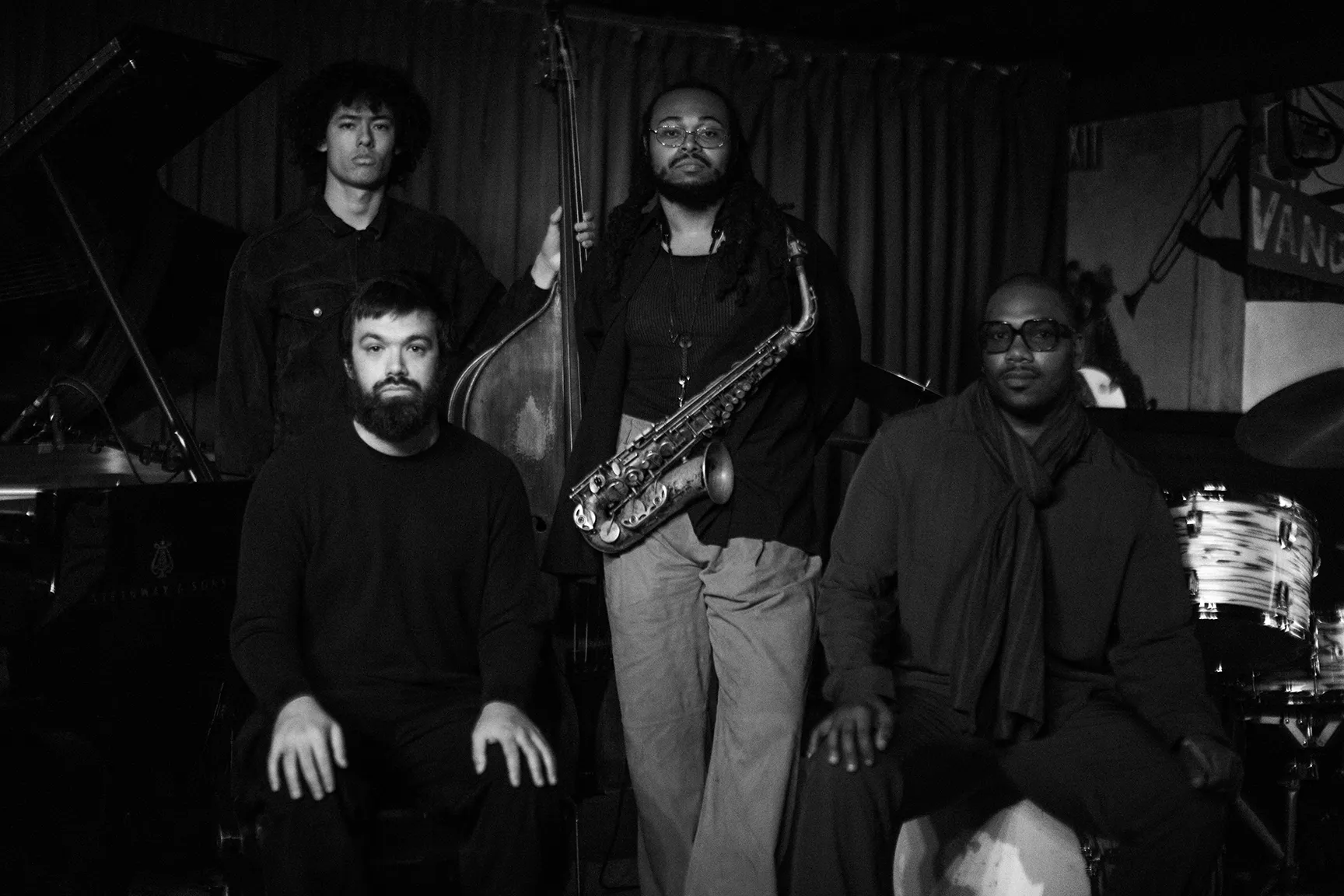
Presently, he is chronicling his longstanding quartet, a unit that includes pianist Micah Thomas, bassist Ryoma Takenaga, and drummer Kweku Sumbry, through a gripping trilogy of live-in-concert releases.
Live At The Village Vanguard Vol. 1, available now, presents four extended performances captured at the famed NYC club last May: a reading of “Warriors” from
Two further volumes are slated to arrive, the second in April and the third in May. Each disc promises all-new material, save for a rendition of “Grace And Mercy” from
“We’ve been rehearsing a great deal of new material,” Wilkins explained during a call from the road. “Some pieces we’ve toured for only about a year on various gigs, while others go back to the band’s inception but hadn’t been captured yet. The most intimidating part was recording at the Village Vanguard; the space demands a lot, and it’s hallowed ground with a revered history, so there was real pressure… but also a lot of excitement. We’re honored to be part of that Vanguard lineage, and the challenge pushed us to ensure the release deserves the tradition.”
Recording took place over two nights, Thursday and Friday, yielding roughly four hours of material; three hours are distributed across the volumes, yet no single set is presented in its entirety. “I curated the sequence with an eye toward a coherent arc,” Wilkins notes, “while some selections were performed back-to-back. Tracks like ‘Ring Shout’ and ‘Composition IX’ [on Vol. 2] were recorded on the same evening and flow into one another.”
His aim, ultimately, was to fuse an immersive live aura with material that transcends mere documentation, resulting in a sound that isn’t bootleg-quality yet retains an unvarnished, visceral edge. “I wanted the recording to feel as immediate as possible—wide room ambience, abundant space—and to convey what it would be like to inhabit this Vanguard universe for an extended spell.”
The music carries the intensity that only a well-traveled, high-energy ensemble can conjure onstage. Of the 13 tracks spread across the three volumes, only three run under ten minutes, with “Composition IX” clocking in at nearly 24. Wilkins solos with fire, but the band is given generous room to breathe—at times the sound resembles a piano-trio in full flight.
“On my other records I’ve tended to present tightly packaged, self-contained pieces that feel like songs with a clear arc,” Wilkins reflects. “This time you get to hear the band’s logic unfold and the sensation of us cutting loose in a room. It mattered to document that freedom, because we haven’t captured a lot of evidence of us aiming for something without preset rules or preconceived notions of the performance. What you hear is a more liberated version of the band.”
While the compositions are by Wilkins—save for “Charanam”—he emphasizes that the other musicians aren’t there merely to execute his ideas. “I’ve always urged everyone in the group to make it their own; we’ve been playing together for seven or eight years, which builds a deep trust,” he says. “There’s no ownership over the music on anyone’s part; the music takes shape as it chooses, and after years of vulnerability together, it never becomes any one person’s show.”
It’s instructive to compare this audacious, open-ended approach to Wilkins’ studio work, most notably Blues Blood, which is meticulously engineered to function as more than a live record. He credits early mentors for nudging him toward treating the studio as a creative instrument rather than a mere capture device.
“That advice came early on, from Jason Moran and Kendrick Scott, who urged me to make the studio sound alive—embrace the magic of the studio and don’t be afraid to tinker with things.” This way of thinking helps him view albums as self-contained artistic statements rather than as mere documents of recent writing.
“I want to produce artifacts,” he asserts. “I want to create things that aren’t simply copies of other things. There exists a mindset where a recording only replicates the live experience, and I find that less interesting than crafting the thing itself. We often say in jazz that recordings don’t quite capture the live experience, and leaning into the studio means recognizing that the recording itself can be a unique, singular object—while the live show remains its own, distinct moment. That’s why the Vanguard performance feels almost like a rough voice memo, with generous room sound and a palpable sense of the audience—the room itself becomes part of the music.”
TAKE 10
10
Pat Metheny – “Don’t Look Down”
For several seasons Pat Metheny has been steering an evolving unit called Side-Eye, essentially his take on an organ trio. The lineup has shifted—keyboardist James Francies remains a staple while drummers have included Marcus Gilmore, Anwar Marshall, and Nate Smith. He recently released the first Side-Eye studio album with a new configuration: Chris Fishman handles piano, synth, and organ, and Joe Dyson sits behind the kit. This project is more than a straight organ trio: Fishman adds textures beyond piano, and the track “Don’t Look Down” features ethereal, wordless backing vocals that give the music an unusual, breathy quality. Metheny’s playing stays within a traditional jazz guitar idiom, avoiding sci-fi synth escapades, which I find refreshing. (From Side-Eye III+, out now via Uniquity/Green Hill.)
9
Jeremy Pelt – “Fathers And Sons”
Trumpeter Jeremy Pelt has been leading groups with players younger than him for some time, and on this project he’s joined by pianist Orrin Evans, youngster Lasse Corson, veteran bassist Buster Williams, and drummer Lenny White. The program is entirely original, instrumental, and the titles—”Manifesto,” “For The Culture,” “Brothas On The Corner,” “Fathers And Daughters,” “Fathers And Sons”—show that Pelt has a modern, socially aware stance. He wields a powerful trumpet voice with the lyricism of Woody Shaw and a knack for memorable melodies and strong arrangements. Listen when he speaks. (From Our Community Will Not Be Erased, out now via HighNote.)
8
Adam O’Farrill – “Herkimer Diamond”
Trumpeter Adam O’Farrill participates in a wealth of exciting ensembles, including projects led by vibraphonist Patricia Brennan, guitarist Mary Halvorson, and keyboardist Hiromi, while also stepping out as a leader himself. His previous release, 2024’s For These Streets, folded in collaborators from his wider circle, including Halvorson, Brennan, and Tomas Fujiwara. His new band Elephant features a fresh quartet—keyboardist Yvonne Rogers, bassist Walter Stinson, and drummer Russell Holzman—and their self-titled debut is packed with pieces that groove with a minimalist or disco-like propulsion, underpinned by tight, punchy drumming and smeared, electronically warped horn lines from O’Farrill. The track “Herkimer Diamond,” showcased in the clip above, rides a drum’n’bass feel with a curiously lyrical, off-kilter dialogue between O’Farrill and Rogers. Elephant is a group to keep on your radar. (From Elephant, out now via Out Of Your Head.)
7
Walter Smith III – “Casual-Lee”
Tenor saxophonist Walter Smith III, who previously released with Whirlwind, is now recording for Blue Note on Twio Vol. 2, with Joe Sanders on bass and Kendrick Scott on drums, and guests including Ron Carter and Branford Marsalis. Smith plays with a clean, contemporary edge but his syntax carries a Texas tenor tradition—he once credited Arnett Cobb as an influence in our interview a decade ago. On the track “Casual-Lee,” Smith and Marsalis trade phrases in a lively, competitive dialogue over a swinging pulse. (From Twio Vol. II, out now via Blue Note.)
6
Espen Berg – “What A Wonderful World”
Norwegian pianist Espen Berg, who often work in trio settings, seems to be filling a space left open by Keith Jarrett’s reduced public appearances. His The Kempen Concert, recorded in November 2024, marks his fourth fully improvised solo release, following The Trondheim Concert (2022) and The Nidaros Concert and The Hamar Concert (both 2023). Like Jarrett, Berg’s solo piano blends classical-inflected romanticism with occasional rhythmic episodes, yet he avoids the goat-like vocalizations that sometimes accompany Jarrett’s performances and welcomes audience response. The program unfolds in five movements over 70 minutes, with two encores—the second a rendering of the standard “What A Wonderful World.” It isn’t the most electrifying entry in this month’s column, but it contains moments of striking beauty and a soothing, extended listening experience. (From The Kempen Concert, out now via ACT.)
5
Harriet Tubman & Georgia Anne Muldrow – “Flowers”
Harriet Tubman—the trio of guitarist Brandon Ross, bassist Melvin Gibbs, and drummer JT Lewis—craft soundscapes that resist easy description, which is part of the appeal. (Disclosure: I’ve released some of their music on Burning Ambulance.) In the simplest terms, it’s dubby, psychedelic-tinged guitar-driven improvisation. When they invite jazz players into their orbit, the results can be extraordinary, such as on the 2017 album Araminta with Wadada Leo Smith, or 2011’s Ascension, featuring Ron Miles on trumpet and turntablists DJ Logic and DJ Singe. Their latest project is a collaboration with jazz-funk luminary Georgia Anne Muldrow, yielding a dreamlike suite of jams where Ross excels in guitar-grounded solos over deep, pulsing grooves from Gibbs and Lewis. Muldrow’s parts are more diffuse; her voice is processed, and her lyrics appear as fragmented phrases, producing a hypnotic effect. (From Electrical Field Of Love, out 3/27 via Pi Recordings.)
4
Mark Turner – “Supersister”
Zen-like tenor saxophonist Mark Turner—who also follows a Buddhist path—has been recording prolifically of late, often with trumpeter Jason Palmer. This project marks the third album by a quartet featuring Turner, Palmer, bassist Joe Martin, and drummer Jonathan Pinson, and the quartet has settled into a deep, collaborative chemistry. They adhere to traditional melodic leadership—Palmer and Turner share the lead—while Martin and Pinson bring a bold, exploratory edge that elevates the performances to extraordinary heights. The track “Supersister” serves as the album’s final and longest piece, smoothly spanning more than 12 minutes and becoming the video’s focus. The group’s lineup is completed by the ensemble’s dynamic interplay. (From Patternmaster, out now via ECM.)
3
Shabaka – “Marwa The Mountain”
Shabaka Hutchings returns to the tenor saxophone after an interlude exploring flutes and other textures. The record, produced during a travel stint with whatever gear happened to be at hand, weaves programmed rhythms, looping motifs, and atmospheric synths, with his rhapsodic horn lines re-emerging on the closing track, “Eyes Lowered,” where he even delivers spoken-word-like raps. Yet the standout moment is “Marwa The Mountain,” where his tenor embarks on bold, expansive lines reminiscent of his work with Sons Of Kemet and The Comet Is Coming. The album is likely to polarize listeners, but for many it will be a compelling listen. (From Of The Earth, out now via Shabaka Records.)
2
Dave Adewumi – “Is”
Dave Adewumi is a swiftly rising trumpet voice. He has already laid down sessions with Dave Douglas, Jason Moran, and Sasha Berliner among others, and now leads a tight quartet featuring Joel Ross on vibes, Linda May Han Oh on bass, and Marcus Gilmore on drums. Recorded live at Ornithology in Brooklyn in 2024, the album is being issued by Giant Step Arts as part of its Modern Masters and New Horizons program. Adewumi’s approach—shaped in part by his work with Jason Palmer—is marked by exceptional technical command and a melodic clarity that shines on tracks like “Is” and the rest of the set. A name to watch in bold relief. (From The Flame Beneath The Silence, out 3/27 via Giant Step Arts.)
1
Irreversible Entanglements – “Don’t Lose Your Head”
Have Irreversible Entanglements loosened their edge? When the quintet—trumpeter Aquiles Navarro, saxophonist Keir Neuringer, bassist Luke Stewart, and drummer Tcheser Holmes with poet Camae Ayewa in the front—made their debut in 2017, they announced themselves with an arresting ferocity. The opening track on that release, “Chicago To Texas,” begins with a martial drum solo that summons the assembled audience, before Ayewa’s verses lacerate the listener with stark images of lynching, prison rape, and infanticide.
The group followed with 2020’s Who Sent You? and 2021’s Open The Gates, plus scattered singles and live cuts, gradually expanding their sound. The decision to partner with Impulse! for a fourth full-length, 2023’s Protect Your Light, made both artistic and pragmatic sense.
That album, cut at Rudy Van Gelder’s legendary studio in New Jersey, offered a concise eight tracks in 45 minutes and a brighter, more optimistic tone than their earlier work. Ayewa’s words—uplift, dance, celebrate love and freedom—sat beside a dynamic arrangements and a revitalized sense of rhythm. The project’s second Impulse! release, Future Present Past, marks another pivot: it is lush with electronics and dub-like textures, with horns and rhythm members weaving in and out as if a jungle chorus were present in the room. Helado Negro and MOTHERBOARD contribute frequent appearances, effectively enlarging the group’s core palette.
Track titles emphasize collectivity and resilience—”Juntos Vencemos” (Together We Win) opens the record, followed by exhortations to “Don’t Lose Your Head,” “Vibrate Higher,” “Hold On,” “Keep Going,” and the concluding rallying cry, “We Overcome.” The compact, Panamanian-inspired fight-song vibe of “Panamanian Fight Song” even condenses the album’s overarching message into a single piece. Ayewa’s lyrics, combined with the ensemble’s energy, deliver a manifesto in music.
“Don’t Lose Your Head” embodies the record’s hopeful thrust, delivered over a pulsating bass line, brisk drums, and a source-horn line that feels almost mantra-like. It’s a strong single, but to truly understand the project you must hear the album in full. (From Future Present Past, out 3/27 via Impulse!)
OUTWARD BOUND
God damn. These kids are killing it.