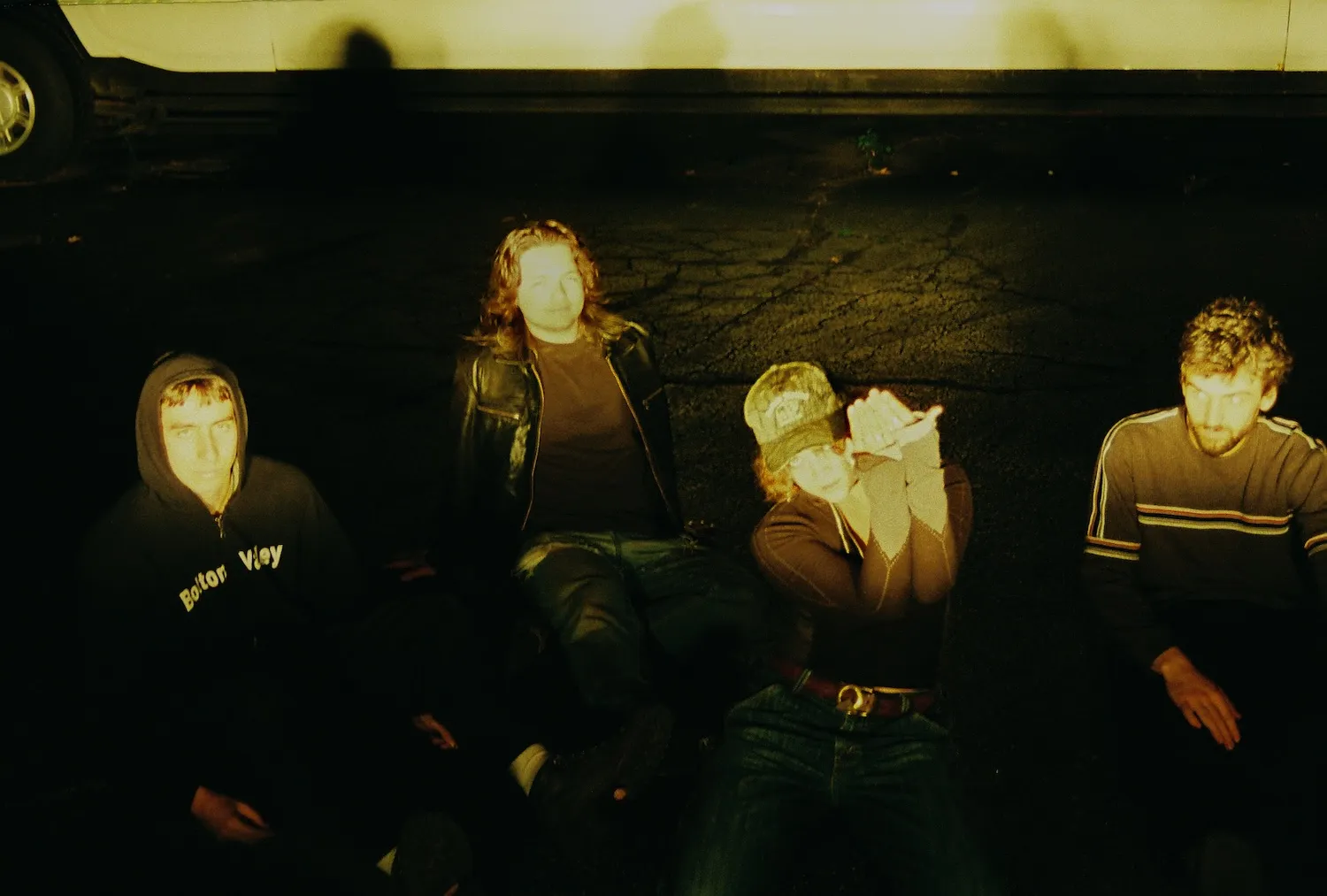
Robber Robber crafted their sophomore record Two Wheels Move The Soul amid a cluster of tense events. One afternoon in 2024, lead singer Nina Cates learned that a fire had erupted in the apartment building where she and drummer/guitarist Zack James shared a downtown Burlington, Vermont dwelling. Incredibly, their unit escaped most of the damage; the two stayed put as the rest of the building was stripped to its bones, enduring a perpetual cycle of construction crews, stray refuse in common spaces, and the jangle of 7 a.m. demolition noise. “We were in a place we adored, but everything felt unstable,” Cates remembers. Eventually, their landlord advised that it would be best for everyone to vacate the shell of a building, given they were the sole residents remaining.
Yet finding a fresh place on short notice in Burlington proved tricky—a university town where most leases start and end in June. So over the ensuing months, whenever tours weren’t on the schedule, Cates and James couch-surfed at friends’ homes, including those of fellow Vermont musicians Greg Freeman and Lily Seabird. They moved so often that they joked their cat was sampling the touring musician lifestyle. Meanwhile, Robber Robber—consisting of guitarist Will Krulak and bassist Carney Hemler alongside James and Cates—found steadiness in the studio, shaping their second album. “The record carries a sense of sonic unease and disharmony,” Cates says in hindsight, calmly via Zoom from the new apartment she and James had moved into in June. “That’s exactly how we were feeling.”
Two Wheels Move The Soul certainly reads as more capricious and forceful than Robber Robber’s impressive 2024 debut Wild Guess. While the core remains anchored in brooding post-punk hooks—just try resisting nodding to “Pieces” or “Talkback”—these songs are also threaded with jolts of subtly rambling noise, kept afloat by a tenuous thread of near-chaotic energy. Thematically, it’s Cates laying bare her emotions as they unfold in real time during upheaval, seeking not definitive answers but a measure of reassurance amid the uncertainty. Below, we dive into the album’s tangled mood.
1. “The Sound It Made”
CATES: Breaking down what lyrics mean is pretty challenging for me. I don’t think that’s unique to me, but I tend to write about feelings that are multifaceted, and I’m not always sure where I land on them. So I end up scribbling a bunch of different lines across large sheets of paper, testing multiple options. Then I prune, ball up, or discard them—basically sorting through it. I’ll keep the lines I’m drawn to and rewrite them on a fresh page with the rest. I’ll quickly toss aside chunks that don’t ring true. It often trims the focus of what the song is truly about, leaving something more tangled. I suppose that’s just how my brain operates, a mechanism for processing complex emotions. Yet “The Sound It Made” sits very much in that orbit; it grew out of many fragments, journal-like in nature, sounding disjointed, with a swarm of ideas jammed together in a flood.
I feel like “The Sound It Made” touches on around fifteen different notions. It’s about an inundation of inputs—being overwhelmed by them, absorbing them, and feeling the weight of it all—and that layering felt fitting for the music. Our process often begins with the music itself before lyrics. There are several small phrases about reaching out to others. The more I reflect on this song after writing it, the more it feels like a social media feed. We frequently scroll with the hope of connecting; sometimes something resonates, but it’s surrounded by a lot of trivial clutter. Perhaps that encapsulates the track—digging through a sea of fluff to reach the moments of genuine contact.
2. “Avalanche Sound Effect”
CATES: This piece is about shouldering a pile of problems—like our housing predicament—while still expected to carry on with everyday life. I recognize that as part of growing up and being a resilient person. It’s the sense of, “Okay, we’ll roll with it,” but eventually it wears on you in the long run.
3. “New Year’s Eve”
CATES: “New Year’s Eve” leans a bit more toward the explicit, exploring hustle culture and the relentless grind while a broader sense of unease looms over society. We feel like our peers in creative fields are juggling a dozen other things to keep things afloat.
I like that the track is tied to New Year’s Eve. It feels like a moment of anxiety for many.
CATES: Indeed. I could have framed it as a birthday tune, too. But New Year’s is a universal marker of, “What did I accomplish this year?”
Zack, Will, and I also play in Dari Bay. We were on tour in San Francisco in October and saw AI company billboards proclaiming, “AI doesn’t take vacations! It never complains about being overworked!” I thought, “That’s wild, yet it’s more adaptable than I am as a person.” So the song ultimately lands on work. I’m also watching my parents age into retirement after years of doing things they don’t love. And then there are people like us, who aim to chase music as a vocation.
If you’re comfortable sharing, what do you do besides music?
CATES: I currently work as a janitor. I also craft jewelry as a production assistant and sell CBD at the farmer’s market from time to time. I take on odd jobs with the understanding that touring could pull me away. Will works at restaurants. Carney is employed at a vape shop, and Zack recently became the drummer for Unknown Mortal Orchestra. I’m thrilled for him—he’s been juggling work for months, and for now, he isn’t taking on another day job, which is pretty great.
4. “Imprint”
CATES: I don’t want to single this song out too pointedly, because I’d have done it differently. Still, I once heard a track with a magnificent swell in its first 40 or 45 seconds that then kept going for too long. I wished it had ended there. So we built this one with the intention of it remaining compact, yet still fully a song. Not a mere interlude.
Many tracks on the record reflect on a moment in time and measure oneself against others. “What is this/ A question of who earned it” touches on our post-college phase—after releasing Wild Guess, we’d just graduated, and now we’re doing music while friends pursue graduate studies. It’s essential for a musician to maintain non-musical friendships, because they offer perspective.
5. “Watch For Infection”
CATES: Some moments in “Watch For Infection” are drawn from real life. “Propped up in the backseat reinforced by metal rods”—I was in a car with people I didn’t fully know, steeling myself for an awkward social moment. The line “watch for infection” serves as a reminder to take care of your own stuff. Small seeds of bitterness and spite can accumulate if you’re not vigilant. It’s a prompt to look after oneself, something I’m prone to neglectting, so it’s a message for me—and for others.
6. “It’s Perfect Out Here In The Sun”
CATES: This track grapples with the pressure to follow a prescribed path and the push to upgrade one’s life, which clashes with the sentiments of the previous song. There isn’t a single grand thesis driving the album—it’s a window into my ongoing processing of what’s around me. Living as a person in the present moment feels almost surreal. For this song, I pictured the sun as a motif, especially given Vermont’s seasonal affective disorder; when the sun does appear, it can uplift.
Usually I write lyrics in a collage-like fashion, and eventually they cohere. Some artists begin with a stated message or narrative, but for me, it’s more about arranging the chaos into a different kind of disorder. It serves as a useful tool for me to process later, letting me hear how I felt at that time.
7. “Pieces”
CATES: “Pieces” took the longest to finish among our songs. We started it in a pre-fire jam with all four of us, which felt thrilling. Zack and I later assembled sections from that jam into the finished song. We’ve been approaching newer material with a similar method. Lyrically, it’s about the pressure of expectations and not necessarily fitting into them. That pressure hit hard after college.
8. “Talkback”
CATES: I once had a confrontation with a boss who snapped at me, and later I replayed in my head what I’d wish I’d said. That’s not how such moments unfold in reality. “Talkback” is about mulling over what you might have said in that moment, and joking with yourself for thinking you’d have said something clever. It’s a recurring theme in my life—how to handle social situations better, even though I know I’ll keep messing up at times.
9. “Enough”
CATES: This one is about past acquaintances who carried dark energy. The lines “He’ll come back again/ Guess we should’ve hid/ I am sick, but I’m working on it/ Give what I can give” channel the sense of encountering certain unsavory people from the past. It also nods to all the chaotic things we’ve faced recently. Beyond the fire, life has been tumultuous. We can only contribute so much to our art and our social lives. Is that enough?
I know we’re discussing what the songs mean, but I also think it’s valuable to hear a songwriter saying they don’t always want to over-interpret. When music is released, being overly precious with it often isn’t helpful.
CATES: Absolutely. If anyone finds resonance in my songs at all, that’s far more meaningful to me than my own interpretation. My thoughts matter less than the human condition.
10. “Again”
CATES: I keep a running note of lines that pop into my head during daily life, and this one grew out of such a note. “Saw it corrode, start bleeding out the mesh/ I care, you don’t, got infinite recycle”—that might be my favorite lyric. We’re all trying to cope with our stuff, but sometimes people process things differently. I feel like we’re all in this storm together; I’m freaking out, and so are others. Many songs on the record hinge on navigating that storm, doing our best, and accepting that this path as musicians may not be the easiest in terms of security. Still, what else am I going to do?
11. “Bullseye”
CATES: This track is the easiest to describe. It recounts a night out in Burlington after a GIFT show at Higher Ground, when a fight erupted nearby between two guys. I stood a touch too close and caught a blow to the face. I have photos of the bruise, but at first I didn’t even realize what had happened. I went to the bathroom, cried, and then watched Justin from GIFT jump in to break things up and eject the aggressor. He even found a fake fingernail afterward. That incident sparked the song’s idea.
It’s a killer album closer, too. It even concludes with the words “gotta go.”
CATES: Initially, we hadn’t even planned to place this one at the end. We were unsure about its sequencing. Then Trevor from Fire Talk suggested ending with “Bullseye,” and it just clicked.
Robber Robber – Two Wheels Move The Soul [LP]
28.99
Amazon
Two Wheels Move The Soul is out now via Fire Talk.