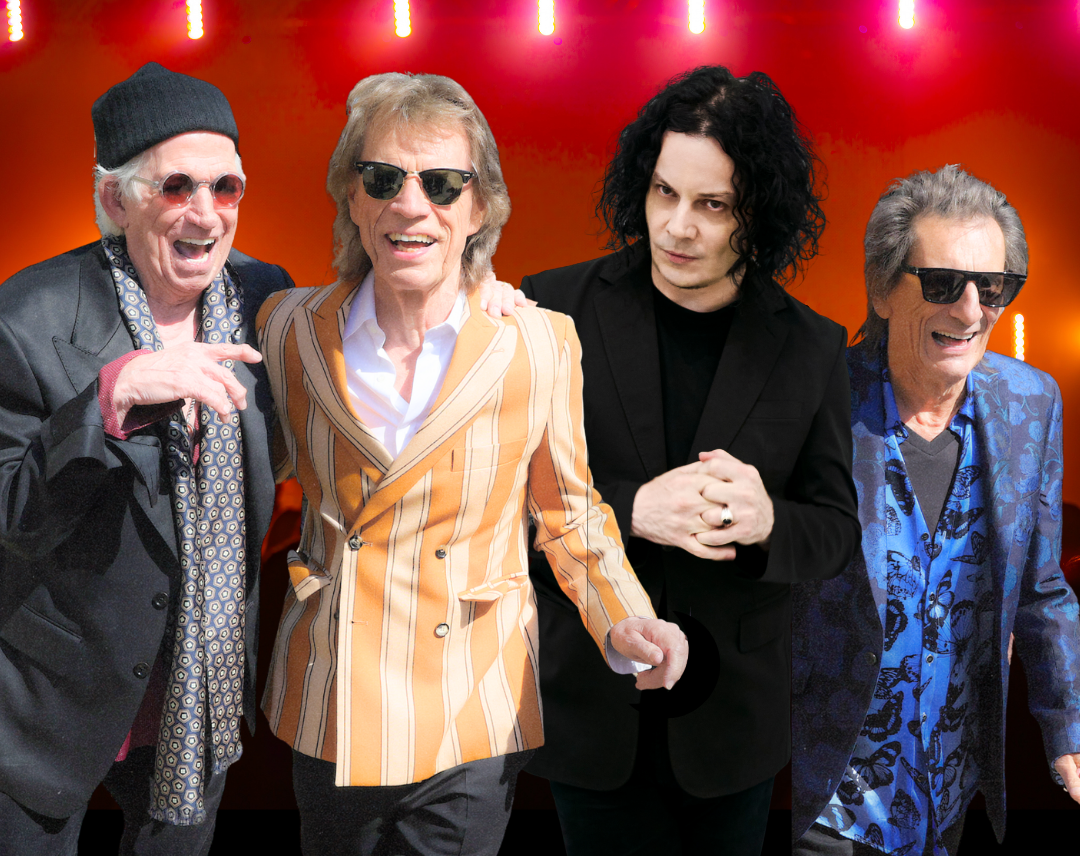
The White Stripes surged onto the scene with remarkable speed. I was finishing up my final year of high school in 2002 when V2 Records brought the prior year’s White Blood Cells to MTV2’s American audience. I remember soaking in the album on a portable CD player in the backseat of my parents’ car during a drive from Columbus to Lansing for a campus visit at Michigan State, marveling at the impact and flexibility of this unusual Detroit garage duo, born from a rough origin story and a bold, lurid color palette. They looked impossibly cool, yet their rough-edged, lo-fi vibe kept me from picturing how quickly they would rocket past the realm of rock-crit fame. In a matter of months, the Stripes found themselves scooping awards at the VMAs, performing on SNL, and selling more than a half-million copies of their record. Yet the moment that truly rearranged my perception was when they opened for the Rolling Stones on arena stages.
The Stones, to a teenager, represented an entirely different cosmos. They were fossilized giants, filthy-rich relics of my parents’ generation, occupying a tier of ubiquity that dwarfed even the most monster-sized breakout acts of my own youth. They were royalty. They stood as a monoculture. Playing a handful of songs before Mick and Keith strutted onto the stage at the Air Canada Centre and Nationwide Arena didn’t instantly crown the White Stripes as Stones-scale superstars, but it did hint that they had ascended into the inner machinery of the music business, stepping into a form of real rock stardom I hadn’t imagined could belong to such scrappy underground darlings. Yes, this happened less than a decade after the major labels’ post-Nevermind underground-rock feeding frenzy, yet by the time my TRL-era adolescence rolled around, the door to the rock mainstream seemed shut to anyone who couldn’t plausibly be part of Ozzfest or Warped Tour.
Despite existing in different moments, the Stones and the Stripes shared plenty of DNA. Both drew life from a riotous, early 20th-century American musical spirit—blues, country, primitive rock ’n’ roll. Both appeared gritty next to their clearest contemporaries (the Beatles and the Strokes, respectively) yet managed to lace their rough tracks with melody. At their best, they felt like emissaries from a wilder era of popular music, capable of gleaming, sunny surfaces but rooted in the dirt. Yet by a certain point, the Stones had proven that at scale, even the dirtiest rock outfit could start to resemble a multinational corporation. They were always delivering a radio-friendly, pre-packaged version of their earthier influences. But eventually, they remained locked in amber—a familiar entity dishing out a pre-ordained remix of old favorites.
Many listeners regarded the White Stripes as throwbacks to a pre-contaminated moment in rock history, and they certainly embraced retro sounds and analog gear without compromise. Their music bore the imprint of punk, a movement that didn’t deeply alter the Stones’ approach, and Jack White allowed his muse to wander into paths far more singular than Jagger would ever dare. Yet in the grand arc, these two bands made a lot of sense together. The Stripes merely had to cross the gulf that separated Sympathy For The Record Industry from a band big enough to transcend the entire recording industry.
The White Stripes always sounded like classic rock, but today they are plainly classic rock. White Blood Cells reached its 25th anniversary just last week. (It arrived two months before 9/11.) Jack and Meg ascended just a touch too late for their catalog to become as woven into the public memory as the ’60s titans. Even though “Seven Nation Army” has become an enduring chant in stadiums without words, they don’t quite have hits in the same way the Stones do. White isn’t headlining Stones-scale venues, though perhaps he might if Meg ever came out of retirement.
Jack White may be living a muted, 21st-century echo of the Rolling Stones’ trajectory, but fifteen years after the White Stripes publicly called it quits, he occupies a similarly iconic niche in pop culture. He has become widely recognized as one of his genre’s most accessible public ambassadors: the guitar hero everyone knows, the living embodiment of rock ’n’ roll. He’s the go-to guitarist Beyoncé calls upon when she wants a rocker for Lemonade, the virtuoso who pleases dads nationwide by introducing Eminem at the Thanksgiving halftime show. And last year, he and Meg were inducted into the Rock & Roll Hall Of Fame.
So it feels almost fated that White and the Rolling Stones are both releasing new albums this Friday. The coincidence nudges me to ask what I want from these artists at this stage in their journeys. Reflecting on the Strokes a decade ago, Jeremy Gordon argued that for bands that have crossed a certain popularity threshold and possess a certain intangible cool, change becomes optional: “Becoming classic rock means a band can recycle their iconography without losing their edge, at least in the eyes of casual and younger listeners.” After a point, you stop counting on your favorite bands to reproduce their past glories. Some fans might even bristle at creative evolution if it threatens the familiar hits.
The Stones, now octogenarians, have nothing left to prove and little to gain from cranking out another LP under the guidance of boomer whisperer Andrew Watt. They have already shown they can still conjure solid Rolling Stones songs on their 2023 return, Hackney Diamonds. As far as we know, this week’s Foreign Tongues isn’t even a pretext for another tour. They’ll profit from the record—the Stones are one of the few acts whose devoted fan base makes releasing music a lucrative enterprise—but they hardly need the money. The official line is that they were inspired to continue making music, so they did. The guys are in a late-life renaissance, creating for the sheer love of it.
That mindset makes Foreign Tongues a captivating listen. They could go in any direction, and they chose the most straightforward, middle-of-the-road avenue possible. Watt arrives as a pop producer, and by Stones standards, Foreign Tongues reads as a pop record. The production can feel a touch too polished at times, as if a protective glaze sits over Keef’s smoking grooves. Jagger’s hooks come across as razor-sharp, almost as if he had penned them with Max Martin (which he did not), and they keep returning well past the point you’d expect the band to settle into blues-vamp filler. I wish some of these tunes had been captured in Muscle Shoals or Nellcôte, and I don’t picture blasting them around the house when the group’s ’60s and ’70s catalog is at easy reach. Don’t pretend this one matches the old legends.
Yet I admire how the Stones keep me guessing. “Divine Intervention” places Robert Smith and Steve Winwood on the same track and even pushes Jagger into an unexpectedly high falsetto on the chorus. “Never Wanna Lose You,” almost a Killers-flavored tune, is followed immediately by “Hit Me In The Head,” which could sit beside a Van Halen cut. “Back In Your Life” asks what would happen if “Wild Horses” became “Hey Jude” by the conclusion. A cover of Amy Winehouse? Sure, why not. For every bold swing that misses, like the irritating “Mr. Charm,” there’s a genuine winner, such as the soulful “Jealous Lover.” The lead single “In The Stars” might feel like the work of bright-eyed Stones acolytes rather than the true article, yet it still manages those pivots between snarling guitar riffs and a fragile, pretty chorus. I’m glad these veterans have rediscovered the joy of making music in their later years, and I’ll be even happier if Foreign Tongues leads to more chances to see them live.
White, who turns 51 tomorrow, is in a different lane in life and career, but the current arc of his output isn’t radically dissimilar. Like the Stones with Hackney Diamonds, he enjoyed a creative resurgence with 2024’s No Name, a strong return to the rugged, explosive garage rock that first put him on the map. And like the Stones, he’s following that up with another LP that largely sticks to the winning formula from the previous record. The key difference is that White is still pushing hard, turning up the heat in a way the Stones seem less inclined to do.
Frozen Charlotte, due out this Friday, presents another set of lean, punchy, deliberately lo-fi songs that put rocking first, before any indulgence. Over the course of his solo work, White has wandered through a variety of strange, often unsatisfying destinations. I respected the restless boldness, but eventually his records began to feel like distractions from why I’d fallen for his music in the first place. Around the twin 2022 releases Fear Of The Dawn and Entering Heaven Alive, I worried he’d drift into a “just play the hits” phase, where the urge for a fresh, vital release would fade and nostalgia would become the default. This back-to-basics re-centering has shown that he still has the punch to carry new material.
You can hear that monster riffs and dazzling vocal melodies still pour from White, and when he unleashes them with less-than-pristine fidelity, I could listen all day. Like No Name before it, Frozen Charlotte is packed with rousing anthems that unleash maximum impact within the compact form of a pop song. While Foreign Tongues may be tuned to sound optimal in a brand-new premium SUV, Frozen Charlotte feels perfectly suited for blasting on the most battered car stereo. Admittedly, White probably prefers vinyl, but it’s worth noting how it evokes the same vibe as his work on De Stijl.
I’m not entirely sure how White keeps turning the raw material of every shabby blues-rock bar into fresh, ferocious songs, but once again, Frozen Charlotte pulls it off. “You’ll Never Fix Me” morphs several times within the opening minutes, hopping between vicious chord riffs and piercing lead-guitar bursts. “Nobody Knows” makes remarkable use of age-old power-chord progressions. He sometimes accelerates toward punk energy, as on “She’s In A Frenzy,” and at other moments slows into a Zeppelin-esque grandeur, as on “There’s Nobody There,” a peak guitar-hero moment amid an album full of them. Not every track is a knockout—closer “Neighbors Blues” nudges me toward wishing I were hearing “Voodoo Chile (Slight Return)”—but the success rate is impressive. I’d be thrilled to see him perform this material, even if it costs him a few cherished old songs.
Nothing White releases will ever hit with the same force as the White Stripes catalog. A different magic surrounded his work with Meg, an indefinable chemistry that many have tried to explain, regardless of the effort. As the 2010s rolled into the early 2020s, it began to seem like perhaps he wouldn’t chase down that band’s glory again. I’m not sure No Name and Frozen Charlotte signify a direct bid to reclaim it. But after a quarter-century, these records come closer to that old spark than I could reasonably hope for.
Now, longing for new records that resemble older ones might be not so far from wishing White would simply perform the hits. It still imposes a familiar restraint on an artist with as many facets as White, constraining him within the classic-rock frame to some extent. Yet seen from another angle, I’m just glad to hear him lean into his strengths. It’s invigorating to press play on new Jack White music and feel delight rather than confusion, especially knowing that he pursued this approach on his own terms. I don’t know how long he’ll want to keep releasing music in this line, but if he intends to turn it into a trilogy, I won’t tire of it.
There is, however, one other project I’d love to see him tackle. Could we get Jack White in the studio with the Rolling Stones before it’s too late? Since Van Lear Rose, we’ve known he enjoys producing albums for elder statesmen of rock, and we know he collaborated with Richards back in 2009. What wild, dangerous music might he coax from the guitarist and his band in their twilight years? Alternatively, what audacious directions could he push them toward? The idea of their collaboration feels as timely now as it did back in 2002. Hello, operator?