James Brandon Lewis presents an impression of wisdom that seems ahead of his years, yet his curiosity remains as abundant as anyone’s. Born to a minister’s family and raised in Buffalo, New York, he studied at Howard University. After earning his degree in 2006, he relocated to Colorado, where he spent several years pursuing gospel music. In 2010, he enrolled at CalArts, learning from Wadada Leo Smith, Charlie Haden, and others, and releasing an independent album titled Moments. Following his MFA, he moved to New York and began collaborating with Matthew Shipp, William Parker, Gerald Cleaver, and a host of others. Divine Travels saw the light in 2014, and his momentum has hardly slowed since.
Lewis’s discography spans a wide range of labels, from the prominent Okeh imprint to small European outfits. He frequently shifts personnel, carrying his saxophone into diverse settings. But since 2018, one relationship has stood out: his creative partnership with drummer Chad Taylor.
“The first time I saw Chad Taylor performing with Cooper-Moore was around 2014,” Lewis recalled in a 2021 conversation with Troy Collins. “We started collaborating after I prepared arrangements of Coltrane tunes for a solo sax marathon in Philadelphia a while back, and we decided to adapt those arrangements for our duo, which became our debut album Radiant Imprints.”
That project, laid down in January 2017 at Park West Studios in Brooklyn, saw release the following year. In its wake, the duo performed in Austria and recorded the album Live In Willisau, which features a rendition of “Willisee,” a piece from the 1985 Dewey Redman/Ed Blackwell album Red And Black In Willisau.
“My affection for the duo recording Red And Black by Dewey Redman and Ed Blackwell, and Chad Taylor’s passion for that recording, sparked our own collaboration and reinforced our commitment to the depth of exploring the duo format,” Lewis told Collins. He added, “Chad has a high melodic sensibility at the drums, and that inspires me. Also, his use of mbira enriches his artistry in dynamic ways. His versatility across many musical genres enables me to draw from a wide array of influences within my experience, granting me maximum freedom.”
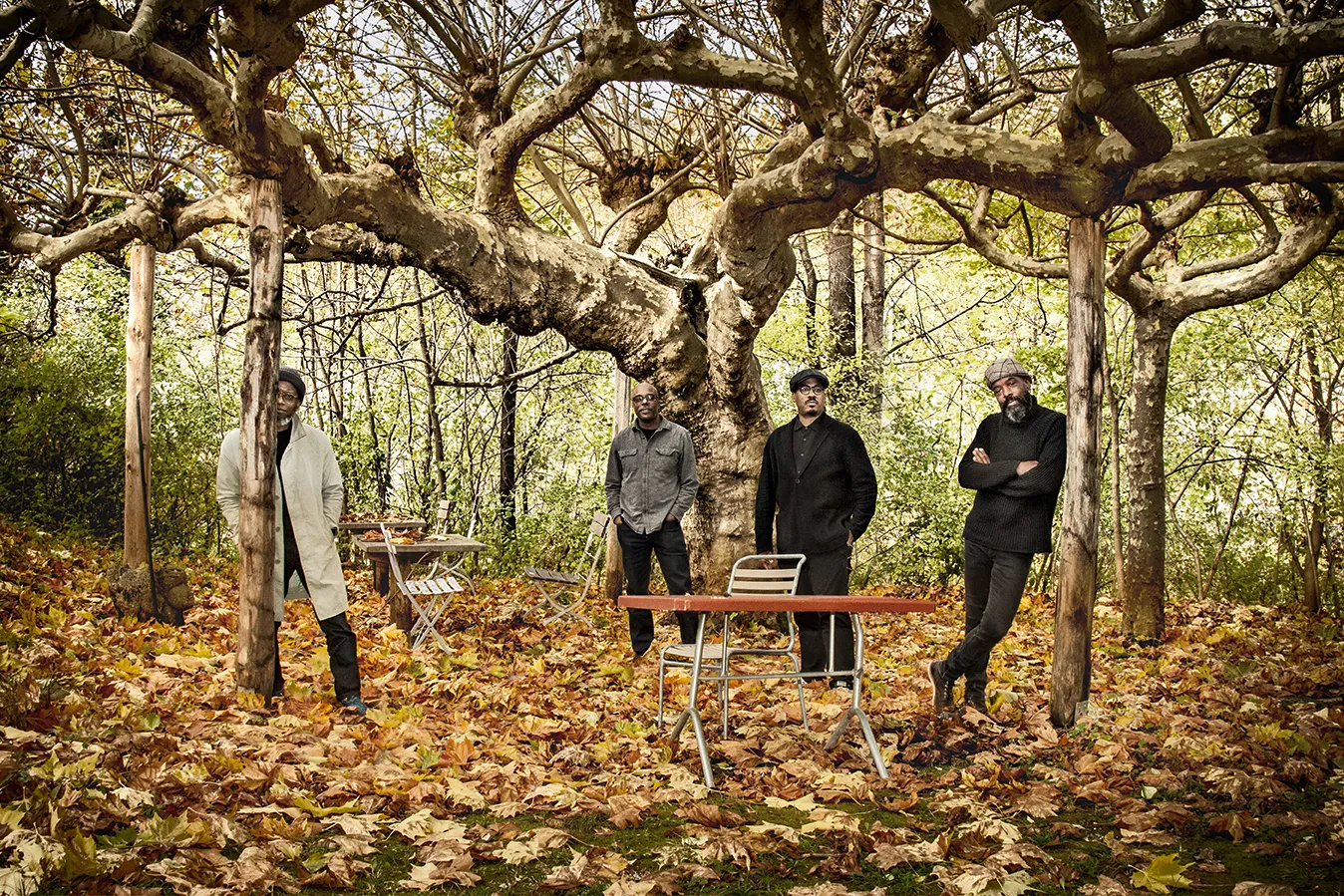
In 2020, Lewis invited Taylor, bassist Brad Jones, and pianist Aruán Ortiz to form a new quartet. The aim of this ensemble, distinct from his other outfits, was to probe a set of compositional principles that Lewis terms Molecular Systematic Music. In a 2020 essay, he explained the logic behind it: the total of a musician’s past listening becomes the DNA of what they’ll play on their chosen instrument. “MSM provides musicians a route to discover their own musical DNA by examining prior experiences, yielding a schematic in the form of a ‘molecule’ that can then be used to generate ideas for composition and improvisation.”
Across five studio albums and a double live CD, Lewis has applied the ideas of Molecular Systematic Music to craft more than 40 pieces, some of which bear evident links (there are tracks simply titled “Per 1” through “Per 7” on the quartet’s first four studio efforts), yet all of which seem to fit together in some fashion, forming a unified body of work.
“I think that for the quartet in particular, separate from my other groups, there’s clearly a language we’ve built up over time,” Lewis told me recently while touring with the Messthetics (guitarist Anthony Pirog, bassist Joe Lally, and drummer Brendan Canty, all former members of Fugazi). “And I’ve never really shown it to them. Chad has glimpsed the molecule and observed how I’ve been constructing the music through the years. But Aruán and Brad, I tend to — I don’t know — I still write in Western notation for the group.”
Lewis described the molecule as a collection of 17 scales consisting of six or seven notes. “But it isn’t modal music. It doesn’t even spring from that premise. Essentially, I built a molecule for myself years ago that draws parallels between molecular biology and music nomenclature. It functions like a structure-mapping engine, a metaphor that pairs two things and allows you to keep drawing correlations until they converge into one.” He notes that even after five albums he’s only scratched the surface of MSM’s potential, that his system is “conceived in a highly specific, idiosyncratic manner, and most albums only touch on one, or perhaps two, of those scales. So it’s really… a life’s work, continuing to build on it.”
The quartet’s latest release, Omni, serves as something of a musical successor to their 2024 record Transfiguration: “I’m now exploring the other, what you’d call in my system the negative space—the remaining six notes of a 12-tone scale. It’s all about this idea of atonal music, but filtered through my own interpretation. It’s not a Schoenberg homage. I devise these formulas and place them into call-and-response or cadence structures. If you listen to ‘Line Upon Line,’ that’s essentially what might happen in a church setting, except I begin with a tone row as an opening.”
Indeed, “Line Upon Line” opens with a fervent, 12-note ascent, like a fanfare. What follows uses those twelve tones as a framework for a fervent free-jazz surge in the spirit of Albert Ayler or David S. Ware. “It’s like church, like Black church,” Lewis says, “where the rhythm section responds to the sermon, but I built it in this manner. It still oscillates between two six-note configurations, answering back and forth. The same goes for ‘Testify.’ It sounds like a blues. It is a blues. Yet conceptually it wasn’t always how I framed it — nearly all of the tunes center on playing with 12 tones without a fixed tonal center.”
The notion of fusing 12-tone music—without dwelling explicitly on Schoenberg—with gospel-inflected, driving blues rhythms is captivating, and the execution is occasionally breathtaking. The music on Omni carries a classical glow; when I first encountered “The Sermon,” it lodged in my mind as if I’d heard it before. With its shuffled drums, Jones’s buoyant bass line, and Ortiz’s heavy piano chords anchoring the track, the piece exudes the melodic heft and soulful essence typical of an Art Blakey blueprint.
Lewis explains that it was another compositional exercise in which you hear him push beyond the framework and lean on his musical intuition, letting the melodic line carry him while he “cheats” a little. He describes the moment as singing through the issue he’s addressing—an approach that often helps him step away from the strict constraints of his method. “That was a line I sang,” he says. “I chose to depart from the system I set up and follow my instincts, what I heard and sang through—an approach I often use to navigate problems by singing through them.”
Lewis treats the quartet as a distinct vessel for ideas he doesn’t pursue with his other bands. “I compartmentalize these groups. When I formed the quartet, I felt a need for a maturity level,” he explains, noting that the veterans in the band push him to sharpen his own work. “They challenge me, and I’ve grown and improved because of it.” Each album to date has therefore served as both a refinement of the central concept and a display of a particular facet of the quartet’s music. For instance, the 2020 debut Molecular established their voice, the 2021 follow-up Code Of Being leaned into strong melodic lines, 2024’s Transfiguration explored ballads and more contemplative moods, and 2025’s Abstraction Is Deliverance offered a collection of impassioned, mantra-like free-jazz pieces that often drew a line between Coltrane and Ware. Omni, in turn, unfolds almost as a suite; Lewis calls it a continuation of Transfiguration while incorporating elements that extend beyond the idea of spiritual jazz—though he notes he isn’t deliberately chasing that vibe, but rather the architecture of a service-like structure.
The question of what truly constitutes “spiritual jazz” remains thorny. Some critics reserve the term for forms rooted in non-Western spirituality, excluding gospel-inflected jazz as insufficiently spiritual. It’s difficult to reconcile how an album like For Mahalia, With Love (a 2023 Red Lily Quintet project dedicated to Mahalia Jackson’s gospel repertoire) fits any definition other than spiritual jazz in its most direct sense, though some critics may carry an unspoken discomfort about Christianity.
“I think that’s been deliberate,” Lewis says. “It’s like when someone tells me they stopped playing music because of a bad teacher on clarinet—the instrument itself isn’t at fault; it’s the experience. We too often cut ourselves off from universal principles: the idea of loving thy neighbor, shared values that we can all embrace. A few negative experiences over centuries, including wars tied to religion, have made some people recoil from the word ‘creator,’ preferring gentler terms.”
Omni comes off as almost a concept album, and, as Lewis suggests, it mirrors the architecture of a service: the order of track titles—“Omnipotent,” “The Sermon,” “Fire In My Bones,” “Testify,” “Omniscient,” “Call To Worship,” “Line Upon Line,” “Spirit Of The Living God,” and “Omnipresent”—reads like a ritual sequence. This is a spiritual proclamation on a par with John Coltrane’s Meditations (a 1965 work whose side-long suites bore the titles “The Father And The Son And The Holy Ghost/Compassion” and “Love/Consequences/Serenity”) or the work of Charles Gayle (another Buffalo-born luminary who heavily influenced Lewis). Yet Omni is so potent that even listeners without faith can be swept away by the force of his tone and the grand, resonant interplay within one of the finest small jazz ensembles of the era.
TAKE 10
10
Eric Harland – “Nascente”
Back in 2010, drummer Eric Harland — known for his work with Chris Potter, Charles Lloyd, and others — formed a group called Voyager with Walter Smith III on tenor, Taylor Eigsti on piano, Julian Lage on guitar, and Harish Raghavan on bass. They released a live album, followed by 2014’s Vipassana. One more record, 2018’s 13th Floor, rounded out that phase before the band members went their separate ways. Now Harland returns with Vipassana II, though the only other Voyager alumnus present is Raghavan. The new lineup features Ben Wendel on tenor, Gilad Hekselman on guitar, Big Yuki on keyboards, and Keita Ogawa on percussion, and the music leans into airy, drifting electronic-funk rather than straight-ahead jazz. There is a notably hard-swinging piece by Ben Wendel, but “Nascente,” a rearranged version of a 1981 Flávio Venturini tune, feels so delicate it seems to dissolve into air. (From Vipassana II, out now via Ropeadope.)
9
Miles Okazaki – “Boomtown Girl”
Guitarist and composer Miles Okazaki weighs composition heavily; he’s recorded every Thelonious Monk piece for solo guitar (and performed them all at this year’s Big Ears festival). This album presents a carefully arranged set for a 10-piece ensemble that includes saxophonists Caroline Davis, Anna Webber, and Jon Irabagon; trombonists Jacob Garchik and Kalia Vandever (who appears three times in this month’s column, so stay alert); pianist Matt Mitchell; bassists Chris Tordini and Hannah Marks; and drummer Dan Weiss. Half of the players (Davis, Webber, Irabagon, Garchik, and Mitchell) also played on Okazaki’s prior release, 2024’s Miniature America, though this record diverges significantly in that it avoids vocalists. At moments the music yields the feel of spontaneity, but every note is deliberately placed as if composing a mosaic. Remember that as you listen, and you’ll be even more impressed. (From Boomtown, out 6/26 via Pi Recordings.)
8
Micah Thomas – “Interface”
Pianist and composer Micah Thomas has assembled a formidable group for his second solo release: Alto saxophonist Immanuel Wilkins, trombonist Kalia Vandever, bassist Thomas Morgan, and drummer Lesley Mok. This crew—whose work across their own projects and others’ groups stretches the edges of acoustic jazz to encompass gospel, contemporary classical, avant-garde electronics, and dreamy pop—are utilized to their fullest. The album’s compositions range from raucous free-jazz eruptions (“Logic”) to nearly chamber-music-style harmony studies (“O”). Most pieces leave space for ideas to take root before the ensemble moves on; the ballad-like “Interface,” with Wilkins and Vandever trading a romantic duet, unfolds as if the players are teaching you the tune. (From Lucid, out now via Micah Thomas.)
7
Lakecia Benjamin – “Flame Keeper”
Lakecia Benjamin’s latest studio outing is richly guest-heavy. Trumpeters Terence Blanchard, Sean Jones, and Chief Adjuah appear; vocalist Tarriona “Tank” Ball and Bilal contribute; drummers Kassa Overall and Jeff “Tain” Watts also participate. Yet the standout track might be the album’s most unexpected moment, simply due to the unusual lineup. Benjamin anchors the alto, Chris Potter sits in on tenor, and three keyboardists—Hiromi on piano, Oscar Perez on Fender Rhodes, and Miki Hayama on synth—join Richie Goods on bass and Jonathan Barber on drums. The track unfolds into a serious jam, with Hiromi’s exuberant soloing stealing the spotlight; Potter sits in on harmony for the choruses, though he does take a turn with a solo on a separate piece, “Dream Breaker.” This is a true burner. (From We Dream, out now via Artwork.)
6
Kalia Vandever – “Waiting”
Often I’ve heard trombonist/composer Kalia Vandever in relatively traditional small ensemble settings: their 2025 record Another View featured guitarist Mary Halvorson, bassist Kanoa Mendenhall, and drummer Kayvon Gordon. Vandever seems to alternate band projects with solo releases, and this is the second solo effort after 2023’s We Fell In Turn. The tracks on this compact record (seven pieces in twenty-seven minutes) aren’t mere trombone improvisations; they’re carefully crafted pieces that present tender, floaty horn lines beneath pink-keyboard haze, expressive piano, and Vandever’s subdued, nearly Sade-like vocals. “Waiting” opens with clouded, echoing trombone that appears haunted by ethereal choirs, solitary notes sighing like a molasses-voiced whale calling in the deep. Midway through, the horn drifts away, leaving processed echoes behind as deep synths throb and Vandever begins to sing amid the shimmer. (From Mana, out now via International Anthem.)
5
SML – “Roundabouts”
SML is a quintet built around saxophonist Josh Johnson, guitarist Gregory Uhlmann, synth player Jeremiah Chiu, bassist Anna Butterss, and drummer Booker Stardrum. With everyone except Butterss and Stardrum doubling on electronics to some degree, the music has a slightly enigmatic, “Who’s making that sound?” vibe. Their earlier releases were recorded live but pass through meticulous editing; Butterss explained earlier this year that she enjoys a tightly curated record—one that quickly presents an idea, leaving listeners wanting more so they’ll seek it in the live show. This album, however, comprises two extended unedited live improvisations from a three-night stand at Zebulon in Los Angeles in December 2025, and it evokes the early ’70s Can vibe, with a saxophonist popping in and out. (From Spontaneous Music Live, out now via International Anthem.)
4
Your Brother’s Keeper & Gary Bartz – “Cauldron”
Back in 2020, alto saxophonist Gary Bartz, who has become something of a guiding spirit for the contemporary spiritual-jazz movement, collaborated with the UK outfit Maisha. That crew, led by drummer Jake Long, included trumpeter Axel Kaner-Lindstrom, keyboardist Al MacSween, bassist Twm Dylan, and percussionist Tim Doyle. After Maisha underwent personnel changes, it adopted the name Your Brother’s Keeper and then recorded with Bartz again. Their first collaboration was a direct-to-disc one-off; this project is far more studio-centered, with plenty of synthetic textures and dubby production sheen layered over the horns. On the opening track, “Cauldron,” Bartz’s horn is caressed by soft chimes and droning, wavering synths before Dylan and Doyle launch into a looping, trancey bass-and-percussion groove. Then the other two horns enter with a melody that hints at Afrobeat, and we’re off. (From Where Rivers Meet, out now via Brownswood.)
3
Patricia Brennan/Sylvie Courvoisier – “The Time We Spent”
When two acknowledged masters and pioneers on their instruments join forces, the results can be extraordinary. Vibraphonist Patricia Brennan has long stretched her instrument’s expressive range through subtle electronics, and in 2025 she contributed to a half-dozen records, revealing herself as a vibraphone counterpart to Mary Halvorson on the guitar. She now teams with Sylvie Courvoisier, a bold pianist who released Bone Bells with Halvorson last year, and the music they create on this duo date is as stunningly imaginative and beautiful as either artist has produced previously. The album title, Talamanti, stems from a Nahuatl term describing things that resemble one another while staying distinct, and indeed in “The Time We Spent” each player’s notes ring out as a single, breathtaking continuum. (From Talamanti, out 6/26 via Antlia.)
2
Alden Hellmuth – “Face The Wall”
On her sophomore release, alto saxophonist Alden Hellmuth is joined by bassist Logan Kane and Miller Wrenn, along with drummer Justin Brown, and includes a handful of guests: Yakiv Tsvietinskyi adds trumpet on one track, Paul Cornish contributes piano on another, Sharada Shashidhar adds vocals to a third, and Caleb Buchanan guests on guitar for a fourth. Some pieces veer toward the highly abstract, while others are clearly composed with care. The titular piece, starting the set and closing it, features the core trio of alto sax, a bassist working both plucked and bowing, and pounding drums, echoing Ornette Coleman’s approach from a Carnegie Hall performance I saw in 2003, a moment when this combination could be almost as forceful as that one. Brown’s work also nods to his affiliations with Ambrose Akinmusire and Thundercat, and he was part of OFF!. (From Tether, out now via Leiter.)
1
Nduduzo Makhathini – “Unembeza”
For almost a decade now I’ve been listening to the South African pianist Nduduzo Makhathini. I first encountered his music with Ikhambi, released in 2017 on Universal South Africa, but I quickly learned that Ikhambi was only his eighth album; over the years he’d released seven discs on his own, ranging from conventional small-group sessions (Mother Tongue, Listening To The Ground, Sketches Of Tomorrow, Icilongo: The African Peace Suite) to a solo set, Reflections, to Inner Dimensions, a project written for a piano trio and an eight-member vocal ensemble. (Those early records are all accessible on Bandcamp—worth a listen.)
In 2020, Makhathini signed with Blue Note and seemed to be resetting his trajectory. His Blue Note debut, Modes Of Communication: Letters From The Underworlds, carried on the spirit of Ikhambi. Its 11 tracks span 75 minutes, blending spiritual jazz (and gospel) with African rhythms and lyrics in English and Isizulu, sung by Makhathini and his wife Omagugu. It excited new listeners, yet for those familiar with his work, I wanted more. The follow-up, 2022’s In The Spirit Of Ntu, was a bolder, more conflicted record, emotionally exposed at times and even aggressive; his piano voice leaned toward the styles of Randy Weston and, at moments, McCoy Tyner, rather than echoing his earlier influence Bheki Mseleku. It was followed by the 2024 trio disc uNomkhubulwane, an 11-track suite divided into three movements.
Makhathini’s fourth Blue Note release leans further into family ties. Built around his current trio with bassist Dalisu Ndlazi and drummer Lukmil Perez, the project was co-produced by his son Thingo and features Omagugu on vocals on several tracks. The session also includes contributions from DJ and producer Black Coffee, flutist Shabaka Hutchings, trumpeter Robin Fassie, guitarist Keenan Ahrends, drummer Ayanda Sikade, and two other singers, Thando Zide and Muneyi, appearing at various points. The tracks range from hymnal spiritual pieces to electronic-tinged experiments and more. The centerpiece, “Unembeza,” is a straightforward trio outing, a gentle melody that reveals the gospel core of much of his work (Makhathini is both a traditional healer and a Christian believer) and perhaps a hint of Keith Jarrett’s influence as well. It’s gorgeous material on a deeply expansive album. With the recent passing of Abdullah Ibrahim, Makhathini stands as one of South Africa’s most prominent jazz voices, and an album like this only helps to propel him further. (From The Myth We Choose, out June 26 via Blue Note.)