
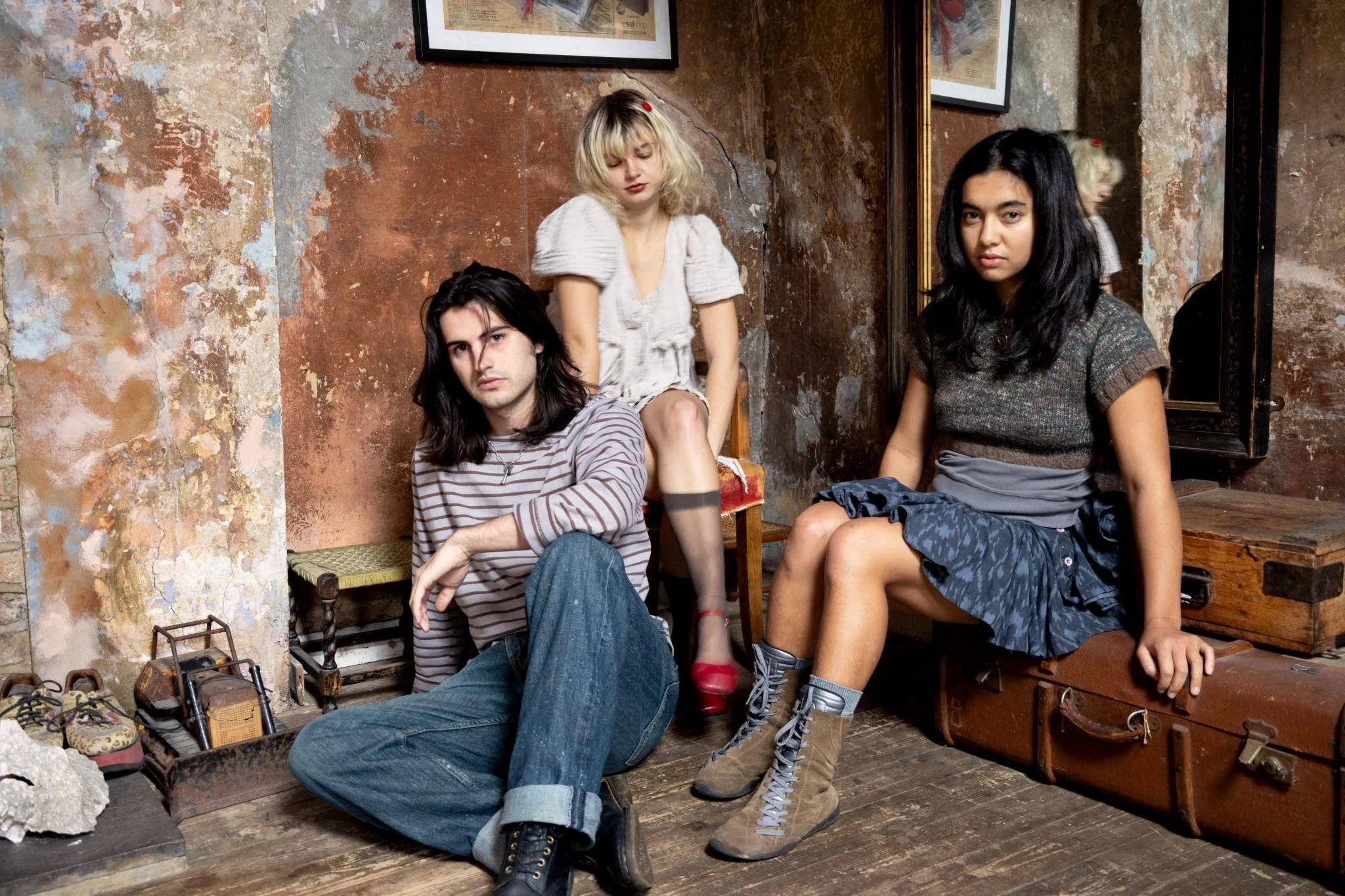
What sparks the birth of a band? Perhaps a ritual where pieces of each person are tucked away in a tiny vessel, awaiting a chance to bind.
Over a generous wedge of tiramisu and a thick coffee in a modest Deptford café, London trio Mary In The Junkyard chat about the moment they first hung out in a squat, after a protest against a Tory police bill in the capital a few years back. Lead singer and guitarist Clari Freeman-Taylor and viola-bass player Saya Barbaglia grew up performing classical pieces side by side, and Freeman-Taylor and drummer David Addison had previously collaborated on another project. Yet the first time all three synchronized was spellbinding. “Somebody sealed our hair in a jar and brewed a potion,” Saya recalls. “Oh! Yes indeed,” Clari breathes with a spark. “Maybe that’s why we started a band,” she adds with a laugh.
Whether or not the spell carried out its intention is beside the point. It makes for a fitting origin story for Mary In The Junkyard—mystical and communal. Their music inhabits a realm where old lifetimes of fisherfolk return as echoes, a sense of nourishment drawn from another’s sacrifice and a buried past, where folk tales seep into the present and ghosts hover in the reverb. Fantasy isn’t escapism; it’s a language to parse life’s irregularities as they move.
Their debut album Role Model Hermit, releasing Friday, leans fully into that space between the fantastic and the ordinary. Building on the eerie folk-rock that first drew attention to them as one of London’s most compelling young bands, the tracks shift between intimate confession and ancient fable. “I welcome the thunder and the storm/ I’ll make it impossible to forget me/ I’m a creature driven by instinct alone,” Freeman-Taylor proclaims on the magnetically rattling song “New Muscles.” The album is rich with lines like these, tipping between Poseidon‑like edicts and primal feelings. The songs feel anchored yet unbound, as if they’ve drifted in from a previous century only to reveal themselves as statements about the uncertainties of your twenties, the people you love, and the versions of yourself you’ve already left behind.
Our chat is full of giggles and openness, as each of the trio’s distinct personalities surfaces across the hour. They’re not far from where they live, orbiting closely in the same neighborhood. Addison became roommates with Barbaglia in January, and Freeman-Taylor resides on the same block. A studio sits just down the road, so ideas rarely lie fallow for long. “Since September we’ve been a 24/7 band,” Barbaglia states simply.
Barbaglia is from London, while Addison and Freeman-Taylor hail from near Hitchin, about an hour outside the city. They began playing regularly in 2022, booking two or three shows a week. “We basically tried to land on every single bill, opening for all kinds of artists. We didn’t headline for an entire year,” Barbaglia says. When asked about their first gig, they all share a warm, collective laugh. “We probably had only five solid songs, so we filled the set with oddities like ‘Spaghetti Man’ and ‘The Snail Song,’” Freeman-Taylor recalls. She remembers giving a earnest introduction to each number in the set. It happened at the Cavendish Arms, Addison notes, a venue more akin to a comedy club. “A peculiar place.”
Even with their tight creative bond as a unit, they each recount pursuits outside the band. “We’ve all thrown ourselves into things beyond the band, which I think is essential for the band,” Clari says.
Those “outside pursuits” aren’t mere distractions; they’re extensions of the same impulse. Barbaglia trains MMA daily, often finding fitness centers in whichever city they’re touring, especially during the odd post-show lull. Freeman-Taylor practices acrobatics. Addison writes a blog and compiles lists of gigs and new music, mapping the city through venues and discoveries. On tour—the latest run in fall 2025, supporting Wet Leg—these rituals anchor them, helping them stay present.
“I’ve found that every city is tough to keep constant,” Barbaglia says. “When you’re drained of energy for sightseeing and just want to live a normal road life, I simply find a gym wherever I am.”
Freeman-Taylor nods. “Find one thing in every city,” she adds. “It gives you a path.”
“We talked about it—the notion of a band as both a performing group and an arts collective,” Addison says. He cites Sonic Youth and Fugazi as inspirations, not only musically but philosophically, as bands that “build networks and support other artists.” He continues, “It has also been really good for us. Where we live now, we’ve got many other friends living with us who are creative, which has allowed us to collaborate more with them.” Among those collaborators is their friend Daisy, who directed the album and, as Addison puts it, “is a big part of the group.”
The same ethos of art as a way of life rather than a temporary pursuit threads through their performances. Freeman-Taylor explains how she judges a show’s success not by exactness but by connection. “A show only feels right if I’ve told jokes that get people laughing,” she jokes.
Her humor balances sharp, dark observations with unexpected silliness. She recalls a San Francisco show where she kept dropping Alcatraz references mid‑set, eventually weaving them into the lyrics of their debut single “Tuesday.”
On another night, a stage dive landed her on the floor. “A crowd of people with cameras—Radio 6 dads, two cameras per person, no hands left,” she says with a grin. “So I stood up and declared, ‘This is New Muscles. You’ll need to grow some if you can’t catch me.’” She shrugs. “It’s not exactly high comedy. My humor is pretty silly.”
Barbaglia and Addison chime in to push back against the self‑deprecation, noting that her father is a comedian and that he has a twin brother with whom he performs. “If you could mention this in the piece, it would really help them out. They’re Victor and Albert, and they tour villages and sometimes towns,” Barbaglia adds with a sincere tone. “When you see Clari’s mum and dad together, you can see where Clari’s stage presence comes from—it’s in her personality.”
During a moment of personal reflection, I mention growing up near Chicago and learn that Freeman-Taylor’s ancestors hail from southwest Chicago. In fact, her great‑great‑uncle was Illinois’ giant, Robert Pershing Wadlow. “He died young… he merely existed and was incredibly tall,” Freeman-Taylor says. It’s an astonishing tidbit, and it’s not lost on me that listening to their debut this week reminded me of Andrew Bird, who wrote “Giant Of Illinois.” “I adore Andrew Bird,” Freeman-Taylor agrees.
Mary In The Junkyard feels less like a project that began and more like a living practice they’re still learning how to inhabit. Yet for Freeman-Taylor and Barbaglia, the looseness stems from disciplined training. Even though they grew up in a musical home, Barbaglia didn’t feel pressure to become a professional musician. “My mum’s a classical musician. She told me not to pursue it as a career,” she laughs. “I was determined to be an artist, though.”
“I enjoy the beginner’s mindset,” Barbaglia says. “I love starting from scratch.” For twelve years she’s continuously picked up new instruments, only to lose interest once she reaches competence. “Then I get bored when I hit the intermediate stage.”
She met Freeman-Taylor when they were thirteen. The two spent their teens busking together, collecting loose change from passersby while learning how to perform publicly. She explains that, while the technical skills shape her artistry, the bigger gain from traditional training is a fresh perception. “When you play string instruments in a quartet, it’s not just about hitting the notes; it’s about reading the other person’s body, the speed of the bow, the attack, the delay—everything,” she says. “It’s far more precise to anticipate how they’ll feel the note, and that sensitivity carries into all kinds of interactions—like dancing in a club, or martial arts, or anything.” It’s a reflex you end up using inside the band as well, she suggests—an instinct rather than a conscious plan.
Freeman-Taylor describes classical training as structurally restrictive, with a built-in tension and the dimming of personality. She recalls once wearing colorful socks and having them taped by a conductor. “Orchestra work is quite submissive,” she notes. “You move under a baton. You’re just a small cog in a hive, playing your part.” Leaving that world felt like a quiet rebellion, a chance to expand rather than reject. “It was exciting to step away from classical music,” she says. “It felt like something we weren’t really meant to do.”
Now, that tension between control and instinct sits at the core of how they write.
“We don’t know what we’re making at the outset,” Freeman-Taylor says. “It just unfolds.”
Barbaglia smiles. “It’s a very immediate, first-hand resource rather than a second-hand account.”
Freeman-Taylor laughs. “It comes out like a thing you can’t hold back—like a release.”
“Like a fart or a sneeze,” Barbaglia riffes, refining the idea. “There’s a tickle, then a sneeze. It’s a response.”
That spontaneous approach extends beyond music. Freeman-Taylor once dreamed of becoming a clown, a childhood ambition that, given her habit of filling sets with jokes and stories, feels less abandoned than integrated into the band’s dynamic.
“When you’re a musician,” she says, “it’s nice because you can channel those thoughts into your identity. Saya with writing, David with writing—you can still be yourself. You don’t have to give up everything else.”
For Freeman-Taylor, songs live in two realms. “There are two modes I write in,” she says. “One is more subjective, a story about something else—metaphorical writing that uses a narrative to convey various ideas for me. The other is a direct expression of a feeling. The album blends both approaches, drawing on things from the past few years I’ve been working through.”
One of the album’s most striking moments is the closing track “Mouse,” which inspired the album artwork showing Freeman-Taylor dressed as an old fisherman with a mouse perched on her shoulder. It’s a song about two old souls meeting again in a new life, while also recalling a painful history. “Mouse, I’m sorry we drowned; the sea swallowed us and then spat us back out,” Freeman-Taylor gently sings. It’s drawn from the many past lives she believes we all traverse.
“‘Mouse’ was one of my first songs where I really wrote a story,” she says. “I heard the tale in my head. I was captivated by the idea that people I know, like David or Saya, or different folks I meet, could have crossed paths with me in another life. I find that incredibly thrilling.”
Her imagination works in wonderfully precise ways. “When I wear a loose tee, one shoulder always seems exposed, and I imagine that’s because I used to be a knight and my arm was severed in battle.”
That fascination became the emotional core of “Mouse.” “I wanted to write a song that speaks to someone, trying to tell them I used to know you better without sounding too crazy,” she says. “I was thrilled when I managed to tell that story, because it’s a difficult thing to put into words.”
Other songs arrived as if they were waiting to be discovered. “‘Thou Shalt Sprout,’ I wanted to sound like a centuries-old tale,” Freeman-Taylor says. “The lyrics came out quickly, perhaps in half an hour, because they already felt as if they existed.”
For Addison, those ideas aren’t confined to the lyrics. “I sense something about past lives in the way the album is produced,” he notes. “Many songs feel like they unfold in vast spaces.” Some of that atmosphere came from recording in a large mock-house beside the studio; the rest came from a “dub-style reverby production,” creating what Freeman-Taylor simply calls “ghost sounds.”
If the album could be given a tangible form, they envision it as a paper-mâché ship—handmade, a touch precarious, designed to hover above them on stage as a symbol of what the songs strive to hold together. Freeman-Taylor envisions a lantern inside it, a light permeating the framework as it sways. A radiant vessel, loosely bound, mirroring the songs’ pull between distant history and a limitless future.
Role Model Hermit is out on July 3 via AMF Records.